Certainty is the sin of bigots, terrorists, and Pharisees. - - PowerPoint PPT Presentation

certainty is the sin of bigots terrorists and pharisees
SMART_READER_LITE
LIVE PREVIEW

Certainty is the sin of bigots, terrorists, and Pharisees. - - PowerPoint PPT Presentation

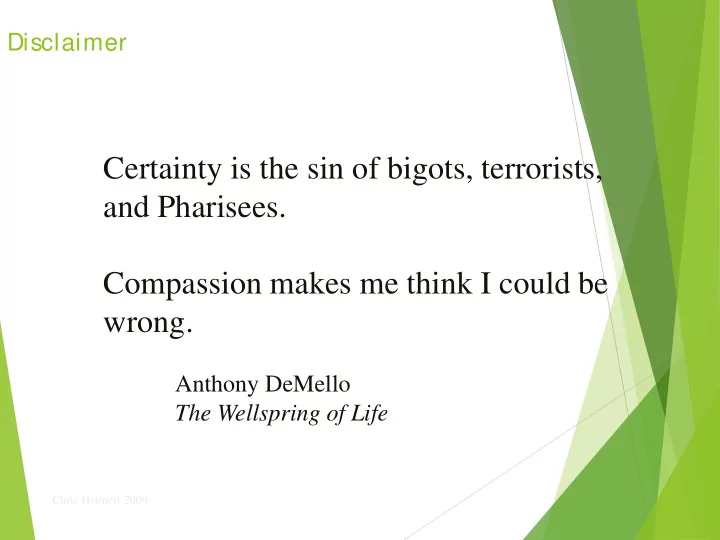
Disclaimer Certainty is the sin of bigots, terrorists, and Pharisees. Compassion makes me think I could be wrong. Anthony DeMello The Wellspring of Life Chris Heimerl 2009 Considering ASD and Behavior Its About Relationships -Will we

slide-1
SLIDE 1

Disclaimer

Certainty is the sin of bigots, terrorists, and Pharisees. Compassion makes me think I could be wrong.

Anthony DeMello The Wellspring of Life

Chris Heimerl 2009

slide-2
SLIDE 2

Continuum of Care March 11,2016

Chris Heimerl chris.heimerl@state.nm.us 505-841-6546

It’s About Relationships

  • Will we listen?
  • Can we bear it?

It’s About Change

  • How will we know?
  • What do we need?

It’s About Action

  • What places will we create?
  • What are we learning?
  • Who will take charge?

Considering ASD and Behavior

slide-3
SLIDE 3

So much of our thought, time and energy are devoted to kid’s extraordinary needs- arising due to impairment and disability- that we neglect or overlook their ordinary needs-those things all kids want in their

  • lives. (That are sometimes extraordinarily

hard to get.)

The Short Course

slide-4
SLIDE 4

Behavior communicates need People's behavior makes sense if you think about it in terms of their goals, needs, and motives

Thomas Mann

slide-5
SLIDE 5

ABC’s of Changing Behavior

A B C

Proactive Intervention Reactive Intervention

slide-6
SLIDE 6

Antecedants as unmet needs

Personal Autonomy

  • Control
  • Choices
  • Power
  • Self regulation
  • Pleasure and joy
  • Accomplishment

Relationships

  • Interdependence
  • Safety and trust
  • Communication
  • Self esteem
  • Sense of belonging
  • Generosity
slide-7
SLIDE 7

Antecedants as unmet needs

Sensory Regulation Filter v. Prism Escape and Avoidance I don’t understand . . . I don’t like this . . .(pain) I don’t like you . . . I don’t want to . . . Attention Be careful with this one What’s so great? Is this the best way? Tangible Food Object Specific person Place or activity

slide-8
SLIDE 8

Learning the language of behavior.

  • What is happening?

(Antecedents/Precursors)

  • Then he/she does this . . .

(Behavior)

  • We think it means this . . .

(Interpretation)

  • And we should . . . (Analysis

and action)

slide-9
SLIDE 9

ABC’s of Changing Behavior

A B C

Proactive Intervention Reactive Intervention

slide-10
SLIDE 10

Finding the Balance

 What is important

t o this person

 What is important

for this person?

Michael S mull

Our responsibility is to distinguish and balance considerations between what is important to and for an individual and engage in creative negotiation.

slide-11
SLIDE 11

What’s Our Job?

S taff core responsibilities.

Identify gifts, practice giving

Bring resources

Abide

Fill in the gaps 

Individual’s responsibility.

Areas of creative negotiation.

slide-12
SLIDE 12

Becoming a Disciplinarian

 Be a leader, parent, teacher, and therapist worth following  Try not to be critical-your approval is critical  Praise achievement -praise effort when achievement is lacking  Be interested in what they do, what they say, and how they feel  Remember how overly sensitive kids are-go easy on sarcasm and

teasing

 Help identify or discover strengths and capacities  Encourage opinions and expression of them-even ones you

disagree with

 Teach responsibility by giving choices  Be tolerant of trends, fads, and fashions by not making a big fuss  Remember kids will do as you do, not as you say  Give them love  Give them hope

slide-13
SLIDE 13

Let’s Talk

On-going conversation about what works, also known as what makes sense; what doesn’ t work, also known as what doesn’ t make sense. This conversation looks at things from the individual’s perspective, the team members’ perspective’s and the participating organizations’ perspectives.

slide-14
SLIDE 14

The Four Questions +

Michael Smull

  • What have w e tried?
  • What have w e learned?
  • What are w e pleased w ith?
  • What are w e concerned w ith?
  • The fifth question and its questions:
  • Now w hat?
  • w hat w ill w e continue to do?
  • w hat w ill w e do less of or stop doing?
  • w hat w ill w e begin or return to doing?
slide-15
SLIDE 15

Kids spend their lives being told by grown ups to behave, to be

  • good. Few have any idea what we
  • mean. Most get that it’s about

conforming to our idea of what’s good and bad behavior, which we sometimes change at will. We need to ask kids what they think we mean.

Chris Heimerl

slide-16
SLIDE 16

S etting Considerations

Relationships Environments

Activities Attributes Most of the time- teaching, supporting, creating

  • pportunities

Manner of relating Providers

  • Competence
  • Caring
  • Coherence

Peers Family Friends Safety Space Stimulation Participation Pleasure Choices Meaning Variety Purpose Expectations

  • Goal direction
  • Challenge
  • Guidance
  • Learning style
  • Routines

Communication Social competence Problem-solving Cognition Emotional status Self regulation Medical Cultural Issues Spiritual Beliefs History-Trauma

Sometimes- when our best efforts fall short Once in aw hile-so no

  • ne gets hurt
slide-17
SLIDE 17

7 Questions-S upport Plan Foundation

1.

How can we help the person to achieve a sense of health and well-being?

2.

How can we help the person to expand and deepen his/her relationships?

3.

How can we help the person to have more fun in ordinary, everyday community places?

O’Brien & Lyle

slide-18
SLIDE 18

7 Questions-S upport Plan Foundation

  • 4. How can we help the person to

have more power? 5. How can we help the person to make a contribution to others? 6. How can we help the person learn valued skills? 7. How can we help the person's supporters to get the support they need?

slide-19
SLIDE 19

What Do Good Staff Do?

They show up They keep their word They listen and learn They teach

slide-20
SLIDE 20

What Do Good Staff Do?

They help with choices They help solve

problems

They see possibilities They have fun

slide-21
SLIDE 21

What Do Good Staff Do?

They are clear They ask for help They take action They take time

slide-22
SLIDE 22

What Do Good Staff Do?

They stay connected to

their community

They take care of

themselves and each

  • ther
slide-23
SLIDE 23

Avoiding Power S truggles S kill 5

Acknowledge power issues Give some control-choices Offer support, problem- solving Predict consequences Remove from setting Reconnect later Know your triggers Avoid “hooks” Listen Rephrase, restate Acknowledge feelings Shift logical levels Redirect

slide-24
SLIDE 24

What do good organization do?

Communicate Care Competence Coherence

slide-25
SLIDE 25

Feedback Questions

 What’s one thing I will take home

with me from this meeting?

 What’s one thing that was missing

  • ver the last two days that I

wanted?

 Future meetings/ discussions could

focus on the following issues and topics:

slide-26
SLIDE 26

Action Plan

 On Monday, I will influence my work

and take this action.

 Within the next month, I will

influence my work and take this action.

 Next week, I will work with my team

in this way.

 In the next month, I will work with

my team in this way.

slide-27
SLIDE 27

If fear alters behavior, you're already defeated.

Brenda Hammond

slide-28
SLIDE 28

Three Roads to Quantum Gravity Lee Smolin

  • 1. There is one, only one, universe and it contains everything and

everything it contains is connected.

  • 2. There is one, only one, universe but many observers and every
  • bserver experiences a different reality.
  • 3. In the future, we will know more.
  • 4. The universe is about relationships, not events.

Four Rules of the Universe