CENTRAL ARIZONA ESTATE PLANNING COUNCIL Being a Philanthropist; - - PDF document

central arizona estate planning council being a
SMART_READER_LITE
LIVE PREVIEW

CENTRAL ARIZONA ESTATE PLANNING COUNCIL Being a Philanthropist; - - PDF document

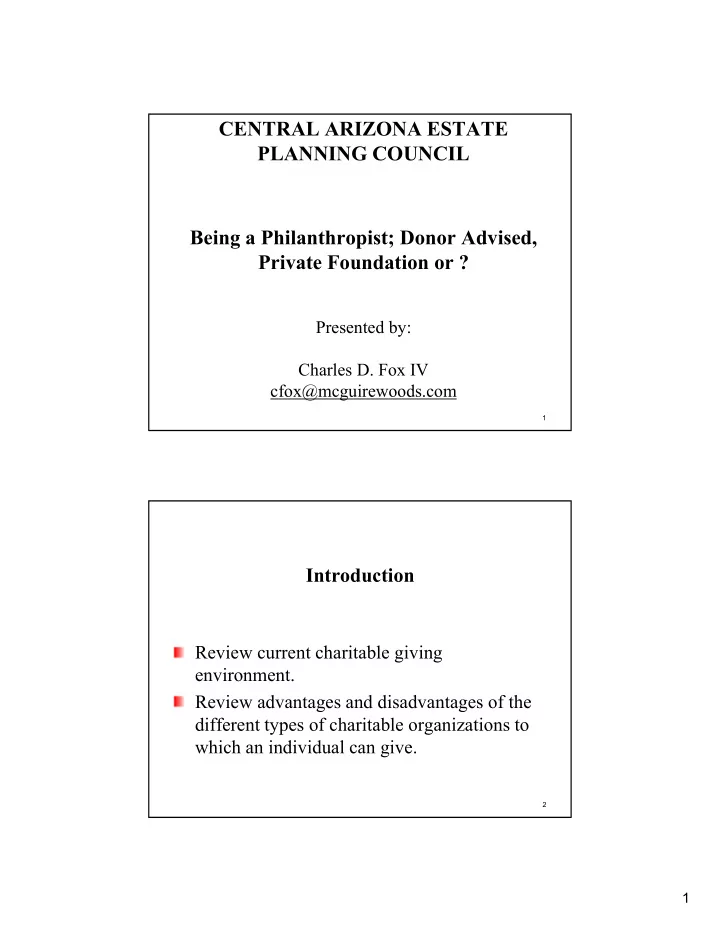
CENTRAL ARIZONA ESTATE PLANNING COUNCIL Being a Philanthropist; Donor Advised, Private Foundation or ? Presented by: Charles D. Fox IV cfox@mcguirewoods.com 1 Introduction Review current charitable giving environment. Review advantages


slide-1
SLIDE 1

1

CENTRAL ARIZONA ESTATE PLANNING COUNCIL Being a Philanthropist; Donor Advised, Private Foundation or ?

Presented by: Charles D. Fox IV cfox@mcguirewoods.com

1

Introduction

Review current charitable giving environment. Review advantages and disadvantages of the different types of charitable organizations to which an individual can give.

2

slide-2
SLIDE 2

2

Review factors in making determination

3

2013 Charitable Giving

Total $335.7 billion: $14.7 billion Increase from 2011 Individuals -- $234.3 billion Bequests -- $25.5 billion Individuals contribute 69.8₵ of each dollar given to charity

4

slide-3
SLIDE 3

3

Availability of Tax Deduction

Gift Tax—No Limitations Estate Tax—No Limitations Income Tax—Two Limitations

– Percentage Limitations – Valuation Limitation

5

Percentage Limitations

Affect amount that can be deducted in a given year

6

slide-4
SLIDE 4

4

Valuation Limitations

Gifts of appreciated property Certain circumstances Deduct basis (not fair market value)

7

Percentage Limitations

What type of property? – Cash – Appreciated property Who is recipient? – Public charity – Private foundation

8

slide-5
SLIDE 5

5

Contribution Base

Adjusted Gross Income Computed without regard to NOL carryback

9

Contribution Base

Adjusted Gross Income Computed without regard to NOL carryback

10

slide-6
SLIDE 6

6

11

Public Charity Private Foundation Cash

50% 30%

Capital Gain Property

30%1 20%2

  • 1. Step down possible
  • 2. Automatic reduction to basis

Substantiation Requirements

Record keeping Appraisals

12

slide-7
SLIDE 7

7

Choices for Philanthropist

Direct gifts to charity Supporting organizations Donor advised fund Private Foundations

13

Direct Gifts to Charity

Simple Often Advantageous from an income tax perspective Can be made for restricted or unrestricted purposes Depending upon the amount, can negotiate terms for the use of the gift

14

slide-8
SLIDE 8

8

Public Charities

Organizations that engaged in activities that are inherently public in nature

– Churches – Schools, Colleges, and Universities

15

Public Charities (continued)

Organizations that receive one-third of annual support from donations from general public Supporting Organizations:

– Support one or more public charities

16

slide-9
SLIDE 9

9

Three Requirements of Supporting Organizations

Support one or more public charities Operated, supervised, or controlled by one or more public charities No control by one or more disqualified persons

17

Supporting Organizations

Type I (operated, supervised, controlled by public charity or charities it supports) Type II (supervised or controlled in connection with a public charity or charities it supports) Type III (operated in connection with public charity or charities it supports)

18

slide-10
SLIDE 10

10

Type III Supporting Organization

Type III supporting organization is responsive to, and significantly involved in the operations of, the publicly supported

  • rganization

Subjective test of Pension Protection Act of 2006

19

Requirements for Type III supporting

  • rganizations

–Notification to supported organization –Cannot support foreign organizations

20

slide-11
SLIDE 11

11

Requirements for Type III supporting

  • rganizations

–Distinquish:

Functionally Integrated Type III Non Functionally Integrated Type III

21

Distribution requirements:

  • Non functionally integrated Type IIIs
  • Do not apply to functionally integrated

Type IIIs (Type III supporting

  • rganization that is not required to make

required distributions and whose activities are related to or performing the functions

  • f or carrying out the purposes of

supported organization)

22

slide-12
SLIDE 12

12

Provisions of 2012 Final and Temporary Regulations Distribution requirement for non-functionally integrated Type III Supporting organizations: Greater of: (1) 85 percent of adjusted net income; or (2) Minimum Asset Amount (3.5% of non- exempt use assets over in previous tax year)

23

Type III Supporting Organization Responsiveness Test

Supporting Organization must be responsive to the needs or demands of the supported

  • rganization.

Officers, directors or trustees of the supported

  • rganization have significant voice in (but not

control of) the supporting organization.

24

t

slide-13
SLIDE 13

13

Private Foundations

Overview Any organization that Is not able to establish that it is a public charity or a supporting organization. Most family and corporate foudnations. Sources of funding: Direct gifts Gifts from trusts such as charitable lead trusts. Subject to greater IRS scrutiny

25

Structure of Private Foundation:

Corporation Trust

26

slide-14
SLIDE 14

14

Restrictions on Private Foundations

Excise taxes

– Tax on net investment income – Self dealing – Minimum distribution requirements – Excess business holdings – Jeopardy investments – Taxable expenditures

27

Compliance Costs

Application for tax exempt status (Form 1023) Annual Information Return (Form 990) State Filings:

– Attorney General – Annual Corporate Reports

28

slide-15
SLIDE 15

15

Donor Advised Fund

Fund or account: – Separately identified by reference to contributions of donor or donors – Owned or controlled by a sponsoring

  • rganization

– Donor has advisory privileges on investment and distribution of account

29

Donor Advised Funds

Tax on taxable distributions:

– Distribution for other than exempt purpose – Failure to exercise expenditure responsibility

Taxes on prohibited benefit Compliance Costs Fees Imposed by Sponsor

30

slide-16
SLIDE 16

16

Factors for consideration of choice of charitable donee

31

Donor’s willingness to relinquish control

  • ver management, investments, or

grantmaking. Donor’s relationship (or lack thereof) with one or more public charities. Amount of assets to be contributed to charitable donee.

32

slide-17
SLIDE 17

17

Availability of investment management. Nature of assets to be contributed to charitable donee. Limitations on income tax charitable deduction associated with gifts of certain types of property to private foundation.

33

Potential application of excess business holdings rules to assets to be contributed . Donor’s desire to have family involvement on board and length of time

  • f involvement.

Donor’s desire for charitable donee to employ family members.

34

slide-18
SLIDE 18

18

Donor’s current need for an income tax charitable deduction without certainty of ultimate charitable donee. Donor’s desire to use the charitable donee as a vehicle for coordinated family philanthropy. Donor’s desire to use the charitable donee as a training vehicle to promote good stewardship and investment management among younger generations of the family.

35

Donor’s expectation that funds may be raised from third parties (i.e., the general public). Donor’s desire for future generations to have a vehicle to continue the family’s philanthropic tradition. Donor’s desire for anonymity or privacy (in connection with funding or in connection with grants awarded).

36

slide-19
SLIDE 19

19

Tax on investment income. Minimum distribution requirements . Donor’s expectations that charitable donee will carry on a direct charitable activity, such as operation of an art museum.

37

Donor’s desire to defer funding until death. Donor’s desire to use planned giving vehicles, such as charitable remainder trusts or charitable lead trusts to fund the charitable donee. Donor’s willingness to bear cost and burden of administration, tax filings, and management of charitable organization.

38

slide-20
SLIDE 20

20

Nature and location of anticipated grantees of charitable donee. Donor’s desire for charitable donee to make scholarship grants to individuals. Donor’s desire for grantmaking support and advice.

39

Characteristics of Charitable Donees

65703080.1

40