Center for Change National Eating Disorders Conference for - - PDF document

center for change national eating disorders conference
SMART_READER_LITE
LIVE PREVIEW

Center for Change National Eating Disorders Conference for - - PDF document

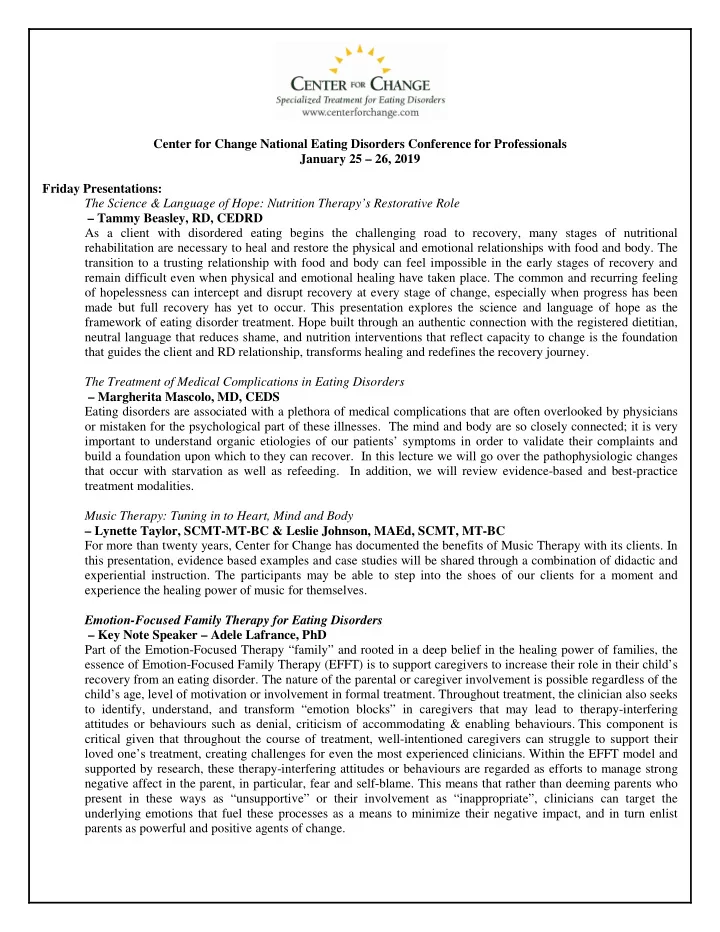
Center for Change National Eating Disorders Conference for Professionals January 25 26, 2019 Friday Presentations: The Science & Language of Hope: Nutrition Therapys Restorative Role Tammy Beasley, RD, CEDRD As a client with


slide-1
SLIDE 1

Center for Change National Eating Disorders Conference for Professionals January 25 – 26, 2019 Friday Presentations: The Science & Language of Hope: Nutrition Therapy’s Restorative Role – Tammy Beasley, RD, CEDRD As a client with disordered eating begins the challenging road to recovery, many stages of nutritional rehabilitation are necessary to heal and restore the physical and emotional relationships with food and body. The transition to a trusting relationship with food and body can feel impossible in the early stages of recovery and remain difficult even when physical and emotional healing have taken place. The common and recurring feeling

  • f hopelessness can intercept and disrupt recovery at every stage of change, especially when progress has been

made but full recovery has yet to occur. This presentation explores the science and language of hope as the framework of eating disorder treatment. Hope built through an authentic connection with the registered dietitian, neutral language that reduces shame, and nutrition interventions that reflect capacity to change is the foundation that guides the client and RD relationship, transforms healing and redefines the recovery journey. The Treatment of Medical Complications in Eating Disorders – Margherita Mascolo, MD, CEDS Eating disorders are associated with a plethora of medical complications that are often overlooked by physicians

  • r mistaken for the psychological part of these illnesses. The mind and body are so closely connected; it is very

important to understand organic etiologies of our patients’ symptoms in order to validate their complaints and build a foundation upon which to they can recover. In this lecture we will go over the pathophysiologic changes that occur with starvation as well as refeeding. In addition, we will review evidence-based and best-practice treatment modalities. Music Therapy: Tuning in to Heart, Mind and Body – Lynette Taylor, SCMT-MT-BC & Leslie Johnson, MAEd, SCMT, MT-BC For more than twenty years, Center for Change has documented the benefits of Music Therapy with its clients. In this presentation, evidence based examples and case studies will be shared through a combination of didactic and experiential instruction. The participants may be able to step into the shoes of our clients for a moment and experience the healing power of music for themselves. Emotion-Focused Family Therapy for Eating Disorders – Key Note Speaker – Adele Lafrance, PhD Part of the Emotion-Focused Therapy “family” and rooted in a deep belief in the healing power of families, the essence of Emotion-Focused Family Therapy (EFFT) is to support caregivers to increase their role in their child’s recovery from an eating disorder. The nature of the parental or caregiver involvement is possible regardless of the child’s age, level of motivation or involvement in formal treatment. Throughout treatment, the clinician also seeks to identify, understand, and transform “emotion blocks” in caregivers that may lead to therapy-interfering attitudes or behaviours such as denial, criticism of accommodating & enabling behaviours. This component is critical given that throughout the course of treatment, well-intentioned caregivers can struggle to support their loved one’s treatment, creating challenges for even the most experienced clinicians. Within the EFFT model and supported by research, these therapy-interfering attitudes or behaviours are regarded as efforts to manage strong negative affect in the parent, in particular, fear and self-blame. This means that rather than deeming parents who present in these ways as “unsupportive” or their involvement as “inappropriate”, clinicians can target the underlying emotions that fuel these processes as a means to minimize their negative impact, and in turn enlist parents as powerful and positive agents of change.

slide-2
SLIDE 2

Center for Change National Eating Disorders Conference for Professionals January 26 – 27, 2018 Saturday Presentations: Orthorexia Nervosa: Pathologically Healthful Eating vs. Pathologizing Healthy Habits – Nicole Hawkins, PhD, CEDS This presentation will detail the evolution of Orthorexia Nervosa from the musings of a physician in the US to the work by Italian researchers to classify those suffering from the condition. Despite methodological flaws, a burgeoning literature has developed about this condition. The current state of the scholarship in ON will be discussed, particularly best estimates of prevalence, original research regarding the ability to detect the condition, and whether ON is deserving its own diagnostic entry in such classification systems as the DSM-5. Diagnostic criteria, case studies, the relationship of ON to AFID and treatment will be addressed. The Power of Pleasure: Embracing the Joy of Eating Well – April N. Hackert, MS, RDN, CEDRD Eating disorder treatment demands a conscious surrender of ones’ fixation of food. Yet, neurochemical reward mechanisms triggered from the consumption of food remain unexplored as a tool for redefining maladaptive attachments to this life-giving fuel. This session will be aimed at offering clinical and practical tools to support a client in using food to embrace their individual creativity through conscious food decisions each day. Furthermore, the willingness to use food as a tool for self-care rather than something to control accelerates the healing journey. The Path to Recovery: Best Practices for Provider-Patient Communication – Quinn Nystrom, M.S. This session addresses the key role of health care professionals and their use of effective communication tools for their patients. Medical professionals will learn how to sharpen the message they need to deliver to their patients for better health outcomes. Nystrom herself was diagnosed with type 1 diabetes at the age of 13 and struggled in silence with ED-DMT1 for 11 years before getting treatment for her eating disorder. Through her personal and professional experience, and graduate school research, you’ll learn the five best communication tips when talking to patients to increase their self-efficacy. The Secret Sauce of Psychotherapy – Michael E. Berrett, PhD, CEDS Over the course of their careers, clinicians acquire knowledge, learn from clients, hone skills, and become “seasoned” in their practices. These unique blends of experience, specialization, and intuitive intervention become the “secret sauce” of their psychotherapy. In this workshop, one seasoned clinician with 37 years of experience will provide his special recipe for therapeutic engagement and success. Dr. Berrett will illuminate the neurobiology of intuition, making treatment experiential, reclamation of spiritual identity, the importance of listening to heart, and other themes, principles, and interventions which are foundation stones of a healing

  • process. Research on Clinical Outcome and ingredients of successful psychotherapy and helping participants

clarify their own “secret sauce” will also be addressed. This workshop will be didactic, self-reflective, interactive, and experiential.

slide-3
SLIDE 3

Center for Change National Eating Disorders Conference for Professionals January 25 – 26, 2019

About the Presenters: Tammy Beasley, RD, CEDRD Tammy has been practicing as a registered, licensed dietitian/nutritionist for over thirty-two years, of which the last 27 have been specialized in the field of eating disorders. Her experience includes inpatient treatment programs and opening and managing several

  • utpatient nutrition programs for clients with eating disorders in both Alabama and Florida. She currently serves as Vice President of

Clinical Nutrition Services for Alsana, working closely with the Clinical Leadership Team to ensure that the nutrition programming blends both evidence-based science and cutting-edge practice. Tammy was the first registered dietitian to become certified with the International Association of Eating Disorder Professionals (iaedp) in 1993, and served on the Certification Committee for nine years, stepping into the role of Director from 2013-2017. During her tenure, the Commission on Dietetic Registration approved the CEDRD Certification for RDs in the field of eating disorders. Due to her work in this field, Tammy received the Excellence in Practice in Eating Disorders award from Behavioral Health Nutrition practice group of the Academy of Nutrition and Dietetics in 2016. Margherita Mascolo, MD, CEDS

  • Dr. Mascolo is the Chief Medical Officer of Alsana: An Eating Recovery Community. Prior to that role, she served as the Medical

Director at the ACUTE Center for Eating Disorders at Denver Health, where she gained experience in caring for critically ill patients suffering from severe eating disorders to become one of the country's leading experts in the medical care of these patients. Dr. Mascolo completed her undergraduate work at the University of St. Thomas in Houston, Texas and earned her medical degree at the University of Texas Health Sciences Center. She completed her internship and residency in Internal Medicine at the University of Colorado in Denver and has been on the Denver Health Staff since 2008. She is board certified in Internal Medicine and is an Associate Professor in the Department of Medicine at the University of Colorado School of Medicine. She remains actively involved in resident teaching and research on the medical complications of malnutrition. Dr. Mascolo has published multiple peer reviewed articles on the medical complications of eating disorders, travels nationally and internationally to speak and educate the public as well as eating disorder professionals on these complications, and has earned her Certified Eating Disorder Specialist (CEDS) certification. Lynette Taylor, SCMT, MT-BC Lynette's educational career began as a violin performance major. She quickly learned that her talents would be better served in a more therapeutic oriented field and switched her major to music therapy. In January of 1998, after the completion of her music therapy degree from Utah State University, and a six month full-time internship at the University of Utah Neuropsychiatric Institute, Lynette created and implemented the current music therapy program at Center for Change. For more than 20 years Lynette has been able to use her accomplishments in violin, guitar, piano, voice and drumming to educate, uplift and serve those who struggle with eating

  • disorders. Lynette is a mother of three and currently plays the violin in a community orchestra and string quartet.

Leslie Johnson, MAEd, SCMT, MT-BC Leslie has worked as a Music therapist at Center for Change since 2012. She attended Utah State University majoring in Family and Human Development. It was there that she discovered the career path of Music Therapy which enabled her to nurture both her passion

  • f music and her passion of helping others who struggle with mental health. Leslie obtained Bachelor degrees in Music Therapy and

Vocal Performance and completed her Music Therapy Internship at the Colorado Mental Health Institute. She worked as a Music Therapist at Hartvigsen School serving students with severe multiple impairments and obtained a Master’s of Education in Educational Counseling. She and her husband have four children and live in Draper City where she has been involved in the community including serving as chair and board member for Draper Community Foundation and Draper Arts Council. Key Note Speaker – Adele Lafrance, PhD Adele Lafrance, PhD is an Associate Professor at Laurentian University and co-developer of Emotion-Focused Family Therapy for Eating Disorders. She is a licensed clinical psychologist with a practice of short-term clinical care and supervision. As founding co- director of Mental Health Foundations, Dr. Lafrance provides training for clinicians, school boards and mental health agencies

  • worldwide. She has published extensively in the field of clinical psychology and currently supports the research base for EFFT across

the lifespan. Dr. Lafrance is perhaps best known for her work promoting family-focused clinical care for adolescents and adults struggling with mental health issues. She also makes many practical resources available on her website for parents, caregivers and clinicians (without cost: www.mentalhealthfoundations.ca).

slide-4
SLIDE 4

Center for Change National Eating Disorders Conference for Professionals January 25 – 26, 2019 About the Presenters: Nicole Hawkins, PhD, CEDS

  • Dr. Hawkins is a clinical psychologist and is the Director of Clinical Services at Center for Change. She is a specialist in eating

disorders and body image and has provided clinical expertise at Center for Change since 1999. Dr. Hawkins developed a comprehensive body image program that focuses on the media, diet industry, plastic surgery, childhood issues, and learning to appreciate one’s body, and she leads these groups for the inpatient and residential patients at Center for Change. She is a Certified Eating Disorders Specialist, has published several articles, and presents regularly at national and regional conferences. April N. Hackert, MS, RDN, CEDRD April is a Clinical Psychiatric Research Dietitian, founder of Choose to Change Nutrition Services, global expert on Nutritional Psychology, amateur chef, visionary thinker, and policy advocate for the healing power of food in generating mental wellness. She speaks internationally on the topic of malnutrition in psychiatric condition and serves on the Executive Committee of the Behavioral Health Nutrition Dietetic Practice Group. Her food chemistry inspired culinary techniques offer dynamic and practical tools for

  • ptimizing brain and gastrointestinal integration. April practically and scientifically investigates the dietary components and food

patterns of humans with symptoms of anxiety. The primary aim of her life’s work is to develop food-based protocols for the assessment, treatment, and management of mental health conditions. Her passion for adventure, food, and breaking the unnecessary nutritional boundaries that limit joyful fulfillment of life is infectious! Follow the #adventuresofapril and #foodmatters for the latest updates in her global experiences. Quinn Nystrom, M.S. For the past 22 years, Quinn Nystrom has been sharing her story of living with type 1 diabetes to audiences across the country speaking to over 300,000 people. She is a published author of the book, “If I Kiss You, Will I Get Diabetes?” and is a regular blogger for OnTrackDiabetes.com. As a professional speaker she travels across North America to diabetes camps, convention halls, corporate

  • ffices, United States Congress and yes, The White House. Her company, Qspeak, allows her to speak, write, consult and raise funds

for diabetes. Quinn has been featured nationally on XM Radio, Glamour Magazine, MSN, Diabetes Forecast, Reader’s Digest and The Learning Channel (TLC). She’s currently the National Diabetes Ambassador for Center for Change, speaking out about the high prevalence of people with type 1 diabetes and an eating disorder. She received her Master of Science Degree in Communication Management from Syracuse University. Michael E. Berrett, PhD, CEDS

  • Dr. Berrett is a licensed psychologist and a Co-founder of Center for Change. He has more than 37 years’ experience working with

those suffering from eating disorders. Dr. Berrett is a Certified Eating Disorders Specialist (CEDS), and worked as a Clinical Advisor to the NEDA Navigator Program. Prior to opening the Center for Change intensive treatment programs in 1996, he worked in private practice as a psychologist, as adjunct faculty in clinical and counseling psychology at Brigham Young University, as Clinical Director

  • f Aspen Achievement Academy youth wilderness program, and at Utah Valley Regional Medical Center in acute psychiatry and as

Chief of Psychology. Dr. Berrett is co-author of books, book chapters, and many peer-review research journal articles including the APA best seller “Spiritual Approaches in the Treatment of Women with Eating Disorders.” He is a nationally recognized presenter and clinical trainer at national and regional clinical conferences, and on television, radio, internet webinars, podcasts, and in various printed publications. Dr. Berrett has dedicated his professional life to helping young people navigate life’s journey with wisdom and self-respect.

slide-5
SLIDE 5

Center for Change National Eating Disorders Conference for Professionals January 25 – 26, 2019 Continuing Education Information:

CE Credits: A Certificate of Attendance for thirteen (13.0) clock hours will be issued to all participants who attend the 13.0 hours of presentations. Partial credit will be offered for Friday only or Saturday only attendance. Signatures on the sign-in sheets are required. Participants are responsible for contacting their respective state and discipline licensing boards to confirm acceptance of CE credits. Center for Change is approved by the American Psychological Association to sponsor continuing education for psychologists. Center for Change maintains responsibility for this program and its content. Center for Change is a continuing Professional Education (CPE) Accredited Provider with the Commission on Dietetic Registration (CDR). CDR Credentialed Practitioners will receive 13.0 Continuing Professional Education Units (CPEUs) for completion of this activity. Approval # - pending. Center for Change has been approved by NBCC as an Approved Continuing Education Provider, ACEP No. 6766. Programs that do not qualify for NBCC credit are clearly identified. Center for Change is solely responsible for all aspects of the programs. This course has been approved by Center for Change, as a NAADAC Approved Education Provider, for 13.0 CE. NAADAC Provider #123302, Center for Change is responsible for all aspects of their programing. This program is Approved by the National Association of Social Workers (Approval #886558729-pending) for 13.0 continuing education contact hours.