CEE 772: Instrumental Methods in 1 Environmental Analysis TOTAL - - PDF document

cee 772 instrumental methods in
SMART_READER_LITE
LIVE PREVIEW

CEE 772: Instrumental Methods in 1 Environmental Analysis TOTAL - - PDF document

10/12/2014 Print version CEE 772: Instrumental Methods in 1 Environmental Analysis TOTAL OR GAN IC H ALOGEN ( TOX ) ( S KOOG, CH AP TS . 2 4 D ; P P . 6 3 2 - 6 3 6 ) (Harris, Chapt. 16-6 & 17-4) (pp.430, 457-461) CEE 772 #9 Rassil


slide-1
SLIDE 1

10/12/2014 1

TOTAL OR GAN IC H ALOGEN ( TOX )

( S KOOG, CH AP TS . 2 4 D ; P P . 6 3 2 - 6 3 6 )

Rassil Sayess & Dave Reckhow CEE 772 #9

1

CEE 772: Instrumental Methods in Environmental Analysis

(Harris, Chapt. 16-6 & 17-4) (pp.430, 457-461)

Print version

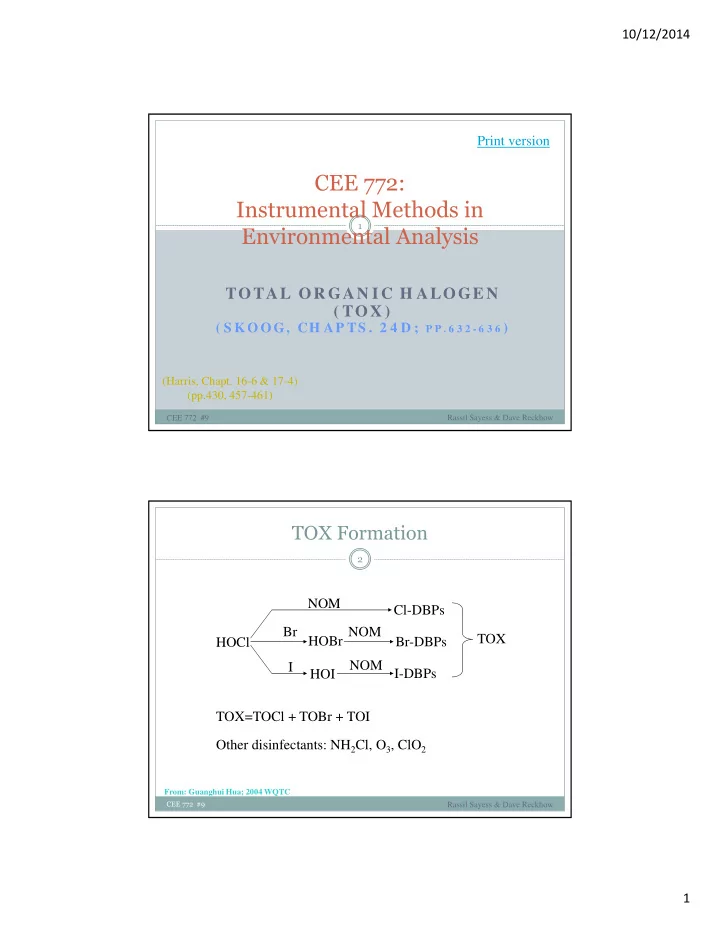
TOX Formation

Rassil Sayess & Dave Reckhow

HOCl NOM Br I HOBr HOI NOM NOM Cl-DBPs Br-DBPs I-DBPs TOX Other disinfectants: NH2Cl, O3, ClO2 TOX=TOCl + TOBr + TOI

From: Guanghui Hua; 2004 WQTC

CEE 772 #9

2

slide-2
SLIDE 2

10/12/2014 2

What do we know so far?

 700 reported DBPs with limited number of quantitative and

epidemiological data

 Approximately 50% of the TOX formed by drinking water chlorination is

not accounted for concern about the identity and concentrations of DBPs

 Heavier halogens result in higher toxicity in chlorinated and chloraminated

drinking water

 Not feasible to account for each and every compound that might be formed

in disinfected water

 Measures of TOX: A surrogate measure for organically-bound halogenated

DBPs in a disinfected water sample.

 Comparing the TOX vales with the halides attributed to the identified

DBPs: allow for the estimation of the unidentified TOX

 TOX analyzers: used to quantify amounts of organically-bound chlorine,

bromine and iodine in raw and disinfected water samples

Rassil Sayess & Dave Reckhow

CEE 772 #9

3

TOX: Known & Unknown

Trihalomethanes 20% Sum of 5 Haloacetic Acids 10% Bromochloroacetic Acid 3% Unknown Organic Halogen 64% Chloral Hydrate 1% Haloacetonitriles 2% Haloketones Chloropicrin

Data from the Mills Plant (CA) August 1997 (courtesy of Stuart Krasner) Regulated DBPs But, the bad stuff is probably somewhere here

Unknown TOX TTHMs

Rassil Sayess & Dave kh

CEE 772 #9

4
slide-3
SLIDE 3

10/12/2014 3

Which Compounds? The DBP Iceberg

Halogenated Com pounds Non-halogenated Com pounds

ICR Com pounds

50 MWDSC DBPs ~ 70 0 Known DBPs THMs, THAAs DHAAs

Stuart Krasner AWWA Susan Richardson USEPA Rassil Sayess & Dave Reckhow

CEE 772 #9

5

Methods to “measure” TOX

 Adsorption, pyrolysis, microcoulometric titration

 Standard method

 UV/H2O2 oxidation/IC  Neutron activation/ ray spectroscopy

 Can differentiate between the halogens  Very high cost

 Adsorption, nitrate wash, pyrolysis with Dohrmann

  • r Euroglas then IC or ICP-MS

 Can differentiate between the halogens

Rassil Sayess & Dave Reckhow

CEE 772 #9

6

slide-4
SLIDE 4

10/12/2014 4

Conventional Method

Rassil Sayess & Dave Reckhow

Adsorption Pyrolysis Microcoulometric Titration

Carrier Gas Coulometry determine the amount of matter transformed during an electrolysis reaction by measuring the amount of electricity (in coulombs) consumed or produced. Drawbacks:

  • Can not differentiate between Cl, Br and I.
  • Calculated as the molar mass of organic halides, expressed as Cl.

From: Guanghui Hua; 2004 WQTC

CEE 772 #9

7

Neutron activation/γ ray spectrometry

Rassil Sayess & Dave Reckhow

CEE 772 #9

8

slide-5
SLIDE 5

10/12/2014 5

Hua and Reckhow, 2006a. Determination of TOCl, TOBr, and TOI in drinking water by pyrolysis and off-line ion

  • chromatography. Anal. Bioanal. Chem.

 Comparing Dohrmann and Euroglas TOX

instruments when coupled with IC

 Looking into effect of nitrate wash on recovery  Comparing Dohrmann and Euroglas TOX

instruments in coulometry mode

Rassil Sayess & Dave Reckhow

CEE 772 #9

9

Rassil Sayess & Dave Reckhow CEE 772 #9

Furnace,1000oC 300oC

  • Conc. H2SO4

Absorber Sample boat

Clamp

O2

Schematic Diagrams of the Absorption Systems Euroglas

O2 CO2

Furnace,800oC Sample boat Absorber

Clamp

Dohrmann

From: Guanghui Hua; 2004 WQTC

10

slide-6
SLIDE 6

10/12/2014 6 Schematic Diagrams of the Absorption Systems

Oxygen was used as the carrier gas with CO2 as an auxiliary gas. Dohrm ann Euroglas Gas O2 (carrier) CO2 (auxiliary) O2 (carrier) Drying prior to combustion 250 decC, 2 min CO2 gas only 1.5 min Furnace temperature (deg C) 800 O2 only 1000 Exit temperature (degC)

  • 300

Acid to remove the water vapour in the off-gas

  • H2SO4

Reaction gas containing hydrogen halides collected 15 mL then 5 mL rinse=20 mL 15 mL then 5 mL rinse=20 mL

Rassil Sayess & Dave Reckhow

CEE 772 #9

11

Rassil Sayess & Dave Reckhow CEE 772 #9

Dohrmann Absorption System

From: Guanghui Hua; 2004 WQTC

12

slide-7
SLIDE 7

10/12/2014 7

Step 1: adsorption, nitrate wash, combustion, off- gas collection

Adsorption Combustion Absorption of off- gas

Rassil Sayess & Dave Reckhow

CEE 772 #9

13

Step 2:

 Use of IC machine for chloride

 Gives peaks at specific retention times

Rassil Sayess & Dave Reckhow

CEE 772 #9

14

slide-8
SLIDE 8

10/12/2014 8

Rassil Sayess & Dave Reckhow CEE 772 #9

15

Characteristics Carbon Identification CPI-002 (standard) CPI-001 F-600 Supplier CPI CPI Calgon Source Coconut Coconut Coal Particle Size 100-200 mesh (149-249 um

  • pening)

100-200 mesh (149-249 um

  • pening)

Granular Background 0.4 gCl/40mg 1.0 gCl/40mg Unknown

Selected GACs for the Tests

From: Guanghui Hua; 2004 WQTC

Nitrate wash after adsorption

 Purpose: to remove interferences related to inorganic

halides so that we don’t get biased TOX results.

Rassil Sayess & Dave Reckhow

CEE 772 #9

16

slide-9
SLIDE 9

10/12/2014 9

HAA recovery

Rassil Sayess & Dave Reckhow CEE 772 #9

0.2 0.4 0.6 0.8 1 0.2 0.4 0.6 0.8 1 1.2

Overall TOX recovery for two columns Ratio of 2nd column TOX/Total

MCAA MBAA DCAA DBAA TCAA

From: Guanghui Hua; 2004 WQTC

  • 30 mL nitrate

wash

  • 100, 300 and

500 ug/L

  • Higher MW

compounds, higher recovery

  • Decreased

ratio, higher recovery

17

DCAA recovery with Euroglas

  • DCAA 300 ugCl/L used
  • Highest recovery with 13 mL of washing

solution

  • Higher washing volumes caused washing
  • ut of the Cl

Rassil Sayess & Dave Reckhow

CEE 772 #9

18

slide-10
SLIDE 10

10/12/2014 10

Halide rejection by different carbon columns

Halide

Concentration (mg/L)

CPI-002 CPI-001 F-600 Cl- 1000 500,000 500,000 200,000 Br- 500 250,000 250,000 45,000 I- 1 >100 >100 12 5 30 >100 3

  • Excessive inorganic I retention using F-600
  • Rejection: Cl>Br>I

Rassil Sayess & Dave Reckhow

CEE 772 #9

19

Euroglas analyzer/IC versus Euroglas/Microcoulometry

Compound Recovery (%) Microcoulometric IC Dibromochloromethane 103 104 Dichlorobromomethane 102 101 Bromoform 98 98 Triboromoacetic acid 98 98 Trichloroacetic acid 100 97 Dibromoacetic acid 102 101 Dichloroacetic acid 98 101 Bromochloroacetic acid 97 100 Monoiodoacetic acid 99 94 Monobromoacetic acid 96 95 Monochloroacetic acid 91 92

Rassil Sayess & Dave Reckhow

CEE 772 #9

20

slide-11
SLIDE 11

10/12/2014 11

General comparisons

  • All data from

model compounds and real water samples

  • No real difference

for Euroglas IC versus Euroglas Microcoulometry

  • r in Dohrmann

and Euroglas Microcoulometry

  • Better

performance of Euroglas IC TOX verus Dohrmann IC TOX

Rassil Sayess & Dave Reckhow

CEE 772 #9

21

Iodinated compounds in the literature

Com pound Nam e Goslan et al., 20 0 9 Ye et al., 20 12 Pan and Zhang, 20 13 Hua et al., 20 0 6 Richardson et al., 20 0 8 Dichloroiodom ethane USEPA 551.1

  • Pentane extraction

GC/ECD USEPA 552.3 Brom ochloroiodom ethane USEPA 551.1

  • Pentane extraction

GC/ECD USEPA 552.3 Iodoform

  • USEPA 551.1
  • Pentane extraction

GC/ECD

  • Iodoacetic acid
  • USEPA 551.1

UPLC/ESI-MS/MS

  • USEPA 552.3

Triiodoactic acid

  • USEPA 551.1
  • 3-iodo-4 -hydroxybenzoic acid
  • UPLC/ESI-MS/MS
  • Diiodoacetic acid
  • UPLC/ESI-MS/MS
  • 3,5-diiodo-4-

hydroxybenzaldehyde

  • UPLC/ESI-MS/MS
  • 2,6-diiodo-4-nitrophenol
  • UPLC/ESI-MS/MS
  • 2,4 ,6 -triiodophenol
  • UPLC/ESI-MS/MS
  • Chloroiodom ethane
  • Pentane extraction

GC/ECD Dibrom oiodom ethane

  • Pentane extraction

GC/ECD Brom oiodom ethane

  • Pentane extraction

GC/ECD Dichlorodiiodom ethane

  • USEPA 552.3

Brom oiodoacetic acid

  • USEPA 552.3

Rassil Sayess & Dave Reckhow

CEE 772 #9

22

slide-12
SLIDE 12

10/12/2014 12

Method improvement

 Still use of adsorption, pyrolysis and collection of off-

gas, with or without nitrate wash.

 Use of off-line inductively coupled plasma-mass

spectrophotometer (ICP-MS) for Iodine and Bromine quantification in place of the IC.

Rassil Sayess & Dave Reckhow

CEE 772 #9

23

ICP-MS

 Sensitive analytical machine for Bromine and Iodine detection  Low method detection limits  Carrier gas is Ar(g)  Look for multiple analytes at the same time  Fast (2-3 minutes per sample) and precise  Famous for detecting metals and several non-metals at very

low concentrations

 Sample is injected and ionized in the ICP part then the MS is

used to separate and quantify the ions

 Drawbacks:

 Ar interferes with some analytes  Uses a lot of gas  High maintenance in case it broke Rassil Sayess & Dave Reckhow

CEE 772 #9

24

slide-13
SLIDE 13

10/12/2014 13

ICP-MS Results

 Method detection limit (MDL)

 The mean concentration and the standard deviation of this mean

between seven replicates were calculated

 The student t-value at 99% confidence interval and n-1 degrees of

freedom (3.143 for seven replicates) was then multiplied by this standard deviation to yield a statistical estimate of the MDL.

 Limit of quantitation (LOQ)

 The minimum concentration that can be reported with a specified

degree of confidence

 Calculated as the MDL multiplied by a factor of 3.182.

 Iodine: the MDL and LOQ were 0.19 and 0.61 µgI/L,

respectively

 Bromine: the MDL and LOQ were 0.98 and 3.13 µgBr/L

Rassil Sayess & Dave Reckhow

CEE 772 #9

25

Recovery of iodinated compounds with/without nitrate wash

0.0% 20.0% 40.0% 60.0% 80.0% 100.0% 120.0% 20.2% 7.3% 12.7% 7.6% 37.2% 10.9% 16.1% 25.5% 75.6% 19.9% 43.0% 111.6% 17.6% 45.5% 127I Recovery Compound With Nitrate Wash Without Nitrate Wash Rassil Sayess & Dave Reckhow

CEE 772 #9

26

slide-14
SLIDE 14

10/12/2014 14

Method development

 Initial pH of sample prior to adsorption

 pH<2 for chloride and bromide  pH<1 for iodide

 Addition of H2O2 in absorber cell

 If the absorber cell contained not only hydrogen halides (HX), but also

halide gas (X2)  need to be converted to X- in order to be detected by the ICP/MS  Addition of tetramethyl ammonium hydroxide (TMAH) prior

to ICP-MS

 0.1% for bromide  2% for iodide  Reduces memory effect on glassware in ICP-MS

 Use of HNO3 (2%) versus TMAH (0.1%) wash as rinse

solution in ICP-MS

 TMAH for Br  HNO3 for HNO3 Rassil Sayess & Dave Reckhow

CEE 772 #9

27

To find best combination

 Verify “optimal” combination of steps to achieve

highest recovery of compounds (e.g., IAA or BAA)

 ANOVA (full-factorial, duplicates)  Study of the effects of multiple factors  Useful for comparing response across multiple combinations of

independent variables

Rassil Sayess & Dave Reckhow

CEE 772 #9

28

slide-15
SLIDE 15

10/12/2014 15

 To next lecture

Rassil Sayess & Dave Reckhow

CEE 772 #9

29