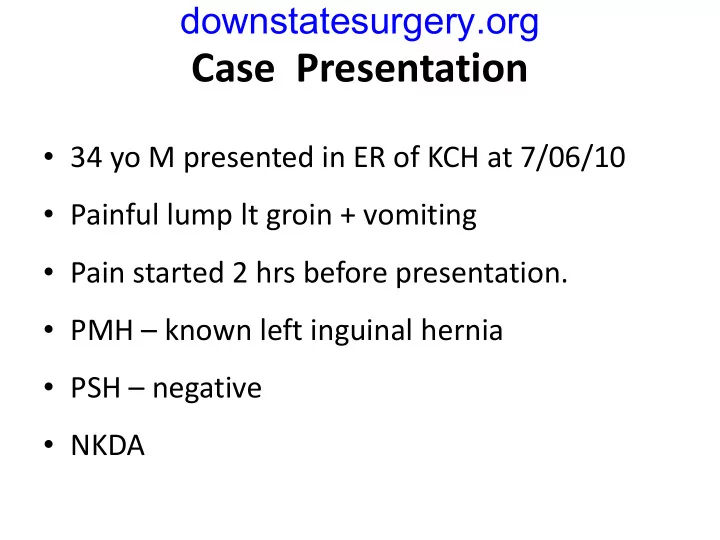
SLIDE 1 Case Presentation
- 34 yo M presented in ER of KCH at 7/06/10
- Painful lump lt groin + vomiting
- Pain started 2 hrs before presentation.
- PMH – known left inguinal hernia
- PSH – negative
- NKDA
downstatesurgery.org
SLIDE 2 Case Presentation
- VS: 146/93, 86 , 18, 98%
- PE:
– suffering from pain – Abdomen
– not distended – Soft – minimal diffuse tenderness
– Lt groin- painful, tender, irreducible mass – GU- both testicles in place
downstatesurgery.org
SLIDE 3 Case Presentation
– WBC 6.9 – Lactate 3.6 – VBG pH 7.53, pCO2 29.8, HCO3 26.3, BE 2.2
downstatesurgery.org
SLIDE 4 Case Presentation
- Dx – Incarcerated inguinal hernia
- OR finding/Procedure:
– Lt inguinal incision – Strangulated , non viable SB in hernial sac – Serosanguinous fluid in the sac – Resection of SB with stapled anastomosis – Repair of hernia with Plug and Patch Bard Mesh
downstatesurgery.org
SLIDE 5 Case Presentation
- Postop course uncomplicated
- Discharged home on POD # 4 when was
tolerating regular diet and had BMs.
- Readmission on POD # 7 for SBO
downstatesurgery.org
SLIDE 6
downstatesurgery.org
SLIDE 7
downstatesurgery.org
SLIDE 8
downstatesurgery.org
SLIDE 9
downstatesurgery.org
SLIDE 10
- NGT/NPO/IVF
- ABD XR on HD#2 – contrast in Rt colon, BM+
- HD#3 diet started
- Discharged HD#4
- Patient visited OPC on POD #15
– doing well – postop scar intact
downstatesurgery.org
SLIDE 11
Use of Mesh for Hernia Repair in in clean-contaminated field
Dr V. Roudnitsky Downstate Medical Center
downstatesurgery.org
SLIDE 12 Hernia repair
- Primary repair ( tissue repair )
- Synthetic mesh repair
- Biological mesh repair
downstatesurgery.org
SLIDE 13 Long-term follow-up of a randomized clinical trial of non-mesh versus mesh repair of primary inguinal hernia British Journal of Surgery 2007; 94: 506–510
- Randomized prospective study
- 1993-1996 randomization of 300 patients
- No specialized hernia center
- Non mesh repair:
– Bassini 51% – Shouldice 20% – McVay 4%
downstatesurgery.org
SLIDE 14 Long-term follow-up of a randomized clinical trial of non-mesh versus mesh repair of primary inguinal hernia British Journal of Surgery 2007; 94: 506–510
– 80 patients non-mesh group– 17% recurrence – 73 patients mesh group – 1% recurrence
- Half of recurrence occurred more then 3 y
after the operation – adequate f/up is important
downstatesurgery.org
SLIDE 15 A COMPARISON OF SUTURE REPAIR WITH MESH REPAIR FOR INCISIONAL HERNIA N Engl J Med 2000;343:392-8
- Multicenter randomized, prospective study
- Suture repair vs mesh repair (100/100 patients )
- The three-year cumulative rates of recurrence:
– suture repair 43 percent – mesh repair 24 percent
- P=0.02
- Risk factor for recurrence:
– Suture repair – Infection – Prostatism ( men ) – Previous surgery for AAA
downstatesurgery.org
SLIDE 16
downstatesurgery.org
SLIDE 17 Abdominal hernia repair with bridging acellular dermal matrix—an expensive hernia sac The American Journal of Surgery (2008) 196, 47–50
- Retrospective review of 11 complex
abdominal hernia repair with Acellular Dermal Matrix
- All cases - bridging of fascial defect
- Mean follow up 24 months
- Recurrence rate 80%
downstatesurgery.org
SLIDE 18
downstatesurgery.org
SLIDE 19
downstatesurgery.org
SLIDE 20
downstatesurgery.org
SLIDE 21
downstatesurgery.org
SLIDE 22 Experiences with a Prophylactic Mesh in 93 Consecutive Ostomies World J Surg (2010) 34:1637–1640
- Use of prophylactic mesh for prevention of
parastomal hernia during creation of end colostomy
- A prophylactic mesh was used in :
– 19 of 29 (65%) dirty wounds – 56 of 64 (87%) contaminated wounds
downstatesurgery.org
SLIDE 23
downstatesurgery.org
SLIDE 24
downstatesurgery.org
SLIDE 25 Experiences with a Prophylactic Mesh in 93 Consecutive Ostomies World J Surg (2010) 34:1637–1640
– A mesh does not increase the rate of complications and can be used in severely contaminated wounds.
downstatesurgery.org
SLIDE 26 Obturator hernia: clinical analysis of 16 cases Hernia (2008) 12:289–297
- Retrospective review of 16 patients with obturator hernia in
20 years period
- 75% strangulated hernias with 56.3% perforation
- Intestinal resection 12 cases
- Repair with polypropylene 11 cases
- Mesh was used in 6 cases of SB perforation
- Mesh was used in 3 cases of SB strangulation/resection
- Wound infection 4 cases
- No need for mesh removal
downstatesurgery.org
SLIDE 27 Tension-free repair versus modified Bassini technique for strangulated inguinal hernia: a comparative study Hernia (2005) 9: 156–159
downstatesurgery.org
SLIDE 28 Tension-free repair versus modified Bassini technique for strangulated inguinal hernia: a comparative study Hernia (2005) 9: 156–159
- No significant difference of wound infection
between the two groups (2/33, 6.1% vs 4/42, 9.5%, p=n.s.)
- No mesh had to be removed.
downstatesurgery.org
SLIDE 29 Early results from the use of the Lichtenstein repair in the management of strangulated groin hernia Hernia (2007) 11:239–242
- 25 patient with strangulated inguinal hernia vs
25 elective hernia repair
- In group of strangulation bowel resection
performed in 4 patients ( 16%)
- No wound infection noted in both group
downstatesurgery.org
SLIDE 30 Use of a preperitoneal prosthesis for strangulated groin hernia BJS Volume 84(3), March 1997, pp 310-312
- 35 Patients with strangulated inguinal hernia
- 9 bowel resection for ischemia but no
perforation
- Midline preperitoneal approach
- 2 postop wound infection neither in Pt with
intestinal resection
- No mesh had to be removed
downstatesurgery.org
SLIDE 31 Elective Colonic Operation and Prosthetic Repair of Incisional Hernia: Does Contamination Contraindicate AbdominalWall Prosthesis Use? J Am Coll Surg 2000;191:366–372.
downstatesurgery.org
SLIDE 32
downstatesurgery.org
SLIDE 33
downstatesurgery.org