Case Newspaper: USA TODAY 43 year old man - surgery, radiation for - - PDF document

case
SMART_READER_LITE
LIVE PREVIEW

Case Newspaper: USA TODAY 43 year old man - surgery, radiation for - - PDF document

Disclosures Adult Growth Hormone Deficiency (GHD) PI of research grants to Massachusetts General Hospital from: Novo Nordisk Opko Versartis Beverly MK Biller MD, FACP Occasional consultant to: Novo Nordisk Professor of Medicine Pfizer


slide-1
SLIDE 1

Adult Growth Hormone Deficiency (GHD)

Beverly MK Biller MD, FACP

Professor of Medicine Harvard Medical School Neuroendocrine Clinical Center Massachusetts General Hospital Boston, MA

Disclosures

PI of research grants to Massachusetts General Hospital from:

Novo Nordisk Opko Versartis

Occasional consultant to:

Novo Nordisk Pfizer Versartis

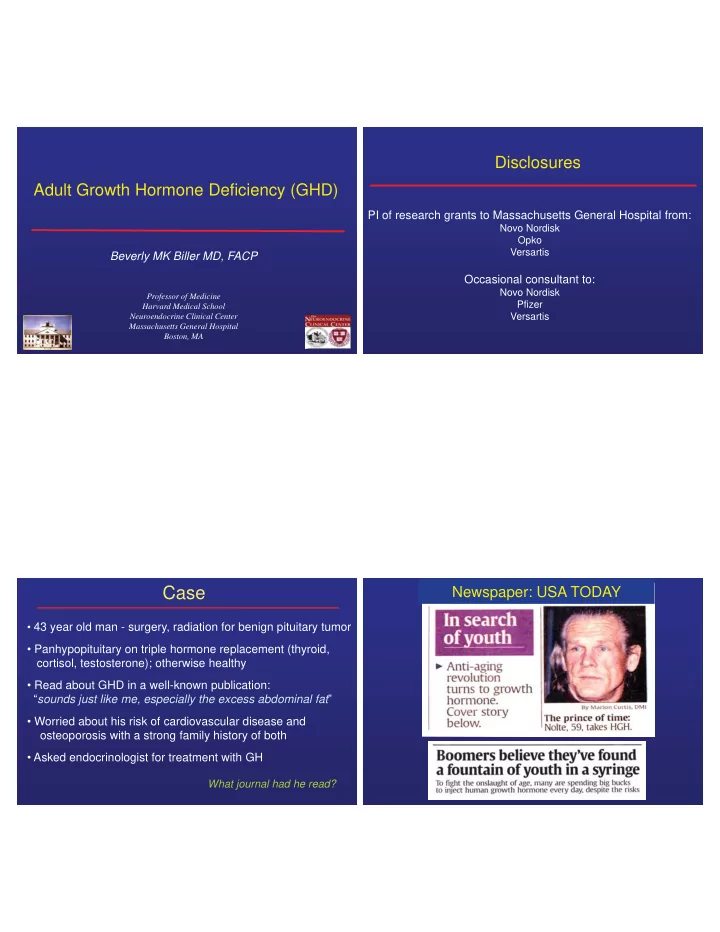
Case

  • 43 year old man - surgery, radiation for benign pituitary tumor
  • Panhypopituitary on triple hormone replacement (thyroid,

cortisol, testosterone); otherwise healthy

  • Read about GHD in a well-known publication:

“sounds just like me, especially the excess abdominal fat”

  • Worried about his risk of cardiovascular disease and
  • steoporosis with a strong family history of both
  • Asked endocrinologist for treatment with GH

What journal had he read?

Newspaper: USA TODAY

slide-2
SLIDE 2

Illicit use by athletes Bodybuilding Baseball Olympics

GH studied in adults with:

  • Aging (“somatopause”)
  • Cardiomyopathy
  • Catabolic states

– Respiratory failure – Burns – AIDS wasting *

  • Short bowel syndrome *
  • GH deficiency *

– Childhood onset (CO) – Adult onset (AO)

*FDA approved uses

Causes of Adult GHD

  • Tumors

– Pituitary tumors – Craniopharyngioma – Meningioma – Rathke’s cleft cyst – Germinoma – Others

  • Infiltrative/infectious/inflammatory

– Hypophysitis – Sarcoidosis – Histiocytosis X – Tb and fungal diseases – Others

Adapted from Cook DM Growth Horm IGF Res 1999

  • Surgery

– Transsphenoidal – Craniotomy

  • Cranial radiation RT

– Brain, head/neck tumors – Pituitary or whole-brain RT

  • Trauma/vascular injury

– Head trauma – Apoplexy – Sheehan syndrome

  • Other

– Childhood onset

  • Idiopathic
  • Organic

Hypopituitarism in patients with traumatic brain injury and subarachnoid hemorrhage

n=100 n=40

Patients evaluated 3m after the event

Aimaretti Clin Endo 2004 61: 320

slide-3
SLIDE 3

Percentage of specific pituitary deficits following TBI and SAH

Aimaretti Clin Endo 2004 61: 320

Chronic trauma a risk as well Retired boxers Ask about CNS events

Adult GHD - Clinical Features

  • Body composition altered

– Fat mass increased – Lean body mass decreased – Skeletal muscle strength decreased

  • Cardiovascular (CV) issues

– Increased risk of CV death – Lipids abnormal – Other CV markers abnormal

  • Bone mineral density decreased
  • Quality of life diminished

He was most worried about fat, cardiovascular risk & bone; let’s discuss those 1st

0 10 20 30 40 60 50 40 30 20 10

Number

  • f

Deaths Years After Diagnosis

Rosen Lancet

Cardiovascular Deaths in Hypopituitarism

  • bserved

expected

  • Abnl body composition (high waist/fat, visceral fat)
  • Lipid abnormalities
  • Decreased QOL: low motivation, less exercise
  • Decreased fibrinolytic activity
  • Increased number of arterial plaques
  • Increased intima-media thickness
  • Endothelial cell dysfunction
  • Altered inflammatory process

Possible Mechanisms Increased cardiovascular (CV) mortality in adult GHD

slide-4
SLIDE 4

Severity of GHD:

Clinical implications: Body composition

Colao JCEM

Very severe: GH peak < 3 on Arg-GHRH test Normals

*p<0.05 vs. all

  • ther groups

Lean mass lowest in severe GHD Fat mass highest in severe GHD

* *

Bengtson JCEM

Before GH 6 months on GH Decreased fat:

  • subcutaneous
  • visceral

Subcutaneous fat

Visceral fat

BODY COMPOSITION by CT

Studies all show decreased body fat on GH replacement

  • 7
  • 6
  • 5
  • 4
  • 3
  • 2
  • 1

1

Salomon n= 24 Whitehead N= 14 Bengtsson N= 10 Hansen N= 29 Weaver N= 22 Baum N= 32 Johannsson N= 68 Attanasio N= 173

Fat (% )

Newman Endocrinologist

Regional decreases in adipose tissue with 6m of GH replacement

Bengtsson JCEM Legs Trunk (SC) Viscera Arms Head/ neck

  • 10
  • 20
  • 30
  • 40

Percent Change

slide-5
SLIDE 5

With GH replacement fat mass decreases, lean mass increases

  • 5
  • 4
  • 3
  • 2
  • 1

1 6 12 18 24 30 36 Body fat Percent Months

GH period Placebo period

1 2 3 4 6 12 18 24 30 36

Lean mass Kg Months

GH period Placebo period

Body composition benefit requires continued GH replacement

Biller JCEM

  • Abnl body composition (high waist/fat, visceral fat)
  • Lipid abnormalities
  • Decreased QOL: low motivation, less exercise
  • Decreased fibrinolytic activity
  • Increased number of arterial plaques
  • Increased intima-media thickness
  • Endothelial cell dysfunction
  • Altered inflammatory process

Possible Mechanisms Increased cardiovascular (CV) mortality in adult GHD

Carotid artery intima media thickness: Decreased during GH replacement

Controls Pre-GH Tx GH replacement

N = 11 * p< 0.001 vs. controls * * p< 0.01 vs. controls

Pfeifer JCEM

6 mo 0.70 3 mo

Intima media thickness (mm)

12 mo 18 mo

* * *

0.65 0.60 0.55 0.50 0.45 Controls Pretreatment GHD

  • Abnl body composition (high waist/fat, visceral fat)
  • Lipid abnormalities
  • Decreased QOL: low motivation, less exercise
  • Decreased fibrinolytic activity
  • Increased number of arterial plaques
  • Increased intima-media thickness
  • Endothelial cell dysfunction
  • Altered inflammatory process

Possible Mechanisms Increased cardiovascular (CV) mortality in adult GHD

slide-6
SLIDE 6
  • Atherosclerosis: chronic inflammatory condition
  • Markers of inflammation predict CV risk

C-Reactive Protein (CRP)

  • acute phase reactant
  • highest quartile predictive of vascular events

(Ridker NEJM, Circulation)

  • Physicians health study: 3 fold MI, 2 fold CVA
  • Women’s health study: 5.5 fold MI

Increased cardiovascular (CV) mortality in adult GHD

4th Quartile: 3 fold increased risk

  • f MI, 2 fold

increased risk

  • f CVA

Sesmilo Ann Int Med 2000

Mean CRP in GHD patients pre-tx at 4th quartile in nls increased risk of CV events GHD mean shifted down one quartile

  • n replacement

Sesmilo Ann Int Med 2000

slide-7
SLIDE 7

Summary of cardiovascular (CV) risk markers

  • GH replacement in GHD reduces markers of CV risk
  • Visceral fat
  • Carotid intima-media thickness
  • Serum Markers of CV risk
  • CRP
  • Interleukin-6
  • Serum Amyloid A (borderline)
  • Homocysteine
  • Tissue plasminogen activator
  • Lipids (not all studies)
  • Long term prospective studies of CV mortality are needed

Adult GH replacement Adult GHD - Clinical Features

  • Body composition altered

– Fat mass increased – Lean body mass decreased – Skeletal muscle strength decreased

  • Cardiovascular (CV) issues

– Increased risk of CV death – Lipids abnormal – Other CV markers abnormal

  • Bone mineral density decreased

GH effects on bone in adults

  • Bone cells have receptors for GH and IGF-1
  • GH and IGF-1 stimulate cell division in bone growth plates in vitro
  • In vivo data show that GH stimulates bone growth
  • GHD is associated with low bone density

GH IGF-1 IGF-1 GH IGF-1

Very severe GHD (< 3mcg/ L ARG-GHRH) Severe GHD Partial GHD

Lumbar Spine

Non GHD Controls

t score

* * *

2.5 1.5 0.5

  • 0.5
  • 1.5
  • 2.5

Femoral Neck

* * *

2.5 1.5 0.5

  • 0.5
  • 1.5
  • 2.5

Very severe GHD Severe GHD Partial GHD Non GHD Controls

*p<0.001 very severe vs. partial, non-GHD, and controls **p<0.05 severe vs. very severe and controls

Colao JCEM

Severity of GHD:

Clinical implications: Bone Density

Lowest t-scores in very severe GHD

slide-8
SLIDE 8

Fracture Frequency in GHD

5 10 15 20 25 30 GH Deficiency Normals Fracture Frequency (%)

*

Rosen Eur J Endocrinol

Odds ratio for a fracture = 3.49 (1.85-6.56, 95% confidence interval; *P<0.001)

Lumbar spine BMD

% change from baseline Duration of treatment (months)

GH PL 6 12 18 24

‡ ‡ ‡ *

*

Men

  • 2
  • 1

1 2 3 4 5

Snyder JBMR

‡ p < 0.05, within group change from baseline * p<0.05 for comparison

  • f change from baseline,

GH vs PL

U Penn, MGH, Brown, Case Western, Mayo, Oregon, St. Louis U

Multicenter study in 67 patients with GHD Double-blind, placebo-controlled vs daily GH for 2 years

Adult GH replacement

  • Increased bone turnover (formation and resorption)
  • BMD very consistently increased in longer studies

– ~5% in lumbar spine at 2 years, 10% at 5 years – ~2.5% in femoral neck – No change in proximal radius

  • Remaining questions

– Gender difference, women show less response – Combination with other drug, further ↑ with bisphosphonates – Fracture rates

Summary of bone and bone marker results

Adult GHD - Clinical Features

  • Body composition altered

– Fat mass increased – Lean body mass decreased – Skeletal muscle strength decreased

  • Cardiovascular (CV) issues

– Increased risk of CV death – Lipids abnormal – Other CV markers abnormal

  • Bone mineral density decreased
  • Quality of life diminished
slide-9
SLIDE 9

Changes in days of sick leave during GH Replacement

Time, months Sick leave, days / 6 months

15 20 10 5

Mean ± SEM

* P< 0.05 vs baseline * * P< 0.01 * * * P< 0.001

** *** ** *

Verhelst Clin Endocrinol

6 12 18 24 Before GH

QOL assessment by partners

  • f adults on GH replacement

Percent reporting (%)

Placebo GH

P less than: More alert

0.0 69.0 0.0001

More active

3.7 51.8 0.001

Higher endurance

3.6 60.7 0.0001

Less easily annoyed

7.1 28.6 NS

Less worried

6.9 37.9 0.05

More extroverted

3.4 37.9 0.01

More industrious

3.3 46.7 0.001

Happier

11.1 48.1 0.01

Better looks

10.3 51.7 0.01

More satisfied with occupation

7.7 34.6 0.05

Fewer family conflicts

3.4 24.1 NS

Better personal relationships

3.4 34.5 0.01 Burman JCEM 1995

Adult GH replacement – overall summary

  • Body composition improved

– Fat mass decreased – Lean body mass increased – Skeletal muscle strength increased

  • Lipids, cardiovascular markers improved (variability)
  • Bone mineral density (BMD) increased
  • Quality of life improved (variability in results)
  • Side effects are usually dose related

How is the diagnosis made?

Society Guidelines for adult GHD diagnosis

*In patients with clearly established recent (within 10 yr) hypothalamic causes of suspected GHD (e.g., irradiation), testing with GHRH-arginine may be misleading (i.e., false positives)

AACE GRS Endocrine Society

Patient population History of pituitary disease, CO-GHD, radiation Same Same Number of tests 1 stimulation test 1 but 2 if isolated GHD 1 stimulation test Test of choice ITT ITT ITT, GHRH-arginine Alternative GH stimulation GHRH-arginine, arginine GHRH-arginine; arginine; glucagon Glucagon GH cut-off values for deficiency All tests: normal is >5 ng/mL NormaI: >5 ng/mL Severe: <3 ng/mL ITT: 5.1 mg/mL GHRH-arginine: 4.1 mg/mL*

AGHD, adult GHD; AACE, American Association of Clinical Endocrinologists; GRS, Growth Hormone Research Society; CO-GHD, childhood

  • nset GHD; ITT, insulin tolerance test; GHRH, growth hormone releasing hormone
slide-10
SLIDE 10

Diagnosis of Adult GHD

  • ITT is the gold standard; allows testing of HPA axis as well
  • Arg-GHRH and glucagon are good alternatives
  • A normal IGF-I does not exclude GHD (unless in upper half)

But a very low level is sufficient for the diagnosis in panhypopituitary pts

Summary

After confirming the diagnosis, what dose would you give this patient?

GH replacement dosing

  • Consider variables which affect dose:

− Gender − Age − Age of onset of GHD − Estrogen status (oral vs. transdermal)

  • Highest doses typically needed in young women on
  • ral estrogen who had childhood-onset GHD
  • Lowest doses typically used in older, adult-onset men

Women on oral estrogen need higher GH dose

50 100 150 200 250

Men IGF-I, ng/ mL Women

  • oral E

Women + oral E

250 500 750 1000

GH dose, mg/ d Men Women

  • oral E

Women + oral E

*

Cook JCEM 1999 *, significantly higher than both other groups

0.376 0.424 0.867

37 patients with GH dose titrated to mid-high nl IGF-I unless side effects Analyzed final dose by gender and oral estrogen use Women on oral E required ~ double dose of GH vs men or women not on E

Men, women on transdermal or no estrogen: $35/mg x 450 mcg/day = $5750/yr Women on oral estrogen: $35/mg x 900 mcg/day = $11,500/yr Cost implications (Merriam)

GH replacement dosing

  • Begin with low dose to minimize side effects
  • Fixed dose with stepwise increments

– Men/Women (no E/on transdermal E): 0.1-0.3 mg/day – Women on oral E or CO pts: 0.2-0.4 mg/day

  • Increase dose gradually based on monitoring:

– Side effects: most relate to fluid retention, are dose-related,

can be minimized by graduated dose titration – IGF-I level ~2-4 weeks after dose changes – Target? (50th percentile = 0SD)

slide-11
SLIDE 11

Adult GHD

  • Replacement shown to improve:
  • body composition
  • muscle strength, endurance
  • bone mineral density
  • cardiovascular markers
  • quality of life
  • Well-tolerated if dose titrated gradually

Yet, many patients are not treated – why?

Lack of awareness about efficacy Dosing and monitoring not standardized Diagnosis perceived as difficult Unusual prescribing system Insurance issues/cost Concern about neoplasia

Barriers to Treatment

GH Replacement Therapy in Adults

DAILY INJECTIONS

Case

  • 43 yo panhypopituitary on cortisol, thyroid, testosterone
  • Enrolled in a study of weekly long-acting GH
  • Reduction in body fat, increase in lean mass, BMD, QOL
  • When study ended, started commercial daily GH
  • Lost job no insurance stopped daily GH
  • New job insurance advised to resume daily GH

“Didn’t like the shots - I’ll wait for your next long-acting GH study”

GRS Workshop on long-acting GH - Table 1

Product Current status

Depot formulation Nutropin Depot LB03002 No longer available Approved in Europe

Hoybye GH & IGF Research 2015

slide-12
SLIDE 12

Product Current status

Depot formulation Nutropin Depot LB03002 No longer available Approved in Europe Pegylated formulations PEG-GH-PHA-794428 NNC126-0083 ARX201016 Jintrolong BBT-031 CP-016 No longer in development No longer in development No longer in development Marketed in China for Childhood GHD Preclinical studies only Preclinical studies only

GRS Workshop on long-acting GH - Table 1

Hoybye GH & IGF Research 2015

Product Current status

Prodrug formulations ACP-001/Transcon NNC0195-0092 Phase 2 in children, Phase 2 in adults Phase 2 in children, Phase 3 in adults

GRS Workshop on long-acting GH - Table 1

Hoybye GH & IGF Research 2015

Product Current status

Prodrug formulations ACP-001/Transcon NNC0195-0092 Phase 2 in children, Phase 2 in adults Phase 2 in children, Phase 3 in adults GH fusion protein technology TV-1106 MOD-4023 LAPSrhGH/HM 10560A VRS-317 GX-H9 ALTU-238 Profuse GH Phase 2 and 3 in adults Phase 2 in children, Phase 3 in adults Phase 2 in adults Phase 2 in children, Phase 3 in adults Phase 2 in children No longer in development Preclinical studies only

GRS Workshop on long-acting GH - Table 1

Hoybye GH & IGF Research 2015

Adult GHD - Conclusions

QUESTIONS?

  • Associated with pituitary and neurologic disorders
  • Common in patients with other pituitary deficiencies
  • Dxd by stim testing or low IGF-I in appropriate setting
  • Well tolerated if starting dose low, increased slowly
  • Long-acting GH being studied as a potential treatment