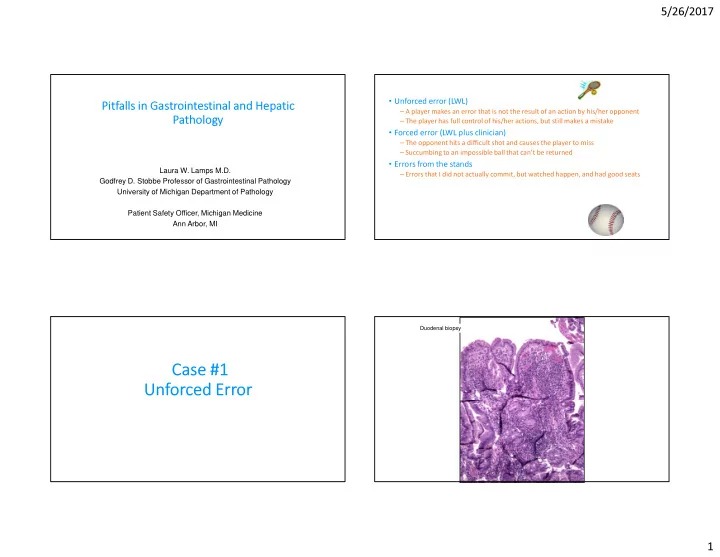
Case #1 Unforced Error 50 year old woman s/p renal transplant, with - - PowerPoint PPT Presentation

case 1 unforced error
SMART_READER_LITE
LIVE PREVIEW

Case #1 Unforced Error 50 year old woman s/p renal transplant, with - - PowerPoint PPT Presentation

5/26/2017 Unforced error (LWL) Pitfalls in Gastrointestinal and Hepatic A player makes an error that is not the result of an action by his/her opponent The player has full control of his/her actions, but still makes a mistake Pathology


slide-1
SLIDE 1

5/26/2017 1 Pitfalls in Gastrointestinal and Hepatic Pathology

Laura W. Lamps M.D. Godfrey D. Stobbe Professor of Gastrointestinal Pathology University of Michigan Department of Pathology Patient Safety Officer, Michigan Medicine Ann Arbor, MI

  • Unforced error (LWL)

– A player makes an error that is not the result of an action by his/her opponent – The player has full control of his/her actions, but still makes a mistake

  • Forced error (LWL plus clinician)

– The opponent hits a difficult shot and causes the player to miss – Succumbing to an impossible ball that can’t be returned

  • Errors from the stands

– Errors that I did not actually commit, but watched happen, and had good seats

Case #1 Unforced Error

50 year old woman s/p renal transplant, with diarrhea

Duodenal biopsy

slide-2
SLIDE 2

5/26/2017 2

Next day………….

  • Clinician called and asked for CMV

immunostain because he was sure patient had CMV (of note, this was on the requisition, but it’s on 98% of his requisitions, so I ignored it)

  • CMV immunostain grudgingly ordered

CMV immunostain

slide-3
SLIDE 3

5/26/2017 3

Mistakes Made

  • Looked at cases too quickly
  • Violated own rules of when to order special stains

Mistakes Made

  • Looked at cases too quickly
  • Violated own rules of when to order special stains
  • Allowed irritability to cloud judgment
  • Corollary: Just because the person asking drives you nuts,

doesn‘t mean what they are asking for is crazy

slide-4
SLIDE 4

5/26/2017 4

Essentially Normal Bx in Immunocompromised Patient

Increased apoptotic epithelial cells CMV Adenovirus Don’t overlook spirochetosis, coccidians, or Giardia! Are they severely immunocompromised? Is there another reason to worry? No Done! Yes

Get history, consider GMS, CMV Big unexplained ulcer

? Elderly Patient

Yes CMV No Get history, tailor workup to that Immunocompromised Patient Yes CMV ?HSV GMS ?AFB

Utility of Special Stains in Evaluation of Biopsies for GI Infections

  • Monkemuller et al, AJCP 2000
  • HIV patients
  • 28 months
  • Sensitivity and specificity for CMV diagnosis on H&E were 97%

and 100%

  • AFB/GMS stains did not identify previously diagnoses infection in

any patient

  • Long-term follow-up revealed no missed infections on H&E
  • Stains doubled cost
slide-5
SLIDE 5

5/26/2017 5

Utility of CMV Stains in Evaluation of Biopsies from UC Flares

  • Kambham et al, AJSP 2004
  • Case control study of UC patient with refractory disease
  • 25% of patients with refractory UC had CMV inclusions
  • n immunostain
  • 60% of these had been missed on H&E
  • Recommend using CMV IHC in evaluation of biopsies

in these patients

CMV-poorly formed inclusions

slide-6
SLIDE 6

5/26/2017 6

Lessons Learned

  • Slow down
  • Don’t break own your own rules; you made them

for a reason

  • Don’t allow irritability to cloud judgment/good

patient care

Whatever it was, I didn’t do it.

Case #2 Unforced Error

56 year old woman with abdominal pain, gastritis

slide-7
SLIDE 7

5/26/2017 7

slide-8
SLIDE 8

5/26/2017 8

Partial gastrectomy

Pseudo-Signet Ring Cells

  • Benign cells with signet ring morphology
  • Degenerative change associated with:
  • Ulceration/reactive gastropathy
  • Ischemia
  • C. difficile-associated pseudomembranous colitis
slide-9
SLIDE 9

5/26/2017 9

Autoimmune gastritis Pseudo signet ring cells in C. difficile infection-courtesy Dr. Wendy Frankel

slide-10
SLIDE 10

5/26/2017 10

Real signet ring cells

Mistakes Made

  • Didn’t put enough weight on the fact that all the atypical cells were

detached

  • Didn’t put enough weight on the fact that the largest nuclei were not

that much larger than normal nuclei

  • Correlation with macroscopic appearance (doesn’t always help with

gastric cancer, though)

Can Stains Help?

  • Cytokeratin
  • Both benign and malignant signet ring cells will be positive
  • Exception: muciphages
  • Mucin
  • Helpful if negative, not so if positive
  • Reticulin
  • Maybe
slide-11
SLIDE 11

5/26/2017 11

Muciphages

Can Stains Help?

  • Proliferation markers
  • Maybe
  • Reactive processes can also be very proliferative
  • E-cadherin
  • Maybe
  • E-cadherin often decreased in signet ring cell carcinomas

From Hughes, Greywoode, and Chetty: Virchows Arch 2011;459:347-9

Reticulin stain highlights basement membrane of glands

slide-12
SLIDE 12

5/26/2017 12

E-cadherin

Pseudomembranous colitis Signet ring cell carcinoma

Courtesy Dr. Wendy Frankel

E-cadherin-signet ring cell carcinoma

Ki-67

Pseudomembranous colitis Chemical gastropathy

Courtesy Dr. Wendy Frankel

slide-13
SLIDE 13

5/26/2017 13

Lessons Learned

  • Location of signet ring cells of paramount importance
  • Lamina propria vs. discohesive, detached
  • Four fine pathologists can all be wrong
  • Proliferation markers, reticulin, E-cadherin might have

helped but not necessarily

Is that a real signet ring cell

  • r a fake one?

Case #3 Unforced Error

65 year old man with poorly defined gastric mass

slide-14
SLIDE 14

5/26/2017 14

Diagnosis: Plasmacytoid Neoplasm

  • Very poorly defined (or so I’m told)
  • Gross description describes tiny bits
  • I worked in one of the largest myeloma centers in the

world

  • CD138 +++++++++++++++++++++
  • Kappa and Lambda have high background staining,

not useful

slide-15
SLIDE 15

5/26/2017 15

Two months later……..

  • Attend CME conference where John Goldblum

speaks about new GIST variants

  • Describes a strikingly plasmacytoid variant of GIST
  • Uh-oh. !@#$%!!

Mistakes Made

  • Should have known the literature better
  • Did not know all the vagaries of immunostains

employed

  • Allowed context of where I worked to influence

differential

Plasmacytoid (pleomorphic) GIST

  • Majority of GISTs are monomorphic
  • Small subset are pleomorphic
  • Myxoid/hyalinized stroma
  • Variant of epithelioid GIST
  • Some have very distinctive plasmacytoid features
slide-16
SLIDE 16

5/26/2017 16

Immunostains will get you into trouble

  • CD117
  • Plasma cells
  • GIST
  • Melanoma
  • Neuroendocrine

tumors

  • Thymic and other

carcinomas

  • Kaposi’s sarcoma
  • PEComa

DOG-1 Molecular studies

Immunostains will get you into trouble

  • DOG-1 positivity
  • Non-mesenchymal
  • Gastric adenocarcinoma
  • Acinic cell carcinoma of

salivary gland

  • Melanoma
  • Rare mesenchymal
  • Synovial sarcoma
  • MPNST

Hemminger and Iwenofu. Histopathology 2012;61;170-77.

Immunostains will get you into trouble

  • CD138
  • Plasma cells
  • Plasmacytoid urothelial

carcinoma

  • Papillary thyroid

carcinoma

  • Other plasmacytoid

carcinomas and mesenchymal tumors

  • Endometrium

Lessons Learned

  • Remove oneself from context before making final

diagnosis

  • Keep up with literature
  • Understand your immunostains
slide-17
SLIDE 17

5/26/2017 17

Zoe and Alys contemplate the pitfalls of immunohistochemistry.

Case #4 Forced Error

Solitary liver mass in young woman with “renal cell carcinoma”

slide-18
SLIDE 18

5/26/2017 18

Frozen Section Conversation

  • LWL: What kind of renal cell carcinoma did she

have?

  • Surgeon: The regular kind.
  • LWL: Clear cell?
  • Surgeon: Yeah.
slide-19
SLIDE 19

5/26/2017 19

Mistakes Made

  • Should have worked harder to find out history on
  • ur own
  • Should have more strongly considered all the
  • ptions in the differential diagnosis of “renal cell

carcinoma”

  • Noncirrhotic liver……
  • LWL (looking at frozens of multiple spindled nodules on serosa of

bowel and stomach): This looks like a neurofibroma.

  • Surgeon: No way!!

SILENCE…………

  • Surgeon: Huh. Maybe that explains the bumps all over him and his

family.

In my defense……..

  • KC (looking at frozen of weird metastatic liver

lesion): It says here that the patient had cancer in the tail of the pancreas. Do you know what kind of cancer it was?

  • Surgeon: The kind that is in the tail of the pancreas.

Nodules in Cirrhotic vs. Noncirrhotic Livers

  • CIRRHOTIC LIVER
  • Regenerative nodule
  • HGDN
  • Hepatocellular

carcinoma

  • NONCIRRHOTIC LIVER
  • Focal nodular

hyperplasia

  • Adenoma
  • Nodular regenerative

hyperplasia

  • Hepatocellular

carcinoma

  • Mets
slide-20
SLIDE 20

5/26/2017 20

HCC, well differentiated Normal HCC

slide-21
SLIDE 21

5/26/2017 21

Quiz: RCC vs. HCC Quiz: RCC vs. HCC Quiz: RCC vs. HCC

slide-22
SLIDE 22

5/26/2017 22

Quiz: RCC vs. HCC

Helpful hint: put in more sections

Helpful hint: HCC, clear cell variant, Hepatocyte Antigen

Feature HCC RCC ACC Clear Cells Yes Yes Yes Prominent vessels Common Common +/- EMA

  • +
  • Hepatocyte Antigen,

Arginase-1, etc.

+

  • Inhibin, SF1

Negative Negative Positive PAX2 and PAX8

  • +
  • Differentiation Between HCC and Other

Trabecular Neoplasms

slide-23
SLIDE 23

5/26/2017 23

A few last minute IHC warnings

  • CD10 can stain HCC
  • PEComa can lose reticulin (but will be HMB45 positive)
  • Hepatocyte antigen can stain carcinoids, and neuroendocrine

markers can stain HCC

  • HCC can stain with CK7 and CK20 and CK19
  • Some adenocarcinomas can stain with HSA, but it’s still better than

AFP

Pulmonary adenocarcinoma: HSA+

Lessons Learned

  • Always leave yourself a little wiggle room on difficult

cases

  • Most people have metastases rather than a new weird

primary

  • Always treat unproven verbal information relayed by

surgeon with healthy degree of skepticism

  • Morphologic pitfalls are even harder to deal with on

frozen section

What do you mean that’s a watering can? It’s not a renal cell carcinoma? I am shocked!

slide-24
SLIDE 24

5/26/2017 24

Case #5 Errors from the Stands

60 year old man with “refractory sprue”

Duodenal biopsy

slide-25
SLIDE 25

5/26/2017 25

“Refractory Sprue”

  • Meanwhile…..
  • Patient continued to do poorly
  • ANA positive, TTG negative
  • Eventually, anti-enterocyte and anti-goblet cell

antibodies came back positive

  • Patient started on azathioprine, did much better

Mistakes Made

  • Persistent belief in diagnosis even though patient

has never responded to therapy and labs don’t match up with diagnosis

  • Multiple doctors in different systems that don’t

communicate

  • Persistence of false history in medical record
  • ”Chart virus”

Autoimmune Enterocolitis

  • Well recognized in children; probably markedly under-recognized in

adults

  • Associated with many extraintestinal autoimmune illnesses
  • Diabetes mellitus
  • Membranous glomerulonephropathy
  • Thyroid disease
  • Thymomas
  • Autoimmune hemolytic anemia
  • Autoimmune polyendocrine syndrome

Autoimmune Enterocolitis

Clinical Presentation

  • Profound diarrhea and weight loss
  • No response to gluten free diet
  • Patients often initially diagnosed as celiac disease
  • Antibodies against enterocytes and/or goblet cells
  • May also have positive ANA, AMA, anti-SM, etc.
slide-26
SLIDE 26

5/26/2017 26

Celiac Disease vs. Autoimmune Enteropathy

Celiac disease

  • Villous blunting
  • Intraepithelial lymphocytes
  • Usually more than AIE
  • Neutrophilic inflammation
  • Numerous lamina propria

plasma cells

  • Crypt hyperplasia

Autoimmune enteropathy

  • Villous blunting
  • Intraepithelial lymphocytes
  • Neutrophilic inflammation
  • Often more than celiac disease
  • Numerous lamina propria plasma

cells

  • Apoptotic epithelial cells
  • Lack of goblet cells
  • May affect entire gut

Autoimmune Enteritis vs. Celiac Disease

Autoimmune enteropathy Celiac disease Celiac disease

Celiac Disease vs. Autoimmune Enteritis

Celiac disease Autoimmune enteritis

slide-27
SLIDE 27

5/26/2017 27

Colon with plasmacytic infiltrate, cryptitis, no goblet cells, apoptosis

Normal Villi Variable Defect Severe Defect Immuno-deficiency* X X X Amyloid* X Mastocytosis* X X Celiac Disease X X X Infection* X X X Drug Injury X X X Crohn’s X X Autoimmune enteritis X X Peptic duodenitis X X Chemo/radiation* X X Eosinophilic enteritis* X X Protein injury X X Stasis X X

*may have more specific or diagnostic histologic features

slide-28
SLIDE 28

5/26/2017 28 Common Variable Immunodeficiency

  • Small bowel
  • Celiac disease-like lesion
  • GVHD-like lesion
  • Decreased plasma cells, goblet cells
  • Granulomatous enteropathy
  • Nodular lymphoid hyperplasia
  • Crohn’s like enteritis
  • Lymphoma
  • Infection

Common Variable Immunodeficiency Sprue-like Lesion

  • Often associated with severe

malabsorption

  • May require parenteral nutrition
  • May be indistinguishable from celiac

disease

  • Most patients do not respond to gluten-

free diet

CVID: sprue-like pattern

Idiopathic Eosinophilic Gastroenteritis

  • Infiltration of one or more segments of GI tract by eosinophils,

including pancreas and biliary tree

  • Villous blunting, increased IELs overlap with celiac disease in

mucosal-predominant IEG

  • Excess of eosinophils favors IEG
  • 75% of patients have peripheral eosinophilia
  • Negative TTG, no response to gluten free diet
slide-29
SLIDE 29

5/26/2017 29

Olmesartan Toxicity

  • Common angiotensin II receptor antagonist

(antihypertensive)

  • Severe chronic diarrhea and weight loss, often

requiring hospitalization

  • Morphologic changes may resemble celiac disease,

collagenous sprue, and/or microscopic colitis

Courtesy Dr. Dora Lam-Himlin

slide-30
SLIDE 30

5/26/2017 30

Features on Biopsy Helpful Features Eosinophilic enteritis Increased eos Peripheral count H/o atopy Autoimmune enteritis Too many polys Absent goblet cells Apoptotic epithelial cells Anti-enterocyte/ anti- goblet cell labs More than small bowel involved CVID Decreased/absent plasma cells Apoptotic epithelial cells Immunodeficiency w/u More than small bowel involved Olmesartan +/- marked villous blunting, crypt hyperplasia, IELs, eosinophils Medication history “Scalloping” is nonspecific

Lessons Learned

  • Most patients with negative celiac disease serologies and

no response to gluten free diet do not have celiac disease

  • There are many mimics of celiac disease,common and

uncommon

  • When many things don’t fit, keep looking, and encourage
  • ur colleagues to do so as well
slide-31
SLIDE 31

5/26/2017 31

Summary

  • Everyone makes mistakes
  • Most mistakes are not because of incredibly complex

cases, but because we do (or fail to do) something simple

  • If someone can help you mess up, they will