SLIDE 2 2/15/2019 2
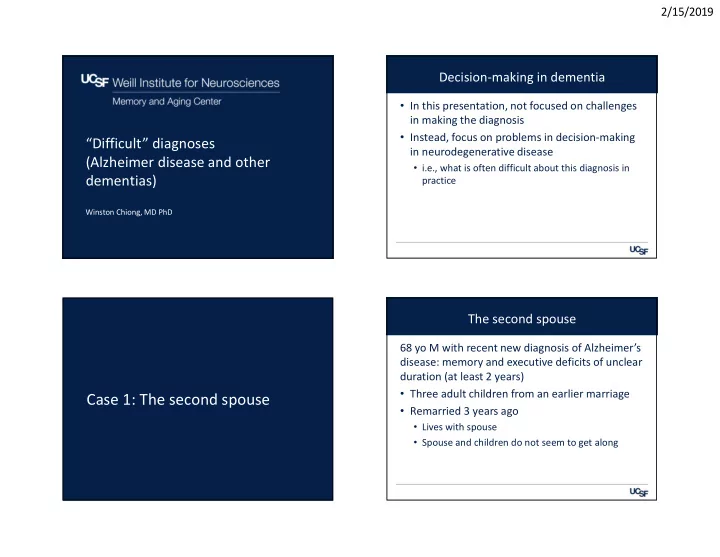
The second spouse
- After your evaluation, the patient’s son reaches
- ut via e-mail, indicating concerns that he could
not share during the visit, and requesting a time to speak on the phone.
- Can you talk with the son? And if so, what
information can you share with him?
Appelbaum PS. N Engl J Med 2007
Initial issue: patient capacity
- Capacity is not global, not settled by diagnosis:
decision-specific
- e.g., does patient have capacity to authorize you to
speak with his son?
- 4 criteria
- Understanding (risks and benefits)
- Appreciation (apply to one’s own case: insight)
- Reasoning (consider means and ends)
- Choice (communicate, reasonable consistency)
Question 1
If the patient lacks capacity and does not have an advance directive, who is legally authorized to receive information about his care?
- A. His spouse, in all circumstances
- B. His spouse, unless there is suspicion of
abuse; in which case his children are next in line
- C. No one
- D. It depends on other features of the
situation
H i s s p
s e , i n a l l c i r c u m s t a . . . H i s s p
s e , u n l e s s t h e r e i s s . . . N
e I t d e p e n d s
h e r f e a t u r e . . .
25% 25% 25% 25%
:10
https://www.americanbar.org/content/dam/aba/administrative/law_aging/2018-november-default-surrogate-consent-statutes.pdf
“Default” surrogates for health care decision-making
- Do not exist in California law for health care (do
exist for medical research…)
- CA Health Care Decisions Law passed in 2000
- Model statute (in other states):
- Individual orally designated by patient, spouse,
adult child, parent, sibling, friend
- In practice, teams often attempt to identify
most appropriate decision-maker
- Basis in practice, not in statute