Case #1: Polka dot Jane Pale, Bleeding, and Febrile: Heme-Onc - - PDF document

case 1 polka dot jane
SMART_READER_LITE
LIVE PREVIEW

Case #1: Polka dot Jane Pale, Bleeding, and Febrile: Heme-Onc - - PDF document

2/1/2013 Case #1: Polka dot Jane Pale, Bleeding, and Febrile: Heme-Onc Emergencies in Kids 3 yo spots on her legs x 1 week, gum bleeding and epistaxis Recent viral illness Judith R. Klein, MD, FACEP PE: vs nl; bruises, petechiae, Assistant


slide-1
SLIDE 1

2/1/2013 1 Pale, Bleeding, and Febrile: Heme-Onc Emergencies in Kids

Judith R. Klein, MD, FACEP

Assistant Professor of Emergency Medicine UCSF-SFGH Department of Emergency Medicine

Case #1: Polka dot Jane

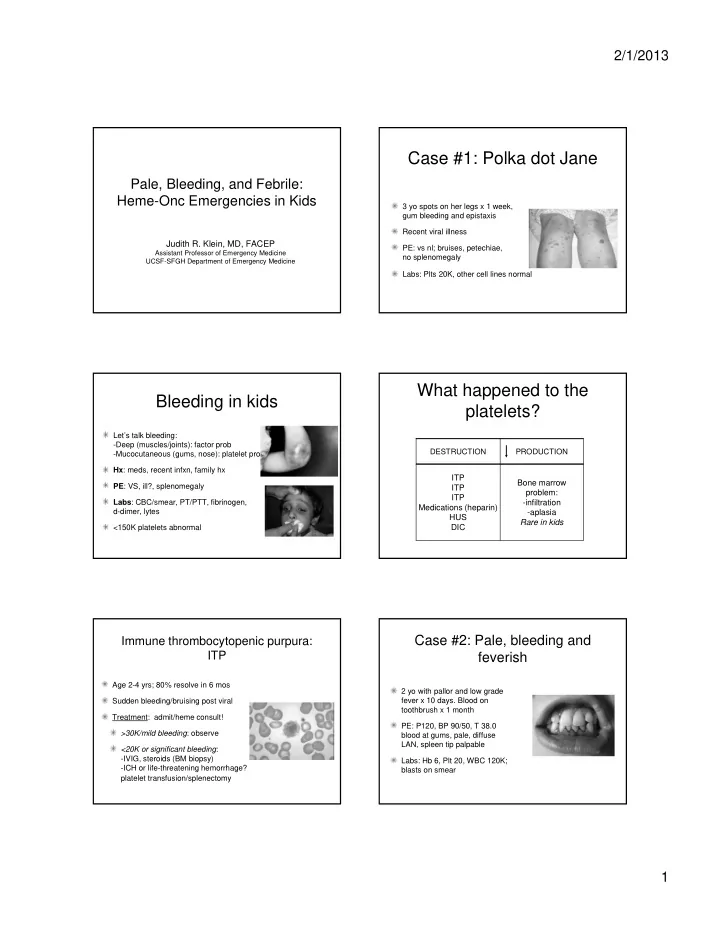
3 yo spots on her legs x 1 week, gum bleeding and epistaxis Recent viral illness PE: vs nl; bruises, petechiae, no splenomegaly Labs: Plts 20K, other cell lines normal

Bleeding in kids

Let’s talk bleeding:

  • Deep (muscles/joints): factor prob
  • Mucocutaneous (gums, nose): platelet prob

Hx: meds, recent infxn, family hx PE: VS, ill?, splenomegaly Labs: CBC/smear, PT/PTT, fibrinogen, d-dimer, lytes <150K platelets abnormal

What happened to the platelets?

DESTRUCTION PRODUCTION ITP ITP ITP Medications (heparin) HUS DIC Bone marrow problem:

  • infiltration
  • aplasia

Rare in kids

Immune thrombocytopenic purpura: ITP

Age 2-4 yrs; 80% resolve in 6 mos Sudden bleeding/bruising post viral Treatment: admit/heme consult! >30K/mild bleeding: observe <20K or significant bleeding:

  • IVIG, steroids (BM biopsy)
  • ICH or life-threatening hemorrhage?

platelet transfusion/splenectomy

Case #2: Pale, bleeding and feverish

2 yo with pallor and low grade fever x 10 days. Blood on toothbrush x 1 month PE: P120, BP 90/50, T 38.0 blood at gums, pale, diffuse LAN, spleen tip palpable Labs: Hb 6, Plt 20, WBC 120K; blasts on smear

slide-2
SLIDE 2

2/1/2013 2

Leukemia in the ED

Most common CA in kids: 75% ALL Differential:

  • Virus (EBV/parvovirus)
  • Autoimmune (HUS)
  • BM failure (aplastic anemia)

Workup: smear, lytes, Ca, PO4, uric acid, T/S, PT/PTT, BCx/Abx if T>38.3, CXR, EKG

Hyperleukocytosis

WBC>100,000-->hyperviscosity

  • ->sludging-->CNS/lungs most affected

Tx: oncology ASAP for leukopheresis and/or immediate chemo Beware transfusions-->can worsen viscosity problem

More bad news.....

K+ PO4 Uric Acid

Ca 6.5, PO4 7, uric acid 10 and K 7.5!! Tumor lysis syndrome--> arrhythmias/renal failure Treatment:

  • Hydration
  • Hyperkalemia/hypocalcemia tx
  • Hyperuricemia

*Alkalinization? Allopurinol? Rasburicase?

  • Hemodialysis

Case #3: He looks like Shrek

15 yo no 1o care large LN in neck bigger x 2 weeks; face fatter; dry cough at night PE: VS wnl, nl resp status, 5 cm neck LN firm, painless; facial plethora Labs: mild anemia, nl lytes/ uric acid, CXR mediastinal mass/tracheal deviation

Isolated lymph node enlargement

#1: Lymphadenitis- try antibiotics, consider MRSA Hx of cat scratch? TB? Monospot? Recheck 1 week: bigger, firm, fluctuant, diffuse-->more aggressive work-up: US, CXR, CBC, FNA biopsy

Lymphoma in kids

#3 cause of CA in kids after leukemia and brain CA. Hodgkins>>NHL Very curable, but initial presentation may be life- threatening

slide-3
SLIDE 3

2/1/2013 3 Mediastinal masses: disasters waiting to happen....

#1 problem: airway SVC syndrome Management:

  • AVOID SEDATION
  • Oncologist for further imaging (CT/MR)

and emergent chemo/radiation/steroids

Case #4: Hot Tot

3 yo with AML with T101 x 2 days; rhinorrhea/mild cough; last chemo 5 days; Imm UTD PE: T 100 P120 RR 30 O2 96%; mod mucositis, nl CRT, CVL site clean Labs: WBC 1.8, ANC 350, PLT 40

Fever/neutropenia in kids

Definition:

  • T>101 or >100.4 x 2; oral or ax
  • ANC<500mm3

Many causes of neutropenia Bugs involved:

  • 10-30% ID’d: rest idiopathic
  • 90% bacterial (skin, resp, GI)
  • Viral (HSV, VZV, RSV, flu): less common
  • Fungal: prolonged neutropenia/steroids

Admit them all?

Not all fever/neutropenia alike Mortality: 80% to 1-3% Risks of admitting:

  • nosocomial infection
  • kids/parents hate it
  • $$$

Risks of not admitting:

  • overwhelming sepsis

Risk profile

Higher risk:

  • <1 year old
  • Lower/longer neutropenia
  • Focal infection
  • Severe mucositis
  • VS abnl/shock/organ failure
  • Indwelling device: CVL
  • CRP>90, PLT<50

Lower risk:

  • T<39; no focal infection
  • no sx except fever

The Science?

Gupta, 2009:

  • 123 episodes: 88 pts 2-15 years
  • Criteria: no focal infxn or sepsis, no
  • ther reasons for inpt, brief

low ANC, no hx fungal infxn Augmentin/oflox po vs. CTX/amikacin IV No difference in fever resolution, no mortality SMALL study

Gupta, Ped Hemat Oncol 2009.

slide-4
SLIDE 4

2/1/2013 4

More science on fever and neutropenia

Agyeman: Predicting bacteremia 423 episodes fever/16% bacteremia 100% sensitivity if any one: Hb>9, Plt<50, shaking chills,

  • ther other reason for admit

Derivation only; needs validation

Agyeman, Ped Infec Dis J 2011

Fever/neutropenia bottom line

Admit unless pediatric oncologist directs

  • therwise or patient in clinical trial

Fever/neutropenia: management

Workup:

  • All: CBC, BCx, UA,*CXR
  • Sx dependent: chem 7, nasal wash

(rsv, flu), throat cx, skin swabs Treatment:

  • Neutropenic precautions!
  • Abx for G+/G-/pseudomonas: ceftazidime,

cefipime, imipenem, zosyn

  • Add vancomycin if CVL
  • G-CSF: no evidence of mortality benefit
  • Hydrocortisone: only if on steroids or pituitary abnl

Case #5: My bones ache

15 yo with SCD/asthma c/o leg, back, chest pain. Mild cough. PE: T 38.2, RR 18, O2 96% chest: few wheezes; legs/back hypesthetic Labs: Hb baseline, retics>10% CXR....

Pain crisis

Duration: 3-7 days Most common complication of SCD

  • 3x more admit 25-29 yrs vs. <4 yrs

Low back>long bones> abd/chest PE: 20% fever, usually normal Red flags: HA, CP, abd pain, jaundice, vomiting, neuro sx, focal bone ttp/edema, fever

Redding-Lallinger, Curr Prob Ped Adolesc Health Care 2006

Pain crisis management

PO or IVF to euvolemia Pain meds: NSAIDs, opiates, PCA D/C: oral pain meds RTC not prn Steroids?: NO, shorter episode but rebound pain common Nitric oxide? No benefit in 150 pt RCT*

*Gladwin, JAMA 2011.

slide-5
SLIDE 5

2/1/2013 5 What about that CXR?

Acute chest definition: new infiltrate + CP, T, O2, RR, cough, or wheezing Pneumonia vs acute chest? Pathophysiology/risks:

  • pain crisis (necrotic BM)-->fat embolism
  • sedation/splinting-->hypoventilation
  • asthma (RR 6-8)*

*Knight-Madden, Thorax 2005.

Acute chest: management

Pain management Oxygen/incentive spirometry* Abx: cephalosporin (CTX)+macrolide Bronchodilators prn pRBC: if deteriorating; to Hb 10 only Future: NO? steroids?

*Bellet, NEJM 1995.

Case #9: Hot sickler

5 mo old SCD and T 39 x 2 days. No other sx; no sick contacts. Nl po and UOP. Immuniz-UTD; on PCN PE: T 39.1, RR 30, O2 98% appears well, nl CRT, no resp

  • distress. No bone ttp. No rash.

Bacterial infection and SCD

Most common cause of death Pathophysiology: functional asplenia Bugs: Pneumococcus, Salmonella, Staph,

  • E. coli, Strep.

Highest risk: <12 mos up to 3 years SCD: 300-600x risk of Pneumococcus (IPD) PCN prophylaxis: reduce IPD by 84%

Impact of vaccinations

Vaccines: H.flu and PCV-13 McCavit 2011: 3x risk of hospitalizations post PCV-7 Adamkiewicz 2008: 68% risk of IPD post PCV-7.

McCavit, Ped Blood Ca 2011 Adamkiewicz, Pediatrics 2008

Work-up: fever and SCD

Fever: T>38 if <6 mo; >38.5 if >6 mo Hx: Immuniz? Pcn? Focal sx? Workup: CBC, retics, BCx; +/- : UA/UCx, CXR, LP Abx: ceftriaxone for all; +/- vanco

slide-6
SLIDE 6

2/1/2013 6

Fever/SCD: disposition?

Admit:

  • all <6 mos
  • >6 mos if toxic, other SCD

complic, T>40, WBC <5 or >30, Hb<5 Discharge:

  • return 24 hrs for re-check
  • repeat abx until Cx (-) x 48 hours and afebrile
  • reliable pt

In a nutshell

Bruising and low platelets? Think ITP but admit them to rule

  • ut bad things

Not just platelets low? Bone marrow problem/cancer Mediastinal mass? Beware of sedation Admit febrile neutropenic kids. Period. SCD and pain? May be just a pain crisis, but look at end

  • rgans

SCD and fever? It may not be a virus!