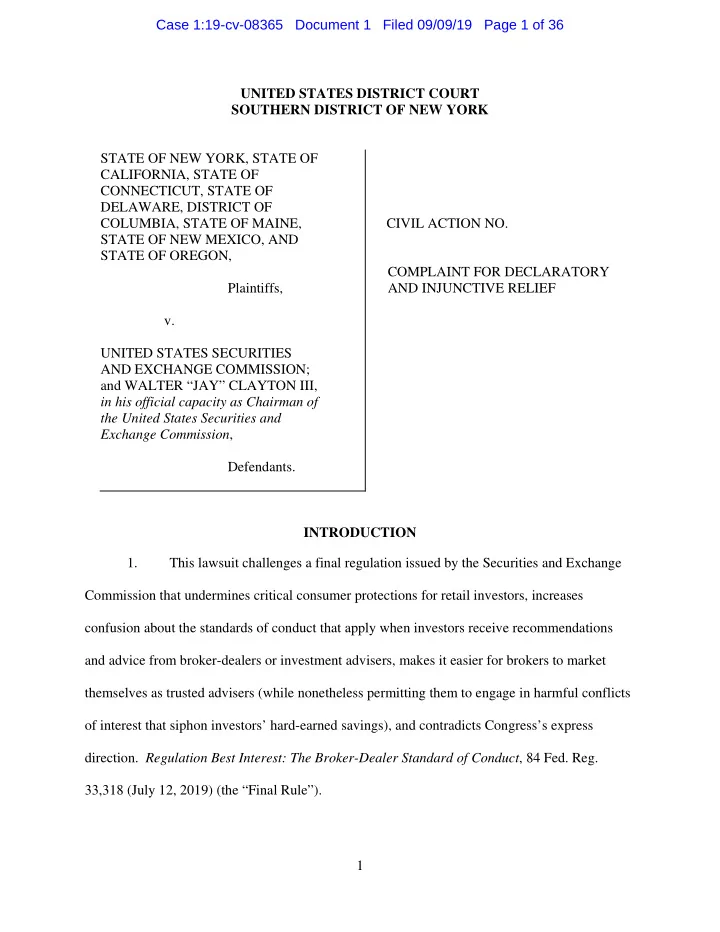
SLIDE 1 1 UNITED STATES DISTRICT COURT SOUTHERN DISTRICT OF NEW YORK STATE OF NEW YORK, STATE OF CALIFORNIA, STATE OF CONNECTICUT, STATE OF DELAWARE, DISTRICT OF COLUMBIA, STATE OF MAINE, STATE OF NEW MEXICO, AND STATE OF OREGON, Plaintiffs, v. UNITED STATES SECURITIES AND EXCHANGE COMMISSION; and WALTER “JAY” CLAYTON III, in his official capacity as Chairman of the United States Securities and Exchange Commission, Defendants. CIVIL ACTION NO. COMPLAINT FOR DECLARATORY AND INJUNCTIVE RELIEF INTRODUCTION 1. This lawsuit challenges a final regulation issued by the Securities and Exchange Commission that undermines critical consumer protections for retail investors, increases confusion about the standards of conduct that apply when investors receive recommendations and advice from broker-dealers or investment advisers, makes it easier for brokers to market themselves as trusted advisers (while nonetheless permitting them to engage in harmful conflicts
- f interest that siphon investors’ hard-earned savings), and contradicts Congress’s express
- direction. Regulation Best Interest: The Broker-Dealer Standard of Conduct, 84 Fed. Reg.
33,318 (July 12, 2019) (the “Final Rule”). Case 1:19-cv-08365 Document 1 Filed 09/09/19 Page 1 of 36
SLIDE 2 2 2. Retail investors—individuals who invest their money for family and household needs—seek advice from financial professionals like broker-dealers and investment advisers to help them plan for their families’ financial future, manage their finances, and achieve a secure retirement. 3. The statutory and regulatory frameworks that govern the advice retail customers receive vary widely between broker-dealers and investment advisers. With regard to the applicable standards of conduct, investment advisers are fiduciaries who must act in their clients’ best interests and are subject to duties of loyalty and care. Broker-dealers, by contrast, have generally been subject under federal law only to a duty of fair dealing, which requires merely that recommendations be “suitable” for a customer. 4. The Commission has long known that retail investors generally are not aware of these different standards or their legal implications; and this investor confusion has been a source
- f concern for both regulators and Congress. See U.S. Sec. & Exch. Comm’n, Study on
Investment Advisers & Broker-Dealers, at i, 101, 165-66 (Jan. 2011) (the “Section 913 Study”). 5. In 2010, Congress enacted the Dodd-Frank Wall Street Reform and Consumer Protection Act (the “Dodd-Frank Act”), which in relevant part directed the Securities and Exchange Commission (the “Commission” or the “SEC”) to complete a report to study the effectiveness of the existing standards of conduct for broker-dealers and investment advisers when providing advice to retail customers, and make recommendations regarding whether regulatory changes were needed to strengthen the existing standards of conduct. Dodd-Frank Act §§ 913(b)-(d), Pub. L. No. 111-203, 124 Stat. 1376, 1824-27 (July 21, 2010). 6. Congress then directed that the Commission consider the results of the study and, in a section expressly entitled “Authority to Establish a Fiduciary Duty for Brokers and Dealers,” Case 1:19-cv-08365 Document 1 Filed 09/09/19 Page 2 of 36
SLIDE 3 3 authorized the Commission to promulgate rules (a) harmonizing the standards of conduct that apply to broker-dealers and investment advisers, and (b) providing that “the standard of conduct for all brokers, dealers, and investment advisers, when providing personalized investment advice about securities to retail customers . . . , shall be to act in the best interest of the customer without regard to the financial or other interest of the broker, dealer, or investment adviser providing the advice.” Dodd-Frank Act §§ 913(g)(1), (g)(2), 124 Stat. at 1828-29. 7. Contrary to this delegation of authority, however—and despite the published recommendations of the Commission’s own expert staff—the Final Rule neither harmonizes the standards of conduct between broker-dealers and investment advisers, nor requires broker- dealers to act in their customers’ best interests “without regard to” the broker’s own financial
8. Plaintiffs the State of New York, State of California, State of Connecticut, State
- f Delaware, District of Columbia, State of Maine, State of New Mexico, and State of Oregon,
(the “Plaintiffs”) bring this action to challenge the validity of the Final Rule. The Commission’s disregard for Congress’s directives in the Dodd-Frank Act will harm Plaintiffs and their
- residents. Among the harms they will suffer, Plaintiffs will lose revenue from the taxable
portions of distributions from their residents’ investment and retirement accounts that are worth less because of expensive conflicts of interest in investment advice; Plaintiffs will bear a greater financial burden to assist retirees and others whose savings are insufficient to meet their needs due to conflicted investment advice; and the regulation will harm Plaintiffs’ strong quasi- sovereign interest in protecting the economic well-being of their residents. 9. Plaintiffs therefore bring this action to vacate the Final Rule and permanently enjoin its implementation because it exceeds and is contrary to Defendants’ statutory authority in Case 1:19-cv-08365 Document 1 Filed 09/09/19 Page 3 of 36
SLIDE 4 4 violation of the Administrative Procedure Act (“APA”), 5 U.S.C. § 706(2)(C); and is arbitrary, capricious, an abuse of discretion, and otherwise not in accordance with law under the APA, 5 U.S.C. § 706(2)(A). JURISDICTION AND VENUE 10. The Court has subject matter jurisdiction pursuant to 28 U.S.C. §§ 1331 and 2201(a). Jurisdiction is also proper under the judicial review provisions of the Administrative Procedure Act, 5 U.S.C. § 702. 11. Declaratory and injunctive relief is sought as authorized in 28 U.S.C. §§ 2201 and 2202. 12. Venue is proper in this judicial district under 28 U.S.C. §§ 1391(b)(2) and (e)(1). Defendants are United States agencies or officers sued in their official capacities. Plaintiff the State of New York is a resident of this judicial district, and a substantial part of the events or
- missions giving rise to this Complaint occurred and are continuing to occur within the Southern
District of New York. PARTIES 13. Plaintiff the State of New York, represented by and through its Attorney General, is a sovereign state of the United States of America. The Attorney General is New York State’s chief law enforcement officer and is authorized to pursue this action pursuant to N.Y. Executive Law § 63. 14. Plaintiff the State of California is a sovereign state of the United States of
- America. California brings this action by and through Attorney General Xavier Becerra. The
Attorney General is the chief law officer of California (Cal. Const., art. V, § 13), and is authorized to file civil suits that either directly involve the State’s rights and interests or that are deemed necessary by the Attorney General to protect public rights and interests. Cal. Gov. Code Case 1:19-cv-08365 Document 1 Filed 09/09/19 Page 4 of 36
SLIDE 5 5 §§ 12600-12; Pierce v. Superior Court, 1 Cal. 2d 759, 761-62 (1934). California brings this action pursuant to the Attorney General’s independent constitutional, statutory, and common law authority to file suit and obtain relief on behalf of the State. 15. Plaintiff the State of Connecticut, represented by and through its Attorney General, is a sovereign state of the United States of America. The Attorney General is authorized to pursue this action pursuant to Conn. Gen. Stat. § 3-125. 16. Plaintiff the State of Delaware is a sovereign state in the United States of
- America. Delaware brings this action by and through its Attorney General Kathleen Jennings.
The Attorney General is the chief law enforcement officer of the State of Delaware, Del. Const.,
- art. III, and has the authority to file civil actions in order to protect public rights and interests. 29
- Del. C. § 2504.
17. Plaintiff the District of Columbia is a municipal corporation empowered to sue and be sued, is the local government for the territory constituting the seat of the government for the United States. The District brings this action through its chief legal officer, the Attorney General for the District of Columbia. The Attorney General has general charge and conduct of all legal business of the District and all suits initiated by and against the District and is responsible for upholding the public interest. D.C. Code § 1-301.81(a)(1). 18. Plaintiff the State of Maine, represented by and through its Attorney General, is a sovereign state of the United States of America. The Attorney General of Maine is a constitutional officer with the authority to represent the State of Maine in all matters and serves as its chief legal officer with general charge, supervision, and direction of the State’s legal
- business. Me. Const. art. IX, Sec. 11; 5 M.R.S., §§ 191 et seq. The Attorney General’s powers
and duties include acting on behalf of the State and the people of Maine in the federal courts on Case 1:19-cv-08365 Document 1 Filed 09/09/19 Page 5 of 36
SLIDE 6 6 matters of public interest. The Attorney General has the authority to file suit to challenge action by the federal government that threatens the public interest and welfare of Maine residents as a matter of constitutional, statutory, and common law authority. According to census data, Maine has the oldest population by median age (44.6) of any state in the country, and has a significant and growing population of aging investors who stand to be particularly injured by persistent conflicts of interest in retirement investment advice. 19. Plaintiff the State of New Mexico is a sovereign state in the United States of
- America. New Mexico brings this action by and through its Attorney General, Hector Balderas.
Attorney General Balderas has the authority to prosecute “all actions and proceedings . . . in which the state may be a party or interested when, in his judgment, the interest of the state requires such action . . . .” N.M. Stat. § 8-5-2(B). Similarly, Attorney General Balderas is permitted by New Mexico law to appear before federal courts “to represent and to be heard on behalf of the state when, in his judgment, the public interest of the state requires such action . . . .” N.M. Stat. § 8-5-2(J). 20. Plaintiff the State of Oregon, represented by and through its Attorney General, Ellen F. Rosenblum, and State Treasurer, Tobias Read, is a sovereign state of the United States
- f America. The Attorney General is Oregon’s chief law enforcement officer and is authorized
to pursue this action pursuant to Or. Rev. Stat. § 180.060. The State Treasurer has charge of all moneys paid into the State Treasury pursuant to Or. Rev. Stat. § 178.050. 21. Plaintiffs are aggrieved by Defendants’ actions and have standing to bring this action because the Final Rule harms Plaintiffs’ sovereign, quasi-sovereign, economic, and proprietary interests, and will continue to cause injury unless and until the Final Rule is vacated. Case 1:19-cv-08365 Document 1 Filed 09/09/19 Page 6 of 36
SLIDE 7 7 22. Defendant SEC is an independent agency of the United States government, and is an agency within the meaning of 5 U.S.C. § 552(f)(1). The SEC promulgated the Final Rule and is responsible for its enforcement. 23. Defendant Walter “Jay” Clayton III is the Chairman of the SEC and is sued in his
ALLEGATIONS I. Background. A. The differing standards of conduct for broker-dealers and investment advisers. 24. Historically, investment advisers provided advice in positions of trust and confidence, and brokers provided arms-length sales recommendations, and they were both regulated accordingly. John J. Topoleski & Gary Shorter, Congressional Research Serv., Department of Labor’s 2016 Fiduciary Rule: Background and Issues 5-7 (July 3, 2017). 25. Over time, brokers’ roles blurred with advisers’ roles, with brokers increasingly functioning as financial advisers without being regulated accordingly. This development has created confusion and caused harm in the marketplace because investors rely on brokers’ recommendations as if those recommendations were trustworthy advice, when in fact they are
- ften highly-conflicted sales recommendations.
26. Investment advisers work with investors to “make significant financial decisions” by helping them “evaluate their investment needs, plan for their future, develop and implement investment strategies, and cope with the every-growing complexities of the financial markets.” Section 913 Study at 6. Investment advisers are fiduciaries who owe investors “a duty of loyalty and a duty of care (encompassing, among other things, a duty of suitability), with the duty of Case 1:19-cv-08365 Document 1 Filed 09/09/19 Page 7 of 36
SLIDE 8
8 loyalty requiring investment advisers to act in the best interest of clients and to avoid or disclose conflicts.” Id. at 106. 27. Broker-dealers, on the other hand, have traditionally been viewed as “intermediaries, [who] connect investors to investments” by offering a variety of brokerage services, including making recommendations for the purchase or sale of securities, executing brokerage transactions, and providing access to securities on a principal or agency basis. Section 913 Study at 8-10. 28. In contrast to investment advisers, broker-dealers have generally not been held to a fiduciary standard under federal law, and, among other things, have no duty to monitor the performance of investors’ accounts. Id. at 106; see also 84 Fed. Reg. at 33,321; Chamber of Commerce of United States of Am. v. U.S. Dep’t of Labor, 885 F.3d 360, 373 (5th Cir. 2018) (“[I]n law and the financial services industry, rendering ‘investment advice for a fee’ customarily distinguished salespeople from investment advisers . . . .”). 29. These historical distinctions, however, have broken down over time. A 2008 research study commissioned by the SEC found blurred distinctions between the activities of investment advisers and broker-dealers. Angela A. Hung et al., Investor and Industry Perspectives on Investment Advisers and Broker-Dealers, RAND Institute for Civil Justice (2008). The emergence of broker-dealers styling themselves as “financial advisers” or similar titles, as well as discount brokers, fee-based brokerage programs, and online investment advisory services have muddled the differences between investor advisers and broker-dealers. Id. at xix, 14-15. 30. In addition, “many financial services firms may offer both investment advisory and broker dealer services,” which adds to investor confusion. Section 913 Study at 10, 12. Case 1:19-cv-08365 Document 1 Filed 09/09/19 Page 8 of 36
SLIDE 9 9 According to the Commission, more than two-thirds of customer accounts were held at firms that were dually-registered as broker-dealers and investment advisers as of December 2017. Dual registration raises the risk that customers will be further confused in situations where financial professionals may be acting in different capacities for the same customer. 31. The lack of clear distinctions between investment advisers and broker-dealers has left investors confused and at increased risk of being harmed as a result of the different level of protections they receive based on the different accounts they have. According to the Section 913 Study, “there is robust recent evidence that many retail investors do not understand or are confused by the different standards of care applicable to investment advisers and broker-
- dealers. . . .” Id. at 94. The Section 913 Study concluded that “in light of this confusion and lack
- f understanding, it is important that retail investors be protected uniformly when receiving
personalized investment advice or recommendations about securities regardless of whether they choose to work with an investment adviser or a broker-dealer.” Id. at 101. The Section 913 Study concluded that the best way to accomplish that goal was to apply a uniform fiduciary
32. The uniform fiduciary standard advocated by the Section 913 Study would protect investors because it is higher than the suitability standard applicable to broker-dealers. Under Financial Industry Regulatory Authority (“FINRA”) Rule 2111, a broker need only have a reasonable basis to believe that a recommended transaction or investment strategy is suitable for the customer, based on the customer’s investment profile. Furthermore, a broker can consider his own interests when making a recommendation. Under this standard, for example, a broker is permitted to recommend a higher-fee, lower-quality security that provides a higher commission to the broker when lower-fee, higher-quality alternatives are readily available. In contrast, Case 1:19-cv-08365 Document 1 Filed 09/09/19 Page 9 of 36
SLIDE 10
10 because the fiduciary standard provided in Section 913(g) and recommended by the expert Commission staff would prohibit a broker’s recommendation from being tainted by any additional compensation a broker would stand to receive, a broker would not be permitted to recommend the higher-fee, lower-quality security that provided the higher commission. B. Congressional consideration of standards of conduct for brokers, dealers, and investment advisers during development of the Dodd-Frank Act. 33. During the drafting and enactment of the Dodd-Frank Act, Congress considered the disparity that exists between the standards of conduct that apply to broker-dealers and investment advisers. 34. On January 20, 2010, the U.S. House of Representatives passed H.R. 4173, the House precursor to the Dodd-Frank Act. H.R. 4173, 111th Cong. (2010) (House version). 35. Section 7103 of the bill, titled “Establishment of a Fiduciary Duty for Brokers, Dealers, and Investment Advisers, and Harmonization of Regulation,” required the SEC to write rules establishing a fiduciary duty for broker-dealers (in place of the more lenient suitability standard), and granted the SEC equal authority under the Securities Exchange Act of 1934 (“Exchange Act”) and the Investment Advisers Act of 1940 (“Advisers Act”) to prosecute violations of these standards. See H.R. 4173, 111th Cong. § 7103(a)(1) (“the Commission shall promulgate rules to provide that . . . the standard of conduct [for brokers and dealers] shall be the same as the standard applicable to an investment adviser”); id. § 7103(b) (providing for “harmonization” of enforcement powers). 36. According to the House Financial Services Committee Report accompanying the bill, “Section 103 requires the SEC to write rules to establish a fiduciary duty for brokers and dealers harmonizing the standard of conduct for brokers and dealers with that of investment Case 1:19-cv-08365 Document 1 Filed 09/09/19 Page 10 of 36
SLIDE 11 11 advisers when giving personalized investment advice about securities to retail customers.” H.R.
- Rep. No. 111-687(I), at 73 (2010).
37. On May 20, 2010, the Senate passed an amended version of the House bill. 156
- Cong. Rec. S4239-02, S4330.
38. The Senate version did not define the standard of conduct that the Commission should apply to brokers or dealers when providing personalized investment advice to retail customers. 39. Instead, the Senate bill directed the SEC to conduct a study to evaluate (1) the effectiveness of existing legal or regulatory standards of care for brokers, dealers, and investment advisers for providing personalized investment advice to retail customers, and (2) whether there were legal or regulatory gaps in the protections for retail customers relating to the standards of care for brokers, dealers, and investment advisers. H.R. 4173, 111th Cong. § 913 (2010) (as amended by the Senate). 40. The Senate bill further provided that to the extent the study identified gaps or
- verlap in the legal or regulatory standards under review, the Commission was authorized to
commence a rulemaking to address these gaps. Id. 41. The Senate bill grounded the SEC’s authority to promulgate any such regulation
- n the Commission’s existing authority under the Exchange Act and Advisers Act. Id.
(authorizing the Commission to “commence a rulemaking . . . using its authority under” the Exchange Act and Advisers Act). C. The Dodd-Frank Act. 42. The Dodd-Frank Act was ultimately enacted in July 2010, and combined elements
- f both the House and Senate approaches with respect to the Commission’s obligations regarding
Case 1:19-cv-08365 Document 1 Filed 09/09/19 Page 11 of 36
SLIDE 12
12 the standards of conduct that apply to broker-dealers and investment advisers. Dodd-Frank Act § 913, 124 Stat. at 1824-30. 1. The requirement to study gaps in the regulatory regime. 43. As enacted, the Dodd-Frank Act directed the SEC to conduct a study of gaps in the regulatory regime and to make recommendations regarding any changes necessary to strengthen existing standards of conduct. Dodd-Frank Act §§ 913(b)-(d), 124 Stat. at 1824-27. 44. Section 913(b) of the Act provided that “[t]he Commission shall conduct a study to evaluate “the effectiveness of existing legal or regulatory standards of care for brokers, dealers, [and] investment advisers . . . for providing personalized investment advice and recommendations about securities to retail customers,” and “whether there are legal or regulatory gaps, shortcomings, or overlaps in legal or regulatory standards in the protection of retail customers relating to the standards of care for brokers, dealers, [and] investment advisers . . . that should be addressed by rule or statute.” Dodd-Frank Act § 913(b), 124 Stat. at 1824-25; see also Dodd-Frank Act § 913(c), 124 Stat. at 1825-27. 45. Section 913(d) of the Act further directed the Commission to prepare a report of the “findings, conclusions, and recommendations of the Commission from the study” required by Section 913(b). Dodd-Frank Act § 913(d), 124 Stat. at 1827. 46. In addition, the Act directed that in any rulemaking “to address the legal or regulatory standards of care for brokers, dealers, [and] investment advisers,” the Commission was required to “consider the findings[,] conclusions, and recommendations of the study required under” Section 913(b). Dodd-Frank Act § 913(f), 124 Stat. at 1827-28. Case 1:19-cv-08365 Document 1 Filed 09/09/19 Page 12 of 36
SLIDE 13 13 2. Delegation of rulemaking authority to establish a fiduciary duty for brokers and dealers. 47. The Dodd-Frank Act also explicitly amended the Securities Exchange Act of 1934 and the Investment Advisers Act of 1940 to authorize the Commission to promulgate rules regarding the standards of conduct for brokers, dealers, and investment advisers. See Dodd- Frank Act § 913(g), 124 Stat. at 1828-29. 48. First, Section 913(g)(1) amended the Exchange Act and authorized the SEC to harmonize the standards of conduct for broker-dealers and investment advisers, providing that: “Notwithstanding any other provision of this Act or the Investment Advisers Act of 1940, the Commission may promulgate rules to provide that, with respect to a broker or dealer, when providing personalized investment advice about securities to a retail customer . . . , the standard
- f conduct . . . shall be the same as the standard of conduct applicable to an investment adviser
under section 211 of the Investment Advisers Act of 1940.” Dodd-Frank Act § 913(g)(1), 124
- Stat. at 1828 (codified at 15 U.S.C. § 78o(k)(1)).
49. Second, Section 913(g)(2) of the Dodd-Frank Act amended the Advisers Act to explicitly set forth the allowable standard of conduct in any rulemaking, providing that the Commission “may promulgate rules to provide that the standard of conduct for all brokers, dealers, and investment advisers, when providing personalized investment advice about securities to retail customers . . . , shall be to act in the best interest of the customer without regard to the financial or other interest of the broker, dealer, or investment adviser providing the advice.” Dodd-Frank Act § 913(g)(2), 124 Stat. at 1828-29 (codified at 15 U.S.C. § 80b- 11(g)(1)). Case 1:19-cv-08365 Document 1 Filed 09/09/19 Page 13 of 36
SLIDE 14 14 50. Third, Section 913(g)(2) of the Dodd-Frank Act further provided that the standard for brokers and advisers under any rulemaking “shall be no less stringent than” the standard for investment advisers under the Investment Advisers Act. Id. 51. The Dodd-Frank Act’s specific delegation to the Commission to regulate broker- dealers who provide investment advice as fiduciaries was recognized by the Fifth Circuit in Chamber of Commerce, 885 F.3d at 386. In that decision, the court vacated and set aside the Department of Labor’s fiduciary rule issued under the Employee Retirement Income Security Act of 1974 in part because Section 913(g)(2) had already delegated that authority to the
- Commission. Id. (“DOL’s direct imposition on the delegation to SEC is made plain by the text
- f Dodd-Frank Section 913(g)(2) . . . . As a major securities law treatise explains, the genesis of
this provision was an SEC initiative commencing in 2006 to address ‘Trends Blurring the Distinction Between Broker-Dealers and Investment Advisers.’”) (internal citation omitted). II. Development and Text of the Final Rule. A. The Section 913 Study. 52. As directed by the Dodd-Frank Act, the SEC conducted a study to evaluate the effectiveness of the existing legal standards that applied to investment advisers and broker- dealers. 53. After soliciting input and reviewing more than 3,500 comment letters, Commission staff published the report of that study in January 2011. 54. The Section 913 Study determined, among other conclusions, that “despite the extensive regulation of both investment advisers and broker-dealers, retail customers do not understand and are confused by . . . the standards of care applicable to investment advisers and broker-dealers when providing personalized investment advice and recommendations about securities.” Section 913 Study at 101. Case 1:19-cv-08365 Document 1 Filed 09/09/19 Page 14 of 36
SLIDE 15 15 55. The Section 913 Study further concluded that the differences between these standards of care, as well as the confusion about which standards apply, ultimately harm retail
56. The Commission staff therefore recommended that the Commission “exercise its rulemaking authority under Dodd-Frank Act Section 913(g), which permits the Commission to promulgate rules to provide that: ‘the standard of conduct for all brokers, dealers, and investment advisers . . . shall be to act in the best interest of the customer without regard to the financial or
- ther interest of the broker, dealer, or investment adviser providing the advice.’” See id. at vi,
108-09 (quoting Dodd-Frank Act Section 913(g)(2), 124 Stat. at 1828-29). 57. In making this recommendation, the Commission staff explained that “it is important that retail investors be protected uniformly when receiving personalized investment advice or recommendations about securities regardless of whether they choose to work with an investment adviser or broker-dealer.” Id. at 101. B. The Commission’s 2018 proposed rulemaking. 58. Seven years later, in May 2018, the SEC published a Notice of Proposed Rulemaking regarding the standard of conduct for broker-dealers when making a recommendation involving securities to retail customers. See Notice of Proposed Rulemaking, Regulation Best Interest, 83 Fed. Reg. 21,574 (May 9, 2018) (the “2018 Proposed Rule”). 59. The 2018 Proposed Rule departed from the Section 913 Study’s recommendations in several significant respects. 60. First, the 2018 Proposed Rule failed to apply a uniform fiduciary standard to both broker-dealers and investment advisers, as envisioned by the Section 913 Study. Id. at 21,575. 61. Second, the 2018 Proposed Rule disregarded the recommendation in the Section 913 Study that broker-dealers “act in the best interest of the customer without regard to the Case 1:19-cv-08365 Document 1 Filed 09/09/19 Page 15 of 36
SLIDE 16
16 financial or other interest” of the broker-dealer. Instead, the proposal required only that broker- dealers “act in the best interest of the retail customer at the time the recommendation is made without placing the financial or other interest of the broker-dealer . . . ahead of the interest of the retail customer.” Id. 62. Third, unlike the 913 Study, which recommended that the Commission regulate based on the authority delegated by Section 913(g) of the Dodd-Frank Act, the Commission purported to ground its authority in Dodd-Frank Act Section 913(f)—a provision that went unmentioned in the Section 913 Study. 63. Numerous commenters, including a coalition of state Attorneys General (collectively, the “State Attorneys General”), objected to the 2018 Proposed Rule. See Comment Letter from the Attorneys General of New York, et al. (Aug. 7, 2018), at https://www.sec.gov/comments/s7-07-18/s70718-4185784-172673.pdf. 64. The State Attorneys General urged the adoption of a uniform fiduciary rule, consistent with the Section 913 Study’s recommendation and Congress’s directive in Dodd- Frank Act Section 913(g). 65. The State Attorneys General warned that the failure to adopt a uniform rule would leave investors exposed to the same confusion and harmful conflicts of interest that motivated Congress to enact Section 913(g) of the Dodd-Frank Act in the first place, and explained that the 2018 Proposed Rule failed to meaningfully define key terms, instead relying on an amorphous “best interest” standard. 66. The State Attorneys General also cautioned that the 2018 Proposed Rule failed to provide meaningful guidance to industry, unlike the clear and strong protections afforded by Section 913(g). Case 1:19-cv-08365 Document 1 Filed 09/09/19 Page 16 of 36
SLIDE 17 17 C. The 2019 Final Rule. 1. The Final Rule as adopted by the Commission largely tracks the 2018 Proposed Rule. 67. The Commission adopted the Final Rule at an Open Meeting on June 5, 2019, and the Final Rule was published in the Federal Register on July 12, 2019. See 84 Fed. Reg. at 33,318, 33,492. The Final Rule is largely consistent with the 2018 Proposed Rule. 68. First, like the 2018 Proposed Rule, the Commission relied on Dodd-Frank Act Section 913(f) as its principal authority for promulgating the Final Rule. 84 Fed. Reg. at 33,329- 30 (“The Commission is adopting Regulation Best Interest pursuant to the express and broad grant of rulemaking authority in Section 913(f) of the Dodd-Frank Act.”). The Commission also cited other general statutory provisions under the Exchange Act as statutory authority to adopt the Final Rule. Id. at 33,330 n.122; see also id. at 33,491. 69. The Commission expressly declined to rely on the rulemaking authority delegated by Dodd-Frank Act Section 913(g), which the SEC characterized as an “overlapping, yet distinct, rulemaking power.” Id. at 33,330; see also id. at 33,491. 70. Second, like the 2018 Proposed Rule, the Final Rule acknowledges that the “best interest obligation” it creates is not a fiduciary standard, like the one that applies to investment advisers under the Advisers Act. 84 Fed. Reg. at 33,322 (“We have declined to subject broker- dealers to a wholesale and complete application of the existing fiduciary standard under the Advisers Act because it is not appropriately tailored to the structure and characteristics of the broker-dealer business model . . . .”). 71. Instead, the Final Rule established a new and largely undefined “best interest
- bligation” providing that a broker or dealer, “when making a recommendation of any securities
transaction or investment strategy involving securities (including account recommendations) to a Case 1:19-cv-08365 Document 1 Filed 09/09/19 Page 17 of 36
SLIDE 18 18 retail customer, shall act in the best interest of the retail customer at the time the recommendation is made, without placing the financial or other interest of the [broker or dealer] ahead of the interest of the retail customer.” Id. at 33,491 (to be codified at 17 C.F.R. § 240.15l- 1(a)(1)). 72. Third, as with the 2018 Proposed Rule, the Final Rule does not require that the broker or dealer act “without regard to” his or her own financial interests as is mandated under Section 913(g)(2). The Final Rule explicitly acknowledges that the “best interest obligation” it creates is not the same as the obligation set out in Section 913(g)(2) of the Dodd-Frank Act to act in the best interest of the customer “without regard to” the broker’s own financial interest. 84
73. The Commission explained that they “replac[ed] the ‘without regard to’ language
- f 913(g) . . . with the ‘without placing the financial or other interest of the [broker-dealer] . . .
ahead of the interest of the retail customer’ phrasing,” because “we are concerned that there is a risk that the ‘without regard to’ language would be inappropriately construed to require a broker- dealer to eliminate all of its conflicts when making a recommendation.” Id. 74. The Commission relied on this perceived risk in defining the best interest
- bligation—namely, the risk that the actual statutory text “would be inappropriately
construed”—despite expressly acknowledging and explaining that any such misinterpretation would be unfounded and unreasonable. Id. at 33,331-32 & n.128; see also 83 Fed. Reg. at 21,586 (notice of proposed rulemaking). Case 1:19-cv-08365 Document 1 Filed 09/09/19 Page 18 of 36
SLIDE 19
19 2. The Final Rule does not meet the standard set by Section 913(g) of the Dodd-Frank Act. 75. Overall, the Final Rule’s best interest obligations fall short of the standard of conduct contemplated by Dodd-Frank Act Section 913(g). Id. at 33,491 (to be codified at 17 C.F.R. § 240.15l-2). 76. First, the Final Rule’s failure to adopt the “without regard to” standard, and adoption of language which only requires that these interests not be placed “ahead of” investors’ interests, means that the Final Rule expressly countenances broker-dealers considering their own interests in making a recommendation. That is a far cry from the fiduciary standard authorized in Section 913(g), where investors’ interests are the only relevant consideration. Instead, the Final Rule produces a standard of care that is similar in large measure to, and fails to meaningfully elevate, the existing suitability obligation in FINRA Rule 2111. Compare FINRA Rule 2111.05, Components of Suitability with 84 Fed. Reg. at 33,491 (to be codified at 17 C.F.R. § 240.15l-1(a)(2)(ii)). 77. Second, in its attempt to accommodate the different business models of broker- dealers, the Commission also left undefined key terms in the Final Rule, including the term “best interest” itself. This ambiguity, in contrast to the clear, uniform fiduciary standard set out in Section 913(g), creates the risk of disparate or ineffective application and enforcement. 78. Third, the failure to adopt a uniform standard and instead rely on a new and amorphous “best interest” standard will result in continued investor confusion as to the duties applicable to broker-dealers and investment advisers. Indeed, the Final Rule leaves investors in a more vulnerable position because the Final Rule’s “best interest” language will exacerbate investors’ mistaken belief that broker-dealers must put aside their own financial interests and actually do what is best for investors, when the Final Rule expressly disclaims that obligation. Case 1:19-cv-08365 Document 1 Filed 09/09/19 Page 19 of 36
SLIDE 20 20 79. As the Commission’s own Investor Advocate explained, “[t]he most worrisome aspect of [the Final Rule] is that it will allow broker-dealers and their associated persons to market themselves as acting in the best interest of their customers. If [the Final Rule] is not enforced rigorously enough to demand behavior that matches customers’ expectations, then customers will be harmed by the new standard.” Rick Fleming, Statement Regarding the SEC’s Rulemaking Package for Investment Advisers and Broker-Dealers (June 5, 2019), https://www.sec.gov/news/public-statement/statement-regarding-sec-rulemaking-package- investment-advisers-broker-dealers. 80. Finally, while the Final Rule largely fails to define the “best interest” obligation, even its rough contours fall short of the fiduciary standard contemplated in Section 913(g). For example, although the Final Rule’s disclosure obligation requires that the broker or dealer provide in writing “full and fair disclosure of [a]ll material facts relating to the scope and terms
- f the relationship with the retail customer,” 84 Fed. Reg. at 33,491 (to be codified at 17 C.F.R.
§ 240.15l-1(a)(2)(i)), the Final Rule permits most of those disclosures to be made on a standardized—not individualized—basis. See, e.g., 84 Fed. Reg. at 33,326, 33,438. 81. In addition, although the Final Rule requires firm-level efforts to develop, maintain and enforce compliance policies to address potential conflicts of interests, these requirements provide no assurance that harmful conflicts will not taint broker-dealer advice. Instead, the Final Rule defers to firms to develop these policies, which will be judged against the vague and undefined “best interest” standard, amid a broader regime that permits almost all conflict of interest obligations to be satisfied through disclosure. 84 Fed. Reg. at 33,385, 33,491 (to be codified at 17 C.F.R. § 240.15l-1(a)(2)(iii)). Case 1:19-cv-08365 Document 1 Filed 09/09/19 Page 20 of 36
SLIDE 21 21 82. Even obviously conflicted practices such as sales contests are left mostly intact by the Final Rule, provided they are not under time-limited, high-pressure circumstances. See id. at 33,396 (“[T]his requirement is not designed to prohibit broker-dealers from providing such incentives, provided they do not create high-pressure situations to sell a specifically identified type of security . . . within a limited period of time, such that the associated person cannot make a recommendation in the retail customer’s best interest.”). But here too, the Commission refuses to define what constitutes a “high-pressure situation” or “limited period of time,” leaving it to firms to decide for themselves how extensively they may continue using these practices. 83. The Commission’s decision to disregard the Section 913 Study’s uniform fiduciary standard recommendation in favor of a weaker, undefined “best interest obligation” leaves investors without the meaningful protections contemplated by the Dodd-Frank Act and the Section 913 Study. 84. The Commission justified these decisions in a cost-benefit analysis arguing that: (1) the Final Rule “enhances the broker-dealer standard of conduct beyond existing suitability
- bligations, and aligns the standard of conduct with retail customers’ reasonable expectations”;
(2) these enhancements provided “broad investor protection benefits” that justified costs; and (3) the Commission did “not believe that . . . adopting a new uniform fiduciary standard of conduct applicable to both broker-dealers and investment advisers would provide any greater investor protection (or, in any case, that any benefits would justify the costs imposed on retail investors in terms of reduced access to services, products, and payment options, and increased costs for such services and products).” 84 Fed. Reg. at 33,318, 33,322, 33,437. Case 1:19-cv-08365 Document 1 Filed 09/09/19 Page 21 of 36
SLIDE 22 22 III. The Commission unlawfully disregarded Section 913(g)’s mandate that broker- dealers be required to act under the same standard of conduct as investment advisers and without regard to their own financial interests. 85. The Commission exceeded its statutory authority in promulgating the Final Rule because the Commission failed to comply with Section 913(g)’s requirements for regulations regarding the conduct of broker-dealers. 86. Section 913(g)(1) amended the Exchange Act and authorized the Commission to harmonize the standards of conduct for broker-dealers and investment advisers, delegating authority to the Commission to “promulgate rules to provide that, with respect to a broker or dealer, when providing personalized investment advice about securities to a retail customer . . . , the standard of conduct . . . shall be the same as the standard of conduct applicable to an investment adviser under section 211 of the Investment Advisers Act of 1940.” Dodd-Frank Act § 913(g)(1), 124 Stat. at 1828 (codified at 15 U.S.C. § 78o(k)(1)). 87. In addition, Section 913(g)(2) directed that any SEC rules establishing a best interest obligation for broker-dealers must provide that the standard of conduct “shall be to act in the best interest of the customer without regard to the financial or other interest of the broker, dealer, or investment adviser providing the advice.” Dodd-Frank Act § 913(g)(2), 124 Stat. at 1828-29 (codified at 15 U.S.C. § 80b-11(g)(1)) (emphasis added). 88. Taken together, these provisions make clear that any rules promulgated by the Commission regarding the standard of conduct for broker-dealers must be “the same as the standard of conduct applicable to an investment adviser” under the Advisers Act. Dodd-Frank Act § 913(g)(1). 89. In promulgating the Final Rule, the Commission unlawfully disregarded these
- requirements. The Final Rule explicitly “declined to craft a new uniform standard that would
apply equally . . . to both broker-dealers and investment advisers” in violation of Section Case 1:19-cv-08365 Document 1 Filed 09/09/19 Page 22 of 36
SLIDE 23 23 913(g)(1). 84 Fed. Reg. at 33,322. And it expressly rejects Section 913(g)(2)’s requirement that broker-dealers must act in customers’ best interests “without regard to the financial or other interest” of the broker-dealer. Id. at 33,331-32. 90. Accordingly, the Final Rule fails to impose the standard required by Section 913(g). IV. The Commission cannot excuse its failure to comply with Dodd-Frank Section 913(g) by relying on Section 913(f) or the cited provisions of the Exchange Act. 91. Despite Section 913(g)’s express directives concerning the Commission’s regulation of broker-dealers’ conduct, the Commission disclaimed any reliance on that section in promulgating the Final Rule. Instead, the Commission purports to rely on Section 913(f) of the Dodd-Frank Act and a grab-bag of assorted unrelated provisions of the Exchange Act. 84 Fed.
- Reg. at 33,330, 33,491. But the cited provisions of the Dodd-Frank Act and Exchange Act do
not authorize this rulemaking or excuse the Commission’s failure to comply with Section 913(g). A. The specific directives in Section 913(g) control over other, more general grants of general rulemaking authority. 92. As a threshold matter, the Commission had no authority to disregard Section 913(g)’s specific and tailored command regarding broker-dealers’ conduct in favor of more general grants of rulemaking authority. 93. “[I]t is a commonplace canon of statutory construction that the specific governs the general.” RadLAX Gateway Hotel, LLC v. Amalgamated Bank, 566 U.S. 639, 645 (2012) (quoting Morales v. Trans World Airlines, Inc., 504 U.S. 374, 384 (1992)). This is so “particularly when the two are interrelated and closely positioned, both in fact being parts of” the same statutory scheme. Id. (quoting HCSC–Laundry v. United States, 450 U.S. 1, 6 (1981) (per curiam)). Case 1:19-cv-08365 Document 1 Filed 09/09/19 Page 23 of 36
SLIDE 24 24 94. This premise applies equally to “statutes in which a general authorization and a more limited, specific authorization exist side-by-side.” Id. (quoting D. Ginsberg & Sons, Inc. v. Popkin, 285 U.S. 204, 208 (1932)). 95. That same reasoning applies here. Even if Section 913(f) or the other Exchange Act provisions cited by the Commission do provide general rulemaking authority, the specifics
- f Section 913(g) trump the more general authorizations in Section 913(f) and elsewhere in the
Exchange Act. 96. The Section 913 requirements are “interrelated and closely positioned” within the same statutory scheme as the provisions the Commission relies on for rulemaking authority to promulgate the Final Rule. RadLAX Gateway Hotel, 566 U.S. at 645. 97. The Section 913 requirements provide more specific rulemaking authorizations— including that the broker-dealer and investment adviser standards of conduct “shall be the same,” and the requirement that best-interest advice is “without regard to” the broker’s own financial interests—than the more general Exchange Act provisions cited by the Commission for rulemaking authority. B. Section 913(f) does not provide an alternative basis for the Commission to promulgate the Final Rule. 98. The Commission’s principal cited authority for promulgating the Final Rule is Section 913(f). But that provision does not provide authority for the agency to promulgate the standard of conduct in the Final Rule in disregard of Section 913(g). 99. Although the Commission asserted that Section 913(f) and Section 913(g) are “distinct, yet overlapping” rulemaking authorities, Section 913(f) is best read as part of a broader rulemaking roadmap with Section 913(g) providing more specific directives that also bind the Commission. Case 1:19-cv-08365 Document 1 Filed 09/09/19 Page 24 of 36
SLIDE 25 25 100. First, this interpretation is consistent with the plain text. Section 913(f) only authorizes the SEC to “commence a rulemaking” while Section 913(g) specifically authorizes the SEC to “promulgate rules” regarding the standard of conduct. This disparity in language reflects Congress distinguishing between rulemaking process and authority to promulgate rules. Russello
- v. United States, 464 U.S. 16, 23 (1983) (recognizing that congressional language choice should
be viewed as intentional and purposeful). 101. Second, this interpretation avoids rendering Section 913(g) superfluous. Courts take care in interpreting statutes to avoid rendering statutory provisions redundant, and this canon of construction “is strongest when an interpretation would render superfluous another part
- f the same statutory scheme.” Marx v. Gen. Revenue Corp., 568 U.S. 371, 386 (2013). Here,
reading Section 913(f) to broadly authorize actual rules would render Section 913(g)—a part of the same statutory scheme—redundant. 102. Third, this interpretation is supported by the broader context. “[T]he words of a statute must be read in their context and with a view to their place in the overall statutory scheme.’” Roberts v. Sea-Land Servs., Inc., 566 U.S. 93, 101 (2012) (quoting Davis v. Michigan Dep’t of Treasury, 489 U.S. 803, 809 (1989)). 103. Here, Section 913 proceeds logically through the process that Congress directed the SEC to follow:
- a. Subsection (b) directs the Commission to conduct a study on the standards of
conduct applied to various financial professionals.
- b. Subsection (c) lists the considerations to go into that study.
Case 1:19-cv-08365 Document 1 Filed 09/09/19 Page 25 of 36
SLIDE 26 26
- c. Subsection (d) directs the Commission to submit a report summarizing the study
and providing recommendations for addressing any legal or regulatory gaps found therein.
- d. Subsection (e) directs the Commission to seek and consider public comment in
- rder to prepare the report required in subsection.
- e. Subsection (f) authorizes the Commission to commence rulemaking and mandates
that the Commission “consider the findings[,] conclusions, and recommendations
- f the study.”
- f. Subsection (g) provides specific authority to promulgate rules.
- g. Subsection (h) provides for harmonization of enforcement, granting the
Commission the same enforcement authority for violations of the broker-dealer standard of conduct as the Commission has with respect to investment advisers. 104. Viewed as a whole, Section 913 is a coherent roadmap: it proceeds from study, to report, to a rulemaking process, to promulgation, and then to enforcement of those rules. 105. The structure of this section makes clear that Section 913(g) is not an alternative to Section 913(f), but is instead the next step in a series of agency actions—from study, to rulemaking, to enforcement—to tackle a problem Congress determined to resolve. 106. Finally, this reading is reinforced by the legislative history. The House precursor to the Dodd-Frank Act directly imposed a fiduciary standard for brokers, dealers, and investment
- advisers. The Senate bill, in contrast, mandated a study and authorized the SEC to commence
rulemaking thereafter, while specifically grounding the SEC’s authority to do so in the existing Exchange Act and Advisers Act. Case 1:19-cv-08365 Document 1 Filed 09/09/19 Page 26 of 36
SLIDE 27 27 107. In the final Dodd-Frank Act, as passed, Section 913(f) authorized the Commission to commence rulemaking but did not, as the Senate version had, specify any statutory authority to promulgate rules; instead, Section 913(g) granted specific authority to promulgate rules regarding the standard of conduct for broker-dealers and investment advisers. 108. This history demonstrates that Congress understood that the authority to “commence rulemaking” in Section 913(f) does not provide independent authority to promulgate
- rules. The Senate bill specifically linked any “rulemaking” to existing statutory authorities.
Likewise, the final Act stripped the provision authorizing the SEC to “commence rulemaking” of reference to any specific statutory authority, essentially substituting Section 913(g) for the Senate bill’s references to existing statutory authorities, and demonstrating Congress’s understanding that the new rules should be promulgated under section 913(g). C. The Exchange Act provisions cited by the Commission do not authorize the Commission to disregard the standard of conduct mandated by Dodd-Frank. 109. In addition to Dodd-Frank Section 913(f), the SEC cites a host of provisions in the Exchange Act as authority to promulgate the Final Rule. 84 Fed. Reg. at 33,491 (citing Exchange Act sections 3, 10, 15, 15(c)(6), 15(l), 17, 23, and 36). 110. The cited provisions do not address the standards of conduct for broker-dealers who provide personalized investment advice to retail customers, and do not authorize this rulemaking. V. The Final Rule is arbitrary and capricious. 111. In addition to being unauthorized, the Final Rule is arbitrary and capricious. 112. First, the Final Rule fails to adequately explain its departure from the recommendation of the Commission’s professional staff in the Section 913 Study. There, the Commission staff itself recognized the need for a uniform fiduciary rule that mandates that Case 1:19-cv-08365 Document 1 Filed 09/09/19 Page 27 of 36
SLIDE 28
28 advice be given “without regard to” broker-dealers’ self-interest in the Section 913 Study. The Final Rule fails to provide new facts that would justify deviating from the expert conclusions of the Commission’s professional staff. 113. Second, the Final Rule runs counter to the evidence before the agency. The Commission justified the Final Rule as providing enhanced investor protection that aligns the standard of conduct. But the evidence demonstrated that the Final Rule fails to provide the enhanced investor protection contemplated by Congress and will instead result in increased investor confusion. 114. Third, the Commission’s explanations for its conclusion are internally inconsistent and contradictory. For example, the Commission justified its decision to depart from the “without regard to” requirement in the Dodd-Frank Act by explaining that this language “would be inappropriately construed,” despite expressly acknowledging and explaining that any such misinterpretation would be unfounded and unreasonable. 115. Finally, the Final Rule failed to consider important aspects of the problem, including that its amorphous standard will increase confusion and costs for investors and industry alike. VI. The Final Rule harms Plaintiffs. 116. The Final Rule harms Plaintiffs’ sovereign, quasi-sovereign, economic, and proprietary interests, including but not limited to the injuries alleged below. 117. First, the Final Rule causes economic injury to Plaintiffs’ proprietary interest in tax revenue because it injures retail investors, which in turn negatively impacts Plaintiffs’ tax revenue and injures Plaintiffs’ economies. 118. Specifically, the Final Rule injures retail investors in at least two significant ways. It first fails to restrict the provision of conflicted advice as intended by Section 913(g). It also Case 1:19-cv-08365 Document 1 Filed 09/09/19 Page 28 of 36
SLIDE 29 29 increases the risk of retail investors receiving conflicted advice because it exacerbates previously existing investor confusion about the duties broker-dealers owe their customers in providing investment advice. 119. One study concluded that retirees who receive conflicted advice in tax-deferred retirement accounts “will lose an estimated 12 percent of the value of [their] savings if drawn down over 30 years.” White House Council of Economic Advisers, The Effects of Conflicted Investment Advice on Retirement Savings 3 (Feb. 2015). 120. Another study calculated that Individual Retirement Account (“IRA”) investors alone lose approximately $17 billion each year through the underperformance of IRA assets that are invested in products for which savers received conflicted investment advice, and that these losses are even larger when considering all types of accounts (retirement and non-retirement) and the full range of products sold within accounts. See Heidi Shierholz & Ben Zipperer, Here is what’s at stake with the conflict of interest (“fiduciary”) rule, Econ. Policy Inst., 2, 4 & tbl.1 (May 30, 2017), https://www.epi.org/files/pdf/129541.pdf. According to this study, residents of Plaintiffs’ jurisdictions lose over $3.6 billion annually through the underperformance of IRA assets, including annual costs to retirement savers of $945 million in New York, $1.8 billion in California, $298 million in Connecticut, $79.8 million in Delaware, $48.1 million in the District
- f Columbia, $73.3 million in Maine, $74.2 million in New Mexico, and $297.3 million in
Oregon. 121. These injuries to investors flow directly to Plaintiffs. For example, because distributions from tax-deferred retirement plans taken by retirees in excess of the specified New York State income tax deduction are taxable and provide revenue to New York State, losses in those plans means less tax revenue for New York State. Similarly, in the District of Columbia, Case 1:19-cv-08365 Document 1 Filed 09/09/19 Page 29 of 36
SLIDE 30 30 distributions from tax-deferred retirement income such as a traditional IRA, a 401(k), or a private pension are fully taxable and any losses in those plans would directly impact tax revenue for those states. The other Plaintiffs are similarly harmed. 122. Thus, Plaintiffs are injured by the loss of tax revenues from the taxable portions
- f the distributions from retirement and other retail investment accounts that have diminished
value as a result of conflicted advice caused by the Final Rule. 123. Second, the Final Rule causes economic injury to Plaintiffs because it will increase Plaintiffs’ financial burden in meeting the unmet needs of retirees and other residents in their states. 124. Reduced retirement savings will injure Plaintiffs both because they will shoulder an increased burden of providing public assistance to their residents, and because reduced retirement savings result in diminished economic activity. 125. For example, the American Association of Retired Persons calculated that, because individuals who save for retirement are less likely to rely on public assistance programs later in life, states would save billions of dollars between 2018 and 2032 through the avoided cost burden of public assistance programs if lower-income retirees increased their retirement income by $1000 more per year—including approximately $1.5 billion in New York, $1.4 billion in California, $90 million in Connecticut, $18 million in Delaware, $23 million in Maine, $7 million in New Mexico, and $99 million in Oregon. Fact Sheet, The US Could Save $33 Billion by Helping People Save for Their Own Retirement, AARP Public Policy Institute (Feb. 2018); see also Econsult Solutions, The Impact of Insufficient Retirement Savings on the Commonwealth of Pennsylvania (Jan. 25, 2018); Karen Zurlo, Serah Shin, Hyungsoo Kim, Case 1:19-cv-08365 Document 1 Filed 09/09/19 Page 30 of 36
SLIDE 31 31 Retiring Poor in New Jersey: The Projected Expenditures on Government Programs for Older Adults (Mar. 2016). 126. Third, Plaintiffs also suffer injury to their strong quasi-sovereign interest in the well-being of their residents. 127. As discussed above, Plaintiffs’ residents will be economically harmed by the Final Rule. The regulation fails to impose a fiduciary standard as contemplated by Section 913(g), and is likely to exacerbate confusion regarding the duties owed from broker-dealers. 128. One study concluded that in states where brokers are subject to a fiduciary standard, investors save fifty-one basis points each year compared to their peers in comparison
- states. Vivek Bhattacharya, Gaston Illanes, & Manisha Padi, Fiduciary Duty and the Market for
Financial Advice (NBER Working Paper No. 25861) (May 2019). 129. The White House Council of Economic Advisers estimated that investors “receiving conflicted advice earn returns roughly 1 percentage point lower each year,” and that “the aggregate annual cost of conflicted advice is about $17 billion each year.” The Effects of Conflicted Investment Advice on Retirement Savings 2. 130. The Final Rule’s failure to promulgate a fiduciary standard for broker-dealers has negative economic impacts on investors and Plaintiffs alike. CLAIMS FOR RELIEF FIRST CLAIM FOR RELIEF (Administrative Procedure Act—Exceeds Statutory Authority) 131. Plaintiffs incorporate by reference the allegations set forth in each of the preceding paragraphs of this Complaint. Case 1:19-cv-08365 Document 1 Filed 09/09/19 Page 31 of 36
SLIDE 32
32 132. Under the Administrative Procedure Act, courts must “hold unlawful and set aside agency action” that is “in excess of statutory jurisdiction, authority, or limitations, or short of statutory right.” 5 U.S.C. § 706(2)(C). 133. Defendants may only exercise authority conferred by statute. City of Arlington v. FCC, 569 U.S. 290, 297-98 (2013). 134. The Final Rule exceeds Defendants’ authority because the Commission expressly disclaimed reliance on the delegation of rulemaking authority in Dodd-Frank Act Section 913(g), which provides Congress’s controlling delegation of rulemaking authority to establish new rules regarding the standards of conduct that apply to broker-dealers providing personalized investment advice to retail customers. 135. The Final Rule is therefore “in excess of statutory jurisdiction, authority, or limitations, or short of statutory right,” in violation of the APA. 5 U.S.C. § 706(2)(C). 136. Defendants’ violation causes ongoing harm to Plaintiffs and their residents. SECOND CLAIM FOR RELIEF (Administrative Procedure Act—Not in Accordance with Law) 137. Plaintiffs incorporate by reference the allegations set forth in each of the preceding paragraphs of this Complaint. 138. Under the APA, a court must set “aside agency action” that is “not in accordance with law.” 5 U.S.C. § 706(2)(A). 139. Section 913(g)(1) of the Dodd-Frank Act requires that any Commission regulation establishing a broker-dealer standard of conduct must provide that the standard “shall be the same as” the standard that applies to investment advisers under Section 211 of the Advisers Act. The broker-dealer best interest obligation established by the Final Rule is not “the same as” the standard of conduct for investment advisers. Case 1:19-cv-08365 Document 1 Filed 09/09/19 Page 32 of 36
SLIDE 33 33 140. Section 913(g)(2) of the Dodd-Frank Act requires that any Commission regulation establishing a best interest obligation for broker-dealers must provide that the standard of conduct “shall be to act in the best interest of the customer without regard to the financial or
- ther interest of the broker, dealer, or investment adviser providing the advice.” The best interest
- bligation established by the Final Rule does not adopt this “without regard to” requirement.
141. The Final Rule is therefore “not in accordance with law” as required by the APA. 5 U.S.C. § 706(2)(A). 142. Defendants’ violation causes ongoing harm to Plaintiffs and their residents. THIRD CLAIM FOR RELIEF (Administrative Procedure Act—Arbitrary and Capricious) 143. Plaintiffs incorporate by reference the allegations set forth in each of the preceding paragraphs of this Complaint. 144. The APA provides that courts must “hold unlawful and set aside” agency action that is “arbitrary, capricious, [or] an abuse of discretion.” 5 U.S.C. § 706(2)(A). 145. The Final Rule is arbitrary and capricious because Defendants’ justification for its decision runs counter to the evidence before the agency, relies on factors Congress did not intend the agency to consider, and disregards material facts and evidence. 146. The Commission conducted and relied on a flawed cost-benefit analysis, citing benefits the regulation would confer without any evidentiary basis, and failing adequately to account for the true costs the regulation will impose. 147. The Final Rule is therefore “arbitrary, capricious, [or] an abuse of discretion” in violation of the APA. 5 U.S.C. § 706(2)(A). 148. Defendants’ violation causes ongoing harm to Plaintiffs and their residents. Case 1:19-cv-08365 Document 1 Filed 09/09/19 Page 33 of 36
SLIDE 34 34 PRAYER FOR RELIEF Wherefore, Plaintiffs respectfully request that this Court: 1. Declare that the Final Rule is in excess of the SEC’s statutory jurisdiction, authority, or limitations, or short of statutory right within the meaning of 5 U.S.C. § 706(2)(C); 2. Declare that the Final Rule is arbitrary, capricious, an abuse of discretion, or
- therwise not in accordance with law within the meaning of 5 U.S.C. § 706(2)(A);
3. Vacate and set aside the Final Rule; 4. Enjoin the SEC and all its officers, employees, and agents, and anyone acting in concert with them, from implementing, applying, or taking any action under the Final Rule; 5. Award Plaintiffs their reasonable fees, costs, and expenses, including attorneys’ fees; and 6. Grant other such relief as this Court may deem proper. DATED: September 9, 2019 Respectfully submitted, Steven C. Wu Deputy Solicitor General Of Counsel LETITIA JAMES Attorney General of the State of New York By: /s/ Matthew Colangelo Matthew Colangelo Chief Counsel for Federal Initiatives Kevin Wallace Acting Chief, Investor Protection Bureau Jeffrey A. Novack Rita Burghardt McDonough Assistant Attorneys General Office of the New York State Attorney General 28 Liberty Street New York, NY 10005 Phone: (212) 416-6057 matthew.colangelo@ag.ny.gov Attorneys for the State of New York Case 1:19-cv-08365 Document 1 Filed 09/09/19 Page 34 of 36
SLIDE 35
35 XAVIER BECERRA Attorney General of the State of California Matthew Rodriquez Chief Assistant Attorney General Martin Goyette Senior Assistant Attorney General Amy Winn* Supervising Deputy Attorney General By: /s/ Nathaniel Spencer-Mork Nathaniel Spencer-Mork* Deputy Attorney General 455 Golden Gate Ave. Suite 11000 San Francisco, CA 94102 Phone: (415) 510-3526 nathaniel.spencermork@doj.ca.gov Attorneys for the State of California WILLIAM TONG Attorney General of Connecticut By: /s/ Joseph J. Chambers Joseph J. Chambers Assistant Attorney General Finance Department Head Office of the Attorney General 55 Elm Street P.O. Box 120 Hartford, CT 06141 Phone: (860) 808-5270 joseph.chambers@ct.gov Attorneys for the State of Connecticut KATHLEEN JENNINGS Attorney General of the State of Delaware By: /s/ Jillian Lazar Jillian Lazar Director of Investor Protection Marion Quirk Assistant Director of Investor Protection Joseph E. Gibbs-Tabler Deputy Attorney General Delaware Department of Justice 820 N. French St. Wilmington, DE 19801 Phone: (302) 577-5088 jillian.lazar@delaware.gov Attorneys for the State of Delaware AARON M. FREY Attorney General of Maine By: /s/ Gregg D. Bernstein Gregg D. Bernstein* Assistant Attorney General 6 State House Station Augusta, Maine 04333-0006 Phone: (207) 626-8814 Gregg.Bernstein@maine.gov Attorneys for Plaintiff State of Maine Case 1:19-cv-08365 Document 1 Filed 09/09/19 Page 35 of 36
SLIDE 36
36 HECTOR BALDERAS Attorney General of New Mexico By: /s/ Tania Maestas Tania Maestas Chief Deputy Attorney General Nicholas M. Sydow, Civil Appellate Chief 408 Galisteo Street Santa Fe, NM 87501 Phone: (505) 490-4060 tmaestas@nmag.gov Attorneys for the State of New Mexico ELLEN F. ROSENBLUM Attorney General of the State of Oregon By: /s/ Brian A. de Haan Brian A. de Haan Assistant Attorney General Civil Enforcement Division Oregon Department of Justice 100 SW Market Street Portland, OR 97201 Phone: (971) 673-3806 brian.a.dehaan@doj.state.or.us Attorneys for the State of Oregon KARL A. RACINE Attorney General for the District of Columbia Kathleen Konopka Deputy Attorney General, Public Advocacy Division Jimmy Rock Assistant Deputy Attorney General, Public Advocacy Division By: /s/ Benjamin M. Wiseman Benjamin M. Wiseman [1005442] Director, Office of Consumer Protection By: /s/ Richard V. Rodriguez Richard V. Rodriguez [1014925] Assistant Attorney General Office of Consumer Protection Public Advocacy Division 441 4th Street N.W., Suite 600 South Washington, D.C. 20001 Phone: (202) 727-6337 Richard.Rodriguez@dc.gov Attorneys for the District of Columbia * Application for admission pro hac vice forthcoming Case 1:19-cv-08365 Document 1 Filed 09/09/19 Page 36 of 36