Caring for a Wounded Brain Spirit Rock Meditation Center November, - - PDF document

caring for a wounded brain
SMART_READER_LITE
LIVE PREVIEW

Caring for a Wounded Brain Spirit Rock Meditation Center November, - - PDF document

Caring for a Wounded Brain Spirit Rock Meditation Center November, 2007 James Baraz Rick Mendius Rick Hanson 1 Common - and Fertile - Ground Psychology Neuroscience Buddhism 2 Heartwood This spiritual life does not have gain,


slide-1
SLIDE 1

1

Caring for a Wounded Brain

Spirit Rock Meditation Center November, 2007

James Baraz Rick Mendius Rick Hanson

2
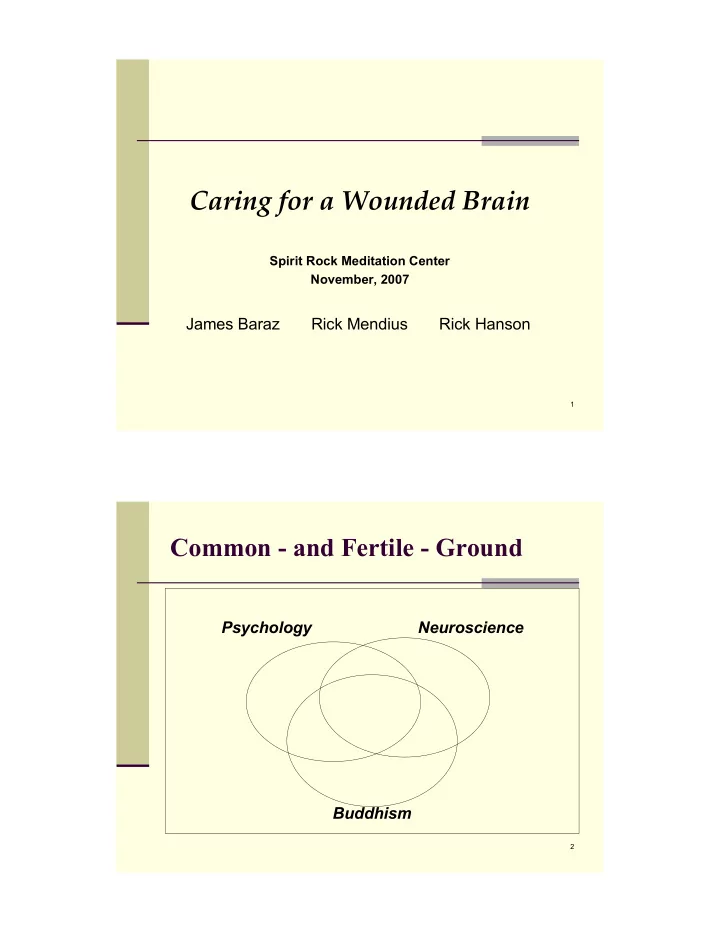
Common - and Fertile - Ground

Psychology Neuroscience Buddhism

slide-2
SLIDE 2

3

Heartwood

This spiritual life does not have gain, honor, and renown for its benefit, or the attainment of moral discipline for its benefit, or the attainment of concentration for its benefit, or knowledge and vision for its benefit. But it is this unshakable liberation of mind that is the goal of this spiritual life, its heartwood, and its end.

The Buddha

4

Plan for the Morning

 Laying the Foundation  Celebrating this Amazing Life  Your Wonderful Brain  The Biology of Suffering  Freedom from “the Second Dart”  Stories of Wounding, Refuge, and Letting Go

slide-3
SLIDE 3

5

Plan for the Afternoon

 Grief, Compassion, and Lovingkindness  How Practices Can Help Your Brain  Loving Midwifery of a New Self  The Long Road Ahead  Honoring the Community of Caregivers  Buddhist Practice with a Wounded Brain

6

Perspectives

 Exploring general ways to practice with

challenges, not treat specific ones

 Please do not change your treatment without

discussing it with your professional providers.

 On the frontiers of science; “see for yourself”  Take care of yourself; adapt this to your own

needs and interests.

slide-4
SLIDE 4

7

When the facts change, I change my mind. What do you do, sir?

John Maynard Keynes

8

Perspectives

 Exploring general ways to practice with

challenges, not treat specific ones

 Please do not change your treatment without

discussing it with your professional providers.

 On the frontiers of science; “see for yourself”  Take care of yourself; adapt this to your own

needs and interests.

slide-5
SLIDE 5

9

The root of Buddhism is compassion, and the root of compassion is compassion for oneself.

Pema Chodren

10

Activating the Parasympathetic

 Full breaths, especially exhalation  Deep relaxation  Balancing heart-rate variability; HeartMath  Mindfulness of the body  Yawning  Meditation  Fiddling with the lips

slide-6
SLIDE 6

11

Your Wonderful Brain

 Complexity  Speed  Activity  Evolution  Mind  Mind/Brain Integration  Natural State of the Brain

12

Complexity

 3 pounds, 1.1 trillion cells,100 billion neurons  Each neuron connecting to about 1000 other

neurons . . .Creating a network of about one hundred trillion synapses

 Number of possible states: 1 followed by a

million zeros

 Circular processes:

 Self-observation and self-regulation  Dynamic, unpredictable, “chaotic” behavior  Wandering stream of consciousness

slide-7
SLIDE 7

13

One Simple Neuron

14

Speed

 Neurons fire 5 - 50 times a second.  Millions, even billions, pulse in rhythmic

harmony with each other many times a second, creating electrical currents detected by EEG’s.

 During the sound of a clap, billions of synapses

activated in your brain.

 Most mental activity is lightning fast and forever

  • utside awareness.
slide-8
SLIDE 8

15

Activity

 In deep sleep or even a coma, the brain is

always “on,” keeping us alive and ready for action.

 The brain - about 2% of body weight -

consumes about 20% of the glucose and

  • xygen circulating in your blood.

16

Evolutionary History

The Triune Brain

slide-9
SLIDE 9

17

Evolution

 To build your brain, it has taken:

 3.5 billion years of life on this planet  650 million years of multi-celled animals  80 million years of mammals  10 million years of ape-like ancestors  2.7 million years of stone tool-using relatives  100,000+ years of our own species, homo sapiens

 The driving forces of brain evolution have been:

 Pair-bonding and raising young together  Cooperation in large primate social groups (20 - 300)  Refinements of human social intelligence (e.g., empathy,

language, emotional complexity)

18

Mind

 The mind is the reason for the brain.  “Mind” = flows of information within the brain  The brain moves information around like the

heart moves blood around.

 The standard neuropsychological view: Most, if

not all, subjective, immaterial states of mind have a 1:1 correspondence with objective, material states of brain.

 The mind is what the brain does.  Representations in mind are incomplete and

inaccurate - especially from a wounded brain

slide-10
SLIDE 10

19

Integration of Mind and Brain

 As your mind changes, your brain changes,

both temporarily and permanently.

“Neurons that fire together, wire together.”

 As your brain changes, your mind changes.  You can use your mind to change your brain to

benefit your whole being - and everyone else whose life you touch.

20

“Ardent, Resolute, Diligent, and Mindful”

slide-11
SLIDE 11

21

Natural State of Your Brain

 Awake  Parasympathetic nervous system activation  Pleasant, rewarding hormones and neurotransmitters:

Norepinephrine, oxytocin, dopamine, endorphins

 Openness to others  Large-scale coherence of billions of neurons firing

together in resonant harmony Aware, even-keeled, contented, benign, integrated

22

Sam sees “peeping among the cloud-wrack . . . a white star twinkle for a while. The beauty of it smote his heart, as he looked up out of the forsaken land, and hope returned to him. For like a shaft, clear and cold, the thought pierced him that in the end the Shadow was

  • nly a small and passing thing: there was

light and high beauty for ever beyond its reach.”

Tolkein, The Lord of the Rings

slide-12
SLIDE 12

23

Be wisdom itself, rather than a person who isn't wise trying to become wise. Trust in awareness, in being awake, rather than in transient and unstable conditions.

Ajahn Sumedho

24

Neuropsychology of Suffering

 Life requires many systems with many parts.  Systems in body, brain, relationships, planet  All need to maintain healthy balance: dynamic,

“within-range,” around a set-point.

 Imbalances embody threat and discomfort:

“dukkha,” suffering, stress: the First Dart

 Since environments are always changing

(impermanent), we are continually imbalanced, thus receiving First Darts; to live is to suffer.

 Wounds to the brain are imbalances in the

brain, a very intimate suffering.

slide-13
SLIDE 13

25

Community of the Wounded

Is it given to anyone to:

 Avoid disease?  Avoid old age?  Avoid death?  Avoid being separated ultimately, one way or

another, from everything they love?

 Avoid inheriting the results of their actions?

26

Neuropsychology of Second Darts

 Feeling tone: pleasant, unpleasant, neutral

 Approach/avoid/ignore (greed/hatred/delusion)  Amygdala and hippocampus

 Pleasant/unpleasant: SNS, stress hormones  Pleasure circuits (e.g., dopamine, oxytocin)

reward success

 Frontal lobe comments, conclusions, views

Very effective for survival - but Mother Nature does not care if we suffer.

slide-14
SLIDE 14

27

Second Dart Suffering

 The stress response feels . . . stressful.  In the body, chronic stress responses:

 Weaken immune and cardiovascular systems  Disturb gastrointestinal and hormone systems  Lower mood, oversensitize brain to negative

 In the mind, second darts “disturb the peace”  In relationships, they lead to over-reactions

which often become self-fulfilling.

28

Know the mind. Shape the mind. Free the mind.

slide-15
SLIDE 15

29

Breaking the Chain

 Contact . . . Feeling . . . Craving . . . Clinging

. . . Suffering

 The power of insight  Equanimity:

 Not reacting to our reactions  The Brahmavihara that is the foundation of the

  • thers: compassion, kindness, and joy

30

Monks, when the uninstructed worldling experiences a painful feeling, he sorrows, grieves, and laments; he weeps beating his breast and becomes distraught. He feels two feelings - a bodily one and a mental one. Suppose they were to strike a man with a dart, and then strike him immediately afterward with a second dart, so that the man would feel a feeling caused by two darts. So too, when the uninstructed worldling experiences a painful feeling, he feels two feelings - a bodily one and a mental one.

The Buddha, SN36:6

slide-16
SLIDE 16

31

In the deepest forms of insight, we see that things change so quickly that we can't hold onto anything, and eventually the mind lets go of clinging. Letting go brings equanimity. The greater the letting go, the deeper the equanimity. In Buddhist practice, we work to expand the range of life experiences in which we are free.

U Pandita

32

Story of a Wounding

Brain Injury Awareness Personal Reaction Presentation for Care Diagnosis Treatment Rehabilitation Recovery Survival Disability Death

slide-17
SLIDE 17

33

Suffering Our Wounds

We suffer helplessness. We suffer fear. We suffer loss of initiative, agency, personal power. We suffer our stress responses and tension. We suffer the loss of our self image, what no longer is. We suffer the loss of our future, and our history. We suffer the loss of our emotional balance. We suffer the loss of our abilities to speak, understand, and comprehend. We suffer feelings of dependence on others.

34

The Four Noble Truths

 There is suffering.  The cause of suffering is clinging.  Suffering ends with the end of clinging.  The way leading to the end of clinging is the

Noble Eightfold Path:

 Wise View, Intention, Speech, Livelihood, Action,

Effort, Mindfulness, and Concentration.

slide-18
SLIDE 18

35

Learning from Your Own Story

 What has happened? To you and to others?  What refuges have you found? What

sanctuaries and sources of wisdom and strength?

 What have you clung to that has increased your

suffering? Increased the suffering of others?

36

If you let go a little, you will have a little happiness. If you let go a lot, you will have a lot of happiness. If you let go completely, you will be completely happy.

Ajahn Chah

slide-19
SLIDE 19

37

A Serenity Prayer

May I find the serenity to accept the things that cannot be changed, the courage to change the things which should be changed, and the Wisdom to distinguish the one from the other. Living one day at a time, Enjoying one moment at a time, Accepting hardship as a pathway to peace, Taking this imperfect world as it is, Not as I would have it, Trusting in my refuges, May I be reasonably happy in this life, And supremely happy forever some day. Adapted from the Serenity Prayer, by Reinhold Niebuhr (1892-1971)

38

Indeed, the sage who's fully quenched Rests at ease in every way; No sense desire adheres to him or her Whose fires have cooled, deprived of fuel. All attachments have been severed, The heart's been led away from pain; Tranquil, he or she rests with utmost ease. The mind has found its way to peace.

The Buddha

slide-20
SLIDE 20

39

Wounds Open the Heart

 The necessity of grieving  Compassion and lovingkindness . . . For

  • neself . . . For benefactors . . . For neutral

people . . . For difficult people May you be safe. May you be healthy. May you be happy. May you live with ease.

40

Activating the Parasympathetic

 Full breaths, especially exhalation  Deep relaxation  Balancing heart-rate variability; HeartMath  Mindfulness of the body  Yawning  Meditation  Fiddling with the lips

slide-21
SLIDE 21

41

Positive Emotions

 Much more than a pleasant feeling:

 Promote energy, vigor, pep, aliveness  Counteract depression and anxiety  Support parasympathetic arousal  Increase resilience, and recovery from stress  Support strong relationships  Support physical health  Support contemplative practice

 Cultivate through meditation, Joy class, daily

gratitude practices, good company, etc. Happiness is skillful means.

42

Taking in the Good

 Cultivating wholesome qualities is central to

psychological growth and spiritual practice.

 It’s important to compensate for the hard-wired,

“negativity bias” of the brain.

 Four steps:

 Register positive events as positive experiences.  Savor and extend the experience.  Sense the experience sinking into oneself.  Imagine the current experience replacing old pain.

slide-22
SLIDE 22

43

Chop wood Carry water

44

With dewdrops dripping, I wish somehow I could wash this perishing world

Basho

slide-23
SLIDE 23

45

To study the Way is to study the self. To study the self is to forget the self. To forget the self is To be enlightened by all things.

Dogen

46

Selflessness is not a case of something that existed in the past becoming nonexistent. Rather, this sort of “self” is something that never did exist. What is needed is to identify as nonexistent something that always was nonexistent.

The Dalai Lama

slide-24
SLIDE 24

47

Wise Views

 All is not well, but all was not ever well before.  I am struggling with deficits and inner demons, but I

was struggling before, whether I saw them or not.

 Others are struggling with deficits and inner

demons, whether I see them or not.

 The struggle is always present, but there is always

this breath to attend to.

 People with obvious wounds know more fully than

most others how thin the ice is for all of us.

 The truths of existence are oftentimes more clearly

seen after injury than seen before.

48

No self, no problem

slide-25
SLIDE 25

49

Be still Listen to the stones of the wall Be silent, they try To speak your Name. Listen to the living walls. Who are you? Who Are you? Whose Silence are you?

Thomas Merton

50

All experience is Preceded by mind, led by mind, made by mind. Speak or act with a corrupted mind, And suffering follows, As the wagon wheel follows the hoof of the ox. All experience is Preceded by mind, led by mind, made by mind. Speak or act with a peaceful mind, And happiness follows, Like a never-departing shadow.

The Dhammapada (trans. by Gil Fronsdal)

slide-26
SLIDE 26

51

Acceptance, Recovery, Transcendence

 Recovery has its organic rhythms.  Acceptance and transcendence are always

possible.

 Behind all wounds is radiant being.

Knowing life is short, enjoy it day after day, moment after moment.

Suzuki Roshi

52

The Long Road Ahead

 Take it easy; take it slowly.  Be clear on what is, what you can and

cannot do, and hopeful about what you can do in the future.

 Honor the Divine Messengers.  Use forgiveness and humor.  Cultivate love and joy.  Draw on spiritual traditions and teachers

slide-27
SLIDE 27

53

Tending to the Causes

You can water the fruit tree - but you cannot make it produce apples. An attitude that is calming - and productive. Do all you can, with what you have, in the time you have, in the place where you are.

Nkosi Johnson

54

Wise Effort

Nurturing the causes of:

 The arising, increase, and continuance of the

wholesome

 The prevention, decrease, and fading away

  • f the unwholesome
slide-28
SLIDE 28

55

We who lived in concentration camps can remember those who walked through the huts comfortiing others, giving away their last piece

  • f bread.

They may have been few in number, but they offer sufficient proof that everything can be taken from a person but one thing: the last of human freedoms – to choose one’s attitude in any given set of circumstances – to choose one’s

  • wn way.

Viktor Frankl, Auschwitz survivor

56

Taking Refuge

 A “secure base,” respite, sanctuary, solace,

and support - the starting point of daily living

 In Buddhism, the Three Jewels:

 Buddha: Siddhartha, and the capacity for

wakefulness and freedom within everyone

 Dharma: the truth and the teachings of truth  Sangha: community, good company of guides

and fellow travelers  Other refuges: God, good times, feeling

loved, practice, awareness, insight, etc.

slide-29
SLIDE 29

57

Penetrative insight joined with calm abiding utterly eradicates afflicted states.

Shantideva

58

Honoring Our Caregivers

 Issues with giving and receiving care: guilt,

exhaustion, fear, dependence, etc.

 Empathy, cooperation are deep in our

  • nature. We all need to give and get care.

 Helping others to help us  Helping others enable us to help them  Caring for ourselves as the foundation of

caring for others; courage and regeneration

 Virtue - sila as the the basis of healthy

relationships

slide-30
SLIDE 30

59

Wisdom and Virtue

Wisdom is . . . all about understanding the underlying spacious and empty quality of the person and of all experienced phenomena. To attain this quality of deep insight, we must have a mind that is quiet and malleable. Achieving such a state of mind requires that we first develop the ability to regulate our body and speech so as to cause no conflict.

Venerable Tenzin Palmo

60

Neurologic Conditions Affecting Meditation

1) Language problems in expressing, understanding, reading, and writing 2) Nonverbal problems in neglect, lack of the whole picture (gestalt), localization in space, recognition of emotions 3) Problems in memory, including short-term and long-term recall, whether progressive or not 4) Problems in motor action and coordination 5) Problems in sensation 6) Problems in autonomic regulation 7) Changes in emotional balance and stability 8) Alterations in personality, impulsivity

slide-31
SLIDE 31

61

Adapting Contemplative Practice

Individualize Compassion Discipline Community Adapt Goals and Practices Nourish the Wholesome

62

Outstanding behavior, blameless action,

  • pen hands to all,

and selfless giving: This is a blessing supreme.

The Buddha