Capital Account Challenges for Partnerships and LLCs Tackling - - PowerPoint PPT Presentation

capital account challenges for partnerships and llcs
SMART_READER_LITE
LIVE PREVIEW

Capital Account Challenges for Partnerships and LLCs Tackling - - PowerPoint PPT Presentation

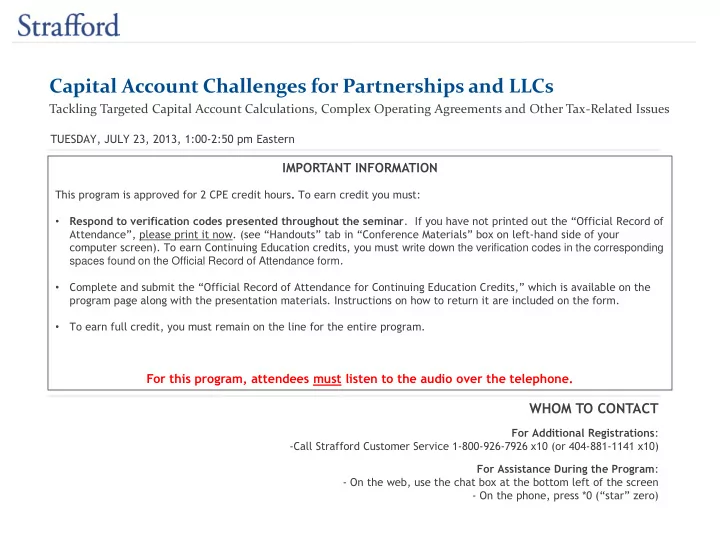
Capital Account Challenges for Partnerships and LLCs Tackling Targeted Capital Account Calculations, Complex Operating Agreements and Other Tax-Related Issues TUESDAY, JULY 23, 2013, 1:00-2:50 pm Eastern IMPORTANT INFORMATION This program is


slide-1
SLIDE 1

Capital Account Challenges for Partnerships and LLCs

Tackling Targeted Capital Account Calculations, Complex Operating Agreements and Other Tax-Related Issues

TUESDAY, JULY 23, 2013, 1:00-2:50 pm Eastern

WHOM TO CONTACT

For Additional Registrations:

  • Call Strafford Customer Service 1-800-926-7926 x10 (or 404-881-1141 x10)

For Assistance During the Program:

  • On the web, use the chat box at the bottom left of the screen
  • On the phone, press *0 (“star” zero)

IMPORTANT INFORMATION

This program is approved for 2 CPE credit hours. To earn credit you must:

  • Respond to verification codes presented throughout the seminar. If you have not printed out the “Official Record of

Attendance”, please print it now. (see “Handouts” tab in “Conference Materials” box on left-hand side of your computer screen). To earn Continuing Education credits, you must write down the verification codes in the corresponding spaces found on the Official Record of Attendance form.

  • Complete and submit the “Official Record of Attendance for Continuing Education Credits,” which is available on the

program page along with the presentation materials. Instructions on how to return it are included on the form.

  • To earn full credit, you must remain on the line for the entire program.

For this program, attendees must listen to the audio over the telephone.

slide-2
SLIDE 2

Tips for Optimal Quality

Sound Quality Call in on the telephone by dialing 1-866-869-6667 and enter your PIN when prompted, and view the presentation slides online. If you have any difficulties during the call, press *0 for assistance. You may also send us a chat or e-mail sound@straffordpub.com so we can address the problem. Viewing Quality To maximize your screen, press the F11 key on your keyboard. To exit full screen, press the F11 key again.

slide-3
SLIDE 3

Program Materials

If you have not printed or downloaded the conference materials for this program, please complete the following steps:

  • Click on the + sign next to “Conference Materials” in the middle of the left-hand column
  • n your screen.
  • Click on the tab labeled “Handouts” that appears, and there you will see a PDF of the

slides and the Official Record of Attendance for today's program.

  • Double-click on the PDF and a separate page will open.
  • Print the slides by clicking on the printer icon.
slide-4
SLIDE 4

Capital Account Challenges for Partnerships and LLCs

Gregory M. Levy, Kaufman Rossin & Co. glevy@kaufmanrossin.com July 23, 2013 Leo HItt, Reed Smith lhitt@reedsmith.com Telma Nadvorny, Ernst & Young telma.nadvorny@ey.com

slide-5
SLIDE 5

Today’s Program

General Overview [Telma Nadvorny] Traditional Layered Approach [Gregory M. Levy] Targeted Capital Account Approach [Leo Hitt] Slide 7 – Slide 29 Slide 43 – Slide 59 Slide 30 – Slide 42

slide-6
SLIDE 6

Notice

ANY TAX ADVICE IN THIS COMMUNICATION IS NOT INTENDED OR WRITTEN BY THE SPEAKERS’ FIRMS TO BE USED, AND CANNOT BE USED, BY A CLIENT OR ANY OTHER PERSON OR ENTITY FOR THE PURPOSE OF (i) AVOIDING PENALTIES THAT MAY BE IMPOSED ON ANY TAXPAYER OR (ii) PROMOTING, MARKETING OR RECOMMENDING TO ANOTHER PARTY ANY MATTERS ADDRESSED HEREIN.

You (and your employees, representatives, or agents) may disclose to any and all persons, without limitation, the tax treatment or tax structure, or both, of any transaction described in the associated materials we provide to you, including, but not limited to, any tax opinions, memoranda, or other tax analyses contained in those materials. The information contained herein is of a general nature and based on authorities that are subject to change. Applicability of the information to specific situations should be determined through consultation with your tax adviser.

slide-7
SLIDE 7

GENERAL OVERVIEW

Telma Nadvorny, Ernst & Young

slide-8
SLIDE 8

Slide 8

Partnership Allocations Overview

slide-9
SLIDE 9

Slide 9

Contrasting Basis And Capital Accounts

Outside tax basis Book capital accounts Tax capital accounts Increased by

 Tax basis of contributions  Share of taxable income  Share of partnership

liabilities

Increased by

 FMV of contributions  Share of book income

Increased by

 Tax basis of contributions  Share of taxable income

Decreased by

 Tax basis of distributions  Share of taxable loss

Decreased by

 FMV of distributions  Share of book loss

Decreased by

 Tax basis of distributions  Share of taxable loss

slide-10
SLIDE 10

Slide 10

Section 704 Overview

► Section 704(a): a partner’s share of tax items is determined by

partnership agreement

► Section 704(b): ensures that allocations of partnership items match

economics of deal (i.e., ensures each partner receives economic benefit or bears economic burden associated with allocations of income and deduction)

► Section 704(c): governs allocations of tax items related to property

that has a tax basis different from its §704(b) book value

► Section 704(d): partner is entitled to deduct allocated losses only to

extent of partner’s basis in his or her partnership interest at end of year

slide-11
SLIDE 11

Slide 11

Partnership Agreement: Starting Place For Partnership Allocations

► Includes all agreements ► Among all partners ► Between some partners ► Need not be called “partnership agreement” ► Can consist of more than one document ► May be oral or written ► Includes applicable non-tax law ► In case of hybrids (i.e., U.S. partnership, foreign corp.), should include

shareholders’ agreement

slide-12
SLIDE 12

Slide 12

Allocations Satisfy §704(b) If:

► Substantial economic effect ► Economic effect test requirements must be satisfied ► Allocations must be substantial ► Partners’ Interest in the Partnership (PIP) ► Deemed to be in accordance with PIP (e.g., nonrecourse deductions,

tax credits)

► Note: An allocation respected under §704(b) may nevertheless be

reallocated under another provision of the Internal Revenue Code (e.g., §482)

slide-13
SLIDE 13

Slide Intentionally Left Blank

slide-14
SLIDE 14

Slide 14

Three Tests For Economic Effect

► Primary test ► Alternate test for economic effect ► Economic equivalence test

slide-15
SLIDE 15

Slide 15

Economic Effect Test Requirements

► Primary test ► Capital account

maintenance

► Liquidation in accordance

with positive capital accounts

► Deficit restoration obligation

(DRO)

► Alternate test ► Capital account maintenance ► Liquidation in accordance with

positive capital accounts

► Loss allocation may not cause

  • r increase adjusted capital

account deficit

► Qualified income offset (QIO)

slide-16
SLIDE 16

Slide 16

Example 1, Stage 1: Capital Account Maintenance – In General

JV

Cash $200 FMV ATB Equipment $100 $40 Land 100 80 Total $200 $120

Money Co.

  • Op. Co.
  • Op. Co.

Book Tax Basis $200 $120 $120 Money Co. Book Tax Basis $200 $200 $200 $200 $200 $500 $200 $120 $120

► What are the partners’ book and tax capital accounts? Outside basis?

 What if JV borrowed $300 from Bank, with loan guaranteed by Money Co.?

slide-17
SLIDE 17

Slide 17

Example 1, Stage 2: Computing JV’s Book Depreciation

► Annual tax depreciation on the equipment is $10. What is

the annual book depreciation?

JV Money Co.

  • Op. Co.

Cash $200 FMV ATB Equipment $100 $40 Land 100 80 Total $200 $120

slide-18
SLIDE 18

Slide 18

Example 1, Stage 3: Reflecting Partnership Income/(Loss)

Year 1 Activity:

► Operating income - $40 ► Operating expenses - $240 ► Tax depreciation - $10; Book - $25 ► Long-term gain on sale of land - $20 ► Current distributions - $30 ► Assume all split 50-50

Equipment FMV=100 ATB=40

Money Co.

  • Op. Co.

50% 50%

Land FMV=100 ATB=80 Cash FMV=200 ATB=200

  • Op. Co.

Book Basis $200.0 $120.0 Money Co. Book Basis Beginning $200.0 $200.0 (100.0) (100.0)

  • Net. op. loss

(100.0) (100.0) (12.5) (0.0) Depreciation (12.5) (10.0) 0.0 20.0 Gain on sale 0.0 0.0 (15.0) (15.0) Distributions (15.0) (15.0) $72.5 $25.0 Ending $72.5 $75.0

JV

slide-19
SLIDE 19

Slide 19

Capital Account Maintenance: Revaluations Of Partnership Property

► Reasons needed: ► Maintain relative economic interests of the partners ► Prevent capital shifts ► Mandatory vs. optional ► Mandatory for property distributed to a partner ► Optional for all assets on contributions, distributions, and in

accordance with industry standards for securities partnerships

► Differences created between partners’ book and tax capital accounts;

must be taken into account under §704(c) principles

slide-20
SLIDE 20

Slide 20

Liquidating Distributions

► Must be made in accordance with the partners’ positive capital

account balances

► Determined after taking into account all capital account adjustments

for partnership taxable year during which liquidation occurs

► Generally, must be made by the earlier of: ► The end of the year of liquidation ► Ninety days following the date of liquidation

slide-21
SLIDE 21

Slide 21

Deficit Restoration Obligation

► Requires partner with deficit capital account balance upon liquidation

  • f his partnership interest to unconditionally restore the amount of

such deficit

► Actual DRO in partnership agreement

Or

► Deemed DRO ► State law requirements ► Promissory notes of partner or related entity that are

contributed to partnership

► Unconditional obligation to contribute ► Ultimate payor on partnership recourse debt ► Minimum gain

slide-22
SLIDE 22

Slide 22

Qualified Income Offset Provision

► In lieu of DRO required under primary test for economic effect,

alternate test requires that partnership agreement contain a QIO.

► Partnership agreement must provide that unexpected distributions

causing/increasing deficit balance in partner’s capital account will be eliminated as quickly as possible.

► Some agreements contain protective allocation provision to

prevent future deficit capital accounts by requiring the allocation of gross income to partner with deficit capital account balance at end

  • f any year (i.e., protective gross income allocation).

► Agreement must also restrict loss allocations so as not to cause or

increase adjusted capital account deficit.

slide-23
SLIDE 23

Slide 23

Substantiality

► An allocation is substantial “if there is a reasonable possibility that the

allocation will affect substantially the dollar amounts to be received by the partners from the partnership, independent of tax consequences.”

► Three general rules:

1. Intra-year shifting rule 2. Inter-year transitory allocation rule 3. Overall tax effect rule

slide-24
SLIDE 24

Slide 24

Shifting Allocations

► Taxable vs. tax-exempt income ► Ordinary income vs. capital gain ► Ordinary loss vs. capital loss ► Domestic vs. foreign source income ► Active vs. passive income (loss) ► Passive vs. portfolio income (loss)

slide-25
SLIDE 25

Slide Intentionally Left Blank

slide-26
SLIDE 26

Slide 26

Transitory Allocations

► Testing period: All tax years in which allocations may occur ► Hallmarks ► Aggregate tax reduction ► Minimal capital impact ► Exceptions ► Five-year waiting period ► Value equals basis rule

slide-27
SLIDE 27

Slide 27

Overall Tax Effect Rule

► Strikes down allocation if after-tax economic consequences of at least

  • ne partner may, in present value terms, be enhanced, and a strong

likelihood exists that after-tax consequences of no partner will, in present value terms, be substantially diminished (taking into account partners’ non-partnership tax attributes).

► Requires that projected after-tax economic results to each partner

under prescribed allocation scheme be compared to same after- tax economics that would result under allocation scheme if the allocations being tested were not included in the agreement.

► However, virtually no guidance as to the various factors that

should be considered in arriving at this “base-line” allocation is provided.

slide-28
SLIDE 28

Slide 28

Partner’s Interest in Partnership (PIP)

► Allocations failing either the economic effect or substantiality safe

harbors will be respected if the allocation is based on PIP

► Facts-and-circumstances test including: ► Relative contributions of partners ► Relative interests in distributions upon liquidation ► Relative interests in cash flow ► Relative interests in economic profit and loss sharing ratios

slide-29
SLIDE 29

Slide 29

Section 704(b) Recap

► To be respected, partnership allocations must: ► Have substantial economic effect ► Be in accordance with the partners’ interests in the partnership

Or

► Be deemed to be in accordance with the partners’ interests in the

partnership

► If allocations are not respected, income, loss, etc. will be allocated in

accordance with PIP rules.

slide-30
SLIDE 30

TRADITIONAL LAYERED APPROACH

Gregory M. Levy, Kaufman, Rossin & Co.

slide-31
SLIDE 31

Gregory M. Levy CPA

Contact Information: Glevy@KaufmanRossin.com 561.394.5100 www.kaufmanrossin.com

slide-32
SLIDE 32

Hedge Fund Tax Allocations: Discussion Topics

  • The basics of book and tax allocations
  • Examples of book/tax differences
  • Tax allocation methods
  • The aggregate method and break periods
  • Stuffing/fill-up

32

slide-33
SLIDE 33

Hedge Fund Tax Allocations: Basics Of Book And Tax Allocations

  • Two broad categories of income:

– Ordinary items (interest, dividends, operating expenses) – Capital items (realized gain/loss, change in unrealized appreciation(depreciation)

  • Book allocations – all items generally allocated pro

rata

33

slide-34
SLIDE 34

Hedge Fund Tax Allocations: Basics Of Book And Tax Allocations (Cont.)

  • Tax allocations – ordinary items generally allocated

pro rata

  • Capital items allocated IN CONCEPT so that partners

who are allocated unrealized gain/loss are allocated the realized gain/loss associated with the sale of such securities

  • TIMING generally drives book/tax differences

associated with allocation of capital items.

34

slide-35
SLIDE 35

Hedge Fund Tax Allocations: Examples Of Book/Tax Differences

  • Unrealized gain/loss
  • Tax realization before book realization

– Constructive sales, 1256 positions, OID

  • Tax realization after book realization

– Wash sales, straddles

  • Tax recharacterizations

– Foreign currency, market discount

35

slide-36
SLIDE 36

Hedge Fund Tax Allocations: Tax Allocation Methods

  • Layering
  • Aggregate
  • Full netting vs. partial netting
  • Layering:

– Involves allocating unrealized gain (loss) to each partner on a security-by-security basis – Very precise, can be cumbersome – Best done by a tax allocation software package

36

slide-37
SLIDE 37

Hedge Fund Tax Allocations: Tax Allocation Methods (Cont.)

  • Aggregate

– Allocates unrealized gain(loss) for all investments together (hence the name), rather than on a security-by-security basis – Introduces judgment, flexibility, subjectivity into the allocation process – Must meet criteria for use of aggregate method

37

slide-38
SLIDE 38

Hedge Fund Tax Allocations Tax Allocation Methods (Cont.)

  • Qualifications for aggregate method

– Management company, or investment partnership

  • 90% are qualified financial assets
  • Revaluations made annually
  • Allocations in accordance with capital

accounts

38

slide-39
SLIDE 39

Slide Intentionally Left Blank

slide-40
SLIDE 40

Hedge Fund Tax Allocations: Aggregate Method And Break Periods

  • Break period

– General definition – Impact on allocations – For capital allocations:

  • Each break period stands alone?
  • Can the taxable year override break periods?

40

slide-41
SLIDE 41

Hedge Fund Tax Allocations: Stuffing/Fill-Up

  • To stuff or not to stuff?
  • Stuff both gains and losses?
  • Stuff partial withdrawals?
  • Stuff long-term investors with short-term gains?
  • Stuff short-term investors with long-term gains?
  • Impact of ceiling rule?
  • Impact of American Job Creation Act of 2004 on

stuffing losses

41

slide-42
SLIDE 42

Hedge Fund Tax Allocations Stuffing/Fill-Up (Cont.)

  • Distributions in kind as a solution to stuffing issues

42

slide-43
SLIDE 43

TARGETED CAPITAL ACCOUNT APPROACH

Leo Hitt, Reed Smith

slide-44
SLIDE 44

Basic Structure Of Safe Harbor Provisions

  • The [g]old standard of allocations [tax practitioner’s view] is a “safe

harbor” allocation provisions.

  • Under IRC Section 704(a) and (b), allocations of partnership

income, gain, loss, deduction or credit between or among the partners are generally respected so long as the allocations to each partner:

  • (1) Are set forth in the partnership agreement, and
  • (2) Have substantial economic effect.
  • Otherwise, allocations will be made in accordance with the “partners’

interest in the partnership.”

Strafford Capital Account Challenges for Partnerships and LLCs

slide-45
SLIDE 45

Basic Structure Of Safe Harbor Provisions (Cont.)

  • Substantial economic effect
  • Basic test for economic effect - throughout the full term of the

partnership, the partnership agreement provides that:

  • Capital accounts are maintained in accordance with the

regulatory requirements.

  • Partnership liquidating distributions are required to be made in

accordance with the partners’ positive capital account balances (after liquidation year adjustments).

  • Any partner having a deficit in his or her capital account is

unconditionally obligated to restore the deficit no later than the end of the tax year, or, if later, within 90 days after the liquidation date (a “deficit restoration obligation”).

Strafford Capital Account Challenges for Partnerships and LLCs

45

slide-46
SLIDE 46

Basic Structure Of Safe Harbor Provisions (Cont.)

  • Substantial economic effect (Cont.)
  • Alternate test for economic effect
  • The partnership agreement must first satisfy the first two

requirements of the basic test.

  • The partnership agreement must contain a “qualified income
  • ffset” provision.
  • The allocation must not cause or increase a deficit balance in

the capital account of the partner receiving the allocation.

Strafford Capital Account Challenges for Partnerships and LLCs

46

slide-47
SLIDE 47

Basic Structure Of Safe Harbor Provisions (Cont.)

  • Substantial economic effect (Cont.)
  • Economic effect equivalence test
  • As of the end of each partnership tax year, a liquidation of the

partnership would produce the same economic results to the partners as if each requirement of the basic test were satisfied regardless of the partnership’s economic performance.

  • This test is made as of the end of each tax year of the

partnership.

  • This test is the heart of the argument that targeted capital

account allocations are compliant with the safe harbor regulations and is sometimes (unfortunately) known as the “dumb but lucky” rule.

Strafford Capital Account Challenges for Partnerships and LLCs

47

slide-48
SLIDE 48

Basic Structure Of Safe Harbor Provisions (Cont.)

  • Substantial economic effect (Cont.)
  • Substantiality
  • Even if an allocation has economic effect, as previously, it will

not be respected unless the economic effect of the allocation is “substantial.”

  • Is there a reasonable possibility that the allocation will

affect substantially the amounts the partners will receive from the partnership, independent of tax consequences?

  • The test includes an analysis of the after-tax economic

consequences to determine if one partner is benefited, while there is a strong likelihood that the after-tax economic consequences of no partner will, in present-value terms, be substantially diminished.

Strafford Capital Account Challenges for Partnerships and LLCs

48

slide-49
SLIDE 49

Targeted Capital Account Provisions

  • Approaches
  • Safe harbor approach: Draft the allocation and liquidation

provisions to rely on the basic or alternative economic effect

  • tests. The allocation provisions would be structured so that

capital accounts are intended to equal the agreed waterfall by the liquidation year.

  • The concern with this approach is that there may not be

enough tax attributes at the time of liquidation (see below for discussion of continuing versus liquidation year provisions), to accomplish the equalization.

  • If the agreement is safe harbor compliant, the distributions will

not follow the waterfall if there is a shortfall of tax attributes.

Strafford Capital Account Challenges for Partnerships and LLCs

49

slide-50
SLIDE 50

Targeted Capital Account Provisions (Cont.)

  • Approaches
  • Targeted capital account approach: Draft a distribution

waterfall (i.e., the partners’ economic deal) and then draft a simple allocation provision that provides:

  • Partnership profit or loss be allocated to cause the partners’

ending capital account balances to equal what they must be in

  • rder to liquidate the partnership in accordance with the

distribution waterfall

  • This causes each partner’s ending capital account balance to

be reduced to exactly zero by the partnership liquidating distribution).

Strafford Capital Account Challenges for Partnerships and LLCs

50

slide-51
SLIDE 51

Slide Intentionally Left Blank

slide-52
SLIDE 52

Targeted Capital Account Provisions (Cont.)

  • Approaches (Cont.)
  • Targeted capital account approach (Cont.)
  • This allocation provision is generally designed to satisfy the

economic effect equivalence test or be viewed as in accordance with the “partners’ interest in the partnership,” but if there’s a shortfall in tax attributes, the waterfall controls!

  • Many investors prefer this approach because of the certainty
  • f the sharing of liquidation proceeds and will accept the

inherent tax risk of this method.

  • As a practice tip, make sure that the investors know that this is

the choice that they have made in selecting the targeted capital account approach over a safe harbor provision.

Strafford Capital Account Challenges for Partnerships and LLCs

52

slide-53
SLIDE 53

Targeted Capital Account Provisions (Cont.)

  • Approaches (Cont.)
  • Comparison of targeted capital account approach versus

safe harbor approach

  • Cash is king, versus tax is king choice
  • The IRS has never specifically approved the targeted

capital account approach. Recent pronouncements indicate that guidance may be coming forth soon or at least that the IRS is feeling some pressure to do so.

  • Practitioners have been requesting guidance for years.
  • The targeted capital account provision is easy for the investor

to understand in concept but problematic for the tax return preparer to apply in practice, particularly with a continuing provision (see next slide).

Strafford Capital Account Challenges for Partnerships and LLCs

53

slide-54
SLIDE 54

Targeted Capital Account Provisions (Cont.)

  • Timing of targeted capital account provision
  • Year of liquidation provision: The allocations to cause capital

accounts to equal the waterfall is made only in the year of liquidation (and possibly at major capital transactions).

  • The primary advantage is simplicity, because it is a single

application of the deemed (or actual) sale approach and the balancing of capital accounts to achieve the target.

  • The primary disadvantage is that this approach greatly

increases the risk the IRS will view the allocations as being non-compliant with substantial economic effect regulations, and will reallocate income/loss in accordance with its view of the economic arrangement of the partners or members.

Strafford Capital Account Challenges for Partnerships and LLCs

54

slide-55
SLIDE 55

Targeted Capital Account Provisions (Cont.)

  • Timing of targeted capital account provision (Cont.)
  • Continuing provision: For each year, allocations will be made

as if there is a deemed sale of assets at Section 704(b) book value and a liquidation.

  • The primary advantage is an increased prospect of the

allocations being viewed as Section 704(b)-compliant.

  • The primary disadvantage is complexity and uncertainty. It

requires annual compliance with the complex capital account maintenance rules and dealing with the uncertainty associated with those rules.

Strafford Capital Account Challenges for Partnerships and LLCs

55

slide-56
SLIDE 56

Targeted Capital Account Provisions (Cont.)

  • Sample language
  • Distribution in liquidation:
  • Section [X.Y] Distributions in liquidation: In the event of a

Liquidation of the Company, distributions shall be made as follows: [Insert the agreed waterfall]. Such liquidating distributions shall be made in accordance with the timing rules set forth in Regs. Sec. 1.704-1(b)(2)(ii)(b)(2).

  • A sample waterfall – Liquidating distributions shall be made

as follows: first, to Partner A in an amount equal to Partner A’s contributions; second, to Partner B in an amount equal to Partner B’s contributions; and, thereafter, to Partner A and Partner B in their respective Percentage Interests.

Strafford Capital Account Challenges for Partnerships and LLCs

56

slide-57
SLIDE 57

Targeted Capital Account Provisions (Cont.)

  • Sample language (Cont.)
  • Allocation provision
  • Section [Y.X] Allocations: Partnership Profit or Loss [in each

taxable year / in the taxable year of Liquidation] shall be allocated in a manner to cause the Partners’ ending Capital Accounts to equal the amount they would receive if the Partnership were to sell all of its assets for Book Value and liquidate pursuant to Section [X.Y] of this Agreement.

  • If a “continuing” targeted allocation is adopted, this would be

the only allocation provision. If the year of liquidation approach is adopted, there would be other allocation provisions (e.g. in accordance with percentage interests) for all other years.

Strafford Capital Account Challenges for Partnerships and LLCs

57

slide-58
SLIDE 58

Targeted Capital Account Provisions (Cont.)

  • Open issues to be addressed
  • Treatment of capital shifts as a result of targeted capital account

provisions (compensatory interests and non-compensatory interests)

  • Treatment of preferred returns as guaranteed payments in

targeted capital account provisions

  • Nature of required support of conclusion that the allocations

comply with the economic effect equivalence test or are in accordance with the “partners’ interest in the partnership,” particularly if allocations are not strictly in proportion to partnership interests.

Strafford Capital Account Challenges for Partnerships and LLCs

58

slide-59
SLIDE 59

To ensure compliance with Treasury Department regulations, we inform you that, unless otherwise expressly indicated, any U.S. Federal tax advice contained herein was not intended or written to be used, and cannot be used, for the purpose of (1) avoiding tax- related penalties under the Internal Revenue Code or (2) promoting, marketing, or recommending to another party the tax-related matters addressed herein.

Strafford Capital Account Challenges for Partnerships and LLCs