Capacity Building for Market Players (CBM) Workshop GN-6: - - PowerPoint PPT Presentation

capacity building for market players cbm workshop
SMART_READER_LITE
LIVE PREVIEW

Capacity Building for Market Players (CBM) Workshop GN-6: - - PowerPoint PPT Presentation

FACILITATING THE IMPLEMENTATION OF THE IFSB STANDARDS FACILITATING THE IMPLEMENTATION OF THE IFSB STANDARDS FIS WORKSHOP SERIES FIS WORKSHOP SERIES Capacity Building for Market Players (CBM) Workshop GN-6: Quantitative Measures for Liquidity


slide-1
SLIDE 1

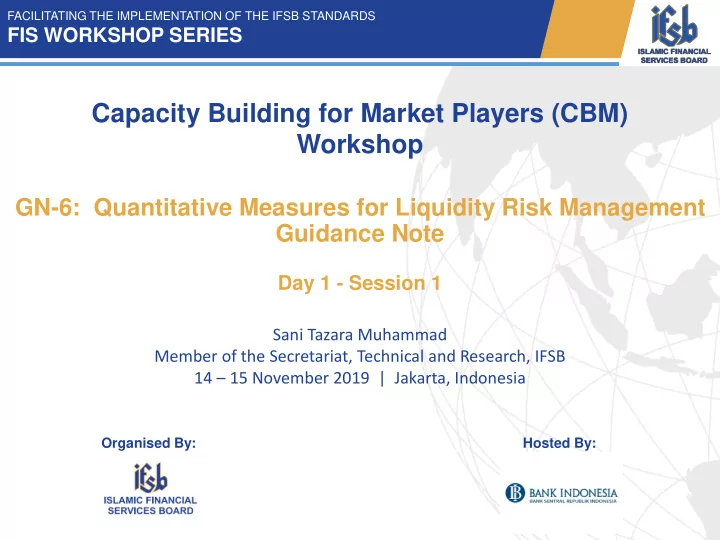
FACILITATING THE IMPLEMENTATION OF THE IFSB STANDARDS

FIS WORKSHOP SERIES

Capacity Building for Market Players (CBM) Workshop

Organised By: Hosted By:

FACILITATING THE IMPLEMENTATION OF THE IFSB STANDARDS
FIS WORKSHOP SERIES

GN-6: Quantitative Measures for Liquidity Risk Management Guidance Note

Day 1 - Session 1

Sani Tazara Muhammad Member of the Secretariat, Technical and Research, IFSB 14 – 15 November 2019 | Jakarta, Indonesia

slide-2
SLIDE 2

FACILITATING THE IMPLEMENTATION OF THE IFSB STANDARDS

FIS WORKSHOP SERIES

Outline of the Presentation

The Need for the GN-6 Application of the LCR in IIFS Definition and Categorisation of HQLA Operational Considerations for HQLA Infrastructure Issues in the Availability of Sharī`ah-compliant HQLA

slide-3
SLIDE 3

FACILITATING THE IMPLEMENTATION OF THE IFSB STANDARDS

FIS WORKSHOP SERIES

These specificities are fully taken into account in the calculation of ratios in this GN-6.

The lack of the interbank market for short-term fund generation The shortage or unavailability of Sharī`ah-compliant securities/Sukūk in many jurisdictions The unavailability of an Sharī`ah-compliant active trading or repurchase (repo) market The lack any form of a Sharī`ah-compliant lender-of-last-resort (SLOLR) and Sharī`ah- compliant deposit insurance scheme.

Market conditions Sharī`ah requirements Balance sheet structure

The Need for the GN-6

slide-4
SLIDE 4

FACILITATING THE IMPLEMENTATION OF THE IFSB STANDARDS

FIS WORKSHOP SERIES Objectives

  • To provide guidance on the application of global liquidity standards – LCR and NSFR- for

the IIFS, with suitable adjustments based on the specific operational characteristics;

  • to provide guidance to supervisory authorities on the application of the LCR and NSFR

in their jurisdictions

  • to delineate the disclosure requirements alongside the application of liquidity standards;

and

  • to present the templates of the LCR and NSFR

Scope

  • A minimum level of liquidity for IIFS for both full-fledged IIFS and Islamic windows of

conventional banks on an individual and a consolidated basis.

  • Supervisory authorities can extend the application of this GN to Islamic investment

banks and other financial institutions at their discretion.

Objectives and Scope of GN-6

slide-5
SLIDE 5

FACILITATING THE IMPLEMENTATION OF THE IFSB STANDARDS

FIS WORKSHOP SERIES

* Subject to Supervisory Authority Requirement

The objective of the LCR is to promote IIFS’s resilience against short-term liquidity shocks.

Liquidity Coverage Ratio (LCR)

To meet this requirement, an IIFS is obliged to have an adequate stock of unencumbered HQLA that can be converted easily and immediately into cash with no or little loss of value, in order to meet its liquidity needs for a 30- calendar-day period under a liquidity stress scenario.

slide-6
SLIDE 6

FACILITATING THE IMPLEMENTATION OF THE IFSB STANDARDS

FIS WORKSHOP SERIES

LCR =

Stock of Sharī`ah-compliant HQLA ≥ 100%* Total net cash outflows over the next 30 calendar days

  • The LCR requirement is based on a scenario that entails a combination of

idiosyncratic and market-wide shocks

IIFS are required to maintain the LCR at a level no lower than that required by the supervisory authority in both normal and financial stress times. However, IIFS may use, with approval from the relevant supervisory authority, their stock

  • f HQLA during stress

conditions in order to minimise the negative impact of the crisis.

* Subject to Supervisory Authority Requirement

Total net cash outflows over the next 30 calendar days = Total gross expected cash outflows – Lesser

  • f (total expected cash inflows; 75% of total expected cash outflows)

Formula for Calculating LCR

slide-7
SLIDE 7

FACILITATING THE IMPLEMENTATION OF THE IFSB STANDARDS

FIS WORKSHOP SERIES

Such as liquidity risk, market risk, credit risk, foreign exchange risk, and legal and operational risk including Sharī`ah non- compliance risk

  • Central banks should consider

Sharī`ah-compliant securities that they accept as eligible collateral.

  • This requirement has to be

fulfilled at all times, including during an underlying stress scenario.

  • Particularly in terms of low risk,

ease and certainty of valuation, and low volatility. Fundamental and market- related characteristics

Low correlation with risky assets, an active and sizeable market, and low volatility

Consideration

  • f the inherent

risk of HQLA by Supervisory Authorities Eligible for intraday and

  • vernight

liquidity facilities

Definition of High Quality Liquid Assets (HQLA)

HQLA are defined as assets unencumbered by liens and other restrictions on transfer which can be converted into cash easily and immediately, with no or little loss of value, including under the stress scenario. The assets are required to meet fundamental and market-related characteristics.

slide-8
SLIDE 8

FACILITATING THE IMPLEMENTATION OF THE IFSB STANDARDS

FIS WORKSHOP SERIES

  • Level 1
  • Level 2A
  • Level 2B
  • ALA treatments (if any)

Components of HQLA

  • Cash outflows
  • Retail Deposits and PSIA
  • Unsecured Wholesale Funding
  • Secured Funds
  • Sharī`ah-compliant hedging instruments
  • CMT-based Deposits
  • Sharī`ah-compliant Interbank Contracts
  • Cash Inflows
  • Secured financing
  • Inflow from committed facilities
  • Inflow from various counterparties

Components of Total Net Cash Outflows

Formula of LCR

Application of LCR in IIFS

slide-9
SLIDE 9

FACILITATING THE IMPLEMENTATION OF THE IFSB STANDARDS

FIS WORKSHOP SERIES

Stock of high- quality liquid assets (HQLA) Expected net cash outflows

(next 30 days) Outflows minus inflows

LCR =

Level 1 – 0% haircut* Sovereign/central bank issuances, central bank reserves, coins and banknotes Level 2 Level 2A : 15% haircut Securities issued by entities with a 20% risk-weight, corporate sukuk rated AA- and above Level 2B : 25-50% haircut Corporate sukuk rated between A+ and BBB-, RMBS, common equity shares

  • ‘Run-off rates’ are prescribed to calculate expected cash
  • utflows in a stress scenario**
  • Expected cash inflows are subject to a cap of 75% of total

expected cash outflows

  • Includes both on and off-balance sheet risks

≤ 40%

  • f total

HQLA

 the run-off of a proportion of retail funding, including current accounts, UPSIA, RPSIA, and other accounts;  a partial loss of unsecured wholesale funding capacity;  a partial loss of secured, short-term financing with certain collateral and counterparties  additional contractual outflows that would arise from a downgrade in the IIFS’s public credit rating by up to and including three notches, including additional collateral posting requirements;  increases in market volatilities that impact the quality of collateral or potential future exposure of Sharī`ah-compliant hedging positions and thus require larger collateral haircuts or additional collateral  unscheduled draws on committed but unused credit and liquidity facilities  the potential need for the IIFS to buy back or honour contractual and non-contractual obligations for the purpose of mitigating reputational risk.

Stress Scenario

Formula for Calculating LCR (2)

slide-10
SLIDE 10

FACILITATING THE IMPLEMENTATION OF THE IFSB STANDARDS

FIS WORKSHOP SERIES

Level 1 Level 2A Level 2B

Assets which qualify as HQLA should have certain fundamental and market-related characteristics, particularly in terms of low risk, ease and certainty of valuation, and low volatility

  • Sharī`ah-compliant securities that may serve as HQLA are unlikely to have a well-established history of trading

in liquid secondary markets

  • The GN-6 proposes that central banks should consider according HQLA status to Sharī`ah-compliant securities

that they accept as eligible collateral, up the limit of the liquidity facility that they would accord to the IIFS holding such securities on the basis of such collateral.

Fundamental Characteristics

  • High credit rating of the

instruments or issuer

  • Easy to value
  • Preferably listed
  • Sharī`ah-compliant

Market – Related Characteristics

  • Liquefiable at all times
  • Historical evidence of market

breadth and market depth

  • High trading volumes
  • Stable asset prices even in stress

times

  • Large, active and deep Sharī`ah-

compliant repo market

Sharī`ah-compliant Instruments that Meet the Requirements for HQLA

slide-11
SLIDE 11

FACILITATING THE IMPLEMENTATION OF THE IFSB STANDARDS

FIS WORKSHOP SERIES

FACILITATING THE IMPLEMENTATION OF THE IFSB STANDARDS

FIS WORKSHOP SERIES

Item Amount Factor Total

Coins and banknotes 100% Qualifying central bank reserves Qualifying Sukūk and other Sharī`ah-compliant marketable securities issued or guaranteed by sovereigns, central banks, public-sector entities (PSEs), multilateral development banks or relevant international

  • rganisations assigned a 0% risk weight for credit risk

under IFSB-15 Qualifying domestic currency Sukūk and other Sharī`ah- compliant marketable securities issued by sovereign or central banks that have a non-0% risk weight Qualifying foreign currencies’ Sukūk and other Sharī`ah- compliant marketable securities issued by sovereign or central banks that have a non-0% risk weight

  • A. Level 1 Assets

Sharī`ah-compliant Instruments that Meet the Requirements for HQLA

slide-12
SLIDE 12

FACILITATING THE IMPLEMENTATION OF THE IFSB STANDARDS

FIS WORKSHOP SERIES

FACILITATING THE IMPLEMENTATION OF THE IFSB STANDARDS

FIS WORKSHOP SERIES

Item Amount Factor Total

Sharī`ah-compliant marketable securities issued or guaranteed by sovereigns, central banks, PSEs, multilateral development banks or relevant international

  • rganisations, qualifying for a 20% risk weighting for

credit risk under IFSB-15. 85% Qualifying Sharī`ah-compliant securities (including commercial paper) and Sukūk that satisfy all of the conditions

  • B. Level 2A Assets: (maximum of 40% of HQLA)

Sharī`ah-compliant Instruments that Meet the Requirements for HQLA

slide-13
SLIDE 13

FACILITATING THE IMPLEMENTATION OF THE IFSB STANDARDS

FIS WORKSHOP SERIES

FACILITATING THE IMPLEMENTATION OF THE IFSB STANDARDS

FIS WORKSHOP SERIES

Item Amount Factor Total

Qualifying Sukūk and other Sharī`ah-compliant securities 75% Qualifying Sharī`ah-compliant equity shares not issued by financial institutions 50% Qualifying other Sharī`ah-compliant liquidity instruments that are widely recognised in the jurisdictions of the home country 50%

  • C. Level 2B Assets: (maximum of 15% of HQLA)

Sharī`ah-compliant Instruments that Meet the Requirements for HQLA

slide-14
SLIDE 14

FACILITATING THE IMPLEMENTATION OF THE IFSB STANDARDS

FIS WORKSHOP SERIES

Max 40%

Sharī`ah-Compliant HQLA Stock

Level 1

Level 2B Level 2A Haircuts

100% 15% 50% 25% Qualifying Sukūk backed by commodity(ies) and other real asset(s) (min AA) Sharī`ah- compliant equity shares, other qualifying Sukūk (A+ to BBB). Cash CB reserves, Qualifying Sukūk issued or guaranteed by sovereign, MDBs and relevant international

  • rganizations (0% risk weight

under IFSB-15) and Sukūk in domestic and foreign currency issued by home jurisdiction’s sovereign and central bank. Qualifying Sukūk issued or guaranteed by sovereigns, central banks, PSEs, MDBs or relevant international

  • rganisations (20% risk weight

under IFSB-15) and Sukūk issued by non-financial institutions (min AA-), etc. Max 15%

Categorisation of HQLA

slide-15
SLIDE 15

FACILITATING THE IMPLEMENTATION OF THE IFSB STANDARDS

FIS WORKSHOP SERIES

Assets meeting the fundamental and market-related characteristics cannot automatically be recognised as HQLA. The assets are subject to operational requirements that are designed to ensure that the stock of HQLA is managed in such a way that an IIFS can convert into cash through Sharī`ah-compliant mechanisms with no restriction on the use of the liquidity generated.

  • All assets included in HQLA should meet the requirement to be unencumbered.
  • The stock should be under the control of the IIFS’s liquidity risk management function.
  • IIFS should mitigate market and rate of return risk associated with ownership of the stock
  • f HQLA.
  • Any surplus of HQLA held by a legal entity within a group can be included at the

consolidated level only if those assets would also be freely available to the consolidated (parent) entity in times of stress.

  • An IIFS should develop and implement procedures, systems and controls that enable

it to determine the stock of HQLA.

  • An IIFS should periodically monetise a representative proportion of the assets in its

stock of HQLA.

Operational Considerations for HQLA

slide-16
SLIDE 16

FACILITATING THE IMPLEMENTATION OF THE IFSB STANDARDS

FIS WORKSHOP SERIES

Infrastructure Issues

This GN acknowledges that it is difficult for IIFS to find liquid instruments that can meet the definition and operational requirements of HQLA. While some Sharī`ah-compliant instruments meet most of the fundamental characteristics of HQLA, they may not fulfil the criteria with regard to market-related characteristics. Although some Sharī`ah-compliant assets may be less risky than many conventional instruments, such assets are as yet untested during stress conditions. IIFS tend to have high holdings of liquid assets due to the absence of a reliable Sharī`ah-compliant lender-of-last-resort (LOLR) facility that is key to meeting short-term obligations when there is a liquidity disruption. Sharī`ah-compliant deposit insurance is another area which needs the attention of supervisory authorities to improve the “stability” of the deposits and UPSIA, and to reduce the risk of withdrawals on the occurrence of adverse idiosyncratic or systemic events.

Infrastructure Issues in the Availability of Sharī`ah-compliant HQLA

slide-17
SLIDE 17

FACILITATING THE IMPLEMENTATION OF THE IFSB STANDARDS

FIS WORKSHOP SERIES

Option 3 – Additional use of Level 2 assets with a higher haircut:

Option 3 is available for jurisdictions where there are insufficient Level 1 assets, as determined through a supervisory liquidity review process (SLRP), but where there are sufficient Level 2A assets.

Option 2 – Foreign currency HQLA to cover domestic currency liquidity needs:

Sukūk issued by MDBs, as well as other international Islamic infrastructure institutions such as the Islamic Development Bank (IDB) and the IILM fall under this category.

Option 1 – Contractual committed liquidity facilities from the relevant central bank, with a fee:

The facility can be constructed by using a Wakālah, Muḍārabah or Commodity Murābahah Transaction (CMT) contract, or any other or a combination of various Sharī`ah-compliant contracts.

Insufficient HQLA? …

HQLA Available

ALA

Required HQLA

ALA Treatments for IIFS

slide-18
SLIDE 18

FACILITATING THE IMPLEMENTATION OF THE IFSB STANDARDS

FIS WORKSHOP SERIES

Questions?

slide-19
SLIDE 19

FACILITATING THE IMPLEMENTATION OF THE IFSB STANDARDS

FIS WORKSHOP SERIES

Capacity Building for Market Players (CBM) Workshop

Organised By: Hosted By:

Thank you

FACILITATING THE IMPLEMENTATION OF THE IFSB STANDARDS

FIS WORKSHOP SERIES

Sani Tazara Muhammad Member of the Secretariat, Technical and Research, IFSB sani@ifsb.org