Dilepton measurements with CBM Volker Friese v.friese@gsi.de CBM - - PowerPoint PPT Presentation

dilepton measurements with cbm
SMART_READER_LITE
LIVE PREVIEW

Dilepton measurements with CBM Volker Friese v.friese@gsi.de CBM - - PowerPoint PPT Presentation

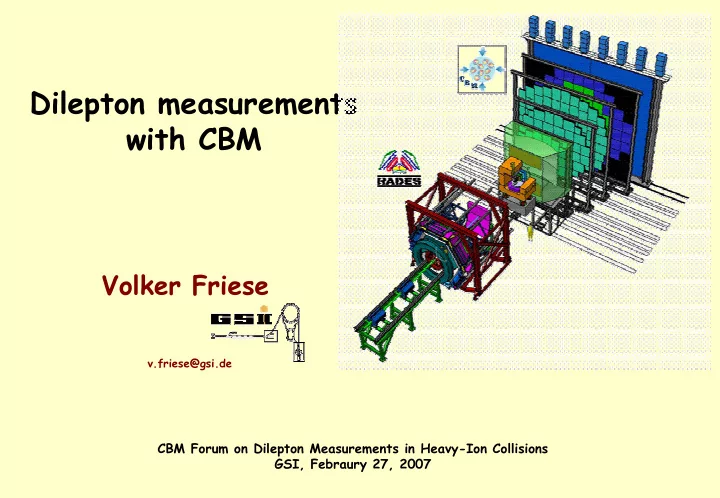
Dilepton measurements with CBM Volker Friese v.friese@gsi.de CBM Forum on Dilepton Measurements in Heavy-Ion Collisions GSI, Febraury 27, 2007 The CBM Experiment "Standard" setup with electron detectors Volker Friese

slide-1
SLIDE 1

Dilepton measurements with CBM

Volker Friese

v.friese@gsi.de

CBM Forum on Dilepton Measurements in Heavy-Ion Collisions GSI, Febraury 27, 2007

slide-2
SLIDE 2

Volker Friese CBM Forum, GSI, February 2007 2

The CBM Experiment

"Standard" setup with electron detectors

slide-3
SLIDE 3

Volker Friese CBM Forum, GSI, February 2007 3

CBM : Overview of Observables

  • Identified hadrons (π, K, p)

STS + TOF

  • Hyperons (Λ, Ξ, Ω)

STS (+ TOF)

  • Open charm (D0, D±)

STS (+ TOF)

  • Direct photons

ECAL

  • Charmonium (ψ, ψ')

STS + RICH + TRD

  • Low-mass vector mesons

STS + RICH (+ TRD + TOF)

  • Charmonium (ψ, ψ')

STS + MuCH (+ TRD + TOF)

  • Low-mass vector mesons

STS + MuCH (+ TRD + TOF) spectra, yields flow fluctuations from p+p to Pb+Pb from 10 AGeV to 35 (45) AGeV

slide-4
SLIDE 4

Volker Friese CBM Forum, GSI, February 2007 4

Measuring Electron Pairs with CBM

  • electron identification

– RICH ( - 12 GeV) – TRD (1 GeV - )

  • background

– mis-identified hadrons – Dalitz decays – γ conversion pairs

  • no electron identification before the

magnetic field suppression of electronic background non-vertex: by tracking for charmonium: single electron pt for LVM: dedicated cut strategy for rejection of conversion and Dalitz

slide-5
SLIDE 5

Volker Friese CBM Forum, GSI, February 2007 5

Electron Identification in RICH

Ring finding efficiency vs. momentum Pattern recognition in the PM plane

slide-6
SLIDE 6

Volker Friese CBM Forum, GSI, February 2007 6

Electron Identification in RICH

ring radius vs. momentum composition of tracks identified as electrons (UrQMD events)

slide-7
SLIDE 7

Volker Friese CBM Forum, GSI, February 2007 7

Improvement of Electron ID by TRD and TOF

RICH-identified electrons RICH and TRD-identified electrons

slide-8
SLIDE 8

Volker Friese CBM Forum, GSI, February 2007 8

Pion Suppression and Electron Efficiency

p [GeV]

slide-9
SLIDE 9

Volker Friese CBM Forum, GSI, February 2007 9

Background topology for LVM

− +

→ e e ρ

Global Track

− +

→ e e γ π 0

Track Segment

− +

→ e e

medium

γ Track Fragment

s i g n a l

f a k e p a i r

Track Fragment - x, y position; no charge information Track Segment

  • reconstructed track

Global Track

  • identified in RICH
slide-10
SLIDE 10

Volker Friese CBM Forum, GSI, February 2007 10

LVM: Efficiency of cuts, S/B ratio

π0-Dalitz region Enhancement region

ω/φ region

ε

Rejection of background from Dalitz and conversion by cuts on distance to closest neighbour pair opening angle pair invariant mass single electron pt

S/B

slide-11
SLIDE 11

Volker Friese CBM Forum, GSI, February 2007 11

LVM: Current Status

identified electrons after background rejection

π0 ω η ρ ω φ

Results include full event reconstruction and electron identification

slide-12
SLIDE 12

Volker Friese CBM Forum, GSI, February 2007 12

LVM: Phase Space Coverage

after all cuts good mid-rapidity coverage

yCM

slide-13
SLIDE 13

Volker Friese CBM Forum, GSI, February 2007 13

Charmonium in the Di-electron channel

)

2

( GeV/c

inv

m 2.6 2.8 3 3.2 3.4 3.6 3.8 4 pairs / 10 20 30 40 50 )

2

( GeV/c

inv

m 2.6 2.8 3 3.2 3.4 3.6 3.8 4 pairs / 50 100 150 200 250 300 350 )

2

( GeV/c

inv

m 2.8 3 3.2 3.4 3.6 3.8 4 pairs / 1 2 3 4 5 6 7 8

35 AGeV

4 x 10⁸ events

25 AGeV

1010 events

15 AGeV

2.5 x 10⁹ events

Results for central Au+Au collisions J/ψ yield from HSD Full event reconstruction and electron identification in RICH and TRD Single electron pt > 1.2 GeV

slide-14
SLIDE 14

Volker Friese CBM Forum, GSI, February 2007 14

Measuring Muons with CBM

Replace RICH by absorber- detector system different absorber concepts under study "Compact" design with 5 Fe absorbers and 15 detector layers

slide-15
SLIDE 15

Volker Friese CBM Forum, GSI, February 2007 15

Muon Option: Results for LVM

signals:

  • ρ
  • ω
  • φ
  • η
  • ηDalitz

background

background+signals

Results include full tracking through STS and absorbers Muons are identified after the last absorber

slide-16
SLIDE 16

Volker Friese CBM Forum, GSI, February 2007 16

LVM: Efficiency and Phase Space

Signal efficiency vs. inv. mass Rapidity coverage Mid-rapidity coverage can be improved by allowing "soft tracks" (crossing 4 of 5 absorbers)

slide-17
SLIDE 17

Volker Friese CBM Forum, GSI, February 2007 17

Charmonium in the Di-Muon Channel

2

GeV/c

inv

m

2.8 3 3.2 3.4 3.6 3.8

Entries

1 10

2

10

S/B = 100 = 20 MeV σ ψ J/

High momentum of charmonium daughters allows a clean identification High quality signal expected

slide-18
SLIDE 18

Volker Friese CBM Forum, GSI, February 2007 18

Muon Measurement: Detector Issues

Very high hit rates after first absorber Coordinate resolution ≈ 100 µm required for tracking through the absorber system Possible solutions GEM / micromegas / MWPC depending

  • n station number / distance from

beam

slide-19
SLIDE 19

Volker Friese CBM Forum, GSI, February 2007 19

Summary

  • Both electron and muon option give access to low-mass vector

mesons and charmonium

  • Feasibility studies are based on full event reconstruction and

electron / muon identification. They are still subject to further

  • ptimisation.
  • Performance on low-mass VM is similar for electrons and muons;

mid-rapidity coverage is more difficult for muons

  • Performance on charmonium is better for muons: higher

charmonium states probably not measurable with electrons

  • Electron measurements rely on established detector technology

(RICH, TRD)

  • Detector issues for muon measurements not yet solved