Canadian Advertising and Competition Law: Compliance Strategies - - PowerPoint PPT Presentation

canadian advertising and competition law compliance
SMART_READER_LITE
LIVE PREVIEW

Canadian Advertising and Competition Law: Compliance Strategies - - PowerPoint PPT Presentation

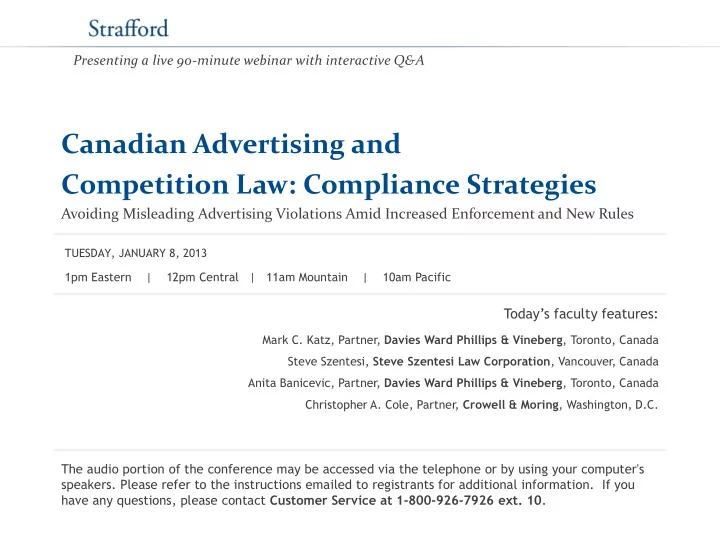
Presenting a live 90-minute webinar with interactive Q&A Canadian Advertising and Competition Law: Compliance Strategies Avoiding Misleading Advertising Violations Amid Increased Enforcement and New Rules TUESDAY, JANUARY 8, 2013 1pm


slide-1
SLIDE 1

Canadian Advertising and Competition Law: Compliance Strategies

Avoiding Misleading Advertising Violations Amid Increased Enforcement and New Rules

Today’s faculty features:

1pm Eastern | 12pm Central | 11am Mountain | 10am Pacific

The audio portion of the conference may be accessed via the telephone or by using your computer's

  • speakers. Please refer to the instructions emailed to registrants for additional information. If you

have any questions, please contact Customer Service at 1-800-926-7926 ext. 10.

TUESDAY, JANUARY 8, 2013

Presenting a live 90-minute webinar with interactive Q&A

Mark C. Katz, Partner, Davies Ward Phillips & Vineberg, Toronto, Canada Steve Szentesi, Steve Szentesi Law Corporation, Vancouver, Canada Anita Banicevic, Partner, Davies Ward Phillips & Vineberg, Toronto, Canada Christopher A. Cole, Partner, Crowell & Moring, Washington, D.C.

slide-2
SLIDE 2

Tips for Optimal Quality

Sound Quality If you are listening via your computer speakers, please note that the quality of your sound will vary depending on the speed and quality of your internet connection. If the sound quality is not satisfactory and you are listening via your computer speakers, you may listen via the phone: dial 1-866-370-2805 and enter your PIN when prompted. Otherwise, please send us a chat or e-mail sound@straffordpub.com immediately so we can address the problem. If you dialed in and have any difficulties during the call, press *0 for assistance. Viewing Quality To maximize your screen, press the F11 key on your keyboard. To exit full screen, press the F11 key again.

slide-3
SLIDE 3

Continuing Education Credits

For CLE purposes, please let us know how many people are listening at your location by completing each of the following steps:

  • In the chat box, type (1) your company name and (2) the number of

attendees at your location

  • Click the word balloon button to send

FOR LIVE EVENT ONLY

slide-4
SLIDE 4

Canadian Advertising and Competition Law: Compliance Strategies

Anita Banicevic & Mark Katz – Davies Ward Phillips & Vineberg LLP Christopher Cole – Crowell & Moring LLP Steve Szentesi – Steve Szentesi Law Corporation

slide-5
SLIDE 5

5

Agenda

  • Key Elements of Misleading Representations
  • Canadian Competition Bureau Enforcement and Trends
  • Key Differences and Similarities between US/Canada
  • Best Practices: Managing and Mitigating Risk

– General best practices – Performance claims – Price claims – Ordinary selling price provisions – On-line advertising and social media – Promotional contests – Anti-spam legislation

slide-6
SLIDE 6

Misleading Representations Key Elements

slide-7
SLIDE 7

7

Misleading Representations: Key Elements

  • Criminal and civil misleading representations provisions

(52, 74.01)

  • Prohibit representations to the public that are materially

false or misleading

  • Promotion of product or business interest
  • Need to assess literal meaning and general impression
  • Includes print, oral, Internet, social / new media claims
  • Bureau generally proceeds civilly (but criminal charges

possible)

  • Bureau enforcement priority
slide-8
SLIDE 8

8

Misleading Representations: Key Elements

  • In addition to general misleading representation provisions,

Competition Act also regulates or prohibits:

– Deceptive telemarketing, double ticketing, multi-level marketing, pyramid selling schemes, performance claims, ordinary selling price claims, bait and switch selling, sales above advertised price, misleading/unauthorized tests/testimonials, promotional contests

  • Penalties

– Administrative monetary penalties (AMPS) up to $10 million – Restitution (compensation for consumers) – Corrective notices – Imprisonment (criminal) – Civil / class actions are also likely (ss. 36, 52)

slide-9
SLIDE 9

Competition Bureau Enforcement and Trends

slide-10
SLIDE 10

10

Misleading Representations an Enforcement Priority

  • "Continued area of concern" for Bureau
  • Closely watching several industries
  • Fits with Commissioner's previously stated "relevance"

agenda

  • Strategy of active enforcement, including litigation

combined with more active monitoring of settlements

  • No new written guidance provided or expected in near term

– guidance through enforcement

  • Recent signals by Interim Commissioner that could be

more criminal enforcement

slide-11
SLIDE 11

11

What's Hot at the Bureau

  • Price advertising

– "All-in" pricing – Additional fees disclosed in fine print

  • Disclosure in digital marketplace

– Competition Bureau has stated e-commerce area "ripe for more work" – Bureau participated in recent sweep of e-commerce sites with ICPEN for disclosure issues

  • Performance and comparative claims
  • Green and health claims
  • Administrative monetary penalties

– Repeatedly asking for highest maximum penalties – Constitutionality has been questioned

slide-12
SLIDE 12

12

Recent Bureau Statements

  • Interim Commissioner (2012)

– "… we will continue to listen to Canadian consumers' concerns and investigate in strategic areas"

  • Former Commissioner (2012)

– "In [recent] challenges … we have signaled how importantly we regard misleading advertising by seeking the maximum Administrative Monetary Penalties now available"

  • Fair Business Practices Branch (2012)

– "You may want to review advertising to ensure that clients are not relying on fine print to contradict the general impression of the advertisement as a

  • whole. This is especially important when developing advertisements viewed
  • n mobile devices."
slide-13
SLIDE 13

13

Recent Enforcement Activity

  • Bell Canada (negotiated resolution)

– All-in pricing / "hidden" fees – Bell agreed to pay $10 million penalty

  • Beiersdorf Canada Inc. / NIVEA (negotiated resolution)

– Performance claims / enforcement of consent agreement – Beiersdorf agreed to pay $300,000 penalty

  • Rogers Communications Inc. (contested)

– Performance claims regarding dropped calls – Bureau seeking maximum monetary penalties and restitution – Proceedings are ongoing

slide-14
SLIDE 14

14

Recent Enforcement Activity (Cont'd)

  • Business Directory Case (contested)

– Subscription obligation in fine print / passing off as Yellow Pages – Bureau proceeded under civil provisions – Court ordered corporate penalties totalling $8 million – Individual penalties of $500,000 for each of two principals – Restitution also ordered – Important reminder that misleading representation provisions apply to promotion of any business interest

  • Premium Texting (contested)

– Proceedings brought against Bell, Telus, Rogers and CWTA – Commissioner suing carriers and industry association for "permitting" representations of others – Commissioner seeking > $30 million in administrative monetary penalties – Significant potential ramifications for wireless and mobile commerce industry

slide-15
SLIDE 15

15

Other Relevant Decisions

  • Richard v. Time Inc. (S.C.C.) Feb. 2012

– Complaint under Quebec consumer protection legislation regarding direct mail solicitation – Commercial solicitations assessed from perspective of "credulous and inexperienced consumer" not from perspective of careful and diligent consumer – A single reading of entire text should provide general impression – Format of advertisement (incl. pictures and font size) will be part of forming general impression – Possible implications:

  • Should not assume sophisticated consumers
  • Bureau has taken position in contested proceeding that this "credulous and

inexperienced" standard applies under Competition Act

slide-16
SLIDE 16

16

Lessons and Implications

  • Aggressive enforcement stance

– High profile cases/industries; media coverage; large penalties; attracts attention of private and class plaintiffs

  • Coordinated enforcement with other jurisdictions
  • Use of enforcement discretion varies; unpredictable
  • Reliance on civil consent agreements

– Strict compliance monitoring by Bureau (e.g., Beiersdorf) – Breach of consent agreement is a criminal offence and creates private right

  • f action
slide-17
SLIDE 17

Key Differences/Similarities Between US/Canada

slide-18
SLIDE 18

18

Key Differences/Similarities Between Canada/U.S.

  • US FTC also has active enforcement agenda

– digital marketplace/privacy - see FTC report re: Mobile Applications – "up to" claims – green claims – financial products (mortgage/debt relief) – health-related claims (weight loss, fitness, dietary supplements)

  • Significant guidance available from FTC in variety of areas
  • Active self-regulatory body (NAD)

– NAD decisions also provide guidance and apply FTC doctrine

  • Penalties

– Broad injunctive relief: (cease and desist, fencing-in, corrective advertising, bans and bonds) – Civil penalties for violation of FTC orders and trade regulations – Consumer redress, disgorgement – Criminal contempt penalties

slide-19
SLIDE 19

Best Practices: Managing and Mitigating Risk

slide-20
SLIDE 20

20

Best Practices: Misleading Representations

  • Disclose all relevant facts and information up front

(particularly price)

  • Take care with use of "disclaimers" and fine print

– Disclaimers must be clear and conspicuous – May qualify a representation but cannot cure or correct a misleading representation – Avoid disclaimers that materially limit or contradict the main text

  • Consider general impression from the perspective of a

"credulous and inexperienced consumer"

  • Consider font size/layout/pictures when assessing general

impression

  • Don't assume external ad/marketing agencies or

generalists will catch potential issues/nuances

slide-21
SLIDE 21

21

Best Practices: Performance Claims

  • Claims about product performance / attributes must be

based on "adequate and proper" tests before being made

– Bureau: vindicating post-claim tests will not avoid liability – Lack of pre-claim substantiation risks exposure to $10 million penalty

  • Bureau says "adequate and proper" test means:

– Based on sound scientific principles – Methodology must be valid and reliable – Based on representative samples – Accounts for normal conditions of use – Uses sound statistical analysis in interpreting the data

slide-22
SLIDE 22

22

Best Practices: Price Claims

  • Take care to disclose all mandatory charges up front in

advertised price

  • Bureau has said it is looking at number of industries for

lack of disclosure

– See also FTC letters to hotels re: charges

  • Do not omit material facts in public representations re:

price

– Failure to specify that a promotional price applies for a limited time or that there are limited quantities available – Failure to specify minimum purchase requirement – Failure to specify that there are limits on the quantity that can be purchased – Failure to specify that an offer applies only to certain styles or colours

slide-23
SLIDE 23

23

Best Practices: Ordinary Selling Prices

  • Ordinary selling price claims

– i.e., "reg…sale" / "was…now" / "compare at" – Regular price representations and related savings claims are powerful marketing tools and can be misleading if "inflated" regular prices are used – Time or volume test must be met – Watch for "reg. price" with:

  • new products
  • promotional products
  • comparison to MSRP
  • "clearance sales"
slide-24
SLIDE 24

24

Best Practices: Green Claims

  • Environmental Claims guide (June 2008)

– Bureau / CSA / ASC collaboration – Informs their review and treatment of "green" claims

  • To minimize risk

– Avoid vague terms implying environmental responsibility (e.g., "green", "environmentally friendly", "all natural") – difficult to substantiate – Use claims that product is "… free" (e.g., phosphate free) only if substance less than "trace" + not if substance never in product – Use environmental symbols sparingly and appropriately: use only for recycled content/recyclable materials; any explanations must be close to symbol – Use natural objects (e.g., fish, trees) only if direct & verifiable link to benefit being claimed

slide-25
SLIDE 25

25

Best Practices: Online & Social Media

  • General principles for print advertising apply online
  • Disclose differences between online / in-store purchases
  • Disclaimers should be clear and conspicuous
  • Important information should be clear and conspicuous

(i.e., not too small and likely to be read)

  • General impression can depend on medium (e.g., mobile

devices, social media, etc.)

slide-26
SLIDE 26

26

Best Practices: Online & Social Media

  • Use hyper-links carefully (e.g., one / several clicks, avoid

including critical information for a claim, label links to flag nature of conditions / limitations, etc.)

  • Purchasers can't inspect merchandise online so extra care

required to ensure that customers are not misled

  • Only genuine / verifiable testimonials should be used
  • Key Bureau concerns:

– Scrolling marquees – Distant sub-pages for conditions/limitations – Disclosure not tailored for new media / mobile devices

slide-27
SLIDE 27

27

Best Practices: Promotional Contests

  • Competition Act / Bureau point-of-purchase disclosure:

– Number and retail value of prizes, regional allocation, any purchase requirement, skill testing question requirement, odds of winning contest closing date, where complete rules can be found

  • Prepare detailed rules that accurately reflect promotion,

reduce risk and anticipate contingencies

  • Review and avoid application of Criminal Code lottery

provisions

  • Review marketing materials for Competition Act misleading

advertising compliance

slide-28
SLIDE 28

28

Best Practices: Promotional Contests

  • Ensure Quebec requirements are met (or exclude

promotion from Quebec)

  • Consider potential IP (e.g., reproduction of 3rd party IP) &

privacy issues (e.g., adequate consent and disclosure of use of information collected)

  • Review and comply with social media sites' terms of use

(e.g., Facebook promotions rules)

  • Obtain U.S. advice if operating a contest outside Canada
  • One size does not fit all – factual / jurisdictional issues
slide-29
SLIDE 29

29

Anti-spam Legislation: Overview

  • Federal anti-spam legislation (CASL)

– Expected to come into force 2013 – Industry Canada regulations being finalized – Will require advance opt-in consent for "commercial electronic messages" unless implied consent / exception

  • "commercial electronic message" – electronic message that encourages

participation in a commercial activity – Will broadly apply to electronic marketing including e-mail, text messaging, social media

  • "Electronic message" – message sent by any means of telecommunication,

including text, sound, voice or image message – Penalties up to $1 million / $10 million (individuals / corporations)

slide-30
SLIDE 30

30

Anti-spam Legislation: Overview

  • Implied consent

– Existing business relationships – Existing non-business relationships – Business card exceptions (B2B)

  • Exceptions (may change, regulations being finalized)

– Personal / family relationships – Inquiries for commercial goods / services – Telemarketing – Other exceptions to be set out in Regulations

slide-31
SLIDE 31

31

Anti-spam Legislation: Best Practices

  • Add anti-spam compliance to existing programs
  • Review marketing for "commercial electronic messages"
  • Review existing marketing lists for consents, implied

consent & where consents required

  • Prepare consent notices to obtain express consent where

required

  • Establish process to document and periodically refresh

consents

slide-32
SLIDE 32

32

Anti-spam Legislation: Best Practices

  • Prepare electronic messages that comply with form and

unsubscribe requirements

  • CRTC Regulations and guidelines set out consent, form

and unsubscribe requirements

  • See CRTC Regulations and guidelines:

www.fightspam.gc.ca

  • Monitor status of Industry Canada regulations (final

regulations prior to coming into force) and coming into force of CASL

slide-33
SLIDE 33

U.S. Anti-Spam Legislation

  • CAN-SPAM (penalties of up to $16,000 per violation)

– Requires honest header information, e.g., originating domain name and email address must be accurate – No deceptive subject lines; identify message as an ad if appropriate. – Include your valid physical postal address – Must include clear and conspicuous opt-out and honor opt-outs promptly.

  • TCPA (penalties of up to $1,500 per unsolicited message)

– Constrains telemarketing calls in time – Establishes national "do not call list" and requires telemarketers to honor any request to not be called again – Calls for charity, for non-commercial purposes, or pursuant to established business relationships are exempt – Law cover unsolicited faxes, use of autodialers and and text messages.

  • Both laws provide for private right of action and have spawned

voluminous class action litigation

33

slide-34
SLIDE 34

CONTACT

Anita Banicevic / Mark Katz Davies Ward Phillips & Vineberg LLP www.dwpv.com 416.863.0900 abanicevic@dwpv.com mkatz@dwpv.com

slide-35
SLIDE 35

CONTACT

Christopher A. Cole Crowell & Moring LLP www.crowell.com 202.624.6701 ccole@crowell.com

slide-36
SLIDE 36

CONTACT

Steve Szentesi www.competitionlawcanada.com 604.601.2047 (Vancouver) 416.993.8852 (Toronto) Twitter: @Canadaattorney

slide-37
SLIDE 37

Thank You