
SLIDE 1
Can Secure architecture perform?
Motivated by Yale’s talk
Machine Learning and Quantum Computing; Is there anything else worth working on?
Avi Mendelson Technion, Israel
avi.mendelson@technion.ac.il
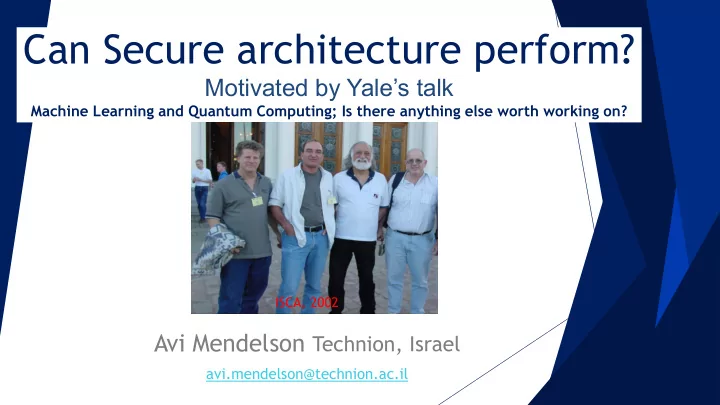
ISCA, 2002
Can Secure architecture perform? Motivated by Yales talk Machine - - PowerPoint PPT Presentation
Can Secure architecture perform? Motivated by Yales talk Machine Learning and Quantum Computing; Is there anything else worth working on? ISCA, 2002 Avi Mendelson Technion, Israel avi.mendelson@technion.ac.il Agenda Intro and motivation
Machine Learning and Quantum Computing; Is there anything else worth working on?
avi.mendelson@technion.ac.il
ISCA, 2002
Intro and motivation New approach Conclusions and next steps
1-July, 2019
2
So we created a power problems
Aims to minimize the performance lost as a result of power considerations.
Current systems are loosing much power and performance in order to be immune
against information leaks.
1-July, 2019
3
So far, with very limited success
1-July, 2019
4
It leaks and most likely will continue to leak
UNLESS we do something different
Speculation is one of the most
noticeable means to gain performance
Speculative execution leaks
information since it creates “observable dependencies” with the data it executes (to be extended)
Systems are becoming extremely
sophisticated and complicated so the probability for bugs cannot be ignored
Security attacks are becoming a
“profitable business” and so, individuals, companies and even armies/countries are spending much effort (and money) to “improve” it.
1-July, 2019 5
Self-driving cars
The goal is to find dependencies between “measurable parameters” and
“secretes”
We can inject faults to help the process
6
1-July, 2019
Notice – in order to “break a code”, it is enough to reduce the “solution space” to a size we can exhaustively search in a reasonable time
7
1-July, 2019
“White box attack”
DPA is mainly used for “black box” model where you know little (if at all) on
what the system is executing (but you may have a good model on the hardware itself.)
We may observe (or guess) that on-average, the power of
the system when execute some values (e.g., “0”) is different than the power when execute other values (e.g., “1”)
We are using distribution of many
samples
We care of the average behavior not
using OOO cores, each execution may consume different amount of power. Still the average of executing some values may be different than the average of executing other values
8
1-July, 2019
Can be “Black box” attack
Cache is great for performance but
problematic for security since “keep traces”
Here, two threads
Thread 1 fill out the cache Allows Thread 2 to operate Thread 1 check which of his cache lines
were replaced.
HOW? Access the data and observe how
long it take you to retrieve the data (cache hit or miss)
Does it expose the secret key ?
Not directly It reduces the search space to a
manageable size that can be exhaustively searched.
9
DRAM cache
1-July, 2019
Spectre and Meltdown are vulnerabilities that allow user level code
(unprivileged) to indirectly read data from all physical pages (including privilege pages and pages belonging to other processes.)
Speculative execution of out-of-order cores leave traces in processor
state since “roll back” impact internal structures such as caches
Based on Branch side effects created during miss speculation of branch
prediction
10
Families of attacks – several generations already exist e.g., was extended for exposing vulnerabilities in SGX (Intel’s extension for Security)
1-July, 2019
in mind (or best performance per given power).
execution as much as possible, since it gains performance
security in general and side channel affects in particular.
were proven to cost much performance
since uses prefer performance over security
11
Intel stock value after the security bugs announced
1-July, 2019
Intro New approach(*) Conclusions and next steps
1-July, 2019
12
(*) Some parts of the new approach are under provision
Modern systems are “hiding” the
speculative execution with in a simple, in-order, non speculative cores
From the external observer point
the system is identical for both systems.
We design to OOO part of the
system so that we could imposes the “in-order view”
1-July, 2019 13
In Order core
OOO – Speculative core
Front End Commit (retire)
I don’t believe we can take a core and make it secure (this is what we are currently try to do)
We need to “design for security” (resembles, design for testability)
From an external observer point of view, the system should looks like secure, but integrally it may differ; e.g.,
Internally, I different execution paths may consume different amount of power
We need to develop a mechanisms that for an external observer, the execution power will not depends on the values
New optimization point →
maximum security with minimal cost in terms of power and performance
1-July, 2019 14
Secure core In Order core
OOO – Speculative core
Front End Commit (retire)
Secure FE Secure BE
please note that current systems try to balance all execution paths, here we only request that the execution paths will not be dependent on the values
SPA resistant mechanism In order to balance all execution
paths, we can impose (by hardware) that commit will take the same time for all execution paths.
Please note that
performance is minimal (assuming that kilo-instruction ROB) In this case we can make the external
time to all paths, w/o significantly impact performance (power)
1-July, 2019 15
SA-- scheduling assist
TP-Time prediction
New modules
(*) More details to appear in the SOCC paper (soon)
Intro New approach(*) Conclusions and next steps
1-July, 2019
16
(*) Some parts of the new approach are under provision
In order to build a secure core we need to develop a “design for security”
methodology
In this presentation I show one possible alternative to implement such a core
Preliminary simulations indicates that with minimal cost in performance (<5%) and
power (<1%) we can build an high performance secure core.
The fun have just began, so the answer to the Yale’s challenge “Machine
Learning and Quantum Computing; Is there anything else worth working
1-July, 2019
17
1-July, 2019
18