can mimic infantile hemangioma both clinically and radiographically - - PowerPoint PPT Presentation

can mimic infantile hemangioma both clinically and
SMART_READER_LITE
LIVE PREVIEW

can mimic infantile hemangioma both clinically and radiographically - - PowerPoint PPT Presentation

Cutaneous metastases of infantile choriocarcinoma can mimic infantile hemangioma both clinically and radiographically Case Report Logan Dance, MD; Patricia Cornejo, MD; Mittun Patel, MD Disclosures None Objectives Understand the


slide-1
SLIDE 1

Case Report Logan Dance, MD; Patricia Cornejo, MD; Mittun Patel, MD

Cutaneous metastases of infantile choriocarcinoma can mimic infantile hemangioma both clinically and radiographically

slide-2
SLIDE 2

Disclosures

  • None
slide-3
SLIDE 3

Objectives

  • Understand the clinical and radiographic challenge of

distinguishing between a common infantile hemangioma and a much less common solitary cutaneous metastasis

  • Understand the time-critical nature of accurate

diagnosis of infantile choriocarcinoma

  • Understand the unique predilection of infantile

malignancies to metastasize to the skin, most commonly lymphoma/leukemia

  • Know when to suggest an alternate diagnosis despite

the initial clinical presumption of infantile hemangioma

slide-4
SLIDE 4

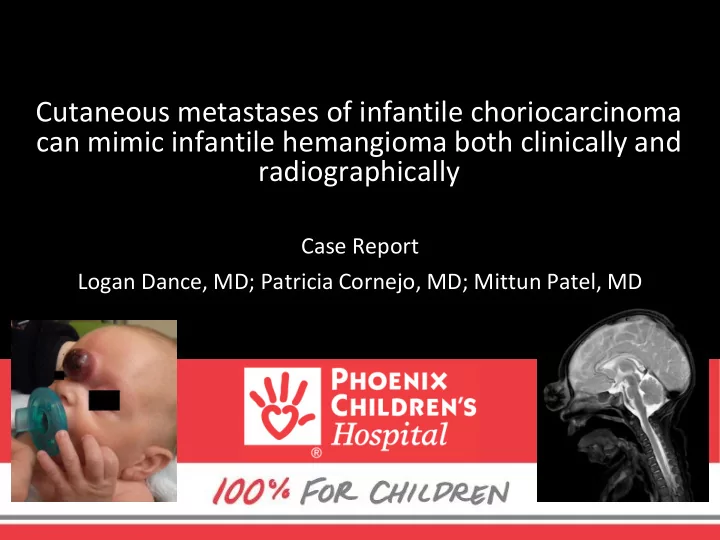
Initial Presentation – 37 day old male

  • Initially noticed a flat, blue

lesion at 10 days of age (not shown)

  • Presents to dermatology

clinic with pedunculated, friable red/blue glabellar mass (shown) at 37 days of age

  • Otherwise healthy

Images courtesy of Kim Eisenstein, MD, Dermatology, Phoenix Children’s

slide-5
SLIDE 5

Initial Treatment and Course

  • Propranolol prescribed for

presumed infantile hemangioma

  • Lesion rapidly grew in size
  • ver several weeks
  • Mother concerned with

alarming growth rate and extension into both eyes affecting lid closure

  • Patient sent to ER,

ultrasound ordered to exclude deeper extension

  • MRI also ordered due to

history of bronchiolitis and concern for possible airway hemangioma

Images courtesy of Kim Eisenstein, MD, Dermatology, Phoenix Children’s

slide-6
SLIDE 6

Images courtesy of Kim Eisenstein, MD, Dermatology, Phoenix Children’s

slide-7
SLIDE 7

Initial ultrasound

Solid hypervascular 2.4 x 2.2 cm mass interpreted as “consider infantile hemangioma or tufted angioma."

slide-8
SLIDE 8

Axial T1 post-contrast: Peripheral enhancement Sagittal T2: Heterogeneous, centrally hypointense

slide-9
SLIDE 9

MRI results

  • No airway or neck hemangioma(s)
  • Although some MRI features not characteristic
  • f clinical diagnosis of infantile hemangioma,

the exam was interpreted as “vascular mass arising from glabella. Coordinate with upcoming biopsy to confirm diagnosis of hemangioma.”

slide-10
SLIDE 10

Initial work-up

  • Lab testing: anemia (7.4 mg/dL) and low platelets

(95 K/uL)

  • Persistent tachycardia, tachypnea
  • Differential at this time:

– tufted angioma – infantile hemangioma – kaposiform hemangioendothelioma with concern for possible Kasabach-Merritt syndrome

  • Biopsy requested
slide-11
SLIDE 11

Biopsy: Necrosis, with few malignant cells seen at periphery of one specimen, insufficient for diagnosis.

slide-12
SLIDE 12

Initial CT Chest/Abd/Pelvis shows peripherally enhancing 6.8 x 6.6 x 5.8 cm liver mass and areas

  • f atelectasis in the lungs with one mass-like

area, right lower lobe.

slide-13
SLIDE 13
slide-14
SLIDE 14

Axial fused PET/CT shows peripherally FDG avid 7 cm liver mass (SUVmax 10.3), small FDG avid lung lesion (SUVmax 4.8).

slide-15
SLIDE 15
  • Glabellar mass partially resected for tissue

diagnosis

  • PET/CT shows small amount of residual glabellar

mass (SUVmax 3.1)

slide-16
SLIDE 16

Diagnosis

  • Choriocarcinoma
  • Liver and lung metastases
  • Glabellar cutaneous metastasis
  • Gross inspection of placenta was reportedly

normal; placenta was not preserved (placental primary is usually small and can go unnoticed on gross inspection)

  • Baby found to have elevated beta hCG
  • Mother negative for beta hCG
slide-17
SLIDE 17

Choriocarcinoma Pathology

Pathology slides courtesy of Steve Taylor, PA, Department of Pathology, Phoenix Children’s Hospital

slide-18
SLIDE 18

Choriocarcinoma

  • Maternal: Arises from B-hCG secreting placental

trophoblastic cells.

– First solid tumor to be cured with chemotherapy (methotrexate, 1956, Min Chiu Li) – Friable, aggressive hemorrhagic metastases to pelvis, distant metastases to lungs, brain, liver. – Usually found after molar pregnancy. – Occurs in 1 of 50,000 live births.

  • Infantile: Much less common, thought to be of same
  • rigin as maternal, usually concurrent with maternal

disease.

– Metastases usually to the liver, although lung and cutaneous metastases have been described. – Highly vascular rapidly growing metastases with central necrosis. – Treatment: Chemotherapy, delayed surgical resection of mets. – Without treatment, patients usually die within 3 weeks.

Min Chiu Li

Image courtesy of National Cancer Institute, Wikipedia public domain

slide-19
SLIDE 19

Clinical Course

  • Respiratory failure and severe anemia required

ICU stay and multiple blood and platelet transfusion

  • Rapid improvement shortly after starting

chemotherapy

slide-20
SLIDE 20

PET 12 days later: dramatic interval regrowth of glabellar tumor but decreased FDG activity (SUVmax 2.1). Contrast- enhanced CT 14 days later again demonstrates regrowth and peripheral enhancement of glabellar mass.

12 days prior

slide-21
SLIDE 21

PET 12 days later: interval growth but significantly decreased FDG activity of both the liver and lung masses.

slide-22
SLIDE 22
  • PET/CT: Liver lesion much smaller, less FDG avid (treatment

response).

  • Glabellar lesion decreased in size

Images courtesy of Kim Eisenstein, MD, Dermatology, Phoenix Children’s

3-month follow-up

slide-23
SLIDE 23

Treatment

  • Choriocarcinoma is treated as a germ cell

tumor with resection of all metastases – Therapy was initiated per COG protocol AGCT 01P1 (6 cycles cisplatin, etoposide, bleomycin) – Right lung lobectomy performed – Residual glabellar lesion resected – Hepatic lesion cannot be resected fully, therefore patient listed for liver transplant

slide-24
SLIDE 24

Cutaneous Metastases in Neonates

  • Relatively common presentation of malignancy, unlike older

children and adults.

  • Solitary or multiple varying-size firm, violaceous bluish skin

nodules or “blueberry muffin baby”

  • From most to least common:

– Leukemia – Langerhans cell histiocytosis – Neuroblastoma – Rhabdoid tumor – Rhabdomyosarcoma – Primitive neuroectodermal tumor – Choriocarcinoma – Adrenocortical carcinoma

IMAGES: http://www.healio.com/pediatrics/journals/pedann/2014-1-43-1/%7Be31fe4d5-ca1c-4056-889d-b1d5a369c918%7D/a-7-week-old-boy-with-violaceous-patches-and-skin- nodules http://www.womansday.com/life/a52089/baby-with-rare-blueberry-muffin-cancer-makes-a-miracle-recovery/

3 month old, ALL 1 month old, born with AML

slide-25
SLIDE 25

Typical MRI characteristics of untreated infantile hemangioma

  • Lobular well-

circumscribed solid mass

  • Homogeneous T2

hyperintensity is most characteristic feature

  • Feeding vessels create

flow voids

  • Uniform, intense contrast

enhancement

3 month old with left cheek infantile hemangioma

  • n axial T2-weighted MRI

Axial T2: 11 mo old, R parotid hemangioma

slide-26
SLIDE 26

Another infantile hemangioma

Axial T2: 9 mo old with right periorbital hemangioma demonstrating uniform T2 hyperintensity with small flow voids Axial T1 post-contrast: Intense, uniform contrast enhancement Color Doppler US: Intense arterial and venous color flow throughout the lesion

slide-27
SLIDE 27

Typical hemangioma

T2 T1 post Ultrasound

Our case: choriocarcinoma

Heterogeneous

  • n T2, no flow

voids Peripheral enhancement Peripheral hypervascularity, minimal central flow

slide-28
SLIDE 28

Typical hemangioma

T2 T1 post Ultrasound

Ewing sarcoma initially diagnosed as infantile hemangioma, 3 mo old

T2 hypointense, less avid contrast enhancement

slide-29
SLIDE 29

Typical hemangioma

T2 T1 post Ultrasound

Nasal glioma also initially diagnosed as infantile hemangioma, 8 mo old

Not as T2 hyperintense, no flow voids, less vascular on ultrasound

slide-30
SLIDE 30

Further Discussion on Choriocarcinoma

  • Clinical presentation: The unusual predilection of

infantile malignancies for cutaneous metastases allows their early discovery and creates vivid clinical stigmata not easily forgotten. While relatively common in infancy, such presentations are uncommon in children and adults. The unsightly cutaneous metastasis in our case hastened the diagnosis and life-saving treatment.

  • Known Mimic: The misdiagnosis of infantile

choriocarcinoma for infantile hemangioma has

  • ccurred previously, as described in a 2014 case report

by Brooks and Nolting also with a solitary cutaneous metastasis on the face.

slide-31
SLIDE 31

Further Discussion on Choriocarcinoma

  • Imaging Findings: Strong, early peripheral enhancement

with central necrosis and hemorrhage. These attributes are nonspecific and can mimic an involuting hemangioma or

  • ther solid tumors. PET/CT shows marked peripheral FDG

avidity; preliminary studies in maternal choriocarcinoma suggest PET/CT is useful in staging and follow-up.

  • Prognosis: Considered one of the fastest growing tumors,

infantile choriocarcinoma classically presents with hepatomegaly, anemia, failure to thrive, and precocious puberty between 0 days and 5 months of life. Chemotherapy and delayed surgical excision of metastases can be curative with long-term survival rates of around 80%.

slide-32
SLIDE 32

Conclusion

  • Beware the potential of solitary cutaneous

metastases to mimic hemangioma both clinically and radiographically

  • Typical MRI appearance of infantile hemangioma

includes T2 hyperintensity, flow voids, and uniform contrast enhancement

  • Atypical features can suggest alternate diagnosis
  • Early diagnosis and treatment for infantile

choriocarcinoma is critical for survival!

  • PET/CT may be useful for staging and follow-up
slide-33
SLIDE 33

Sources

  • Hart I et al, Cutaneous metastases in neonates: a review. Pediatric Dermatology, 28:2,

85-93, 2011.

  • Yarris JP et al, Roy Hertz, MD (1909-2002): The cure of choriocarcinoma and its impact
  • n the development of chemotherapy for cancer. Gynecologic Oncology, 89:2, 193-198,

2003.

  • Tidy JA et al, Presentation and management of choriocarcinoma after nonmolar
  • pregnancy. The British Journal of Obstetrics and Gynaecology, 102:9, 715–719, 1995.
  • Brooks T, Nolting L, Cutaneous Manifestation of Metastatic Infantile Choriocarcinoma.

Case Reports in Pediatrics. Volume 2014, 3 pages, http://dx.doi.org/10.1155/2014/104652

  • Van der Hoef M et al, Solitary infantile choriocarcinoma of the liver: MRI findings.

Pediatric Radiology. 34:10, 820-823, 2004.

  • Mapelli P et al, Role of 18F-FDG PET in the management of gestational trophoblastic

neoplasia, Eur. J. Nuc. Med. and Mol. Imaging, 40:4, 505–513, 2013.

  • Yoon JM et al, Treatment of infantile choriocarcinoma of the liver. Pediatric Blood

Cancer, 49:1, 99-102, 2007.

  • McNally OM et al, Successful treatment of mother and baby with metastatic

choriocarcinoma, International Journal of Gynecological Cancer, 12:4, 394–398, 2002.