Cameroun to take a lead ? Building institutional capacity for land - - PDF document

cameroun to take a lead
SMART_READER_LITE
LIVE PREVIEW

Cameroun to take a lead ? Building institutional capacity for land - - PDF document

Land Governance in Support of the Global Agenda: The Imperative of Capacity Development in Central Francophone Africa Prof. Stig Enemark Honorary President Aalborg University, Denmark LAND POLICIES AND LAND GOVERNANCE , FIG/FGF NTERNATIONAL


slide-1
SLIDE 1

1

Land Governance in Support of the Global Agenda: The Imperative of Capacity Development in Central Francophone Africa

  • Prof. Stig Enemark

Honorary President Aalborg University, Denmark

LAND POLICIES AND LAND GOVERNANCE , FIG/FGF NTERNATIONAL SYMPOSIUM AND WORKSHOP: YAOUNDE, CAMEROUN, 21 – 25 OCTOBER 2013

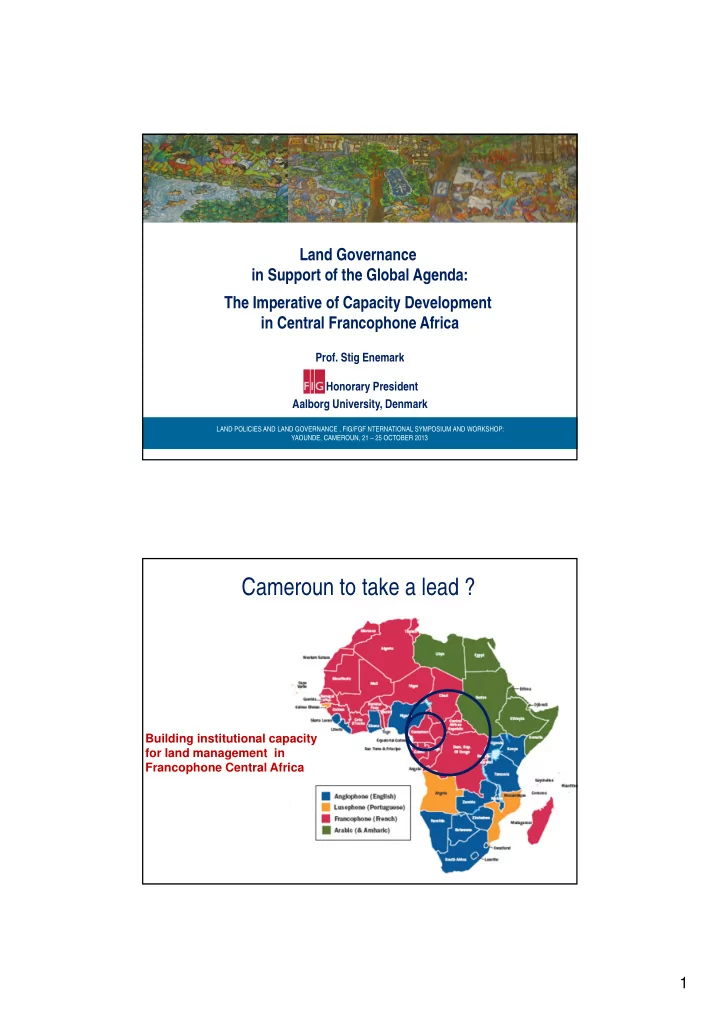
Building institutional capacity for land management in Francophone Central Africa

Cameroun to take a lead ?

slide-2
SLIDE 2

2

Land Governance

Land governance is about the policies, processes and institutions by which land, property and natural resources are managed. This includes decisions on access to land; land rights; land use; land development. Land governance is about determining & implementing sustainable land policies.

The land management paradigm

Land Tenure: Allocation and security of rights in lands; legal surveys of boundaries; transfer of property; Land Value: Assessment of the value of land and properties; gathering of revenues through taxation; Land-Use: Control of land-use through adoption of planning policies and land-use regulations at various levels; Land Develop: Building of new infrastructure; implementation of construction works and the change of land-use

Land Administration Systems provide the infrastructure for implementation of land polices and land management strategies in support of sustainable development.

Land Administration Systems

slide-3
SLIDE 3

3

Benefits to Society

  • Support for governance

and the rule of law

  • Protection of state lands
  • Alleviation of poverty
  • Management of land

disputes

  • Security of tenure
  • Improvement of land

planning

  • Support for formal land

markets

  • Development of

infrastructure

  • Security of credit
  • Management of resources

and environment

  • Support for land and

property taxation

  • Management of

information and statistical data

Williamson, Enemark, Wallace, Rajabifard, ESRI Press, 2010, 500 pages. The book is available for free online at http://www.fig.net/pub/others/index.htm

A Land Governance Vision

Trustable land information and good land administration is fundamental for:

  • Responsible governance of tenure
  • Coping with climate change
  • Meeting the Millennium Development Goals
  • Achieving sustainable development

Land governance to underpin the three core components of the global agenda

slide-4
SLIDE 4

4

Climate change - The world in terms of carbon emission Climate change - The world in terms of increased mortality

8 Goals

18 Targets

48 Indicators

www.un.org/millenniumgoals/pdf/report-2013/mdg-report-2013-english.pdf

slide-5
SLIDE 5

5

32

Corruption Perception Index 2012

slide-6
SLIDE 6

6

International soft law instrument. The Guidelines represent a global consensus

  • n internationally accepted principles and

standards for responsible practices. They provide a framework that States can use when developing their own policies, legislation and programmes. Human rights based approach. The Guidelines place tenure rights in the context of human rights. Tenure rights and their governance are important for the realization of human rights, such as the rights to adequate food and to adequate housing. Guidance for a variety of actors. With the help of the Guidelines actors can determine whether their proposed actions and the actions of others constitute acceptable practices.

Responsible Governance of Tenure

www.fao.org/docrep/016/i2801e/i2801e.pdf

  • In 2010 Africa had a

population of 1 billion with 40% living in in cities

  • In 2030 Africa will become

urbanised, and in 2050 African cities will host 1,2 billion people – 60% of all Africans.

  • A tripled urban population is a

huge challenge.

  • Mega cities will explode but

medium and smaller cities will absorb 70% of the growth.

Africa becomes urbanised

UN-Habitat, State of the African Cities 2010

African urban population trend, 1950–2050 These trends call for enhanced land governance capacity with land administration systems as the key component.
slide-7
SLIDE 7

7

Sustainable Land Administration Systems should serve as a basis for poverty reduction, social equity, and economic growth.

Land Administration and the Global Agenda

Incorporating a pro-poor and environmentally resilient approach into national land policies Integrate means of climate change adaptation by controlling the use of land in relation to climate change and disaster risks Incorporating all land into the formal land administration systems - 70% of the land in most developing countries are currently outside. Incorporating all rights – formal as well as informal – into the land administration systems by adopting innovative approaches such as the STDM. Avoiding land grabbing and the attached social and economic consequences through participatory approaches. Avoiding informal development through sustainable land use planning and control. Guarantee good, transparent, affordable and gender responsive governance of land

The land professionals must be able to take a lead and explain the relevance of land administration, land parcel mapping, and good land governance in relation to the global agenda.

“Building the capacity for facing the global agenda”

Key Message

slide-8
SLIDE 8

8

Africa on the Move…

  • Africa has a growth rate of 5% over

the last decade and is expected to continue to grow twice as fast as the global economy

  • Africa is still mostly poor – and has

not been able to convert the growth into rapid poverty reduction

  • Africa has been left behind and is

struggling with insecurity of tenure, informal settlements, urban slums, and degrading of natural resources

  • These issues indicate that poor land

governance may be root of the problem

A recent and promising African agenda is focusing on good land governance

slide-9
SLIDE 9

9

The Africa Land Policy Initiative

A commitment from African leaders to

  • Prioritise land policy development and

implementation

  • Develop appropriate institutional

framework for land policy

  • Allocate adequate budgetary resources

for land policy

  • Ensure equitable access to land for all

land users

  • Strengthen woman´s land rights
  • Develop adequate human, financial and

technical capacity to support of land policy development, implementation and monitoring through A Capacity Development Framework .

http://www.uneca.org/sites/default/files/uploaded- documents/au_declaration_on_land_issues_eng.pdf www.achpr.org/instruments/framework-guidelines-land-policy

The Capacity Development Concept

”Capacity Development within LPI refers to the continual and comprehensive learning and change processes by which African governments, organisations and people identify, strengthen, adapt, create and retain the needed capacity for effective land policy development, implementation and tracking for the resolution of priority land challenges facing the continent.”

slide-10
SLIDE 10

10

Regional Land Issues across Africa Regional Assessment Studies

Top five land issues for Central Africa:

  • Lack of land policies, inadequate

regulations and pluralism of decision making as regards land issues

  • Gender issues with special attention to

access to land for women and marginaIised groups.

  • Lack of capacity in land policy

development and implementation.

  • Lack of financial and human resources

for land management

  • Centralised land management

administration and lack of participation. Key challenges: Good governance, sustainable resource management, economic growth, poverty alleviation, and secure land rights.

http://repository.uneca.org/bitstream/handle/ 123456789/17775/Bib-67927.pdf?sequence=1

slide-11
SLIDE 11

11

The World Bank Agenda

A 10-point programme to scale up land policy reforms and investments for improving land governance

  • Improving tenure security and land

access

  • Increasing efficiency and transparency

in land administration services

  • Developing capacity in land

administration,

  • Increasing scope and effectiveness of

land use planning. The cost estimate for African countries and their development partners is USD 4,5 billion over 10 years

www.worldbank.org/en/region/afr/publication/securing-africas-land-for-shared-prosperity

The Role of Land Professionals

Dealing with the land issue will require skills in the following areas:

  • High level geodesy models to predict future

change

  • Modern surveying and mapping tools to support

management and implementation

  • Spatial data infrastructures to support decision

making on the natural and built environment

  • Secure tenure systems and sustainable systems

for land valuation, land use management and land development

  • Systems for transparency and good governance

Land governance is an interdisciplinary and cross-cutting area mixing technical, natural and social science ...... It is basically about people

slide-12
SLIDE 12

12

A Regional Training Centre in Yaounde, Cameroun ? University programme for land professionals Building institutional capacity In Francophone Central Africa

Cameroun to take a lead ? The Road Map…

Lack of training opportunities for surveying and land management in Central Francophone Africa. Establishing a Regional Training Centre in Cameroun has been discussed and supported by FIG over recent

  • years. The Centre should provide:
  • Bachelor programme in Land Management
  • Diploma in Surveying and Land Administration
  • One year programme for training of land clerks
  • Research and support of land reform programmes,

and land policy implementation,

  • Institutional development, and

short term training programmes

  • Monitoring and evaluation of progress

Government commitment and funding is currently pursued in line with the new Africa agenda on land policies and governance.

slide-13
SLIDE 13

13

Thank you for your attention

Simply put, sustainable development requires sustainable land governance Land professionals have a key role to play