SLIDE 1 Mount Auburn Street Corridor Study
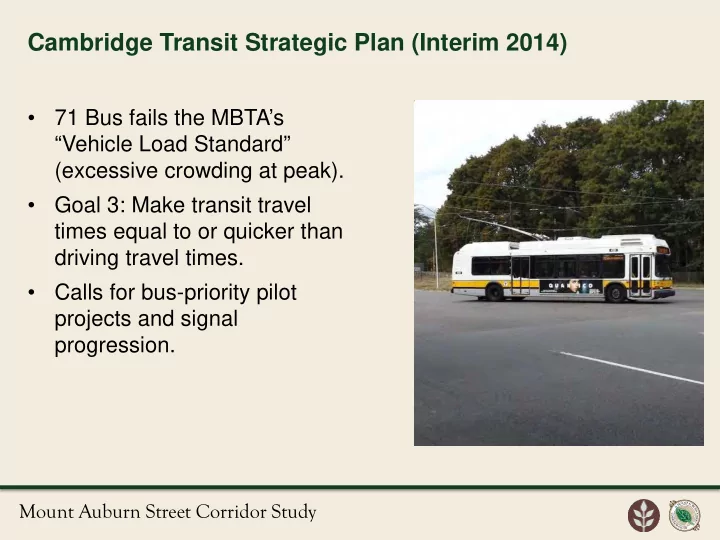
Cambridge Transit Strategic Plan (Interim 2014)
“Vehicle Load Standard” (excessive crowding at peak).
- Goal 3: Make transit travel
times equal to or quicker than driving travel times.
- Calls for bus-priority pilot
projects and signal progression.
SLIDE 2
Mount Auburn Street Corridor Study
Watertown 71 and 73 woes circa 2014
SLIDE 3
Mount Auburn Street Corridor Study
Watertown 71 and 73 woes circa 2014 “The main focus was the crowding and lateness of buses on the 71 and 73 lines heading to and from Harvard Square… they have not heard anything further from the T about how the town's public transportation will be improved. Councilor Aaron Dushku raised the issue and asked whether to try to arrange another meeting with the MBTA.”
SLIDE 4
Mount Auburn Street Corridor Study
Watertown 71 and 73 woes circa 2014
SLIDE 5
Mount Auburn Street Corridor Study
Watertown 71 and 73 woes circa 2014 According to Town Councilor Angeline Kounelis, the task force has received inquiries from people who were considering moving to Watertown but hesitated after hearing reports on how badly the transportation service has slumped. “What is most concerning to me is the implication that Watertown can be a less-than-desirable location to reside because of the T’s lack of quality service,” said Kounelis.
SLIDE 6
Mount Auburn Street Corridor Study
Belmont St. to Homer Ave. (AM Peak)
SLIDE 7
Mount Auburn Street Corridor Study
Belmont St. to Homer Ave. (AM Peak)
Vehicles People
SLIDE 8
Mount Auburn Street Corridor Study
Brattle St. to Coolidge Ave. (AM Peak)
SLIDE 9
Mount Auburn Street Corridor Study
Brattle St. to Coolidge Ave. (AM Peak)
Vehicles People
SLIDE 10
Mount Auburn Street Corridor Study
Proposed Bus Lanes
SLIDE 11
Mount Auburn Street Corridor Study
Proposed Bus Lanes on Belmont St.
SLIDE 12
Mount Auburn Street Corridor Study
Proposed Bus Lane between Brattle St. and Coolidge Ave.
SLIDE 13
Mount Auburn Street Corridor Study
Bus (AM Peak) – Passenger Travel Time Savings
SLIDE 14
Mount Auburn Street Corridor Study
Bus (AM Peak) – Round Trip Travel Time Savings
SLIDE 15
Mount Auburn Street Corridor Study
Bus (PM Peak) – Passenger Travel Time Savings
SLIDE 16
Mount Auburn Street Corridor Study
Bus (PM Peak) – Round Trip Travel Time Savings
SLIDE 17 Mount Auburn Street Corridor Study
Transit Improvements: Benefits for Passengers
- Faster
- More reliable
- Potential for 9 percent
increase in frequency
- Less “bunching”
- Less crowding
SLIDE 18 Mount Auburn Street Corridor Study
Transit Improvements: Benefits for Car Commuters
increase in bus ridership possible
SLIDE 19 Mount Auburn Street Corridor Study
Key Points We Heard
- Strong support for separated bike lanes on entire Mt. Auburn
Corridor.
- Strong support for transit lanes on Mt. Auburn.
- Support for keeping motorist delay at a minimum.
- Strong support for removing the Brattle merge.
- Suggestion for a pedestrian actuated crossing signal at Larch
Road.
- Support and Non-support of use of raised tables at signalized
intersections.
- Concern about safe access to the U-Turn off Greenough Blvd.
- Concern about pedestrian crossing of Fresh Pond Parkway
- Support for bike lanes on Eliot Bridge
SLIDE 20 Mount Auburn Street Corridor Study
Mt Auburn EB Travel Time Savings
Longer Storage Space for Queues
- Reduced Intersection Width = Reduced Yellow and
All Red Signal Times
- Reallocated some Green Signal Time from Fresh
Pond Parkway to Mt Auburn Street
SLIDE 21
Mount Auburn Street Corridor Study
Auto Travel Time (AM Peak)
SLIDE 22
Mount Auburn Street Corridor Study
Auto Travel Time (PM Peak)
SLIDE 23
Mount Auburn Street Corridor Study
Cushing St Concerns – Option 1 – Find a Gap .5 Mile
SLIDE 24 Mount Auburn Street Corridor Study
VISSIM Animations
- Long Term Concept: Mt Auburn Street
SLIDE 25
Mount Auburn Street Corridor Study
Average Person Delay On Mt Auburn Street (without ridership increase)
SLIDE 26
Mount Auburn Street Corridor Study
Average Person Delay On Mt Auburn Street (without ridership increase)
SLIDE 27 Mount Auburn Street Corridor Study
Key Points We Heard
- Strong support for separated bike lanes on entire Mt. Auburn
Corridor.
- Strong support for transit lanes on Mt. Auburn.
- Support for keeping motorist delay at a minimum.
- Strong support for removing the Brattle merge.
- Suggestion for a pedestrian actuated crossing signal at Larch
Road.
- Support and Non-support of use of raised tables at signalized
intersections.
- Concern about safe access to the U-Turn off Greenough Blvd.
- Concern about pedestrian crossing of Fresh Pond Parkway
- Support for bike lanes on Eliot Bridge
SLIDE 28 Mount Auburn Street Corridor Study
Midblock Crossing at Larch Road – Old Version
– Sight lines – Noise – Unclear desire line
SLIDE 29
Mount Auburn Street Corridor Study
New Solution: Signalized Crosswalk
SLIDE 30 Mount Auburn Street Corridor Study
Raised Crossing Debate – To Be Continued
– Not typically used at signals or on high volume streets – Potential Noise
SLIDE 31
Mount Auburn Street Corridor Study
Police Enforcement Opportunity – Long Term
SLIDE 32 Mount Auburn Street Corridor Study
Key Points We Heard
- Strong support for separated bike lanes on entire Mt. Auburn
Corridor.
- Strong support for transit lanes on Mt. Auburn.
- Support for keeping motorist delay at a minimum.
- Strong support for removing the Brattle merge.
- Suggestion for a pedestrian actuated crossing signal at Larch
Road.
- Support and Non-support of use of raised tables at signalized
intersections.
- Concern about safe access to the U-Turn off Greenough Blvd.
- Concern about pedestrian crossing of Fresh Pond Parkway
- Support for bike lanes on Eliot Bridge
SLIDE 33
Mount Auburn Street Corridor Study
Old Turnaround Solution
SLIDE 34
Mount Auburn Street Corridor Study
New Turnaround Solution
SLIDE 35 Mount Auburn Street Corridor Study
Key Points We Heard
- Strong support for separated bike lanes on entire Mt. Auburn
Corridor.
- Strong support for transit lanes on Mt. Auburn.
- Support for keeping motorist delay at a minimum.
- Strong support for removing the Brattle merge.
- Suggestion for a pedestrian actuated crossing signal at Larch
Road.
- Support and Non-support of use of raised tables at signalized
intersections.
- Concern about safe access to the U-Turn off Greenough Blvd.
- Concern about pedestrian crossing of Fresh Pond Parkway
- Support for bike lanes on Eliot Bridge
SLIDE 36
Mount Auburn Street Corridor Study
Stop Bar Distances – Existing
SLIDE 37
Mount Auburn Street Corridor Study
Stop Bar Distances – Proposed
SLIDE 38
Mount Auburn Street Corridor Study
Crossing Distances – Existing
SLIDE 39
Mount Auburn Street Corridor Study
Crossing Distances — Long-Term Option
SLIDE 40
Mount Auburn Street Corridor Study
Existing – Eastbound Pedestrian Crossing
SLIDE 41
Mount Auburn Street Corridor Study
Proposed – Eastbound Pedestrian Crossing
SLIDE 42
Mount Auburn Street Corridor Study
Existing – Westbound Pedestrian Crossing
SLIDE 43
Mount Auburn Street Corridor Study
Proposed – Westbound Pedestrian Crossing
SLIDE 44 Mount Auburn Street Corridor Study
Key Points We Heard
- Strong support for separated bike lanes on entire Mt. Auburn
Corridor.
- Strong support for transit lanes on Mt. Auburn.
- Support for keeping motorist delay at a minimum.
- Strong support for removing the Brattle merge.
- Suggestion for a pedestrian actuated crossing signal at Larch
Road.
- Support and Non-support of use of raised tables at signalized
intersections.
- Concern about safe access to the U-Turn off Greenough Blvd.
- Concern about pedestrian crossing of Fresh Pond Parkway
- Support for bike lanes on Eliot Bridge
SLIDE 45
Mount Auburn Street Corridor Study
Bike Lanes on Eliot Bridge (Next Phase of Design)
SLIDE 46
Mount Auburn Street Corridor Study
Analysis Changes
SLIDE 47
Mount Auburn Street Corridor Study
Old “Down by the River”
SLIDE 48
Mount Auburn Street Corridor Study
New “Down by the River”
SLIDE 49 Mount Auburn Street Corridor Study
VISSIM Animations
- Long Term Concept: Gerry’s Landing – Memorial Dr. – Eliot
Bridge – Greenough Blvd
SLIDE 50
Mount Auburn Street Corridor Study
Did We Achieve the Goals?
SLIDE 51 Mount Auburn Street Corridor Study
Shared Goals (Approved by Stakeholders June 23)
- 1. Calm traffic, provide clarity, reduce crashes and severity of crashes
– Narrowed Traffic Lanes – 3 Raised Intersections – Less Pavement in intersections – Overhead Signals and Signage – Elimination of Brattle Merge – Protected Bike Lanes in some places – Protected Bike Turning Movement at Brattle Street – Shorter Pedestrian Crossings – Two new Signal Protected Pedestrian Crossings – Plenty of time to cross the street
SLIDE 52 Mount Auburn Street Corridor Study
Shared Goals (Approved by Stakeholders June 23)
2. Improve connectivity, air quality and expand mobility choices by:
- a. Measuring people, not cars
- b. Reducing transit delays
- c. Improving safety, access, parking and comfort for bicycles.
- d. Maintaining mobility for motor vehicles
- e. Improving safety, attractiveness, noise, and comfort for pedestrians
and residents
SLIDE 53 Mount Auburn Street Corridor Study
Shared Goals (Approved by Stakeholders June 23)
3. Address cut-through traffic in the Larchwood, Huron Village, and Coolidge Hill Neighborhoods
– Explore speed humps in the Larchwood Neighborhood and others that need to resolve existing cut-through problems – No new cut-throughs encouraged
SLIDE 54 Mount Auburn Street Corridor Study
Shared Goals (Approved by Stakeholders June 23)
4. Offer short-term and long-term solutions
– Short Term Option at Mt. Auburn and Fresh Pond can achieve all of the traffic and bus benefits, and only some of the bike and pedestrian benefits, but can be implemented within 1-2 years with funding.
SLIDE 55 Mount Auburn Street Corridor Study
Shared Goals (Approved by Stakeholders June 23)
5. Acknowledge enforcement and special uses by BB&N, Mt. Auburn Cemetery, Mt. Auburn Hospital, Shady Hill School, and Tufts Health Plan
– Improved clarity at BB&N for bus parking and parking lot access. – Improved crossings for students. – Improved visibility at Mt. Auburn Cemetery Entrance/Exit – Mt. Auburn Hospital Access maintained – New Raised Crossing at Coolidge Road for Shady Hill Students – Widened Sidewalk from that crossing to FPP and Brattle Intersection – Possible access to Bus Lane for Tufts Parking Shuttles? TBD…
SLIDE 56 Mount Auburn Street Corridor Study
Shared Values (Approved by Stakeholders June 23)
– Design for everyone’s needs, including the disadvantaged
– Designs responsive to:
- Peak and off-peak
- School pick up and drop off
- Funeral processions
- Emergency vehicle access
- Balance
– Try to balance goals that may conflict
SLIDE 57 Mount Auburn Street Corridor Study
Other Benefits
- 4.5 acres of new park land
- Traffic Calming
- Road Diets
- Better Ped/Bike Connections
to the River
SLIDE 58
Mount Auburn Street Corridor Study
Next Steps
SLIDE 59
Mount Auburn Street Corridor Study
Potential Short-Term Concept
SLIDE 60 Mount Auburn Street Corridor Study
Potential Long-Term Phase I – DCR/Cambridge/Watertown
SLIDE 61
Mount Auburn Street Corridor Study
Potential Long-Term Phase II – DCR
SLIDE 62
Mount Auburn Street Corridor Study
Potential Long-Term Phase III – DCR
SLIDE 63
Mount Auburn Street Corridor Study
City of Cambridge Right-of-Way
SLIDE 64
Mount Auburn Street Corridor Study
City of Cambridge Right-of-Way
SLIDE 65
Mount Auburn Street Corridor Study
City of Watertown Right-of-Way (Approximate)
SLIDE 66 Mount Auburn Street Corridor Study
Next Steps:
- Final Report: March
- Next Meeting: Discuss Short-Term Options
– Short Term Design of Fresh Pond Parkway and Mount Auburn intersection – Mount Auburn Street bus lanes
SLIDE 67 Mount Auburn Street Corridor Study
For More Information:
- Project Website: www.mass.gov/dcr/mt-auburn-corridor-study
- If you have comments on this project:
– Submit online at: http://www.mass.gov/eea/agencies/dcr/public-
- utreach/submit-public-comments/
– Write: Department of Conservation and Recreation, Office of Public Outreach, 251 Causeway Street, Suite 600, Boston, MA 02114 – Comment Period (pertaining to this meeting): January 31 – February 17, 2016
- Note: Public comments submitted to DCR may be posted on the DCR
website in their entirety.
- If you have questions, please email:
MaryCatherine.McLean@massmail.state.ma.us