California Solar Initiative 2 Content Introduction Overview - - PowerPoint PPT Presentation

california solar initiative
SMART_READER_LITE
LIVE PREVIEW

California Solar Initiative 2 Content Introduction Overview - - PowerPoint PPT Presentation

California Solar Initiative 2 Content Introduction Overview of California Solar Initiative (CSI) Generation Interconnection Services (GIS) ClimateSmart 3 PG&Es Integrated Approach Energy Efficiency Reduce


slide-1
SLIDE 1

2

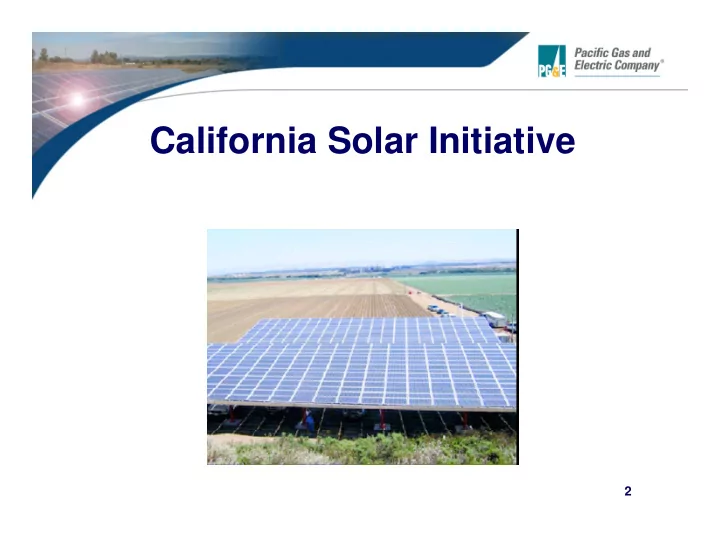
California Solar Initiative

slide-2
SLIDE 2

3

Content

  • Introduction
  • Overview of California Solar Initiative (CSI)
  • Generation Interconnection Services (GIS)
  • ClimateSmart
slide-3
SLIDE 3

4

PG&E’s Integrated Approach

Reduce Energy Use Renewable Power Supply

Neutralize Energy Use

Energy Efficiency Solar & Wind Climate Smart

slide-4
SLIDE 4

5

Solar for your Home

  • 1. Start with Energy Efficiency
  • Energy Audit Required to Participate in CSI Program
  • Online Audit http://www.pge.com/myhome/saveenergymoney/analyzer/en/index.shtml
  • Phone Audit 1-877-743-4112
  • Saves energy and money in 2 ways
  • Less usage = smaller energy bills
  • Reduced load = smaller solar system = lower cost
  • 2. Contact and Choose an Installer
  • Interview and obtain bids from at least 3 installers
  • Installer must have A, B, C10, or C46 license to participate
  • 3. Solar Installer usually Handles Paperwork
slide-5
SLIDE 5

6

Overview of CSI

slide-6
SLIDE 6

7

What is CSI?

  • The California Solar Initiative provides a

financial incentive for the installation of solar

  • n a home or business.
  • CSI incentives vary by incentive type,

customer segment and system size.

  • Incentive amounts gradually reduce over

time.

slide-7
SLIDE 7

8

CSI Eligibility

  • Project site must be within service territory and receive retail electric

service from Pacific Gas and Electric (PG&E), Southern California Edison (SCE) and San Diego Gas and Electric (administered by the CCSE)

  • Retrofit Residential Projects (Single Family homes and Multifamily

properties)*

  • Retrofit and New Construction Non-Residential Projects

(Commercial, Industrial, Agricultural and Government)

  • Minimum System Size of 1 kW
  • Maximum System Size of 5 MW
  • Incentives will be capped to the First MW
  • System size must be < previous 12 month usage history (kWh)
  • Unless there is added load: new appliances, added square footage, etc.

* New construction residential projects are administered separately under the New Solar Homes Partnership Program

slide-8
SLIDE 8

9

CSI Incentive Structure

There are two types of Incentives: Expected Performance-Based Buydown (EPBB)

  • EPBB is a one time, up-front payment based on an

estimate of the system's future performance Or… Performance-Based Incentives (PBI)*

  • PBI are monthly payments for 5 years based on actual

performance of the system as measured by a separate performance meter

*Any system larger than 50 kW are required to select for the PBI Incentive **Effective January 1, 2010 any system larger than 30kW are required to select the PBI Incentive

slide-9
SLIDE 9

10

CSI Incentive Rates

(Original Allotment)

Incentive structure:

  • Rebates automatically decline based upon reservations reserved
  • Higher rebates for non-taxable entities

$0.10 $0.03 $0.03 $0.70 $0.20 $0.20 102.5 50.5 10 $0.12 $0.03 $0.03 $0.90 $0.25 $0.25 83.4 41.1 9 $0.15 $0.05 $0.05 $1.10 $0.35 $0.35 73.2 36.1 8 $0.19 $0.09 $0.09 $1.40 $0.65 $0.65 62.9 31 7 $0.26 $0.15 $0.15 $1.85 $1.10 $1.10 55.6 27.4 6 $0.32 $0.22 $0.22 $2.30 $1.55 $1.55 46.8 23.1 5 $0.37 $0.26 $0.26 $2.65 $1.90 $1.90 38.1 18.7 4 $0.46 $0.34 $0.34 $2.95 $2.20 $2.20 29.3 14.4 3 $0.50 $0.39 $0.39 $3.25 $2.50 $2.50 20.5 10.1 2 n/a n/a n/a n/a n/a n/a

  • 1

Gov't / Nonprofit Commercial Residential Gov't / Nonprofit Commercial Residential Non- Res Res Step PBI Payments (per kWh) EPBB Payments (per Watt) PG&E (MW)

Res Non-Res

slide-10
SLIDE 10

11

Calculating your CSI Incentive

EPBB Incentive = EPBB Incentive Rate x CSI rating

  • CSI rating = CEC-AC Rating x Design Factor

Example

Current Incentive Rate: $1.90/W System Size: 4kW Design Factor: 94% CSI Rating: 4kW x 94% = 3.760kW

Incentive: 1.90 x 3760 = $7,144

slide-11
SLIDE 11

CSI Application Process

slide-12
SLIDE 12

13

2 Step vs 3 Step Applications

2 Step

  • All Residential retrofit

projects

  • All retrofit and new

Non-Res projects < 10 kW

Commercial Industrial Agricultural Government Non-Profit

3 Step

  • All Non-Res retrofit and

new Non-Res projects > 10 kW

Commercial Industrial Agricultural Government Non-Profit

slide-13
SLIDE 13

2 Step

All Residential Retrofit and All Non-Res Projects < 10 kW Submit Incentive Claim Form

ICF

Submit Reservation Request Form

RRF Step 1. Reserve the Funding Step 2. Claim your Incentive

slide-14
SLIDE 14

2 Step Process and Timeframe

All retrofit Residential and All Non-Res Projects < 10 kW

Please note: Timeframes are approximate. *Missing or Incorrect information/documents cause indefinite delays.

Due 1 year from date Reservation Approved for retrofit Res and Non-Res Incentive Claim Form Incentive Approval Notification PG&E Review Reservation Request Form Within 30 days* Reservation Confirmation Notification PG&E Review Within 30 days* Due 18 months from date Reservation Approved for Comm New Construction, Gov’t and Non-Profits

Needed For Berkeley FIRST

slide-15
SLIDE 15

16

Generation Interconnection Services (GIS)

slide-16
SLIDE 16

17

What is Interconnection?

  • Interconnection is the physical connection of your solar system

to the utility grid.

  • The interconnection required with net metering allows PG&E to

provide any extra electricity or back-up power that you may need.

  • It assures that safety protocols are adhered to for the protection
  • f the utility linemen.
slide-17
SLIDE 17

18

Net Energy Metering Net Energy Metering

The utility grid is a two- way street! Electricity can be “sent back” to the grid by the customer

  • Eliminates the need for batteries
  • Reduces cost and maintenance.
  • Ensures a constant supply of electricity.X
slide-18
SLIDE 18

19

Net Energy Metering (NEM) Net Energy Metering (NEM)

  • The intent of the NEM program is that the generation is

primarily to offset part or all of the customer’s own electrical requirements.

  • The electric grid acts as a "battery" for the customer and

their meter measures the net usage ("spins backwards" when the customer is exporting electricity to the grid).

  • Exports are credited at the retail rate and used to offset

charges for usage at other times (when the sun isn't shining).

  • In California, systems up to 1 MW can participate in the

program; other states typically have a lower size limit.

slide-19
SLIDE 19

20

Resources

Applications:

www.pge.com/csi www.pge.powerclerk.com

California Energy Commission:

www.gosolarcalifornia.ca.gov

Energy Efficiency:

Residential

www.pge.com/myhome/saveenergy money

Business

www.pge.com/mybusiness