Ca p ita l Ba se Exp ecta tions a nd Solv ency Presented by: - - PDF document
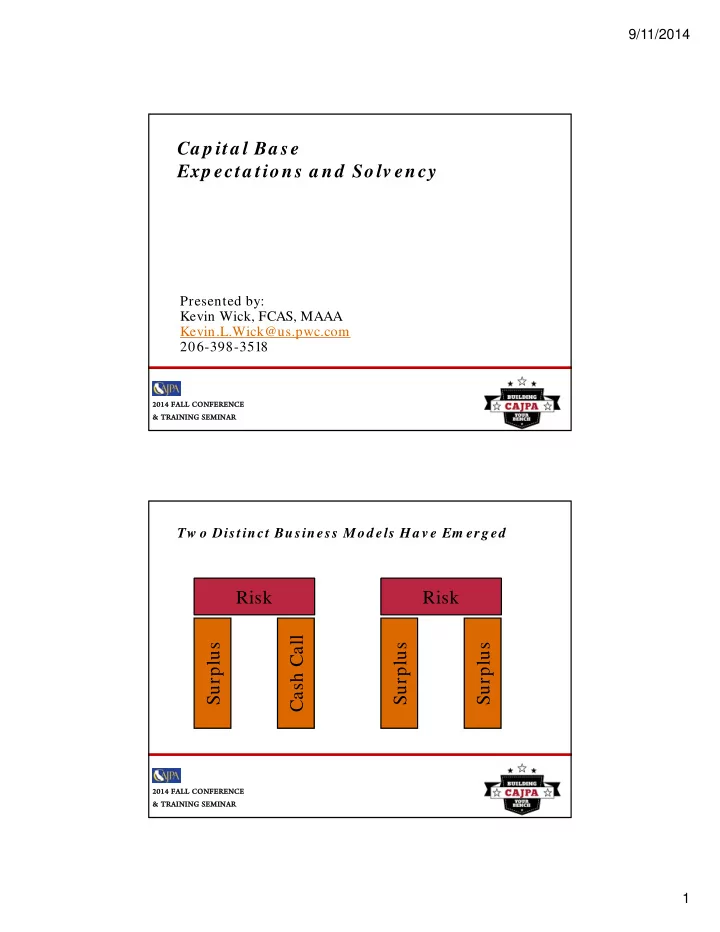
9/11/2014 Ca p ita l Ba se Exp ecta tions a nd Solv ency Presented by: Kevin Wick, FCAS, MAAA Kevin.L.Wick@us.pwc.com 206-398-3518 2014 FALL CONFERENCE 2014 FALL CONFERENCE & TRAINING SEMINAR & TRAINING SEMINAR Tw o Distinct
9/11/2014 2
2014 FALL 2014 FALL CONFERENCE CONFERENCE & TRAINING & TRAINING SEMINAR SEMINAR
Pools a re a t Different Sta ges
- Minimal effort in assessing capital needs
- Same measurement tools that were used 25 years ago
- “It has worked so why change?” resistant to change attitude
Have not recognized business model has changed
- Common pitfall is using the wrong measure
- “90% confidence level” is not conservative
- Universal set of “financial benchmark ratios” does not exist
- “Risk based capital” is not a target
Recognized change but are struggling to upgrade financial measures
- Defined appropriate surplus targets
- Leverage off recent advances in capital measures
- Consider impact on surplus needs of key financial decisions.
Understands capital requirements and pool operation is consistent with goals
2014 FALL 2014 FALL CONFERENCE CONFERENCE & TRAINING & TRAINING SEMINAR SEMINAR
Com m on Pool Solv ency Mea sures The “Confid ence Lev el”
- Incomplete measurement of
program risk
- Unpaid claims only
- Misleading
- Percentage scale
- Generally misunderstood by
stakeholders
- Not used in broader insurance
marketplace
- Made sense in the context of
pooling when use started
9/11/2014 3
2014 FALL 2014 FALL CONFERENCE CONFERENCE & TRAINING & TRAINING SEMINAR SEMINAR
Com m on Pool Solv ency Mea sures Benchm a rk Fina ncia l Ra tios
- Dependent on benchmark
values
- Are pools comparable to the
insurance industry?
- Value of comparing to mostly
unregulated and unrated industry?
- Individual pools are unique
Exam ples
- Reserve to Surplus
- Premium to Surplus
- Net Retention to
Surplus A “
- ne size fits all”
set of pool financial ratios to determ ine
- ptim al capital targets does not
and cannot exist 2014 FALL 2014 FALL CONFERENCE CONFERENCE & TRAINING & TRAINING SEMINAR SEMINAR
Com m on Pool Solv ency Mea sures “Risk Ba sed Ca p ita l” form ula
- RBC is a Regulatory Tool
– Developed for a specific context – Having sufficient resources left in a troubled company to rehabilitate or liquidate – Not capital you should hold based on your risk “… w ill not com pute the precise am ount of capital an insurer needs to m aintain in a com petitive, dynam ic and uncertain m arketplace.”
9/11/2014 4
2014 FALL 2014 FALL CONFERENCE CONFERENCE & TRAINING & TRAINING SEMINAR SEMINAR
Are Pools Different tha n Insura nce Com p a nies?
- Goal is not to make money for
investors
- Oversight is done by Board of
Directors made up of members
- Members have voting privileges
- Policies and business practices
are focused on serving the members
- Lower cost structure
How different is the underlying business model and need for capital?
2014 FALL 2014 FALL CONFERENCE CONFERENCE & TRAINING & TRAINING SEMINAR SEMINAR
Determ ining Ca p ita l Ta rgets using Ca p ita l Mod eling
Risk Measurement Financial Goals (Risk Appetite)
Capital Requirements
9/11/2014 5
2014 FALL 2014 FALL CONFERENCE CONFERENCE & TRAINING & TRAINING SEMINAR SEMINAR
Fina ncia l Risk Ca tegories
- Actual unpaid claims may be higher than current
estimates
Reserving
- Next year’s losses may come in higher than projected
Underwriting
- Interest rates may go up which results in bond
holdings decreasing in value
- Excess carrier may default
Asset/Credit
- Next year’s administrative budget may be exceeded
due to an unforeseen event
Operational
2014 FALL 2014 FALL CONFERENCE CONFERENCE & TRAINING & TRAINING SEMINAR SEMINAR
Risk Mea surem ent (Ca p ita l Mod eling) Process
AL GL APD
Underwriting Reserving Asset & Credit Operational
Int. rate Counter
- party
Equity External System People
Total Funding Need
PR AL GL APD PR WC WC
Step 1: The uncertainty associated with each of this risk elements is measured. Step 2: The individual risks are aggregated into four broad categories considering interdependencies. Step 3: In a similar manner, the total funding need is determined through a risk aggregation process.
Slide 10
9/11/2014 6
2014 FALL 2014 FALL CONFERENCE CONFERENCE & TRAINING & TRAINING SEMINAR SEMINAR
Exa m p le of Mod eling Outp ut
2014 FALL 2014 FALL CONFERENCE CONFERENCE & TRAINING & TRAINING SEMINAR SEMINAR
Determ ining Ca p ita l Ta rgets
Risk Measurement Financial Goals (Risk Appetite)
Capital Requirements
9/11/2014 7
2014 FALL 2014 FALL CONFERENCE CONFERENCE & TRAINING & TRAINING SEMINAR SEMINAR
Context for Determ ining Risk Ap p etite/ Fina ncia l Goa ls
Pool Financial Goals
Insurance Industry Standards “Pooling” versus “Insurance” Differences Perspective from Other Pool’s Other Financial Demands of Members
2014 FALL 2014 FALL CONFERENCE CONFERENCE & TRAINING & TRAINING SEMINAR SEMINAR
Exa m p le of Outcom e/ Fina ncia l Ta rgets
In this example, the minimum target funding level is a 1-in-100 year
- event. The board felt
members are expecting at a minimum that level of protection. The board consensus was that funding which exceeded what is necessary to cover a 1-in-500 year event is excessive. The current funding level is below the target.
9/11/2014 8
2014 FALL 2014 FALL CONFERENCE CONFERENCE & TRAINING & TRAINING SEMINAR SEMINAR
Mod eling a lso Prov id es Und ersta nd ing on the Source of the Ca p ita l Need s
The current funding level is below the target. Modeling showed a large source of risk and thus capital need was from the long bond duration. Reducing the bond duration reduced risk and thus fund need.
2014 FALL 2014 FALL CONFERENCE CONFERENCE & TRAINING & TRAINING SEMINAR SEMINAR
Decision Fra m ew ork
Representative common “pooling” measures
9/11/2014 9
2014 FALL 2014 FALL CONFERENCE CONFERENCE & TRAINING & TRAINING SEMINAR SEMINAR
Observ a tions from Stud ies Com p leted
- Common solvency measures being
used by pools provide a false sense
- f security
- Comparing to insurance industry
problematic
- smaller, concentrated exposure,
higher retentions
- Pool structures and risk profiles are
unique
- Clarity on funding adequacy is
valuable to the stakeholders
- Greater risk awareness leads to
better financial decisions
2014 FALL 2014 FALL CONFERENCE CONFERENCE & TRAINING & TRAINING SEMINAR SEMINAR
Key Milestones
Transition from a “cash call” to a “risk transfer” business model
- Business model has matured
- Surplus is important
- Common pool solvency measures developed in a “cash call” context
Recognition
- Consideration of all financial risks
- Extreme enough events measured
Understand Capital Requirements
- Members/owners make this decision
- Context provided by management and consultants
Financial Goals Defined
- Understanding of how financial decisions impact risk and funding
adequacy
- Surplus is used efficiently – proper financial controls and framework
Ongoing Financial Discipline
9/11/2014 10
2014 FALL 2014 FALL CONFERENCE CONFERENCE & TRAINING & TRAINING SEMINAR SEMINAR
Reca p of Session Objectiv es
1. Provide clarity on the “appropriate pool surplus” question
- 2. Critique the common measures used
by many pools to evaluate funding adequacy
- 3. Present at a high level an alternative
approach to develop target surplus levels
- 4. Relate how the results of a capital
modeling study can be used to answer common pool financial questions
- 5. Outline key milestones for making the
transition from a “cash call” to a “risk transfer” business model 2014 FALL 2014 FALL CONFERENCE CONFERENCE & TRAINING & TRAINING SEMINAR SEMINAR
Questions a nd Com m ents
For further discussion regarding pool solvency measures and framework, please contact: Kevin L. Wick, FCAS, MAAA Hyeji Kang, FCAS, MAAA Craig J. Scukas, FCAS, MAAA Managing Director Director Director +1 (206) 398 3518 +1 (312) 298 4167 +1 (206) 398 3585 Kevin.L.Wick@us.pwc.com Hyeji.Kang@us.pwc.com Craig.J.Scukas@us.pwc.com