C2TAM: A first Approach to a Cloud framework for Cooperative - - PowerPoint PPT Presentation

c2tam a first approach to a cloud framework for
SMART_READER_LITE
LIVE PREVIEW

C2TAM: A first Approach to a Cloud framework for Cooperative - - PowerPoint PPT Presentation

C2TAM: A first Approach to a Cloud framework for Cooperative Tracking and Mapping Luis Riazuelo, Javier Civera and J. M. M. Montiel I3A (Aragn Institute for Engineering Research) Universidad de Zaragoza Spain Web-enabled robots and


slide-1
SLIDE 1

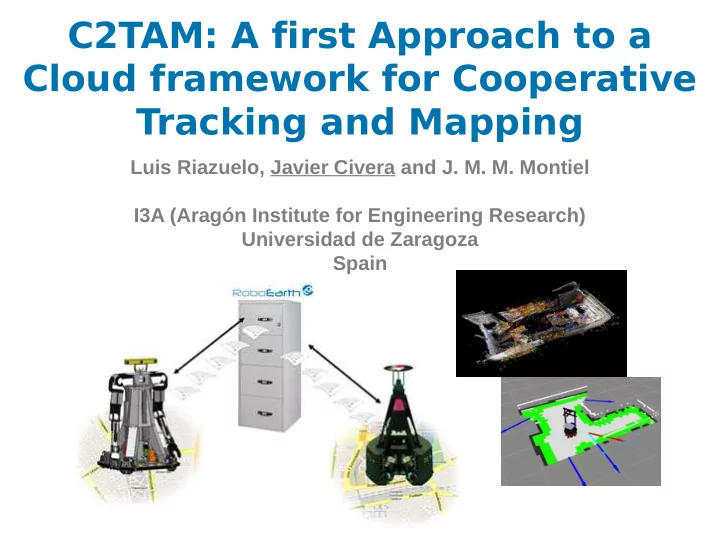
C2TAM: A first Approach to a Cloud framework for Cooperative Tracking and Mapping

Luis Riazuelo, Javier Civera and J. M. M. Montiel I3A (Aragón Institute for Engineering Research) Universidad de Zaragoza Spain

slide-2
SLIDE 2

Web-enabled robots and RoboEarth

  • RoboEarth: A set of servers, a

joint database and a network that allow robots to:

  • Upload information.
  • Download information.
  • Outsource computation.
  • EU-funded 4-year project,

finishing this year.

slide-3
SLIDE 3

Web-enabled robots and RoboEarth

CAN YOU HELP US WITH THE SENSING/SLAM?

slide-4
SLIDE 4

Web-enabled robots and RoboEarth

CAN YOU HELP US WITH THE SENSING/SLAM? YES, BUT…

  • Robotics in general (SLAM in particular) have hard real-time constraints.
  • The Cloud Computing has latencies associated with the net, particularly with

raw sensing data.

slide-5
SLIDE 5

Visual SLAM

  • Several robots, equipped with sensors (in our case RGB-D cameras), build a

map of their environment and estimate their poses sequentially and hopefully in real-time.

slide-6
SLIDE 6

Visual SLAM as Parallel Tracking and Mapping

  • Traditionally, joint sequential optimization of pose and map.
  • PTAM –Parallel Tracking and Mapping– [Klein & Murray 2007] divides the SLAM

problem into 2 threads:

  • Mapping thread: Estimates a map from a set of keyframes.
  • Tracking thread: Estimates the camera pose for every frame assuming a known

map. Mapping Tracking

slide-7
SLIDE 7

C2TAM scheme

  • Data flow:
  • Server->Client: Optimized

map and keyframe poses.

  • Client->Server:
  • New keyframes.
  • Modes of operation:
  • Map building and storage

(single-user single-map)

  • Relocation in a previous map

(single-user multi-map). Intensive in computation and data flow.

  • Map extension (single-user

multi-map)

  • Concurrent mapping (multi-

user multi-map)

slide-8
SLIDE 8

Experiment 1: Cloud Tracking and Mapping

  • Experimental setup:
  • 1 [Kinect + laptop].
  • Cloud server (running RoboEarth ROS stack and local copy of RoboEarth).
  • Linked by a standard wireless.
  • Results:
  • Map (images + geometry)

stored in RoboEarth

  • Data flow ~1MBs;

(standard wireless ~3.75MBs).

  • Robust to network delays.
slide-9
SLIDE 9

Experiment 1: Cloud Tracking and Mapping

Map creation. Map relocation and upgrade. Map creation and map merging.

slide-10
SLIDE 10

Experiment 2: Cooperative Tracking and Mapping using C2TAM

  • Experimental setup:
  • 2 [Kinect + laptop].
  • Cloud server (running RoboEarth

ROS stack and local copy or RoboEarth database).

  • Linked by a standard wireless.
  • Results:
  • Data flow ~1MBs; less than the

standard wireless bandwith (~3.75MBs).

  • Robust to network delays.
  • Real-Time cooperative mapping
  • f a room (video).
  • Map (images + geometry + tags)

stored in RoboEarth

slide-11
SLIDE 11

Conclusions

  • We propose the partition of a real-time PTAM algorithm that moves part of the

computation to the Cloud without loss of performance.

  • The bandwith of a standard wireless connection is enough in our experiments.
  • The PTAM algorithm is robust to network latencies.
  • Experimental demonstration of several modes of operation: single-user single map,

single-user multi-map and multi-user multi-map.

  • Extended version submitted to RAS (conditionally accepted)
  • Open source version coming soon! (mail me at jcivera@unizar.es if you are interested)