C ONT . A PPLICABILITY OF I NTERNAL A UDIT Companies Act - 2013 - - PowerPoint PPT Presentation

c ont a pplicability of i nternal a udit
SMART_READER_LITE
LIVE PREVIEW

C ONT . A PPLICABILITY OF I NTERNAL A UDIT Companies Act - 2013 - - PowerPoint PPT Presentation

C ONT . A PPLICABILITY OF I NTERNAL A UDIT Companies Act - 2013 Particulars Listed Unlisted public Private Companies Company Company Paid share capital Always > 50 Crore N.A applicable Turnover Always > 200 Crore > 200


slide-1
SLIDE 1

APPLICABILITY OF INTERNAL AUDIT CONT….

Companies Act - 2013

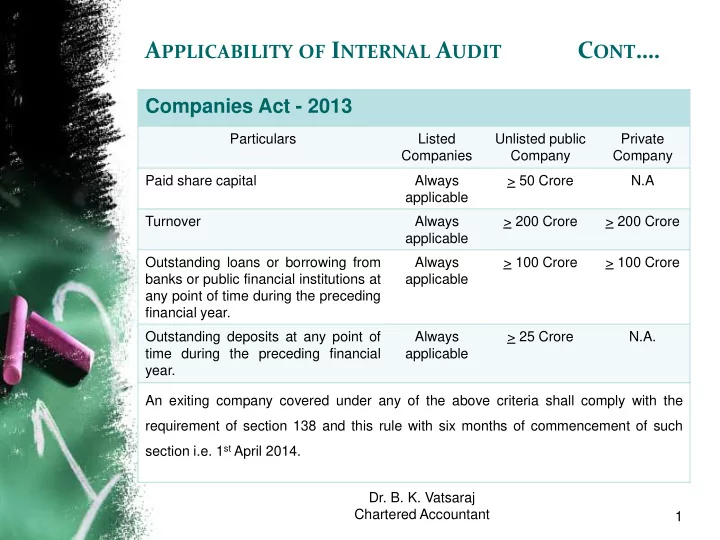
Particulars Listed Companies Unlisted public Company Private Company Paid share capital Always applicable > 50 Crore N.A Turnover Always applicable > 200 Crore > 200 Crore Outstanding loans or borrowing from banks or public financial institutions at any point of time during the preceding financial year. Always applicable > 100 Crore > 100 Crore Outstanding deposits at any point of time during the preceding financial year. Always applicable > 25 Crore N.A. An exiting company covered under any of the above criteria shall comply with the requirement of section 138 and this rule with six months of commencement of such section i.e. 1st April 2014.

  • Dr. B. K. Vatsaraj

Chartered Accountant 1

slide-2
SLIDE 2

ELIGIBILITY OF APPOINTMENT OF IA

 The internal auditor shall be either Chartered Accountant or Cost Accountant

  • r such other professional as may be decided by the board.

 The internal auditor may or may not be an employee of the company.  “Chartered Accountant” shall mean a Chartered Accountant whether engaged in practice or not – therefore, every registered member of the Institute of Chartered Accountants of India is eligible for appointment as Internal Auditor of company.  Thus, the board of company via the Audit Committee has been given freedom to appoint any professional and competent person to be its internal auditor.  Statutory auditor appointed under section 139 of Act is not eligible to provide the service of Internal audit whether rendered directly or indirectly to the company or its holding company or subsidiary company.

  • Dr. B. K. Vatsaraj

Chartered Accountant 2

slide-3
SLIDE 3

SCOPE AND FUNCTIONS OF IA

 The scope and functions of Internal Auditors has not been defined in Companies Act, 2013 nor in the Rules prescribed.  The Audit Committee of the company or the Board shall, in consultation with the Internal Auditor, formulate the scope, functioning, periodicity and methodology for conducting the internal audit – Sub-rule 2 of Rule 13 of Companies (Accounts) Rules, 2014.

  • Dr. B. K. Vatsaraj

Chartered Accountant 3

slide-4
SLIDE 4

Clause 49 in Listing agreement

 SEBI inserted clause 49 in the listing agreement, to ensure good Corporate Governance, specially in view of various scandals  Focused accountability on listed company managements which are generally divorced from ownership  This is also known as Corporate Governance Clause

  • Dr. B. K. Vatsaraj

Chartered Accountant 4

slide-5
SLIDE 5

Need for Corporate governance

Emerging Needs:

 Sound Reporting of Financial situation and governance of the company  Building investors confidence  Providing motivating work environment  Compliance with laws & regulations  Compliance with contracts/covenants  Safeguarding shareholders interest

5

“Corporate governance is the acceptance by management

  • f the inalienable rights of shareholders as the true owners
  • f the corporation and of their own role as trustees” - N R

Narayana Murthy

  • Dr. B. K. Vatsaraj

Chartered Accountant

slide-6
SLIDE 6

Standards on Internal Audit (SIA)

slide-7
SLIDE 7

Wh Why are re SIA’s Introduced?

  • To provide a

benchmark for quality

  • f services during an

internal audit.

  • With the introduction
  • f SIA’s the ICAI aims

to codify the best practices in the area

  • f internal audit

services.

7

  • Dr. B. K. Vatsaraj

Chartered Accountant

slide-8
SLIDE 8

SIA

The ICAI has Prescribed 18 Standards on internal audits, which have

been enumerated below:

  • SIA 1 : Planning an internal audit
  • SIA 2 : Basic principles governing Internal audit
  • SIA 3 : Documentation
  • SIA 4 : Reporting
  • SIA 5 : Sampling
  • SIA 6 : Analytical Procedures
  • SIA 7 : Quality assurance in internal audit
  • SIA 8 : Terms of internal audit engagement
  • SIA 9 : Communication with management
  • SIA 10: Internal audit evidence
  • SIA 11: Consideration of fraud in an internal audit
  • SIA 12: Internal control evaluation
  • SIA 13: Enterprise risk management
  • SIA 14: Internal audit in an information technology environment
  • SIA 15: Knowledge of the entity and it’s environment
  • SIA 16: Using the work of an expert
  • SIA 17: Consideration of laws and regulations in an internal audit.
  • SIA 18: Related Parties

8

  • Dr. B. K. Vatsaraj

Chartered Accountant

slide-9
SLIDE 9

Types pes Of Of IA

  • Operational Audits
  • Financial Audits
  • Information Systems Audits
  • Compliance Audits
  • Follow-up Audits

9

  • Dr. B. K. Vatsaraj

Chartered Accountant

slide-10
SLIDE 10

Internal audit, thus can be positioned as a risk management tool to support top and middle management in their pursuits

10

  • Dr. B. K. Vatsaraj

Chartered Accountant

slide-11
SLIDE 11

11

  • Dr. B. K. Vatsaraj

Chartered Accountant

slide-12
SLIDE 12

The he Aud udit it Pr Proc

  • cess

ess Mo Model el

Internal Audit Knowledge and Skills Computers, Software and IIA Standards Time and Money Reputation for Integrity and Fairness Internal Audit Practices and Procedures Analyses, Appraisals, Recommendations, Counsel and Information Promote the Effective use of Internal Control Supporting the Organization in the Discharge of their Responsibilities INPUTS PROCESSES OUTPUTS OUTCOMES

12

  • Dr. B. K. Vatsaraj

Chartered Accountant

slide-13
SLIDE 13

Cha haracteristi racteristics cs Of Of An n Int ntern ernal al Aud udito itor

Care Professional

Internal Auditor

Integrity Objectivity Independence Competence Confidentiality Skills

13

  • Dr. B. K. Vatsaraj

Chartered Accountant

slide-14
SLIDE 14

IA Pl Planni nning ng

  • Charter / Mandate
  • Audit Plan
  • Scope Determination
  • Scope Review
  • Resource Mobilisation
  • Pre Preparation

14

  • Dr. B. K. Vatsaraj

Chartered Accountant

slide-15
SLIDE 15

Crit itic ical al area eas s tha hat t ne need ed to

  • be foc
  • cus

used ed dur uring ing an n IA can an be cate tegoriz

  • rized

ed un under er the hese se thr hree ee sphe heres es

People Process Technology

  • Organization roles

and relationship

  • Change in job

descriptions

  • New KPIs and

performance measurement systems

  • Technology

savviness

  • Training on new

software

  • Roles in ERP
  • Internal controls in

a fully automated environment

  • Standard operating

procedures

  • Customer accounts

reconciliation status

  • Inter-office

transactions

  • Employee related

transactions like PF, ESI

  • IT Strategy vs.

Business growth

  • Data conversion
  • Mapping business

processes to IT

  • Marrying standard
  • perating

procedures to Oracle functionalities

  • IT Organization
  • IT Controls –

authorization

  • Dr. B. K. Vatsaraj

Chartered Accountant 15

slide-16
SLIDE 16

Process

  • Treasury related

processes

  • Bank

reconciliation

  • Deposit of

customer collection

  • Inventory control
  • Processes relating to

advances – control account vs. subsidiary ledgers

  • MIS - Reporting

mechanisms, data integrity etc

Process Process

  • Control, valuation and

effective project management relating to Capital Work in Progress

  • Verification of capital

work in progress

  • Assistance in Royalty

and Technical Know- How Payments

  • GOs – verification,

follow up and analysis

  • f consequential effect
  • n operational

transactions

  • Taxation related

processes such as

  • TDS
  • Annual taxation
  • Income

exemption

  • Costing systems

Crit itic ical al area eas s tha hat t ne need ed to

  • be foc
  • cus

used ed dur uring ing an n IA can an be cate tegoriz

  • rized

ed un under er the hese se thr hree ee sphe heres es

  • Dr. B. K. Vatsaraj

Chartered Accountant 16

slide-17
SLIDE 17

KEY TAKEWAYS….

 Board, management, independent directors are expected to seek increased comfort from Internal Audit on areas of :- Compliance; Fraud; Internal financial controls; Corporate social responsibility; Related party transactions to comply with their fiduciary responsibilities.

  • Dr. B. K. Vatsaraj

Chartered Accountant 17

slide-18
SLIDE 18

KEY TAKEWAYS….

CONT…

 Many new companies, including mid-sized listed companies, without structured IA set-up, are now required to comply with Section 138  Internal auditors are now covered under class action suits  Potential use of IA documents as evidenced in class action suits  IA will be required to play an enhanced role in “Assurance Coordination” - an activity to outline who provides assurance on what aspects of the entire assurance universe

  • Dr. B. K. Vatsaraj

Chartered Accountant 18

slide-19
SLIDE 19

The final word…

Internal audit may be performed across

  • rganizations and units and will have to be

customized to the requirements of the auditee, but the process can be standardized and can be used as your brand identity.

19

  • Dr. B. K. Vatsaraj

Chartered Accountant

slide-20
SLIDE 20

Whistleblower Responsibilities

  • It basically means a formulated complaint-making

process. It is also called the employee “whistleblower” programs

  • The whistleblower process should be viewed as an
  • pportunity to strengthen the Board as an

independent counterbalance to management.

  • It is an opportunity to prevent or mitigate the effect
  • f misconduct and the resulting liability, as well as

to enhance the company’s reputation and boost public in its business.

It is said amongst legal professionals that the sooner one learns of the problem, the easier and less costly it is to resolve it.

  • Dr. B. K. Vatsaraj

Chartered Accountant 20