c i,j max k,m c k,m 4 Wednesday, 26 Feb. 2020 Machine Learning - - PowerPoint PPT Presentation

c i j
SMART_READER_LITE
LIVE PREVIEW

c i,j max k,m c k,m 4 Wednesday, 26 Feb. 2020 Machine Learning - - PowerPoint PPT Presentation

Uses of Nearest Neighbors } Once we have found the k -nearest neighbors of a point, we can use this information: In and of itself : sometimes we just want to know what 1. those nearest neighbors actually are (items that are similar to a given


slide-1
SLIDE 1

1

Class #12: Applications of Nearest-Neighbors Clustering

Machine Learning (COMP 135): M. Allen, 26 Feb. 20

1

Uses of Nearest Neighbors

} Once we have found the k-nearest neighbors of a point,

we can use this information:

1.

In and of itself: sometimes we just want to know what those nearest neighbors actually are (items that are similar to a given piece of data)

2.

For additional classification purposes: we want to find the nearest neighbors in a set of already-classified data, and then use those neighbors to classify new data

3.

For regression purposes: we want to find the nearest neighbors in a set of points for which we already know a functional (scalar) output, and then use those outputs to generate the output for some new data

Wednesday, 26 Feb. 2020 Machine Learning (COMP 135) 2

2

Measuring Distances for Document Clustering & Retrieval

} Suppose we want to rank documents in a data-base or on the web

based on how similar they are

} We want a distance measurement that relates them } We can do a nearest-neighbor query for any article to get a set of those

that are the closest (and most similar)

} Searching for additional information based on a given document is

equivalent to finding its nearest neighbors in the set of all document

Wednesday, 26 Feb. 2020 Machine Learning (COMP 135) 3

3

The “Bag of Words” Document Model

} Suppose we have a set of documents X = {x1, x2,…, xn} } Let W = {w |w is a word in some document xi} } We can then treat each document xi as a vector of word-counts

(how many times each word occurs in the document): Ci = {ci,1, ci,2,…, ci,|W|}

} Assuming some fixed order of the set of words W } Not every word occurs in every document, so that some count values

may be set to 0

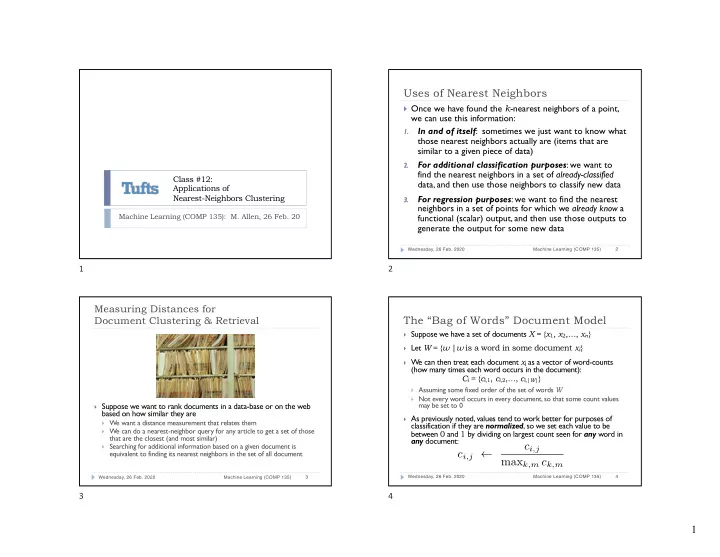
} As previously noted, values tend to work better for purposes of

classification if they are normalized, so we set each value to be between 0 and 1 by dividing on largest count seen for any word in any document:

Wednesday, 26 Feb. 2020 Machine Learning (COMP 135) 4

ci,j ← ci,j maxk,m ck,m

4

slide-2
SLIDE 2

2 Distances between Words

} We can now compute the distance function between any

two documents (here we use the Euclidean):

} We could then build a KD-Tree, using the vectors of

words as our dimension values, and query for some set of most similar documents to any document we start with

} Problem: word counts turn out to be a lousy metric!

} Common every-day words dominate the counts, making most

documents appear quite similar, and making retrieval poor

Wednesday, 26 Feb. 2020 Machine Learning (COMP 135) 5

d(xi, xj) = v u u t

|W |

X

k=1

(ci,k − cj,k)2

5

Better Measures of Document Similarity

}

We want to emphasize rare words over common ones:

1.

Define word frequency: t(w,x) as the (normalized) count of occurrences of word w in document x

2.

Define inverse document frequency of word w :

3.

Use combined measure for each word and document:

Wednesday, 26 Feb. 2020 Machine Learning (COMP 135) 6

id(w) = log |X| 1 + |{x ∈ X | w ∈ x}| tid(w, x) = t(w, x) × id(w)

Total # of documents # that contain word w

cx(w) = # times word w occurs in document x c?

x = max w∈W cx(w)

t(w, x) = cx(w) c?

x

<latexit sha1_base64="9AlSyY3dNL6afTRkAF6okxiuCqU=">ACiHicZVFNa9wEJXdr8T92rTHXIbutmwhbG03kORQCMmlxS62UC8GK0sb0Rky0j2MH41/T/9J5/E63XPbgZkBhG72ZeVoVUhj0/QfHfb8xctXO7ve6zdv370f7X24NKrUjM+ZkpfrajhUuR8jgIlvyo0p9lK8sXq9nzvrj2giV/8b7gi8zus5FKhFW4pHf1hcT6uv8OUHRMhrbKIxoMi4gUrpBCbVBRjpTYgckgUKzOeI0zqSQtR5EW6lLzxC2ybILS3xyKDOq47uYzWcVNBZImLFvo+Q1LYkXBaHdTbEVJNWbOFtk0v1sajsT/zu4CnSdAnY9LHRTz6G/0blUlqzHVguy0bqlEwyVsvKg0vKLula950Frbw2ZYSJW2xy7YVQe4XGFn2YB9XWJ6vGxEXpTIc7aVSUsJqGDjNiRCc4by3iaUaWH7A7uhdkm0fzJQ2piSHMDd5iMTO6tcK4u/yUI7rzUg+H/dp8lOAu+z8Jfh+PTs96KHbJPpEpCcgROSU/yQWZE+bsOt+cY+fE9VzfPXJPtlDX6TkfySDcs0dGBsDG</latexit>

6

Inverse Document Frequency

} We want to emphasize rare words over common ones: } id(w ) goes to 0 as the word w becomes more common } tid(w,x) is highest when w occurs often in document x, but

is rare overall in the full document set

Wednesday, 26 Feb. 2020 Machine Learning (COMP 135) 7

id(w) = log |X| 1 + |{x ∈ X | w ∈ x}| tid(w, x) = t(w, x) × id(w)

7

An Example

} The inverse document frequency of word w: } Suppose we have 1,000 documents (|X| = 1000), and the word

the occurs in every single one of them:

} Conversely, if the word banana only appears in 10 of them: } Thus, when calculating normalized word-counts, banana gets

treated as being about 4,600 times more important than the!

} If we threshold id (w ) to a minimum of 0 (never negative) we then

completely ignore words that are in every document

Wednesday, 26 Feb. 2020 Machine Learning (COMP 135) 8

id(w) = log |X| 1 + |{x ∈ X | w ∈ x}| id(banana) = log 1000 10 ≈ 6.644 id(the) = log 1000 1001 ≈ −0.001442

8

slide-3
SLIDE 3

3 Distances between Words

}

Given the threshold on the inverse document frequency, the distance between two documents is now proportional to that measure:

}

Our KD-T ree can now efficiently find similar documents based upon this metric

}

Mathematically, words for which frequency id(w) = 0 have no effect on the distance

}

Obviously, in implementing this we can simply remove those words from word-set W in the first place to skip useless clock-cycles…

Wednesday, 26 Feb. 2020 Machine Learning (COMP 135) 9

d(xi, xj) = v u u t

|W |

X

k=1

(tid(wk, xi) − tid(wk, xj))2 = v u u t

|W |

X

k=1

([t(wk, xi) × id(wk)] − [t(wk, xj) × id(wk)])2 = v u u t

|W |

X

k=1

(id(wk) × [t(wk, xi) − t(wk, xj)])2

<latexit sha1_base64="RNW3oSmy0/Xtc0SYqhDUtdbRE=">ADC3icnVJLb9NAEF6bVwmPpnDksiIqiqUS2Wml9lKpKheORSJNpWxqbdabdJO1+yO+5Dlf1D+DNygV67c+TesHaPW5IDESLuancf3zc7MJXCgO/ctx79x8fLT2uPXk6bPn6+2NF8dGZrxAVNS6ZMJNVyKhA9AgOQnqeY0nkg+nCzelf7hOdGqOQjXKV8HNZIqaCUbCmcMPZjLqXodjCl+Hcw2/2MTGfNOTEZHGYL/aD4jQnjOoHxYF7oKIuhfhowWHn6L7znfaLzAhLaIzyXM/hSLfLu/Wv1BHcAeUgIi5wUtgb2xJbt3zFXfF+V+kNcIfwEYN9mO3lBVH2O74Pb8SvKoEtdJBtRyF7Z8kUiyLeQJMUmNGga1qnFMNgkletEhmeErZgs54Xk2xwJvWFOGp0vYkgCtrIy5RUE2tkT3KYLo3zkWSZsATtoSZhKDwuXAcSQ0ZyCvrEKZFpYfszOqKQO7Fg2ksoXRFj4vdymytcqZsvFncd/WaxsQ/P3dVeW43wu2e/0PO52Dw7oVa+gVeo26KEC76AC9R0dogJhz7Xxvjs37mf3q/vNvVmGuk6d8xI1xP3xGzHQ8EY=</latexit>

9

Nearest-Neighbor Clustering for Image Classification

} The STATLOG project (Michie et al., 1994): given satellite imagery of

land, predict its agricultural use for mapping purposes

} T

raining set: sets of images in 4 spectral bands, with actual use of land (7 soil/crop categories) based upon manual survey

Wednesday, 26 Feb. 2020 Machine Learning (COMP 135) 10

Spectral Band 1 Spectral Band 2 Spectral Band 3 Spectral Band 4 Land Usage Predicted Land Usage

Image source: Hastie, et al., Elements of Statistical Learning (Springer, 2017)

10

Nearest-Neighbor Clustering for Image Classification

} T

  • predict the usage for a given pixel in a new image:

1.

In each band, get value of a pixel and 8 adjacent, for (4 x 9) = 36 features

2.

Find the 5 nearest neighbors of that feature-vector in labeled training set

3.

Assign the land use class of the majority of those 5 neighbors

} Achieved test error of 9.5% with a very simple algorithm

Wednesday, 26 Feb. 2020 Machine Learning (COMP 135) 11

Spectral Band 1 Spectral Band 2 Spectral Band 3 Spectral Band 4 Land Usage Predicted Land Usage

Image source: Hastie, et al., Elements of Statistical Learning (Springer, 2017)

N N N N X N N N N

11

Nearest-Neighbor Regression

} Given a data-set of various

features of abalone (sex, size, weight, etc.), a regression classifier predicts shellfish age

} A training set of

measurements, with real age determined by counting rings in the abalone shell, is analyzed and grouped into nearest neighbor units

} A predictor for new data is

generated according to the average age value of neighbors

Wednesday, 26 Feb. 2020 Machine Learning (COMP 135) 12

12

slide-4
SLIDE 4

4 Nearest-Neighbor Regression

} Predictions for 100 points, given regression on shell length and age } With one-nearest neighbor (left), the result has higher variability and

predictions are noisier

} With five-nearest neighbors (right), results are smoothed out over

multiple data-points

Wednesday, 26 Feb. 2020 Machine Learning (COMP 135) 13

1-nearest neighbor 5-nearest neighbors

13

Coming Up Next

} Topics: Support Vector Machines (SVMs) and kernel methods

} Readings linked from class schedule page

} Assignments:

} Project 01: due Monday, 09 March, 5:00 PM } Feature engineering and classification for image data } Midterm Exam: Wednesday, 11 March } Practice exam distributed next week } Review session in class, Monday, 09 March

} Office Hours: 237 Halligan

} Monday, 10:30 AM – Noon } Tuesday, 9:00 AM – 1:00 PM } TA hours can be found on class website

Wednesday, 26 Feb. 2020 Machine Learning (COMP 135) 14

14