But what about Perceptions of Peer Norms? 2 HW Perkins - - - PDF document

but what about perceptions of peer norms
SMART_READER_LITE
LIVE PREVIEW

But what about Perceptions of Peer Norms? 2 HW Perkins - - - PDF document

HW Perkins - Presentation Slides April 5, 2014 Best Practices and Current Issues for Successful Social Norms Interventions Meeting of the Minds, Kansas City, Missouri April 5, 2014 2014 Meeting of the Minds Conference Best Practices and


slide-1
SLIDE 1

HW Perkins - Presentation Slides Best Practices and Current Issues for Successful Social Norms Interventions Meeting of the Minds, Kansas City, Missouri April 5, 2014 1

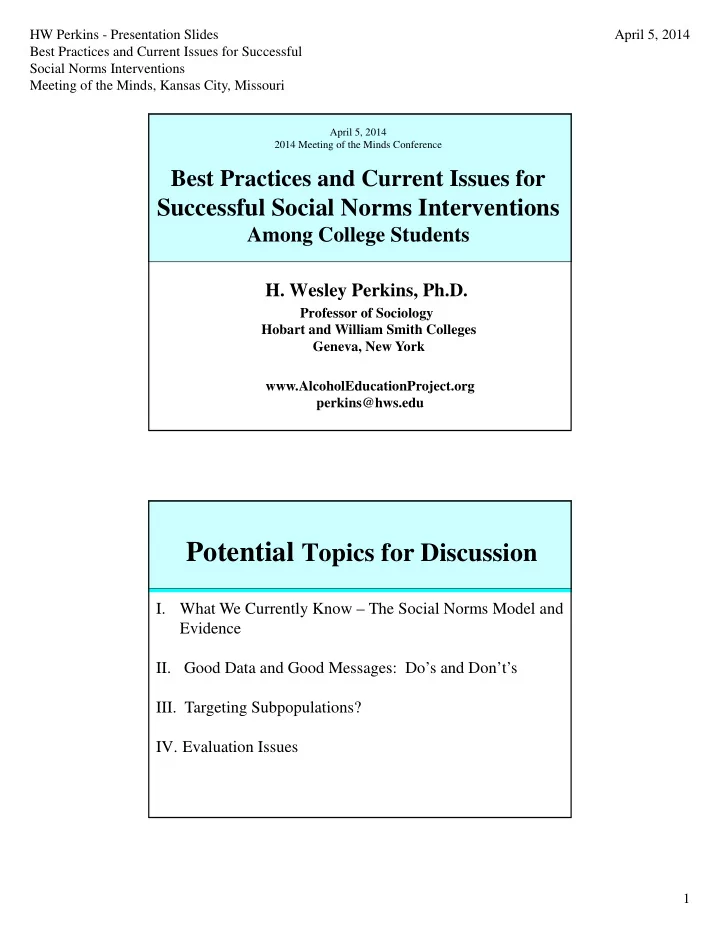
April 5, 2014 2014 Meeting of the Minds Conference

Best Practices and Current Issues for

Successful Social Norms Interventions

Among College Students

  • H. Wesley Perkins, Ph.D.

Professor of Sociology Hobart and William Smith Colleges Geneva, New York www.AlcoholEducationProject.org perkins@hws.edu

Potential Topics for Discussion

I. What We Currently Know – The Social Norms Model and Evidence

  • II. Good Data and Good Messages: Do’s and Don’t’s
  • III. Targeting Subpopulations?
  • IV. Evaluation Issues
slide-2
SLIDE 2

HW Perkins - Presentation Slides Best Practices and Current Issues for Successful Social Norms Interventions Meeting of the Minds, Kansas City, Missouri April 5, 2014 2

What We Currently Know

  • Traditional approaches to reduce problem

drinking (health education, health terrorism, and social control) have limited or no effect.

  • Grossly exaggerated perceptions of the

drinking norms pervade all campuses and subcultures.

Long Tradition of Theory and Research on Peer Influence and Conformity to Peer Norms

But what about Perceptions of Peer Norms?

slide-3
SLIDE 3

HW Perkins - Presentation Slides Best Practices and Current Issues for Successful Social Norms Interventions Meeting of the Minds, Kansas City, Missouri April 5, 2014 3

What students think are the most common attitudes and behaviors of peers regarding alcohol are often inaccurate.

  • Most students overestimate:

1) the permissiveness of peers 2) how often peers drink 3) how much peers drink 4) how frequently peers incur consequences

  • Most students underestimate:

1) peer use of protective drinking strategies 2) peer support for campus alcohol policies

Students’ Misperceptions of the Norm for the Number of Drinks Consumed the Last Time Other Students “Partied”/Socialized at Their School

(NCHA Nationwide Data from 72,719 Students Attending 130 Schools, 2000-03)

Accuracy of Perceived Drinking Norm

Under- estimate by 3+ Drinks Under- estimate by 1-2 Drinks Accurate Estimate Over- estimate by 1-2 Drinks Over- estimate by 3+ Drinks

3% 12% 14% 32% 39%

Source: HW Perkins, M Haines, and R Rice, Journal of Studies on Alcohol, 2005.

71% Overestimate Peer Drinking!

slide-4
SLIDE 4

HW Perkins - Presentation Slides Best Practices and Current Issues for Successful Social Norms Interventions Meeting of the Minds, Kansas City, Missouri April 5, 2014 4

What We Currently Know

  • Perception of the peer norm is the strongest

predictor of personal drinking level compared to all personal, demographic & environmental factors that have been researched.

  • Bystanders become more prevalent due to

misperceptions of the norm.

Consequences of Misperceptions

  • Definition of the situation produces a

“Reign of Error”

  • Problem Drinking Increases
  • Layers of Misperceptions Compound
  • Opposition is Discouraged from Speaking
  • Intervention by Others Declines
  • “Carriers” of Misperception Contribute

to the Problem

Source: H. W. Perkins, “Designing Alcohol and Other Drug Prevention Programs…,” 1997

slide-5
SLIDE 5

HW Perkins - Presentation Slides Best Practices and Current Issues for Successful Social Norms Interventions Meeting of the Minds, Kansas City, Missouri April 5, 2014 5

Normative Education

Letting more people know that most of their peers drink in moderation helps even more peers make responsible decisions about drinking.

The Social Norms Model

Baseline Identify Actual & Misperceived Norms Intervention Intensive Exposure to Actual Norm Messages Less Exaggerated Misperceptions of Norms Predicted Result Less Harmful or Risky Behavior

slide-6
SLIDE 6

HW Perkins - Presentation Slides Best Practices and Current Issues for Successful Social Norms Interventions Meeting of the Minds, Kansas City, Missouri April 5, 2014 6

Examples of Strategies to Reduce Misperceptions and Strengthen Positive Norms

  • Print media and PSA campaigns
  • Peer education programs and workshops

for targeted risk groups

  • New student orientation presentations
  • Counseling interventions
  • Curriculum infusion
  • Electronic multimedia
  • Online Personalized Normative Feedback

Getting Good Data

  • Sample Size and Frequency
  • Representative Sample
  • Measures of Injunctive (Attitudinal) Norms
  • Measures of Frequency of Use
  • Measures of Quantity
  • Measures of Negative Consequences
slide-7
SLIDE 7

HW Perkins - Presentation Slides Best Practices and Current Issues for Successful Social Norms Interventions Meeting of the Minds, Kansas City, Missouri April 5, 2014 7

Creating Good Messages

  • Majority behavior that is positive
  • Include images that identify local population
  • Avoid identifying individuals
  • Do not display the problem behavior
  • Provide the source and make it large enough

to make it part of the message

  • Avoid overuse of logos and branding
slide-8
SLIDE 8

HW Perkins - Presentation Slides Best Practices and Current Issues for Successful Social Norms Interventions Meeting of the Minds, Kansas City, Missouri April 5, 2014 8

slide-9
SLIDE 9

HW Perkins - Presentation Slides Best Practices and Current Issues for Successful Social Norms Interventions Meeting of the Minds, Kansas City, Missouri April 5, 2014 9

slide-10
SLIDE 10

HW Perkins - Presentation Slides Best Practices and Current Issues for Successful Social Norms Interventions Meeting of the Minds, Kansas City, Missouri April 5, 2014 10

slide-11
SLIDE 11

HW Perkins - Presentation Slides Best Practices and Current Issues for Successful Social Norms Interventions Meeting of the Minds, Kansas City, Missouri April 5, 2014 11

HWS students typically drink alcohol

  • nce a week or less.

Source: Data collected in the Spring 2000 BD295 survey of a representative cross-section of 327 students.

slide-12
SLIDE 12

HW Perkins - Presentation Slides Best Practices and Current Issues for Successful Social Norms Interventions Meeting of the Minds, Kansas City, Missouri April 5, 2014 12

slide-13
SLIDE 13

HW Perkins - Presentation Slides Best Practices and Current Issues for Successful Social Norms Interventions Meeting of the Minds, Kansas City, Missouri April 5, 2014 13

slide-14
SLIDE 14

HW Perkins - Presentation Slides Best Practices and Current Issues for Successful Social Norms Interventions Meeting of the Minds, Kansas City, Missouri April 5, 2014 14

slide-15
SLIDE 15

HW Perkins - Presentation Slides Best Practices and Current Issues for Successful Social Norms Interventions Meeting of the Minds, Kansas City, Missouri April 5, 2014 15

When is the Social Norms Approach Most Effective?

  • Clear positive norm messages
  • Credible data
  • Absence of competing scare messages
  • Dosage is high (ongoing and intense social

marketing of actual norms)

  • Synergistic strategies
  • Broad student population receives message

in addition to any high-risk target groups

Source: H. W. Perkins (ed), The Social Norms Approach to Preventing School and College Age Substance Abuse , 2003

slide-16
SLIDE 16

HW Perkins - Presentation Slides Best Practices and Current Issues for Successful Social Norms Interventions Meeting of the Minds, Kansas City, Missouri April 5, 2014 16

Research on Effects of Perceived Norms and Social Norms Intervention Programs

  • Multi-site cross-sectional studies
  • Longitudinal panel studies
  • Brief intervention experiments using random

assignment

  • Longitudinal pre/post case studies of school populations
  • Experiments with experimental and control counties
  • Experiments with experimental and control classroom

interventions

  • Longitudinal experiments randomly assigning

institutions to experimental and control conditions

Heavy Drinking Reductions at Five Diverse Institutions Initiating a Social Norms Approach

(2 Year Rates of Change)

  • Hobart & Wm. Smith Colleges, NY -21%
  • University of Arizona
  • 21%
  • Western Washington University
  • 20%
  • Rowan University, NJ
  • 20%
  • Northern Illinois University
  • 18%

Source: H. W. Perkins (ed.), The Social Norms Approach to Preventing School and College Age Substance Abuse, 2003.

slide-17
SLIDE 17

HW Perkins - Presentation Slides Best Practices and Current Issues for Successful Social Norms Interventions Meeting of the Minds, Kansas City, Missouri April 5, 2014 17

All Undergraduates Students Parent Orientation Annual Session with Normative Statistics

  • - Commenced

Summer 2002 At Risk Groups First Year Students Target Audience Supplemental Social Norms Programs Campus Wide Campaign Weekly Campus Posters, newspaper ads, BAC cards, & E-mails

  • - Commenced Fall 2002

Annual music event

  • - Commenced Spring 2004

Facebook Ads

  • - Commenced Spring 2005

Primary Campaign Monthly Dorm Posters

  • - Commenced Fall

1999 Small Group Norms For Athletes, Fraternities & Sororities

  • - Commenced Fall 2003

Social Norms Programs

Social Norms Marketing Programs at the University of Virginia

Source: James Turner, H. Wesley Perkins, and Jennifer Bauerle, “Declining Negative Consequences Related to Alcohol Misuse Among Students Exposed to a Social Norms Marketing Intervention on a College Campus,” Journal of American College Health 2008.

Six Years of Declining Negative Consequences Related to Alcohol Misuse Among Students Exposed to a Social Norms Intervention at U of Virginia

Source: J Turner, H W Perkins, J Bauerle, Journal of American College Health, 2008

2001 2002 2003 2004 2005 2006

% No Consequences

33 38 44 46 48 51

% Multiple Consequences

44 40 36 34 31 26

slide-18
SLIDE 18

HW Perkins - Presentation Slides Best Practices and Current Issues for Successful Social Norms Interventions Meeting of the Minds, Kansas City, Missouri April 5, 2014 18

Not All Results From the Field Are Consistently Positive:

What does a lack

  • f impact reflect?

Model Outcome of Social Norms Approach

Time 1 Baseline Identify Actual & Misperceived Norms Time 2 Intervention Provide Intensive Exposure to Actual Norm Messages Less Exaggerated Misperceptions

  • f Norms

Predicted Result Less Harmful or Risky Behavior

Source: H. Wesley Perkins, 2001

YES YES YES YES

slide-19
SLIDE 19

HW Perkins - Presentation Slides Best Practices and Current Issues for Successful Social Norms Interventions Meeting of the Minds, Kansas City, Missouri April 5, 2014 19

Possible Outcomes of Social Norms Approach

Time 1 Baseline Identify Actual & Misperceived Norms Time 2 Intervention Provide Intensive Exposure to Actual Norm Messages Less Exaggerated Misperceptions

  • f Norms

Predicted Result Less Harmful or Risky Behavior

Source: H. Wesley Perkins, 2001

YES NO Not enough dosage or synergistic strategies to generate sufficient message awareness

Possible Outcomes of Social Norms Approach

Time 1 Baseline Identify Actual & Misperceived Norms Time 2 Intervention Provide Intensive Exposure to Actual Norm Messages Less Exaggerated Misperceptions

  • f Norms

Predicted Result Less Harmful or Risky Behavior

Source: H. Wesley Perkins, 2001

YES YES NO Confusing or Counter Messages

slide-20
SLIDE 20

HW Perkins - Presentation Slides Best Practices and Current Issues for Successful Social Norms Interventions Meeting of the Minds, Kansas City, Missouri April 5, 2014 20

Possible Outcomes of Social Norms Approach

Time 1 Baseline Identify Actual & Misperceived Norms Time 2 Intervention Provide Intensive Exposure to Actual Norm Messages Less Exaggerated Misperceptions

  • f Norms

Predicted Result Less Harmful or Risky Behavior

Source: H. Wesley Perkins, 2001

YES YES YES NO But only for a targeted subgroup

April 5, 2014 2014 Meeting of the Minds Conference

Best Practices and Current Issues for

Successful Social Norms Interventions

Among College Students

  • H. Wesley Perkins, Ph.D.

Professor of Sociology Hobart and William Smith Colleges Geneva, New York www.AlcoholEducationProject.org perkins@hws.edu