SLIDE 1
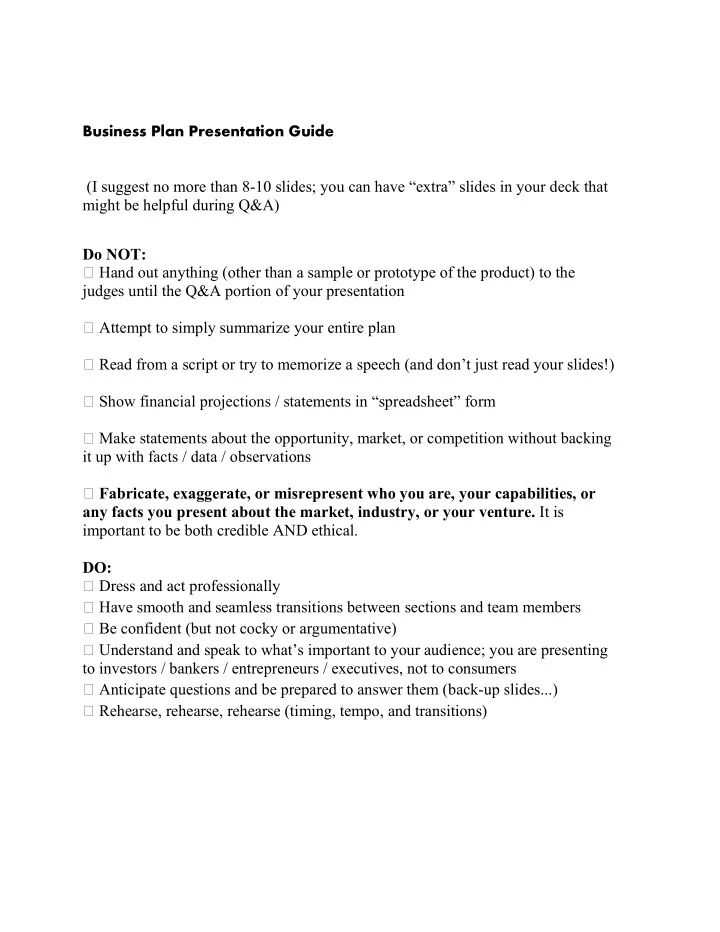
Business Plan Presentation Guide (I suggest no more than 8-10 slides; you can have “extra” slides in your deck that might be helpful during Q&A) Do NOT: Hand out anything (other than a sample or prototype of the product) to the judges until the Q&A portion of your presentation Attempt to simply summarize your entire plan Read from a script or try to memorize a speech (and don’t just read your slides!) Show financial projections / statements in “spreadsheet” form Make statements about the opportunity, market, or competition without backing it up with facts / data / observations Fabricate, exaggerate, or misrepresent who you are, your capabilities, or any facts you present about the market, industry, or your venture. It is important to be both credible AND ethical. DO: Dress and act professionally Have smooth and seamless transitions between sections and team members Be confident (but not cocky or argumentative) Understand and speak to what’s important to your audience; you are presenting to investors / bankers / entrepreneurs / executives, not to consumers Anticipate questions and be prepared to answer them (back-up slides...) Rehearse, rehearse, rehearse (timing, tempo, and transitions)
SLIDE 2 Oral Business Plan Presentation Evaluation Criteria
Team Presentation Style (35%)
Materials presented in clear, concise, and logical and/or sequential form Presentation stayed within time frame Conveyed confidence and professionalism Responsiveness to judges/Effectively fielded questions Stimulated investor interest and/or ability to maintain judge’s interest Clearly described product/service and demonstrated knowledge of industry Operations addressed and major challenges/risks identified
Visual Aids (15%)
Clear and readable Relevant to plan Attractive and professional
Viability (50%)
Market Opportunity: Present clear market need and way to take advantage of that need Distinctive Competence: Show the venture’s uniqueness that offers a competitive advantage Management Capability: Show the team can effectively develop the venture and handle risks Financial Understanding: Show the team has a solid understanding of the financial
requirements
Investment Potential: Show the business is investment worthy.
SLIDE 3 Business Plan presentation order (group B)
- 1. Millenium travel and tours
- 2. Mythesis
- 3. Online Business Kolla
- 4. Hunny Bunny
- 5. Glammer 4Ever
- 6. Millenium care
- 7. Safety Homesolo
- 8. Solartrick
- 9. Coolme Umbrella
- 10. Crunch Healthy food
- 11. Smart house cleaning
- 12. Print protection lottery
- 13. Synergy Acadamy
Business Plan presentation order (Group A)
- 1. Highfliers
- 2. Gro
- 3. Find your lot
- 4. Smart Unitlity Mgt Device
- 5. Organic restaurant
- 6. clinic rebirth mobile spar
- 7. click to home
- 8. Hybride Insitutions
- 9. Inhouse childcare
- 10. ………
SLIDE 4
Written Business Plan Evaluation Criteria
Executive summary (5%) Summary is clear, interesting, and effective as a stand-alone overview of the plan; includes brief description of other sections of the plan. Can be read in 5 minutes. Venture Overview (5%) Presents vision, history, current status, strategy, goals, mission and objectives for the venture. Products or Services (10%) Describes the key features and benefits, current stage of development, proprietary position, and competitive advantages of the product or service. Intellectual Property (5%) Awarded only if the venture has secured license to or ownership of intellectual property to protect the product or service, or intends to secure such. Market Analysis (10%) Presents the growth trends and key driving forces of the industry; identifies the key characteristics and needs of the target market(s); assesses the competitive environment; demonstrates market acceptance for the product or service as well as estimated size of market. Management Team (10%) Provides backgrounds and roles of key individuals; history and ability to work as an effective team; personnel needs; organizational structure. Operating Strategies (10%) Addresses the marketing, production, R&D, personnel, administrative, and financial strategies for the proposed firm. Critical Risks (10%) Realistically identifies the major internal and external critical risks that could threaten the business and presents viable contingency plans to address these issues. Cash Flow Statement (10%) Presents a realistic assessment of cash requirements—inflows and outflows—over a projected 5-year period; cash flows are consistent with operating and marketing strategies outlined in the body of the plan; cash flow information detailed for first 2 years; quarterly/annually for years 3-5. Income Statement (5%) Demonstrates realistic and attractive income potential of the business; the income statement is consistent with the operating and marketing strategies outlined in the body of the plan; income statement information detailed for first 2 years; quarterly/annually for years 3-5.
SLIDE 5
Balance Sheet (5%) Presents a realistic assessment of the working capital and fixed asset requirements of the business; appropriately reflects the projected capital structure of the business – long-term debt and equity positions; balance sheet information is projected annually for 5 years. Funds Required/Used (5%) Presents a clear and concise description of the amount, timing, type and use of funds required for venture. Offering (10%) Articulates clearly the proposal/terms to private investors; identifies what the venture is seeking from investors; states how much, if any, equity will be given up in return for investment capital; presents a realistic assessment of ROI potential; and presents an appropriate deal structure and possible exit scenarios.