Bus Stop Improvement Plan A Metropolitan Washington Council of - - PowerPoint PPT Presentation

bus stop improvement plan
SMART_READER_LITE
LIVE PREVIEW

Bus Stop Improvement Plan A Metropolitan Washington Council of - - PowerPoint PPT Presentation

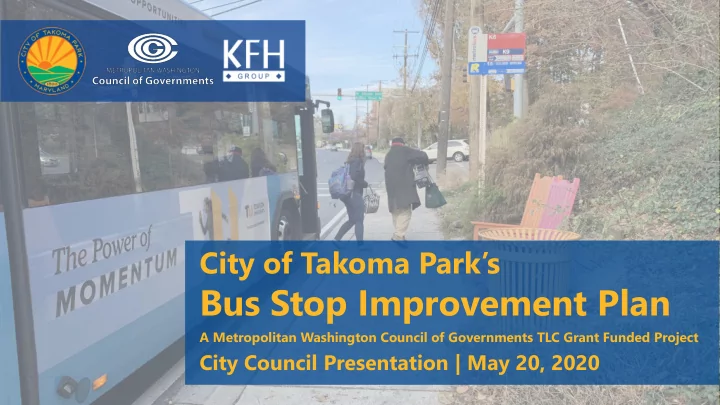
City of Takoma Parks Bus Stop Improvement Plan A Metropolitan Washington Council of Governments TLC Grant Funded Project City Council Presentation | May 20, 2020 Bus Stop Assessment & Plan The City of Takoma Park provides passenger

slide-1
SLIDE 1

City of Takoma Park’s

Bus Stop Improvement Plan

A Metropolitan Washington Council of Governments TLC Grant Funded Project

City Council Presentation | May 20, 2020

slide-2
SLIDE 2

Bus Stop Assessment & Plan

  • The City of Takoma Park provides passenger

amenities and accessible pathways for

138 bus stops

  • Technical assistance was requested through

COG for a bus stop assessment & plan

  • Field survey & ADA evaluation
  • Improvement guidelines
  • Recommended improvements
  • Project is 100% funded through a COG

Transportation Land-Use Connections Grant

2

Study Partners

slide-3
SLIDE 3

Bus Stops

3

  • Every transit rider is a pedestrian
  • Sidewalks and street crossings are

foundational elements

  • Accessibility – greater mobility for

individuals with disabilities

  • Equitable outcomes – public transit is a

key public investment

  • Marketing tool – better experience for

riders and pedestrians, makes transit a better option

  • Installation and maintenance requires

communication, resources, and funding

Inaccessible Bus Stop on University Ave. Inviting Bus Stop on New Hampshire Ave.

slide-4
SLIDE 4

Bus Stop Accessibility Guidelines

4

  • Americans with Disabilities Act (ADA)
  • ADA Accessibility Guidelines

(ADAAG)

  • Public Right-of-Way Accessibility

Guidelines (PROWAG)

  • All Bus Stops Must Have:
  • Firm and stable surface
  • Level slope (no more than 2% slope)
  • Clear space (landing pad) minimum
  • f 96” perpendicular and 60” parallel

to the direction of the street

  • Connection to street or sidewalk

Landing Pad Guidelines Shelter Guidelines

slide-5
SLIDE 5

Bus Stop Data Collection & Inventory

5

  • 138 Bus Stops Evaluated
  • 54 ADA Compliant
  • 84 ADA Non-compliant
  • Landing pads are the

leading cause of non-compliance

slide-6
SLIDE 6

Bus Stop Passenger Amenities

6

81%

54%

5%

Passenger Amenities at Bus Stops

42% 40% 28% 26% 18%

slide-7
SLIDE 7

Local Bus Stop Guidelines

7

Bus Stop Element Guideline

Bus Stop Sign

Required

ADA Compliant 5’ x 8’ Landing Pad

Required

Sidewalk Connection

Required

Lighting (within 30-feet)

All Stops

Bench/Seating

All Stops

Information Case

Site Specific

Trash/Recycling

Site Specific

Shelter

30+ Daily Boardings

Real-time Arrival Displays

All Shelters

slide-8
SLIDE 8

Recommended Improvements

8

Estimated Costs for ADA Accessibility & City Initiative Improvements

Estimated costs are generalized and based on FY2020 Montgomery County Bus Stop Improvement Program costs

$50k

Landing Pads

72 Stops $4,000 Each

Shelters

8 Stops (ADA) 14 Stops (30+) $15,000 Each

Curb Ramps

30 Stops $3,500 Each

Sidewalk Improvements

5 Stops $10,000 Each

Lighting

26 Stops $1,000 Each

Digital Display

22 Stops $1,000 Each

New Sign

12 Stops $200 Each

Detectable Warning

20 Stops $100 Each

$26k $22k $330k $288k $105k $50k $2.4k $2k Total Estimated Cost: $825,400

slide-9
SLIDE 9
  • Over half (72) of the City’s bus stops require expanded or improved

landing pads to meet ADA Guidelines

  • Estimated 35 stops with potential ROW conflicts (legal and/or physical)
  • Some sidewalk & curb ramp improvements may also face ROW conflicts

9

Landing Pads & the PROW

Steep Grade Retaining Wall Vegetation

slide-10
SLIDE 10

Improvement Approaches

  • Implementation should focus on ridership, racial equity, climate

impact, cost and safety

  • Incorporate improvements into other public works projects
  • Consider community-based approaches and creative elements
  • This plan developed a cumulative priority score that included:

10

slide-11
SLIDE 11

11

Flower Avenue Improvements

December 2019 April 2020

slide-12
SLIDE 12

What’s Next?

  • Consider bus stop improvements holistically
  • Strides can be made through other City

initiatives:

  • ADA Sidewalk Improvements
  • Streetscape Improvements
  • Streetlight Replacement/Upgrades
  • Tree Pruning/Vegetation Management
  • Update and maintain the Bus Stop Inventory
  • Promote progress and update implementation

plans regularly

  • Maintain bus stop amenities

12