
SLIDE 1
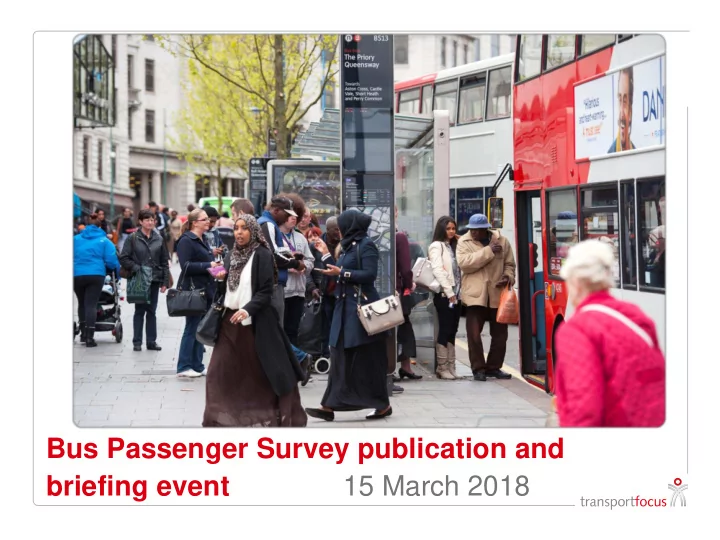
Bus Passenger Survey publication and briefing event 15 March 2018 - - PowerPoint PPT Presentation
Bus Passenger Survey publication and briefing event 15 March 2018 Welcome Jeff Halliwell, Chair, Transport Focus Todays agenda 11:05 Bus Passenger Survey Autumn 2017 results briefing Robert Pain, Senior Insight Advisor, Transport Focus 11:25
11:05 Bus Passenger Survey Autumn 2017 results briefing
Robert Pain, Senior Insight Advisor, Transport Focus
11:25 The Government’s view
Nusrat Ghani MP, Parliamentary Under Secretary of State for Transport
11:35 The opposition’s view
Matt Rodda MP, Shadow Minister for Transport
11:55 Why bus drivers make a difference to passengers
David Sidebottom, Director, Transport Focus
12:00 Drivers – their role in delivering bus passenger satisfaction
Maks Pruszewicz, “Driver of the year” & Martijn Gilbert, Chief Executive Officer, Reading Buses
12.25 What should the industry do to help drivers deliver better service?
Alex Warner, Chief Executive, Flash Forward Consulting
12.40 Audience Q&A (chair: Jeff Halliwell, Transport Focus) 12:55 Sum up & next steps,
5
Presentation of results
15 March 2018
6
48 areas in England: a. 6 former metropolitan counties, b. 13 unitary authorities, c. 8 two-tier authorities, d. 21 bus company divisions; Around 70% of remit journeys covered 7 areas in Wales: a. 4 Welsh regions (covering the majority of the country) b. 3 bus company boosts (Newport Bus, TrawsCymru and TrawsCymru weekend) 8 areas in Scotland: a. 7 bus company divisions (for First, Stagecoach and National Express) b. 1 authority area boost (Aberdeenshire) Across the entire survey, opinions gathered from 47,862 bus passengers.
Bus Passenger Survey 2017 - Scope
7
England Local Authorities – key measures
15 March 2018
8
Overall satisfaction - by local authority area
Total very and fairly satisfied
9
Latest results show continuing variability in passenger journey experience across the country, but better news in PTEs
top of the table this time with 94%
Northumberland (59%) have the highest levels of passengers ‘very satisfied’ with their journey
Somerset has seen the biggest improvement since 2016, going from 85% to 89% overall satisfaction
(79%) are both new to the survey, with the highest shares of passengers ‘neither satisfied nor dissatisfied’ with their journey overall (19% and 13% respectively)
Overall satisfaction - by local authority area
10
Of our four key measures, value for money has the widest range in satisfaction, but this has narrowed in our latest survey
(72%) and Greater Manchester (72%) are top of the table this time
levels of passengers ‘very satisfied’ with the value for money of their journey
generally improved, with Essex going from 46% to 51% and West Yorkshire from 57% to 62%, but the biggest improvements are for County Durham (from 58% to 73%), Northumberland (56% to 65%) and West of England (56% to 64%)
Cornwall, down from 61% in 2016 to 54% in 2017
Satisfaction with VFM for fare payers - by local authority area
12
Punctuality remains a challenge, with passengers in some parts of the country experiencing an improvement, others a deterioration
top the table this time with 83% satisfaction with punctuality of the bus
biggest improvement since 2016, going from 67% to 73%
the largest decline, going from 79% to 74%
satisfaction with punctuality, at 63%, while also having the highest share of passengers who were ‘very dissatisfied’ with the punctuality of the bus, at 17%
Satisfaction with punctuality - by local authority area
14
Passengers continue to rate their on-bus journey time better than punctuality, but there are similar patterns
Bournemouth (91%) are top of the table this time, while Mersey & Halton and Tyne & Wear top the PTE list (both 89%)
have been seen in Greater Manchester (from 79% to 84%), Leicester City (81% to 85%) and Northumberland (88% to 92%)
Cornwall, down from 85% in 2016 to 80% in 2017
level of satisfaction with the time their journey took, at 77%, although 21% were ‘neither satisfied nor dissatisfied’
Satisfaction with on-bus journey time - by local authority area
21
Individual Operators in England (outside of London) – key measures
15 March 2018
22
Latest results show wider variability in passenger journey experience between operators, both within major urban centres and beyond
and the major operators in Nottinghamshire (Nottingham City Transport, Stagecoach and Trent Barton all on 94%)
First (82%) within the county
Overall satisfaction - by bus operators
23
Passenger ratings of value for money remain highly dependent upon local performance, ticket levels and other ticketing initiatives Satisfaction with VFM for fare payers - by bus operators
lowest (42% for the Cambridge Busway) levels of satisfaction with value for money
between First (68%) and Stagecoach (75%) within Greater Manchester, whereas in South Yorkshire the same two operators both received scores of 67%
24
Wide variation in passenger ratings of punctuality, both within major conurbations and beyond, illustrates the impact of local conditions Satisfaction with punctuality - by bus operators
(87%) and the major operators in Nottinghamshire (all between 84% and 86%)
Diamond Bus in West Midlands to 85% for Keighley & District in West Yorkshire; while in Manchester, satisfaction ranged from 64% for First to 77% for Stagecoach
25
Wide variation in passenger ratings of the time their journey took, even for the same national operator, illustrates the impact of local conditions
Satisfaction with on-bus journey time - by bus operators
within PTEs for Arriva in Mersey & Halton (90%)
Stagecoach in Swindon and Diamond Bus in Worcestershire (both 73%), while within PTEs it was Arriva in West Yorkshire (77%)
30
England (outside of London) – factors affecting journey times
15 March 2018
31
What affected journey time in England (outside London)?
32
What affected journey time in England (outside London)?
33
Total very and fairly satisfied
Journey time by travel time in England (outside London)
Satisfaction with on-bus journey time What affected journey time?
Q.Was the length of time your journey took affected by any of the following? [note: multiple responses permitted]
34
England (outside of London) – key results
15 March 2018
35 Overall journey
Key performance measures for England (outside of London)
Value for money Punctuality Journey time Figures shown are total very or fairly satisfied. Last year's figure shown in grey, where available.
36
Overall experience: what makes a satisfactory or great journey?
Key Driver Analysis’ looks at fare paying passengers’ overall journey satisfaction response and their response to the 30 individual satisfaction measures in the survey (including value for money), which have been grouped into 10 themes based upon a statistical analysis of the responses. The left hand chart shows which themes most differentiate between those not satisfied and satisfied overall – making a journey ‘satisfactory’. The right hand chart shows which themes most differentiate between those fairly and very satisfied overall – making a ‘great’ journey.
37
What could be improved - proportion of all those stating an improvement area % passengers who wrote an improvement comment % passengers who wrote nothing could be improved
Overall experience: what could be improved?
38
Total very and fairly satisfied
Bus driver interaction and the driving
B) The driver’s appearance; C) The greeting/welcome you got from the driver; D) The helpfulness and attitude of the driver; E) The time the driver gave you to get to your seat: F) Smoothness/freedom from jolting during the journey; G) The safety of the driving (i.e. appropriateness of speed, driver concentrating).
England (outside of London)
39
Total very and fairly satisfied
On the bus: bus driver - the driving by travel time
Satisfaction with smoothness/freedom from jolting Satisfaction with safety of the driving
F) Smoothness/freedom from jolting during the journey; G) The safety of the driving (i.e. appropriateness of speed, driver concentrating).
40
Passenger ratings for safety of the driving remain high; top scores are shared between national and local operators
40
Bus drivers: safety of the driving – by bus operators
41
Passenger ratings for the helpfulness/attitude of the driver are more varied; top scores more concentrated amongst locally branded
41
Bus drivers: helpfulness and attitude – by bus operators
42
Wales – key results
15 March 2018
43 Overall journey
Key performance measures for Wales
Value for money Punctuality Journey time
44
Overall experience: what makes a satisfactory or great journey?
Key Driver Analysis’ looks at fare paying passengers’ overall journey satisfaction response and their response to the 30 individual satisfaction measures in the survey (including value for money), which have been grouped into 10 themes based upon a statistical analysis of the responses. The left hand chart shows which themes most differentiate between those not satisfied and satisfied overall – making a journey ‘satisfactory’. The right hand chart shows which themes most differentiate between those fairly and very satisfied overall – making a ‘great’ journey.
45
Scotland – key results
15 March 2018
46 Overall journey
Key performance measures for Scotland
Value for money Punctuality Journey time Figures shown are total very or fairly satisfied.
47
Emerging themes
15 March 2018
48
Here are a few more themes and stories emerging from the results that we will be sharing during our ‘roadshow’
upon waiting time, punctuality, journey time (including those factors affecting it), space on board and smoothness of the driving
(backing up what we saw in our young people’s research)
saying that they had no option to travel by other means provide clues to the decline in patronage?
48
49
Any questions?
Robert Pain and David Sidebottom
there were more like him. Two weeks ago the same driver actually waited for my mother who is unable to walk, switched everything off, walked up to her shopping and accompanied her to her seat. What a perfect gentleman. Well done.”
have issues with the buses, just staff.”
without parents. Gaining independence
– Real appeal and like the idea of relaxing, talking to friends, enjoying the journey – Initial experiences inform development of attitudes towards buses & difficulties resonate for a while – not easily forgotten
– Early experience can deter future use
look/ feel silly
– How do I get there or find out best bus or route? – How do I catch the bus? Where is the stop? Is it safe? – How do I know what time will my bus arrive? What if it is late? – What do I say to bus driver? What fare am I asking for? – How much will it cost me? What if I get it wrong and asked to get off bus? – How will I know where to get off? What time are the buses coming back?
“The independence is a big one, being able to get the train and bus on their own is quite cool for young people who are still too young to drive”. (Essex, 17-19s)
– Reliability of buses (turning up on time) – Clean seats and floors, – Comfortable seats (leather effect) – Friendly bus driver – smile and say ”hello” – Device charge points – Fast Wi-Fi (fast enough to stream music) – Better legroom – Newspapers?
enough
– It is also about communication of how easy and useful a bus journey can be – Digital display boards/live trackers
“Clean, on time, drivers that greet you, maybe something to do on the bus like the Metro and more reliable, make sure it’s on time every time”. (Leeds, 17-19s)
“Would be nice to have something that tells you where you are or when you are getting to a certain bus stop because I had to look on Google Maps on my phone, or at least for it to say the name of the bus stop at the actual stop”. (Essex, 14-16s)
Bus passengers’ experience of delays and disruption
passengers’ experiences and their desire that bus drivers behave as the customer service representative during disruption
be providing information, demonstrating empathy and expressing regret during delays and disruption
at times, there is genuine conflict between ‘operations’ and ‘customer service’ in a driver’s role
passengers do (e.g. congestion, road works/blocks, diversions, weather, accidents, mechanical problems)
they do – an assumption that things have been seen, read, understood and assimilated
They can see that something’s happened there, it’s not just a queue of traffic, they’ve probably seen that there’s been an accident You can see the posters up at the stop so they know the bus will divert [For example] there’s been an accident….you can get in touch with [your base] and say am I ok if I go up here, and they’ll… say yes ok… and away you go – you’re putting an effort in, which you know [the passengers] can see you doing so they appreciate that
Bus driver training: What works? What next?
interviews
training centres and training materials
talked to trainers
research data, verbatim comments from passengers and our own
Bus driver training. What works? What next? Headlines…
impact they have on passengers’ travel experience
skills
and their desire that bus drivers behave as the bus company’s customer service representative
service training
driver, it is a whole-business responsibility Bus driver training. What works? What next? Headlines…
What should the industry do to help bus drivers deliver better service? 15 March 2018 Alex Warner
experience by experienced customer service commentators – focusing on factual evidence and the customer emotional aspects against their priority requirements for each touchpoint
adequate, but unmemorable)
caution)
a glow when taking one’s seat are the minority
schisms
limited
a greeting of sorts and over-compensate
training is better and there is a greater level of intent and awareness that something needs to change amongst management, but it is still an aspiration, rather than genuine conviction
and where this is the case, the rapport seems better
The Job
but not followed-up on
product changes
and travel shops as well as marketing collateral leaves drivers feeling
queries and unsupported
fares/product overload
accidents and customer expectations
Structure
Service benchmarking/body
and if annual leave is granted
friendly
progress into management
process undefined (and by exception)
limited coaching around impact of decisions on customers
drivers on products
Culture
make a song and dance about driver attitude issues
Allocators lack interpersonal skills
they are doing (unless there is a complaint)
network or product changes
managers
re-structures
supervisors and managers have fallen behind
visible
equipment in wrong places, with a general feeling of a poorly managed supervisory team”
inconsistency’s I currently work for – expecting vehicles to be looked after and it’s clear they aren’t, placing the wrong vehicles on routes which are not suitable for said work. But the most rewarding and enjoyable thing is knowing I am providing a bus service to people who have no other means of getting about, I am providing a friendly face to their day out”
Buses knew how to look after their staff. The routes were varied and they provided good training and career progression. The staff were friendly and everybody was made to feel welcome.
get you into the company, then treat you like dirt after you have signed an agreement with them that keeps you there for a minimum of 2 years”
hoops, get shafted after the hoops, customers are full of abusiveness, not respectful to you as a driver nor the companies vehicles. This job destroys families”
friendly person, then this can be a great job/career choice. On any typical day, you’ll get the odd couple of impolite passengers but as long as you don’t take things personally you’ll be fine. Only you as the driver can make your job difficult, such as coming to work tired or stressed”
vehicles on the road. But the company itself didn’t care about the staff without the driver no money would be made and they looked at drivers as the lowest of the low, you’re just a number”
the vicinity of his cab, that it sub-consciously lifts his/her behaviour to customers
companies when it comes to issues such as accountability for leaflets and maintenance of notices
when they have been logged
leads them to be, in many cases, anything but product ambassadors
properly – and that’s even before we start talking about Apps, Wi-Fi and e-ticketing
1/. Customer Services Vision, Strategy and derivative Customer Service Plans 2/. Driver to Staff Manager ratio – it’s a false economy and needs resolving! 3/. Proving you can emancipate the Staff Manager to exit the surgery – psychological block 4/. Proper process for senior leadership visibility with customers & drivers (non-patronising) 5/. Create momentum around customer service scores & insight – cascade briefs from TF 6/. National Customer Services Standards– & SOPs (particularly for on-board presentation) 7/. Invigorating industry-wide customer experience training– with external benchmarking 8/. Proper follow-up training – structured, recorded “Job Chats” – industry standard/process 9/. Mystery shopping with conviction – good, bad or indifferent, feed the results back 10/. Product awareness coaching, support & tools – national online app/manual and ambassador training
11/. Network Planning – involve drivers – running times & their insight on customer needs 12/. Programme to identify and fast-track future customer service leaders from driving team 13/. Competency framework for recruitment, performance management and development 14/. Stop incessant, debilitating re-structures, the grind factor ultimately impacts on drivers 15/. Properly pay and train first line managers (across full spectrum of skills) 16/. Relentlessly focus on the Diversity Agenda – not just rhetoric but action! 17/. Greater collaboration on developing drivers, including loan system 18/. Industry bodies / seminars raising profile of customer service 19/. Create pan-industry customer service group (like Customer Experience Board at RDG) 20/. Nationwide customer experience accreditation process for each operator