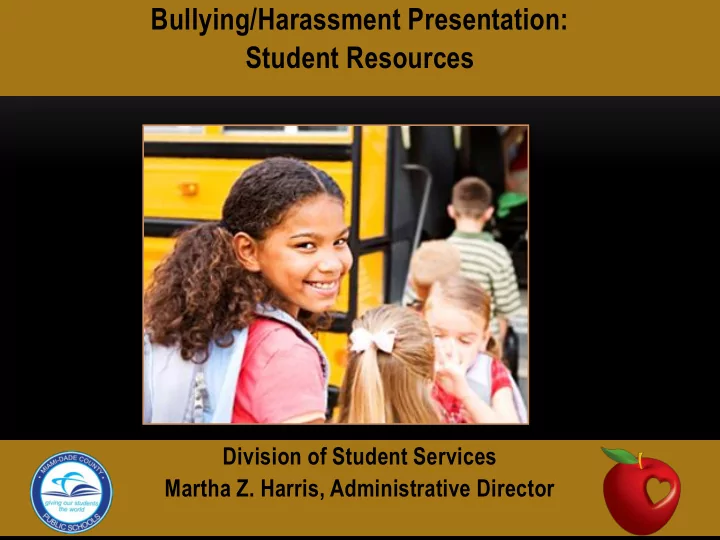
Bullying/Harassment Presentation: Student Resources Division of - - PowerPoint PPT Presentation

bullying harassment presentation
SMART_READER_LITE
LIVE PREVIEW

Bullying/Harassment Presentation: Student Resources Division of - - PowerPoint PPT Presentation

Bullying/Harassment Presentation: Student Resources Division of Student Services Martha Z. Harris, Administrative Director Raise Your Hand If You Told a friend or two that you dont like someone and that they should not like her/him and


slide-1
SLIDE 1

Division of Student Services Martha Z. Harris, Administrative Director

Bullying/Harassment Presentation: Student Resources

slide-2
SLIDE 2

2

Raise Your Hand If You…

  • Told a friend or two that you don’t like someone and that they should not

like her/him and should ignore her /him or be outright mean to her/him.

  • Started a rumor about someone at school or on FACEBOOK/

INSTAGRAM/ TWITTER/ or other form of social media.

  • Set out to outright hurt someone emotionally or physically.
  • Tried to control someone else.
  • Made someone feel like they don’t belong.
  • Laughed while another person is being humiliated or made fun of.
slide-3
SLIDE 3

3

slide-4
SLIDE 4

4

Policy Against Bullying & Harassment

  • A result of a Florida Law: “Jeffrey

Johnston Stand Up for All Students” (FL Statute 1006.147, June 2008)

  • FDOE requires that all school districts adopt

a policy prohibiting Bullying & Harassment of students and staff on school grounds, at school- sponsored events, and through school computer networks by December 1, 2008.

  • School Board Policy 5517.01
slide-5
SLIDE 5

5

Policy

Bullying, Harassment, Cyberbullying, and Discrimination (as referred to and defined herein) encompasses,

but is not limited to, unwanted harm towards a student

  • sex
  • disability (physical,

mental, or educational)

  • gender
  • race
  • marital status
  • gender identity or

expression

  • color
  • socio-economic

background

  • linguistic preference
  • religion
  • ancestry
  • political beliefs
  • national origin •ethnicity
  • sexual orientation
  • age
  • social/family background
slide-6
SLIDE 6

6

WHAT IS BULLYING?

A pattern of repeated behavior that is unwanted and that can cause a person to feel intimidated, scared, uncomfortable, sad, etc. It can affect their school work and how they feel about themselves. The behavior can be: –Verbal –Written –Physical –Direct –Indirect

slide-7
SLIDE 7

7

Examples of Bullying / Harassment

* Teasing * Social exclusion * Threats * Intimidation * Stalking * Physical violence

* Hazing

* Theft * Sexual, religious, or racial harassment * Public humiliation * Destruction of Property * Cyber-stalking

 Cyber-bullying

slide-8
SLIDE 8

8

Bullying can be Direct or Indirect Direct

  • Hitting, shoving, etc.
  • Teasing

Indirect

  • Starting a rumor in school or on the computer
  • Purposely excluding others and getting others to do the

same.

slide-9
SLIDE 9

9

Is It Teasing or Bullying?

Good-Natured Teasing

  • Playful between BOTH people
  • Uses a friendly tone
  • Encourages friendships
  • Doesn’t lead to physical confrontations
  • Sometimes lightens a tense moment

Hurtful Teasing

  • Uses angry tone
  • Angry body language
  • Continues even when distress is evident
  • Continues even when the topic is upsetting to others
  • Accompanied by “showing off”
slide-10
SLIDE 10

10

Trusted Adult?

  • You don’t have to figure things out by yourself.
  • The best solution is to have three adults that you know you

can trust. Pick them before trouble arises.

  • Qualities of a trusted adult:

* Confidentiality/Anonymity * Listens * Work together to find a solution * Available * Makes you feel safe * Helps you do the right thing

  • Examples of trusted adults might be: TRUST Counselors,

teachers, counselors, school social workers, school police, coaches, administrators, security guards, or cafeteria staff.

slide-11
SLIDE 11

11

Tattle-telling vs Snitching vs Reporting

  • Tattle-telling is just trying to get someone into trouble –

it is usually about silly things.

  • Snitching is a behavior that guilty criminals engage in

to get a lesser punishment. Reporting is the right thing to do to:

  • Help people do the right things or stop them from

doing a very bad thing

  • Keeps everyone safe
  • Sends a clear message that this is YOUR school
  • It does take courage
slide-12
SLIDE 12

12

How to report bullying?

  • All school board employees are required to

report bullying, so you can go to one of your trusted adults.

  • Your parent, friend or loved one can report for

you.

  • Bullying Box can be used to make anonymous

bullying reports.

  • Use 305-995-CARE to report anonymously.
  • Use the anonymous texting system.

Bullying needs adult intervention! Ignoring something bad rarely works.

slide-13
SLIDE 13

13

What will happen when it is reported?

  • Parents are contacted.
  • Everyone involved gets to tell their side of the story privately and

confidentially.

  • Everyone needs to put their experiences in writing.
  • The Principal determines what happened based on the evidence.
  • In every case, everyone needs help, and the adults make sure that the

bad behavior or conflict is resolved .

  • Depending on the behavior, there also may be school and/or police

consequences.

  • Many bullying behaviors are against the law, not just against

school rules.

slide-14
SLIDE 14

14

You don’t have to like everyone…

  • But everyone deserves RESPECT and to feel

emotionally and physically safe.

  • Respect is basically doing to others what you want

done to you.

  • Agree to disagree.
  • Handle conflicts peacefully. If you need help finding

a solution, go to your parent or trusted adult for help.

  • Everyone has a right to their opinion and to be who

they choose to be.

  • Have courage and do the right thing. If you don’t

stand up for others, who will be left to stand up for you?

slide-15
SLIDE 15

15

slide-16
SLIDE 16
slide-17
SLIDE 17

17

Everyone has the right to feel safe. Safety is everyone’s shared responsibility.

slide-18
SLIDE 18
  • Ms. Martha Z. Harris

Administrative director 305-995-7338 http://studentservices.dadeschools.net

slide-19
SLIDE 19

QUESTIONS

19

Crisis Management Program

Frank Zenere, School Psychologist Chairperson, Crisis Team Member 305-995-7319 fzenere@dadeschools.net Alina Gallego, Licensed Clinical Social Worker Crisis Team Member 305-995- 7338 agallego@dadeschools.net