Building Tomorrows Building Tomorrows Superheroes by being a - - PowerPoint PPT Presentation

building tomorrow s building tomorrow s superheroes by
SMART_READER_LITE
LIVE PREVIEW

Building Tomorrows Building Tomorrows Superheroes by being a - - PowerPoint PPT Presentation

Building Tomorrows Building Tomorrows Superheroes by being a Superheroes by being a Trauma Sensitive Trauma Sensitive Elementary School Elementary School Presented By: Procter Elementa ry Sta ff Cassie Barnes, Terri Brewer, Amy


slide-1
SLIDE 1

Presented By: Procter Elementa ry Sta ff

Cassie Barnes, Terri Brewer, Amy Hawley, Alesia Robinson & Milli (service dog)
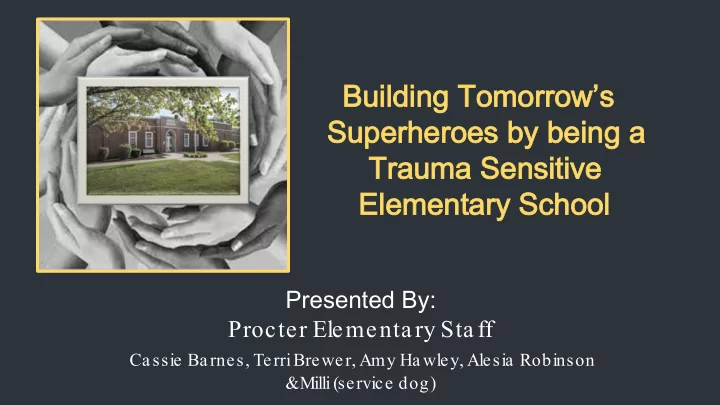
Building Tomorrow’s Building Tomorrow’s Superheroes by being a Superheroes by being a Trauma Sensitive Trauma Sensitive Elementary School Elementary School

slide-2
SLIDE 2

Today’s Goals Today’s Goals

  • Define Trauma Informed Care
  • Participate in Classroom Meeting
  • Create a Self-Care Plan
  • Understand Student Power Plans
  • Explain the trauma sensitive classroom
  • Create a Calming Corner
  • Drama Triangle
slide-3
SLIDE 3

We will soar today and always go beyond in our learning. We a re energized by being sa fe, respectful a nd responsible. Ea ch of us is a superhero with unique superpowers. We believe we a re here for a rea son!

Aspire Energize Unique Believe Aspire Energize Unique Believe

slide-4
SLIDE 4

Procter Elementary Demographics Procter Elementary Demographics

Student Population Student Population

221 students (99 boys, 122 girls) White - 47% Hispanic - 22% Multi-Racial - 19% Black - 11% Indian - .5% Asian - .5%

Free and Reduced Lunch Free and Reduced Lunch 81%

slide-5
SLIDE 5

Data to Support TSS Data to Support TSS

Office Disciplinary Referrals School Year ODRs 1st semester 2016-2017 474 474 2017-2018 211 211 2018-2019 84 84

Annual Performance Report Annual Performance Report 2014 2015 2016 2017 2017 APR Total APR Total Points Points 52/70 41.5/70 43.5/70 57/70 57/70 Percent of Percent of Points Points 74.3% 59.3% 62.1% 81.4% 81.4% MSIP Standards MSIP Standards Points Possible Points Possible Points Earned Points Earned Percent Earned Percent Earned Academic Achievement Academic Achievement 48 48 37 37 77.1% 77.1% Subgroup Achievement Subgroup Achievement 12 12 10 10 83.3% 83.3% Attendance Attendance 10 10 10 10 100% 100% Total Total 70 70 57 57 81.4% 81.4%

IEP, ELL, FRL, Ethnicity IEP, ELL, FRL, Ethnicity

slide-6
SLIDE 6

Wonder Woman vs. Bizzaro Wonder Woman vs. Bizzaro

Safety Unpredictable Trustworthiness Deceitful Empowerment Autocratic Collaborative Winners & Losers Peer Support Isolation Resilience Stagnate Self-Care Burn-out

What happened to you? What’s wrong wit What happened to you? What’s wrong wit

slide-7
SLIDE 7

Trauma Informed Care Trauma Informed Care

A shift

The toxic stress is coming from outside of school. De-escalate and regulate behaviors before solving the issue at hand. It’s never about the issue at hand. It goes deeper. It’s a brain issue, not a behavioral issue. The brain drives behavior. Discipline is to teach, not to punish.

~ taken from The Trauma-Informed School by Jim Sporleder and Heather T. Forbes, LCSW

slide-8
SLIDE 8

Quotes from Support Staff... Quotes from Support Staff...

I contribute by developing trusting relationships with our students. I feel that my job is not just to be the school custodian, but someone that our students can trust and look up to and to be a positive role model for them. I enjoy working at Procter because I feel that I am valued and appreciated by

  • ur staff and students.

~ Terry Spring, Head Custodian Procter Elementary is a wonderful place to work. My role as the secretary is to make all who enter full

  • welcomed. A lot of my interactions

with parents happen on the phone and I want them to feel important and

  • heard. I want each person to know I

am here to help them. When students come to the office I often find myself working with them in the calming

  • corner. The culture of Procter is a

team, we all support the students and each other. ~ Paula McKinney, Secretary As a Family School Liaison, I not only assist families in meeting their basic needs, but I work with families in trauma/crisis. I exercise trauma sensitivity by teaching parents the importance of self-care, mindfulness, and being aware of their emotions and how those emotions impact their children. Procter students learn this at school, so it is essential that parents are learning the same skills at home. A great deal of effort is placed in building trust and strong relationships with parents so we can work together with the Procter staff to promote success for their children. ~ Terri Brewer, FSL At the very root of Trauma Sensitive Schools is the belief that relationships

  • matter. . As a school counselor, I am

grateful that I have the privilege to listen to students, staff, parents and

  • ther stakeholders and form some

great relationships, after all, "Building Healthy Relationships Help Transform Lives". ~Alesia Robinson, Counselor In my position, trauma informed care, sensitivity and knowledge are all

  • encompassing. It's absolutely everything that I do from small moments to big
  • moments. There are outcomes that come organically out of the flow of TSS and

PBIS, such as relationship building and stable, positive energy throughout the entire building. I feel there is a cohesive mindset and it's amazing that I can call upon any staff member in the building for support if I needed and they would know how to help support whatever student needing it at the time with consistent TSS/PBIS language and calming techniques.. I always have "check in with adult" as part of the students power plans because it's a part of my plan, as well ~Mallory Elton, Recovery Room Interventionist

slide-9
SLIDE 9

Afternoon Meeting Afternoon Meeting

Greeting: Ask a partner at your table these three questions. How are you feeling this afternoon? What is a goal you have for this afternoon? Who can help you with that goal? Share: Share something you learned today at your grade level collaboration. Activity: Human Knot Human Knot Afternoon Message: Dear Friends, Today, we will share Procter’s journey as a Trauma Sensitive School. This story is still being written and we are continuously learning new things about how to foster resilient learners. Thank you for coming and allowing us to share our story with you. We hope that something we share today will assist your school along their journey as a Trauma Sensitive School. Blessings, Procter Staff

  • Ps. We are sharing the first six weeks of our

Morning Meetings with you!

slide-10
SLIDE 10

Hand Model of the Brain Hand Model of the Brain

slide-11
SLIDE 11

“Don’t Flip Your Lid” “Don’t Flip Your Lid”

Teaching the Brain to Students-Teacher Handout

slide-12
SLIDE 12

Professional Self Professional Self -Care, Power Plan Care, Power Plan What brings you JOY? What brings you JOY?

  • Fold your 3 x 5 card into thirds.
  • Label each section with the

following and list 3 to 5 things you can do to support yourself in your daily life. ○ Prevention ○ In the Moment ○ After-care

  • Let this card live in your wallet,

purse, or desk.

slide-13
SLIDE 13

What to do In the Moment What to do In the Moment

Place your hand on your heart Press your feet into the floor Notice your breath and heart rate Repeat a positive affirmation Notice things around the room, such as the colors,

  • bjects

Make yourself smile Think of something funny Flex your muscles Stretch Press a magic button on your desk Visualize calm places and favorite things Doodle Massage pressure points Put on lotion/hand massage Think of something that you are looking forward to Think of someone you care about

slide-14
SLIDE 14
slide-15
SLIDE 15

Purpose of Student Power Plan... Purpose of Student Power Plan...

  • Understand what you need to be safe, respectful, and responsible.
  • Use of large and small body movements to help your brain think, body

stay calm, and heart to be positive.

  • Use strategies to prevent, have in the moment, and aftercare for you

to use when life gets hard.

  • Remember what does your mind, body and heart need to be the best

learner.

slide-16
SLIDE 16
  • Create an environment in which you are mindful of yourself and
  • thers
  • Do the SHARKFIN to recharge your superpowers.
slide-17
SLIDE 17

Click on planning tool to access template. Click on planning tool to access template.

slide-18
SLIDE 18

Creating a Student Power Plan... Creating a Student Power Plan...

slide-19
SLIDE 19

After Care My Su p er p ower Pla n _ _ _ _ _ _ _ _ _ _ ’s Pla n Wh o Ca n Help Me Pr even ta tive In th e Momen t

Click on “Foldable” to access template. Click on “Foldable” to access template.

slide-20
SLIDE 20
slide-21
SLIDE 21

Student Power Plan Examples Student Power Plan Examples

slide-22
SLIDE 22

Student Power Plan Examples Student Power Plan Examples

slide-23
SLIDE 23

Student Power Plan Examples Student Power Plan Examples

slide-24
SLIDE 24

Common Language in Trauma Sensitive Common Language in Trauma Sensitive Classroom and School Classroom and School

Adult Language: Predictable; consistent language

  • Tell me what happened
  • I see....
  • I notice...
  • I see that you need help with...
  • That can be hard...
  • I get the sense that....

Student Language:

  • I need a minute
  • I am going to flip my lid
  • I feel Fast and Wiggly
  • I feel Fast and Emotional
  • I feel Slow and Tired
slide-25
SLIDE 25

Calming Corner Calming Corner

  • Preventative and In the Moment

○ De-escalate ○ Get out of fight or flight, and engage the thinking part of the brain again ■ Pre-taught calm down strategies ○ Comfort, Sensory, Calming, Engaging ○ 5- 10 minute use, frequency determined by student/ teacher

  • After-care

○ Teach the skills she needs to do better the next time such a situation arises

slide-26
SLIDE 26
slide-27
SLIDE 27

Conflict Management Conflict Management

  • Participants will explore conflict and understand that it often triggers re -

enactment

  • Participants will define re-enactment (the drama triangle) as behavior that is

rooted in the neurobiological effects of trauma

  • Participants will learn empowering strategies to escape the drama triangle,

both in professional and personal interactions

slide-28
SLIDE 28

https://www.youtube.com/watch?v=ovrVv_RlCMw

slide-29
SLIDE 29

Karpman, 1972

  • Three dramatic roles: Victim, BULLY, Rescuer
  • Common, unsatisfactory, repetitive, largely

unconscious behavior that is often rooted in trauma

  • It is possible to play all three roles even in the

same encounter

  • When we are stuck in the drama triangle,

instead of resolving problems, we endlessly repeat them

slide-30
SLIDE 30

Strong Emotions Hopeless, helpless Furious, irritated, angry Sad, protective, uncomfortable Physical Response Hot or flushed face Racing heart Muscle tension

slide-31
SLIDE 31

Pouring Fuel on the Fire Pouring Fuel on the Fire

Latham, 1994

  • Using force (verbal

and/or physical)

  • Threatening
  • Arguing
  • Taking away

(including The Silent Treatment)

  • Lecturing
  • Public shaming
  • Using sarcasm or

teasing

  • Questions used

disrespectfully

  • Expressing despair
  • One-upping
slide-32
SLIDE 32
  • Avoid future interaction
  • Get even (Fight)
  • Esca pe in the moment (Flight or Freeze)
  • Lea rn coercive beha vior (More dra ma )
  • Beha ve less confidently
  • Receive reinforcement for undesira ble beha vior
  • Rela tionship difficulties a nd/or fa ilure
slide-33
SLIDE 33
  • Are used to using undesirable behaviors

beca use of our own pa st experiences

  • Ha ve just been coerced by someone else
  • Ha ve ha d a ba d da y or encounter a pet peeve
  • Are frustra ted or get over-excited
  • Feel unsupported
  • Ha ve unmet ba sic needs
slide-34
SLIDE 34

COACH RESCUER

Escaping the Escaping the Triangle Triangle

CONFL ICT

Graphic used with permission from Cornerstones of Care

slide-35
SLIDE 35

Uses power wisely Rema ins true to self Seeks help responsibly, a ppropria tely, & clea rly Seeks to lea rn Focuses on the future

DRIVER DRIVER

Denies power Lets the experience define him or her Looks to others for rescue Relinquishes responsibility Feels hopeless

VICTIM VICTIM

slide-36
SLIDE 36

Empowers others Communica tes directly Respects bounda ries Models beha vior Provides expecta tions Offers a lterna tives Commends strengths Encoura ges others to link ca use & effect

GUIDE GUIDE

Misuses power Uses pa ssive a ggression Dema nds or coerces Threa tens/Bullies Uses physica l force Finds fa ult Bla mes/sha mes

BULLY BULLY

slide-37
SLIDE 37

Assists only as necessa ry Sta nds beside Encoura ges a ction of

  • thers

Empowers Expresses confidence Asks permission Checks ba ck

COACH COACH

Helps no ma tter the cost Ta kes the pla ce of Fixes Meddles Encoura ges dependence Feels ma rtyred

RESCUER RESCUER

slide-38
SLIDE 38
  • Which role in the reenactment triangle do you think you

a re most likely to fa ll into a t work?

  • Wha t a re some of the qua lities you ha ve tha t ma ke you

vulnera ble to fa lling into this role?

  • Wha t beha viors in the people tha t you serve a re most

likely to trigger you or push you into one of these roles?

  • Wha t beha viors in other sta ff members a re most likely to

trigger you or push you into one of these roles?

slide-39
SLIDE 39

Victim Victim Rescuer Rescuer BULLY BULLY “I really lost it yesterday with Brandon. Nikki and Nora were playing in the backyard with the soccer ball. Brandon took the ball away and threw it over the fence. I was really angry that he would bully them that way. I made him stay in his room the rest of the afternoon. At bedtime Nikki cried and told me it was her fault that Brandon had to stay in his

  • room. She told me that Brandon had asked to play with

them and she told him no. She wouldn’t let Nora play either. She wanted the ball all to herself. That’s why he got mad and threw the ball over the fence. I felt bad that I did not handle it better. What should I have done?”

slide-40
SLIDE 40
  • Remain curious and nonjudgmental
  • Determine where your power is
  • Own your feelings and actions; allow others to own theirs
  • Practice alternative behaviors (Driver, Guide, Coach)
slide-41
SLIDE 41

Self Self-Reflection Reflection

  • Think of a conflict situation you have been in recently.
  • Identify the roles each person is/was playing in the drama

triangle.

  • Consider how you can shift your power to change your role and

begin to escape the triangle.

  • Consider how you could support the others in that situation to

move from Victim to Driver, Persecutor to Guide, and Rescuer to Coach.

slide-42
SLIDE 42

Contact Information Contact Information

Amy Hawley, Principal amy_hawley@isdschools.org Cassie Barnes, SPED Teacher cassie_barnes@isdschools.org Alesia Robinson, Counselor alesia_robinson@isdschools.org Terri Brewer, Family School Liaison terri_brewer@isdschools.org