
SLIDE 1
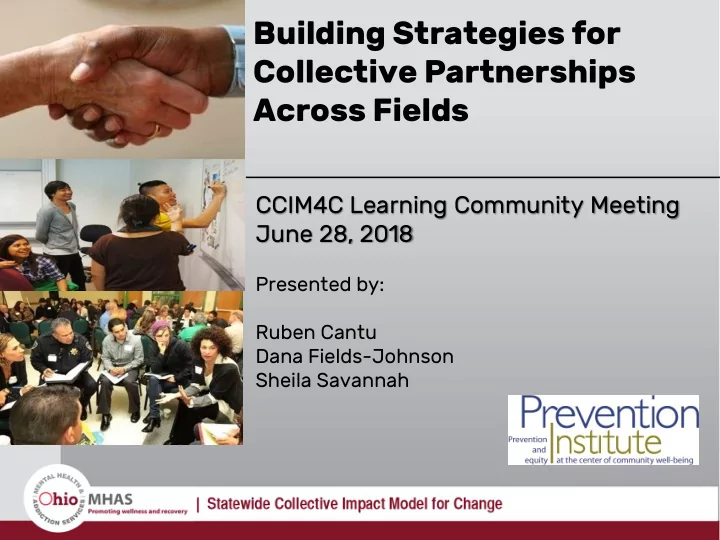
Building Strategies for Collective Partnerships Across Fields
CCIM4C Learning Community Meeting June 28, 2018
Presented by: Ruben Cantu Dana Fields-Johnson Sheila Savannah
Building Strategies for Collective Partnerships Across Fields - - PowerPoint PPT Presentation
Building Strategies for Collective Partnerships Across Fields CCIM4C Learning Community Meeting June 28, 2018 Presented by: Ruben Cantu Dana Fields-Johnson Sheila Savannah Objectives Use and share Collaboration Multiplier as a tool
Building Strategies for Collective Partnerships Across Fields
CCIM4C Learning Community Meeting June 28, 2018
Presented by: Ruben Cantu Dana Fields-Johnson Sheila Savannah
differences in partners’ skills, resources, mandates and interests, as well as
and agencies that are essential to advancing the vision, directives and strategies
strengthen new and existing coalitions that can advance their CCIM4C goals.
ecosystem for sustaining CCIM4C goals.
Collaborating to Prevent OUD What’s one partnership
working on and why is it important to your goals?
Collaborating to Prevent OUD What opposition are you coming up against as you work to engage other sectors and partners?
Working with other partners and sectors means we have different perspectives, more resources, greater trust, a bigger network, and a comprehensive approach.
— Julie Young-Burns
Minneapolis Public Schools
Coming together across many government sectors, we have different vocabularies, theoretical frameworks and worldviews. We have to find a common language to get work done together.
— Noelle Wiggins
Multnomah County Health Department
to engage more partners
solutions
approach an issue differently
Collaboration Multiplier Helps Multi-Sector Partnerships to…
Collaboration Multiplier: Two Phases
share information. Learn more about your partners and their perspectives.
discuss implications of Phase 1, explore possible directions, agree on next steps.
1 Information Gathering 2 Analysis
13
Houston, Texas
Public Works Public Health
Property Owners And Managers School & Youth
Organizations
Information Gathering
Public Health Property Owners Public Works Youth Groups
What is this group’s mandate? For what is it held accountable? Why might improving safety be important to this group?
Public Health Property Owners Public Works Youth Groups
What is this group’s mandate? For what is it held accountable? Why might improving safety be important to this group?
Public Health Property Owners Public Works Youth Groups
Prevent disease and injury. Create the conditions that promote health and wellness. Maintain safe, habitable
the property is secure. Design, construct, renovate and maintain public facilities and infrastructure. Promote positive development and prepare children and youth to succeed in life.
What is this group’s mandate? For what is it held accountable? Why might improving safety be important to this group?
Public Health Property Owners Public Works Youth Groups
Which of this group’s current strategies and activities relate to increasing safety and/or reducing blight?
Public Health Property Owners Public Works Youth Groups
Coordinate efforts to prevent injuries and disease. Maintain property and increase curb appeal. Clear ditches. Dispose of waste and recycling. Remove graffiti. Coordinate volunteers. Develop and
programs for youth.
Which of this group’s current strategies and activities relate to increasing safety and/or reducing blight?
Public Health Property Owners Public Works Youth Groups
Decreased injury, death and trauma from violence. Increased safety. Increased property value. Decreased litter and graffiti. Public ownership
Improved school attendance.
What specific results or outcomes would this group like to see to make participation in our coalition worthwhile? What does success look like for this group?
Sector/ Partner
Public Health Property Owners Public Works Youth Groups
Mandate ___________ ___________ ___________ ___________ _ ___________ ___________ ___________ ___________ _ ___________ ___________ ___________ ___________ _ ___________ ___________ ___________ ___________ _ Activities & Resources ___________ ___________ ___________ ___________ _ ___________ ___________ ___________ ___________ _ ___________ ___________ ___________ ___________ _ ___________ ___________ ___________ ___________ _ Data ___________ ___________ ___________ ___________ ___________ ___________ ___________ ___________ ___________ ___________ ___________ ___________ ___________ ___________ ___________ ___________
Shared Outcomes Partner Strengths Joint Strategies
Public Health
Property Owners and Managers
Youth Groups Public Works
Shared Outcome
A safe open space near the school that promotes attendance and reduces fear of violence among youth
Public Health
Property Owners and Managers
Youth Groups Public Works
What can be achieved together?
Collective Strengths
more combined than if they were separate
attractive, safe physical space
volunteers
Public Health
Property Owners and Managers
Youth Groups Public Works
What partner strengths can the collaborative group utilize?
Joint Strategies
Engage young people to conduct a survey
identify areas where they feel unsafe
Public Health
Property Owners and Managers
Youth Groups Public Works
What strategies can two or more partners work on together?
Joint Strategies
Utilize a shared use agreement to remove trash and clear toxins
Public Health
Property Owners and Managers
Youth Groups Public Works
What strategies can two or more partners work on together?
Joint Strategies
Engage tenants and civic
maintain the land, and discourage illegal dumping and drug-dealing
Public Health
Property Owners and Managers
Youth Groups Public Works
What strategies can two or more partners work on together?
Joint Strategies
Make micro-grants and support young people in leading neighborhood clean-up projects and other community-based programs
Public Health
Property Owners and Managers
Youth Groups Public Works
What strategies can two or more partners work on together?
Public Health Property Owners Public Works Youth Groups
Expertise:
and families in their comm. and workplaces.
inform and evaluate public health strategies and programs
Desired Outcomes:
health, health equity and perception of safety.
Key Strategies:
injuries and diseases
develop policies that keep people healthy and safe.
Expertise:
and ensure property is secure.
meet safety requirements.
Desired Outcomes:
responsible tenants care for property.
Key Strategies:
habitation to increase curb appeal.
and return security deposits.
Expertise:
public facilities and infrastructure
geographic location
Desired Outcomes:
by civic groups and residents.
and number of graffiti incidents
Key Strategies:
Remove graffiti. Coordinate volunteers for cleanup projects.
Expertise:
through activities and opportunities
Desired Outcomes:
activity
Key Strategies:
health and career programs
youth leadership.
Shared Outcomes
school that promotes attendance and reduces fear
Partner Strengths
when combined than separately
attractive, safe physical space
staffing supplemented by volunteers to complete the work
Joint strategies/Activities
as a problem area.
agreement for Public Works and Engineering to remove trash, toxins, and improve water drainage
and local civic organizations as volunteers to maintain the land and discourage illegal dumping and drug- dealing.
grants for young people to lead neighborhood clean-up projects and other community-based campaigns, with support of partners
1 Information Gathering 2 Analysis
Phase 1: Information Gathering Activity
implemented relevant to this issue?
as a result of this collaboration? What does success look like?
table to enhance outcomes?
this collaborative?
1. What did you find valuable?
sector’s shoes?
appealing to this sector?
Phase 1: Multi-Sector Group Discussion Information Gathering
utilize? How do you leverage each partner’s expertise?
together?
partners work together on?
1 Information Gathering 2 Analysis
Shared Outcomes Partner Strengths Joint Strategies
Faith
Parks & Recreation Business &
Employers
Housing
Shared Outcome
What can be achieved together?
Faith
Parks & Recreation Business &
Employers
Housing
Collective Strengths
more combined than if they were separate
volunteers
What partner strengths can the collaborative group utilize?
Faith
Parks & Recreation Business &
Employers
Housing
Faith
Parks & Recreation Business &
Employers
Housing
Joint Strategies
What strategies can two or more partners work on together?
Shared Outcomes Partner Strengths Joint Strategies
Public Health
Property Owners and Managers
Youth Groups Public Works
Public Health Property Owners Public Works Youth Groups
Expertise: Desired Outcomes: Key Strategies: Expertise: Desired Outcomes:
Key Strategies:
Expertise: Desired Outcomes: Key Strategies: Expertise:
Key Strategies:
Shared Outcomes Partner Strengths Joint strategies/Activities
1. What did you find valuable or helpful?
shared ideas or opportunities that surfaced?
learned?
1. How might you use CM with your coalition to sustain the work?
video that was shared with partners in June, what implications does multi-sector involvement have for your structure?
do next with your partners, coalition and/or workgroup?
www.preventioninstitute.org
Image: Ruth Hartnup, Creative Commons
ruben@preventioninstitute.org dana@preventioninstitute.org sheila@preventioninstitute.org
Follow us on: