Building a Winning Evidentiary Record at the PTAB (and Surviving - - PowerPoint PPT Presentation

building a winning evidentiary record at the ptab and
SMART_READER_LITE
LIVE PREVIEW

Building a Winning Evidentiary Record at the PTAB (and Surviving - - PowerPoint PPT Presentation

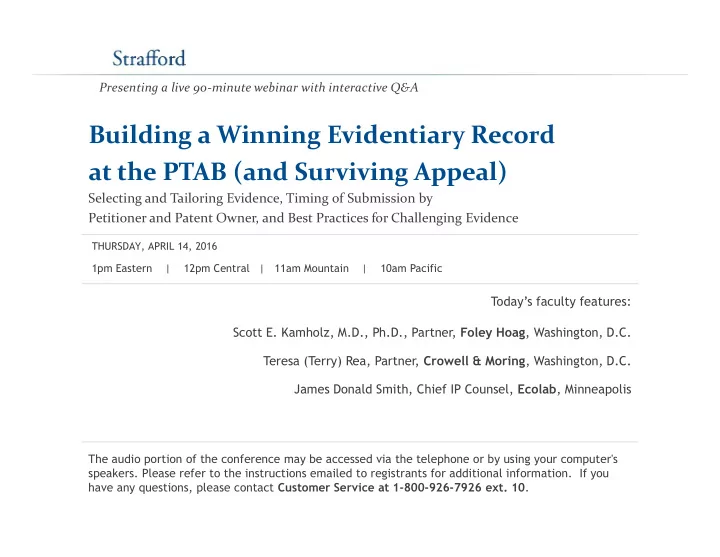
Presenting a live 90-minute webinar with interactive Q&A Building a Winning Evidentiary Record at the PTAB (and Surviving Appeal) Selecting and Tailoring Evidence, Timing of Submission by Petitioner and Patent Owner, and Best Practices for


slide-1
SLIDE 1

Building a Winning Evidentiary Record at the PTAB (and Surviving Appeal)

Selecting and Tailoring Evidence, Timing of Submission by Petitioner and Patent Owner, and Best Practices for Challenging Evidence

1pm Eastern | 12pm Central | 11am Mountain | 10am Pacific THURSDAY, APRIL 14, 2016

Presenting a live 90-minute webinar with interactive Q&A

The audio portion of the conference may be accessed via the telephone or by using your computer's

  • speakers. Please refer to the instructions emailed to registrants for additional information. If you

have any questions, please contact Customer Service at 1-800-926-7926 ext. 10.

Today’s faculty features: Scott E. Kamholz, M.D., Ph.D., Partner , Foley Hoag, Washington, D.C. Teresa (Terry) Rea, Partner , Crowell & Moring, Washington, D.C. James Donald Smith, Chief IP Counsel, Ecolab, Minneapolis

slide-2
SLIDE 2

Tips for Optimal Quality

Sound Quality If you are listening via your computer speakers, please note that the quality

  • f your sound will vary depending on the speed and quality of your internet

connection. If the sound quality is not satisfactory, you may listen via the phone: dial 1-866-819-0113 and enter your PIN when prompted. Otherwise, please send us a chat or e-mail sound@straffordpub.com immediately so we can address the problem. If you dialed in and have any difficulties during the call, press *0 for assistance. Viewing Quality To maximize your screen, press the F11 key on your keyboard. To exit full screen, press the F11 key again.

FOR LIVE EVENT ONLY

Sound Quality If you are listening via your computer speakers, please note that the quality

  • f your sound will vary depending on the speed and quality of your internet

connection. If the sound quality is not satisfactory, you may listen via the phone: dial 1-866-819-0113 and enter your PIN when prompted. Otherwise, please send us a chat or e-mail sound@straffordpub.com immediately so we can address the problem. If you dialed in and have any difficulties during the call, press *0 for assistance. Viewing Quality To maximize your screen, press the F11 key on your keyboard. To exit full screen, press the F11 key again.

slide-3
SLIDE 3

Continuing Education Credits

In order for us to process your continuing education credit, you must confirm your participation in this webinar by completing and submitting the Attendance Affirmation/Evaluation after the webinar. A link to the Attendance Affirmation/Evaluation will be in the thank you email that you will receive immediately following the program. For additional information about continuing education, call us at 1-800-926-7926

  • ext. 35.

FOR LIVE EVENT ONLY

In order for us to process your continuing education credit, you must confirm your participation in this webinar by completing and submitting the Attendance Affirmation/Evaluation after the webinar. A link to the Attendance Affirmation/Evaluation will be in the thank you email that you will receive immediately following the program. For additional information about continuing education, call us at 1-800-926-7926

  • ext. 35.
slide-4
SLIDE 4
slide-5
SLIDE 5

Introduction: Two misconceptions

  • A PTAB “trial” is not a trial in a conventional sense
  • Unlike any other kind of trial
  • Much of it is over before it starts
  • Deposition is on-the-stand cross-examination

The PTAB has adopted the Federal Rules of Evidence but rarely invokes them

Judges often defer admissibility and weight determinations to the final decision Judges are scientifically sophisticated fact-finders Judges rarely exclude evidence

A PTAB “trial” is not a trial in a conventional sense

Unlike any other kind of trial Much of it is over before it starts

  • Deposition is on-the-stand cross-examination
  • The PTAB has adopted the Federal Rules of Evidence

but rarely invokes them

  • Judges often defer admissibility and weight

determinations to the final decision

  • Judges are scientifically sophisticated fact-finders
  • Judges rarely exclude evidence

5

slide-6
SLIDE 6

Evidentiary standards

  • Petitioner: burden of proof by preponderance on all

questions of unpatentability

  • Prior art teachings
  • Rationale to combine

Lack of written description for a challenge based on intervening art

Patent Owner: burden of going forward on certain issues

Secondary considerations – no rule but informal Disqualifying prior art Real party in interest – some gray

Petitioner: burden of proof by preponderance on all questions of unpatentability

Prior art teachings

  • Rationale to combine
  • Lack of written description for a challenge based on

intervening art

  • Patent Owner: burden of going forward on certain issues
  • Secondary considerations – no rule but informal
  • Disqualifying prior art
  • Real party in interest – some gray

6

slide-7
SLIDE 7

Evidentiary Standards, cont.

  • CAFC review
  • Questions of fact: substantial evidence
  • Questions of law: de novo

Claim construction: Teva

CAFC review

Questions of fact: substantial evidence Questions of law: de novo

  • Claim construction: Teva

7

slide-8
SLIDE 8

PTAB Timeline

8

slide-9
SLIDE 9

Form of Evidence

  • The PTAB has prescribed specific requirements

for formatting evidence.

  • Follow them to the letter to avoid irritating the

judges Documents in languages other than English

English translation Affidavit attesting to accuracy

The PTAB has prescribed specific requirements for formatting evidence. Follow them to the letter to avoid irritating the judges

  • Documents in languages other than English
  • English translation
  • Affidavit attesting to accuracy

9

slide-10
SLIDE 10

Petitioner: The Petition

  • The entire case-in-chief and all supporting

evidence must be presented with the Petition

  • Petition is due within one year of the first service of

a complaint for infringement (35 U.S.C. § 315(b)) Petition cannot be filed after the filing of a declaratory judgment action for invalidity (35 U.S.C. § 315(a))

The entire case-in-chief and all supporting evidence must be presented with the Petition

Petition is due within one year of the first service of a complaint for infringement (35 U.S.C. § 315(b))

  • Petition cannot be filed after the filing of a

declaratory judgment action for invalidity (35 U.S.C. § 315(a))

10

slide-11
SLIDE 11

Petitioner: Supplemental Information

  • A motion to file supplemental information is pre-

authorized if filed within one month of trial institution (37 C.F.R. § 42.123(a)(1))

  • PTAB has discretion to disregard supplemental

information (Redline Detection v. Star Envirotech) Open to attack as exceeding case-in-chief evidence A motion to file supplemental information is pre- authorized if filed within one month of trial institution (37 C.F.R. § 42.123(a)(1))

  • PTAB has discretion to disregard supplemental

information (Redline Detection v. Star Envirotech)

  • Open to attack as exceeding case-in-chief

evidence

11

slide-12
SLIDE 12

Petitioner: Reply

  • Most other tribunals do not permit new evidence

with a Reply in the regular course

  • PTAB permits new expert declarations and

essentially any other form of evidence without requiring stipulation or pre-authorization PTAB does impose strict limits on the scope of Petitioner’s Reply (37 C.F.R. § 42.23(b)) Most other tribunals do not permit new evidence with a Reply in the regular course PTAB permits new expert declarations and essentially any other form of evidence without requiring stipulation or pre-authorization

  • PTAB does impose strict limits on the scope of

Petitioner’s Reply (37 C.F.R. § 42.23(b))

12

slide-13
SLIDE 13

Petitioner: Opposition to Amendment

  • Petitioner may introduce all forms of evidence
  • Note Patent Owner bears the burden of proving

patentability

13

slide-14
SLIDE 14

Petitioner: Motion for Observations

  • Not mentioned in the rules
  • Authorized in the Scheduling Order
  • Available when cross conducted within the regulated

time limits but after that party’s last brief was due Strictly limited to citing pinpoint passages from the cross-examination testimony and identifying other evidence already of record for which the new testimony has relevance The significance of observations evidence may be addressed in the oral hearing. Not mentioned in the rules Authorized in the Scheduling Order Available when cross conducted within the regulated time limits but after that party’s last brief was due

  • Strictly limited to citing pinpoint passages from the

cross-examination testimony and identifying other evidence already of record for which the new testimony has relevance

  • The significance of observations evidence may be

addressed in the oral hearing.

14

slide-15
SLIDE 15

Patent Owner: Preliminary Response

  • May include all kinds of evidence
  • Due within 3 months of issuance of notice of Petition filing date
  • Aim for showing that Petition does not meet standard
  • “Reasonable likelihood” for IPR

“More likely than not” for CBM/PGR

Documentary evidence

Research papers or other publications, for example that might undercut Petitioner’s expert assessment of the prior art Prior inconsistent testimony of Petitioner’s expert New testimonial evidence by Patent Owner expert

May include all kinds of evidence Due within 3 months of issuance of notice of Petition filing date Aim for showing that Petition does not meet standard

“Reasonable likelihood” for IPR

  • “More likely than not” for CBM/PGR
  • Documentary evidence
  • Research papers or other publications, for example that might

undercut Petitioner’s expert assessment of the prior art

  • Prior inconsistent testimony of Petitioner’s expert
  • New testimonial evidence by Patent Owner expert

15

slide-16
SLIDE 16

Patent Owner: New Testimonial Evidence

  • Newly authorized with PTAB trial rule revisions announced April

1, 2016 and effective May 1, 2016

  • PTAB cautions that if new testimonial evidence is accepted

from the Patent Owner, any inconsistencies with Petitioner’s evidence will be resolved in favor of the Petitioner for purposes

  • f deciding whether to institute trial

Questionable whether new declaration testimony could be dispositive in favor of Patent Owners, because PTAB probably reluctant to deny Petitioner relief on the strength of untested direct testimony Patent Owners might consider seeking PTAB authorization to conduct limited cross-examination of Petitioner witness Newly authorized with PTAB trial rule revisions announced April 1, 2016 and effective May 1, 2016 PTAB cautions that if new testimonial evidence is accepted from the Patent Owner, any inconsistencies with Petitioner’s evidence will be resolved in favor of the Petitioner for purposes

  • f deciding whether to institute trial
  • Questionable whether new declaration testimony could be

dispositive in favor of Patent Owners, because PTAB probably reluctant to deny Petitioner relief on the strength of untested direct testimony

  • Patent Owners might consider seeking PTAB authorization to

conduct limited cross-examination of Petitioner witness

16

slide-17
SLIDE 17

Patent Owner: Full Response

  • Due date set in the scheduling order that accompanies

institution decision but typically is 3 months after institution

  • All of Patent Owner’s case-in-chief evidence must be

submitted

Documentary evidence New expert declaration(s)

Need not be same expert as used in preliminary response, if any No pedigree contest – judges are not particularly sensitive to where the expert teaches or was educated Should be directed to refuting Petitioner expert

Due date set in the scheduling order that accompanies institution decision but typically is 3 months after institution All of Patent Owner’s case-in-chief evidence must be submitted

  • Documentary evidence
  • New expert declaration(s)
  • Need not be same expert as used in preliminary response, if

any

  • No pedigree contest – judges are not particularly sensitive to

where the expert teaches or was educated

  • Should be directed to refuting Petitioner expert

17

slide-18
SLIDE 18

Patent Owner: Full Response, cont.

  • Deposition testimony of Petitioner witnesses
  • This is the trial cross-examination, not a preliminary

interrogation to be filed by on-the-stand testimony

  • Deposition is the time to extract key admissions

Impeaching expert’s qualifications rarely succeeds

Rebuttal evidence where Patent Owner has burden

  • f going forward

Deposition testimony of Petitioner witnesses

This is the trial cross-examination, not a preliminary interrogation to be filed by on-the-stand testimony

  • Deposition is the time to extract key admissions
  • Impeaching expert’s qualifications rarely succeeds
  • Rebuttal evidence where Patent Owner has burden
  • f going forward

18

slide-19
SLIDE 19

Patent Owner: Motion to Amend

  • Has declined sharply in popularity as success rate

has remained low and the Federal Circuit has upheld PTAB’s procedures

  • PTAB requires Patent Owner to prove

patentability

Idle Free: burden extends to “the prior art of record and also prior art known to the patent owner.” MasterImage: clarified these terms

Has declined sharply in popularity as success rate has remained low and the Federal Circuit has upheld PTAB’s procedures

  • PTAB requires Patent Owner to prove

patentability

  • Idle Free: burden extends to “the prior art of record

and also prior art known to the patent owner.”

  • MasterImage: clarified these terms

19

slide-20
SLIDE 20

Patent Owner: Scope of Prior Art

  • “Prior art of record”
  • any material art in the prosecution history of the patent;
  • any material art of record in the current proceeding,

including art asserted in grounds on which the Board did not institute review; and any material art of record in any other proceeding before the Office involving the patent.”

“Prior art known to the patent owner”

no more than the material prior art that Patent Owner makes of record in the current proceeding pursuant to its duty of candor and good faith to the Office under 37 C.F.R. § 42.11, in light of a Motion to Amend

“Prior art of record”

any material art in the prosecution history of the patent; any material art of record in the current proceeding, including art asserted in grounds on which the Board did not institute review; and

  • any material art of record in any other proceeding before the

Office involving the patent.”

  • “Prior art known to the patent owner”
  • no more than the material prior art that Patent Owner

makes of record in the current proceeding pursuant to its duty of candor and good faith to the Office under 37 C.F.R. § 42.11, in light of a Motion to Amend

20

slide-21
SLIDE 21

Patent Owner: Reply for Motion to Amend

  • Analogous to Petitioner’s Reply in support of

Petition

  • Many fewer cases addressing whether Patent

Owner exceed permissible scope of Reply, because there have been comparatively few Motions to Amend Analogous to Petitioner’s Reply in support of Petition Many fewer cases addressing whether Patent Owner exceed permissible scope of Reply, because there have been comparatively few Motions to Amend

21

slide-22
SLIDE 22

Patent Owner: Observations

  • Same as discussed for Petitioner

22

slide-23
SLIDE 23

Discovery

  • Limited – this is a fundamental principle of PTAB

trials

  • Two types
  • Routine Discovery (37 C.F.R. § 42.51(b)(1)): parties

are entitled to: Additional discovery (37 C.F.R. § 42.51(b)(2)): everything else

Limited – this is a fundamental principle of PTAB trials Two types

  • Routine Discovery (37 C.F.R. § 42.51(b)(1)): parties

are entitled to:

  • Additional discovery (37 C.F.R. § 42.51(b)(2)):

everything else

23

slide-24
SLIDE 24

Routine Discovery

  • Parties are entitled to:
  • Copies of all exhibits
  • Deposition of all witnesses
  • Information inconsistent with positions the
  • pponent takes

A lot of gray here Reflects duty of candor Often times the relevant material is publicly available

Parties are entitled to:

Copies of all exhibits Deposition of all witnesses

  • Information inconsistent with positions the
  • pponent takes
  • A lot of gray here
  • Reflects duty of candor
  • Often times the relevant material is publicly

available

24

slide-25
SLIDE 25

Additional Discovery

  • Covers everything not specified in routine discovery
  • Obtainable only on motion and when “in the interests
  • f justice”
  • Cannot file motion without PTAB authorization
  • Must be able to explain

Precisely what is sought How it is material to the case Why it is necessary

Rarely granted. Requires persuading the PTAB that the evidence exists and likely is outcome-determinative

Covers everything not specified in routine discovery

Obtainable only on motion and when “in the interests

  • f justice”

Cannot file motion without PTAB authorization

  • Must be able to explain
  • Precisely what is sought
  • How it is material to the case
  • Why it is necessary
  • Rarely granted. Requires persuading the PTAB that the

evidence exists and likely is outcome-determinative

25

slide-26
SLIDE 26

Additional Discovery, cont.

  • Garmin factors: the PTAB uses these to weight additional

discovery requests

  • Fishing expedition? Must show that something useful will be

uncovered

  • Gaming the system?The PTAB will not entertain motions that

appear geared toward obtaining litigation positions Available elsewhere? Don’t put the opponent to the trouble of production if the information is reasonably available elsewhere Simple Instructions?The PTAB does not look kindly on, say, ten pages of prefatory instructions for response Too Burdensome?The PTAB will hesitate to put the opponent to expense or employee distraction that is not commensurate with the scope and expedited nature of the proceeding.

Garmin factors: the PTAB uses these to weight additional discovery requests

Fishing expedition? Must show that something useful will be uncovered

  • Gaming the system?The PTAB will not entertain motions that

appear geared toward obtaining litigation positions

  • Available elsewhere? Don’t put the opponent to the trouble of

production if the information is reasonably available elsewhere

  • Simple Instructions?The PTAB does not look kindly on, say, ten

pages of prefatory instructions for response

  • Too Burdensome?The PTAB will hesitate to put the opponent to

expense or employee distraction that is not commensurate with the scope and expedited nature of the proceeding.

26

slide-27
SLIDE 27

Additional Discovery, cont.

  • Additional discovery scenarios
  • Real party-in-interest and privity issues
  • Lab notebooks – primary evidence from

experimentation Sales figures etc. for accused infringed product (but beware trial-within-trial)

Additional discovery scenarios

Real party-in-interest and privity issues Lab notebooks – primary evidence from experimentation

  • Sales figures etc. for accused infringed product (but

beware trial-within-trial)

27

slide-28
SLIDE 28

Protective orders

  • 37 C.F.R. § 42.54
  • Disfavored and inherently risky
  • PTAB prefers openness
  • Confidential information relied upon in final decision may be

unsealed

Procedure

Submitting party: file under “Board and Parties Only” Owner of the information must file the motion to seal Proposed protective order: default preferred

Expungement available after the proceeding (37 C.F.R.§ 42.56) 37 C.F.R. § 42.54 Disfavored and inherently risky

PTAB prefers openness Confidential information relied upon in final decision may be unsealed

  • Procedure
  • Submitting party: file under “Board and Parties Only”
  • Owner of the information must file the motion to seal
  • Proposed protective order: default preferred
  • Expungement available after the proceeding (37 C.F.R.§ 42.56)

28

slide-29
SLIDE 29

Compelled discovery

  • 37 C.F.R. §§ 42.52-53
  • Routine and additional discovery noncompliance
  • Opponent’s witnesses not made reasonably

available Subpoena power for third party documents and witnesses Foreign language and depositions in other countries – lots of headaches 37 C.F.R. §§ 42.52-53 Routine and additional discovery noncompliance

  • Opponent’s witnesses not made reasonably

available

  • Subpoena power for third party documents and

witnesses

  • Foreign language and depositions in other

countries – lots of headaches

29

slide-30
SLIDE 30

Attacking the opponent’s evidence

  • Weight vs. admissibility
  • Attacking weight
  • This is the main show

APJ’s don’t like to read cross-motions to exclude.

Objections and exclusion

10 days for patent owner to object to petition evidence Later: the 5/10 rule

Weight vs. admissibility Attacking weight

  • This is the main show
  • APJ’s don’t like to read cross-motions to exclude.
  • Objections and exclusion
  • 10 days for patent owner to object to petition

evidence

  • Later: the 5/10 rule

30

slide-31
SLIDE 31

Deposition Objections

  • Objections must be stated during deposition
  • Follow deposition guidelines
  • No “speaking” objections

Curing evidence must be provided during the deposition unless parties agree otherwise on the record Objections must be stated during deposition

Follow deposition guidelines No “speaking” objections

  • Curing evidence must be provided during the

deposition unless parties agree otherwise on the record

31

slide-32
SLIDE 32

Motions to Exclude

  • Will get nowhere unless truly directed to

admissibility

  • Even if there is an admissibility issue, judges may

elect to eliminate the evidence on the merits Will get nowhere unless truly directed to admissibility Even if there is an admissibility issue, judges may elect to eliminate the evidence on the merits

32

slide-33
SLIDE 33

Presenting evidence at the Hearing

  • First chance to weave all evidence together into cohesive

story

  • Post-briefing evidence (observations)
  • Opportunity to provide a map to navigate a large record
  • Never live testimony (well, hardly ever)

Use demonstratives either to summarize argument or simply to display evidence

Take care that summary does not introduce new arguments

  • r recharacterize evidence

If eschewing prepared slides in favor of going directly to the record, have a good IT person on hand who is nimble with the record

First chance to weave all evidence together into cohesive story

Post-briefing evidence (observations) Opportunity to provide a map to navigate a large record

  • Never live testimony (well, hardly ever)
  • Use demonstratives either to summarize argument or

simply to display evidence

  • Take care that summary does not introduce new arguments
  • r recharacterize evidence
  • If eschewing prepared slides in favor of going directly to the

record, have a good IT person on hand who is nimble with the record

33

slide-34
SLIDE 34

CAFC remands on evidentiary issues

  • There have not been many
  • Vast majority of cases are affirmed – and most of those under Rule

36

  • There have been some reversals, mostly on claim construction
  • Remands

To reconsider the evidence in light of a modified claim construction (Proxyconn v. Microsoft) To explain the basis for PTAB’s final decision (Cutsforth I) To explain the basis for PTAB’s decision not to consider certain evidence (Ariosa v.Verinata)

CAFC largely has expressed approval of the PTAB’s procedures and deference to its practices There have not been many

Vast majority of cases are affirmed – and most of those under Rule 36 There have been some reversals, mostly on claim construction

  • Remands
  • To reconsider the evidence in light of a modified claim construction

(Proxyconn v. Microsoft)

  • To explain the basis for PTAB’s final decision (Cutsforth I)
  • To explain the basis for PTAB’s decision not to consider certain

evidence (Ariosa v.Verinata)

  • CAFC largely has expressed approval of the PTAB’s procedures

and deference to its practices

34

slide-35
SLIDE 35

Conclusion

  • Evidence is the lifeblood of a PTAB proceeding, as

in most other forms of litigation

  • Procedures, practices, and timelines bear almost

no resemblance to those of other tribunals, however Effective evidence presentation at the PTAB requires deep familiarity with its unique rules Evidence is the lifeblood of a PTAB proceeding, as in most other forms of litigation Procedures, practices, and timelines bear almost no resemblance to those of other tribunals, however

  • Effective evidence presentation at the PTAB

requires deep familiarity with its unique rules

35

slide-36
SLIDE 36

Thank You

Scott E. Kamholz skamholz@foleyhoag.com Terry Rea trea@crowell.com James Donald Smith james.smith4@ecolab.com Scott E. Kamholz skamholz@foleyhoag.com Terry Rea trea@crowell.com James Donald Smith james.smith4@ecolab.com

36