Build Savings Aaron Dibner-Dunlap Program Manager | Innovations for - - PowerPoint PPT Presentation

build savings
SMART_READER_LITE
LIVE PREVIEW

Build Savings Aaron Dibner-Dunlap Program Manager | Innovations for - - PowerPoint PPT Presentation

SMS Nudges to Build Savings Aaron Dibner-Dunlap Program Manager | Innovations for Poverty Action Agenda Background & research questions Summary of field research Prelim. results & lessons learned Limited Attention A Barrier


slide-1
SLIDE 1

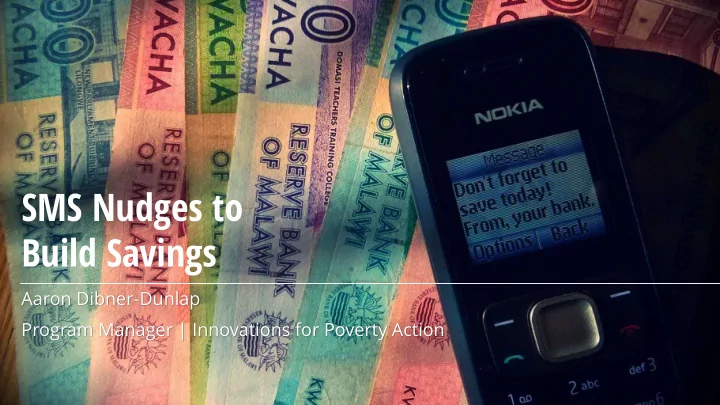
SMS Nudges to Build Savings

Aaron Dibner-Dunlap Program Manager | Innovations for Poverty Action
slide-2
SLIDE 2

Agenda

  • Background & research questions
  • Summary of field research
  • Prelim. results & lessons learned
slide-3
SLIDE 3

We have limited bandwidth to prioritize demands on money (Karlan et al., 2015)

  • We pay more attention to everyday expenses, like food
  • We pay less attention to “extraordinary” expenses, like:

We may inadequately save as a result

A Barrier to Savings

Limited Attention

Predictable but infrequent Rent, loan payment Predictable but distant New child, house purchase Unpredictable Repairs, medical bills

slide-4
SLIDE 4
  • 89% of all SMS are read within 3

minutes

  • Focuses attention at crucial

moments

  • Efficiently provide information
  • Interaction creates relationship

Mobile Phone Messages can Overcome Biases

Immediate Timely

Informative

Image credit: Flickr user blackbeltjones

Interactive

slide-5
SLIDE 5

Hi Pooja, don’t forget to save! Thanks for using

  • ur bank.

Hi Pooja, don’t forget to save for predictable expenses like rent or utilities! Thanks for using our bank. Dear client, don’t forget to save! Thanks for using our bank. Dear client, don’t forget to save for predictable expenses like rent or utilities! Thanks for using our bank.

What does it look like to evaluate SMS campaigns?

= Personalization Variation = Content Variation

slide-6
SLIDE 6

Content Variations

  • Simple
  • Goal-Oriented
  • Incentive Reminder
  • Product Information
  • Financial Education
  • Future Expenses
  • Framing: Gain v. Loss

Other Variations

  • Personalization (sender,

recipient)

  • Timing: time of day, day of

week, frequency

  • Duration

Field Experiments in Financial Messages

What has been tested?

slide-7
SLIDE 7

Country Population Content Variations Other

Simple Goal

  • Incent. / Benefit

Product Info

  • Fin. Ed.

Future Exp. Gain v. Loss Personalized Timing Duration

Savings Bolivia, Peru, Philippines 13,500 commitment savings

   

Kenya 2,400 mobile money users

 

Colombia 10,000 youth accountholders

  

Philippines (2) 108,000 CCT recipients

       

Peru (2) 31,000 m-banking users

    

Dominican Republic 2,000 remittance recipients

 

Ghana 108,000 agent banking clients

       

Colombia (2) 180,000 retirement savings clients

    

Credit Philippines (3) 900 loan recipients

   

Uganda 1,100 loan recipients

Field Experiments in Financial Messaging

slide-8
SLIDE 8
  • The right messages can improve behavior
  • Increased savings by 6 – 100% relative to no messages
  • Improved total loan repayment by 7-9% ( ),

timeliness by 24% ( )

  • Personalization is effective for loan repayment
  • Messages that invoke both goal and incentive

are particularly effective

  • Reminders work better than financial education

What we already know

Messages for Financial Behavior: Lessons Learned

Bolivia, Peru, Philippines Kenya Colombia Philippines (Credit) Uganda (Credit)

slide-9
SLIDE 9

Philippines

  • Increased likelihood of depositing by 13%...but no overall impact on balances.
  • Simple reminder or goal-oriented messages increased balances by 1 pp (19%

more than control)

  • Personalization & action-oriented ending had similar impact

Peru

  • Increased account balances by 6%
  • Successful messages: Simple reminder, future expenses, banking information
  • Personalization had no impact

New preliminary findings (do not cite)

Messages for Financial Behavior: Lessons Learned

slide-10
SLIDE 10

Dominican Republic

  • Decreased transaction activity, but no impact on balances
  • However, older clients increased deposits
  • Goals survey did not predict treatment response

Pooled Results

  • Very small impact on transaction volumes (< 1%)
  • No impact on balances

New preliminary findings (do not cite)

Messages for Financial Behavior: Lessons Learned

slide-11
SLIDE 11
  • No clear picture of response to SMS
  • Divergent responses among individual sites & subgroups
  • SMS cost-effective in Peru
  • Active userbase, higher transaction volumes
  • Can reactivate clients, but not enough
  • Personalization, customized content, action-orientation can work

in right context

Implications of Early Findings

slide-12
SLIDE 12
  • Many unanswered questions remain
  • Long-term impacts
  • Other behavioral mechanisms
  • Interactivity
  • Trust-building
  • Release preliminary findings from Wave 1 in Q4 2016
  • Complete ongoing sites – Colombia, Ghana
  • Continue subgroup analysis & results pooling

Next Steps for Messaging Research

slide-13
SLIDE 13

Thank you

Aaron Dibner-Dunlap addunlap@poverty-action.org

References:

Akbaş, M., Ariely, D., Robalino, D. A., & Weber, M., 2016. How to Help the Poor to Save a Bit: Evidence from a Field Experiment in Kenya. Available at http://sites.duke.edu/merveakbas/files/2014/08/How-to-help-the-poor-.pdf Cadena, X. and A. Schoar., 2011. “Remembering to Pay? Reminders vs. Financial Incentives for Loan Payments.” NBER Working Paper no.

  • 17020. Available at http://www.nber.org/papers/w17020.

Karlan, D., McConnell, M., Mullainathan, S. and Zinman, J., 2016. Getting to the top of mind: How reminders increase saving. Management

  • Science. Available at http://pubsonline.informs.org/doi/abs/10.1287/mnsc.2015.2296

Karlan, D., Morten, M., and J. Zinman., 2012. “A personal touch: Text messaging for loan repayment.” NBER Working Paper no. 17952. Available at http://www.nber.org/papers/w17952. Rodriguez, C. and Saavedra, J.E., 2015. Nudging Youth to Develop Savings Habits: Experimental Evidence Using SMS Messages. CESR- Schaeffer Working Paper, (2015-018). Available at http://csd.wustl.edu/Publications/Documents/WP16-19.pdf York, B.N. and Loeb, S., 2014. One step at a time: The effects of an early literacy text messaging program for parents of preschoolers (No. w20659). National Bureau of Economic Research. Available at http://www.dicdoha.net/sites/default/files/NBERPaper_York%20Loeb(November%202014).pdf