SLIDE 1
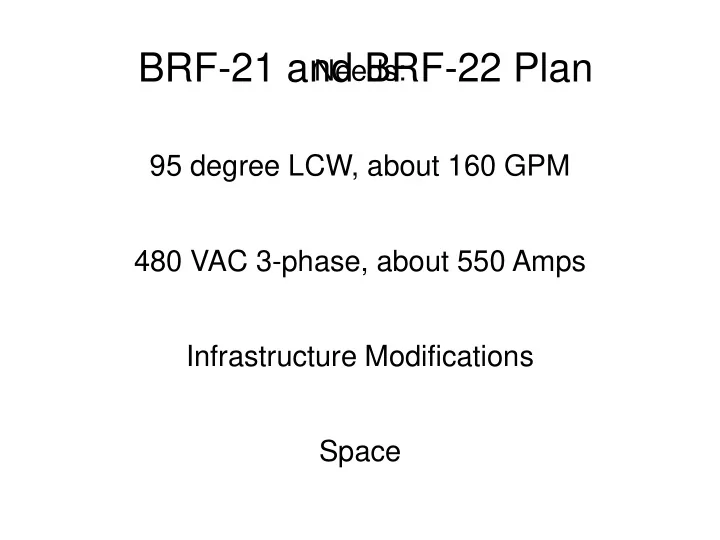
BRF-21 and BRF-22 Plan
Needs: 95 degree LCW, about 160 GPM 480 VAC 3-phase, about 550 Amps Infrastructure Modifications Space
SLIDE 2
We need additional LCW Flow 2 RF Cavitys, 2 x 18 GPM 36 2 Power Amplifiers, 2 x 25 GPM 50 2 Modulators, 2 x 20 GPM 40 2 Bias Supplies, 2 x 13 GPM 26 2 Solid State Amps, 2 x 7 GPM 14 166 GPM
SLIDE 3 95 Degree LCW system is running at full capacity. More CUB flow requires more pressure or bigger pipes. We can conserve water; examples:
- Valve out the four PEI's in the cooling room, 28 GPM
- Close the 150 GPM bypass valve at XGW-000, 150 GPM
- Closed the bypass at the end of TG-9
, 30 GPM
- Cut both APS skids by half,
50 GPM
- We can gain another 200 GPM with a $60K recirculation
pump at TG-9 to Switch-Yard. Dave Hixson.
SLIDE 4
SLIDE 5
Tuner thermisters are pushing 60 C, (140 F) at 15 Hz in the winter time. Can CUB keep up in July, August, and September? The $60K recirculation pump may be needed.
SLIDE 6 Power
The new RF needs 570 amps or 475 KVA.
- Hard to route new power from Y-BW1.
- Y-L5 is only a 500 KVA, 600 amp transformer.
- A new 1000 KVA transformer for Y-L5 is $72K.
- That leaves Y-L4 and USS-Y-L3.
- USS-Y-L3 is 1500 KVA or 1800 Amps at 480 VAC 3ph
and has about 700 amps per phase while NTF runs.
- It has 1100 amps or 950 KVA of spare capacity. It
runs about 150 amps/phase w/o NTF.
SLIDE 7 Power
- Clamp-on ammeter on Y-L4 during normal
- perations shows:
- 900 amps/phase, or 50% of 1500 KVA capacity.
- We can free up more capacity and better isolate
linac from booster, if we rearrange panels in linac lower-level.
SLIDE 8
- Panels PHP-L4-3 and PHP-L4-4 are in the linac lower
- level. Clamp-on shows only ~100 amps-phase will run
both panels.
- Change supply for those two panels from transformer Y-
L4 to transformer USS-Y-L3.
- The cable pulls are quick and the cable is reusable.
Power
SLIDE 9
SLIDE 10 The run from DHP-L4-1 to BGW-124 This is about 15 large conductors.
SLIDE 11
Alternate power costs about $85K more with new Y-L5 1000KVA transformer.
SLIDE 12 Infrastructure
- Take out the door and make a bigger hole.
- Cut a hole in the north wall to route LCW, the station coax
bundles, BIAS buss bar, small signals, HV. Fire safety does not
- bject to opening the room. No fire stops needed.
- Avoid long coax runs to the MCR and LLRF:
- Steal RFA from BRF-17. Sum BRF-21 with BRF-17.
- Steal RFB from BRF-18. Sum BRF-22 with BRF-18.
- Pull 30KV, 750V, grounds from WAPS.
- Maybe build a wall to isolate the carpeted area for noise and air
- conditioning. Re-use the door, gain a foot of rack-space.
SLIDE 13 Infrastructure
- Cut and cap some un-used ICW that interferes with buss-bar.
- Cut and patch a hole in the ceiling to install buss-bar with crane.
- Raise the lighting fixtures.
- Redo the large AC ductwork that partially blocks the hole in the
north wall.
- Remove the unused fire hose cabinets and 2” feeds and cap the
line near BWT. This is likely, no-cost. This makes more room to get stuff over the duct-work.
SLIDE 14
Cut out the door. Make a big hole
SLIDE 15 North wall. Buss- bar comes out
DP18 review done with “no-comment”
SLIDE 16
North east corner. Sprinkler test can be moved. Overhead sprinklers are OK. Lights can be raised.
SLIDE 17
LCW manifold. Two go on the north wall.
SLIDE 18
Final Questions? tomlin@fnal.gov