Brane vector dark matter T. E. Clark, S. T. Love, C. Xiong, --Purdue - - PowerPoint PPT Presentation

brane vector dark matter
SMART_READER_LITE
LIVE PREVIEW

Brane vector dark matter T. E. Clark, S. T. Love, C. Xiong, --Purdue - - PowerPoint PPT Presentation

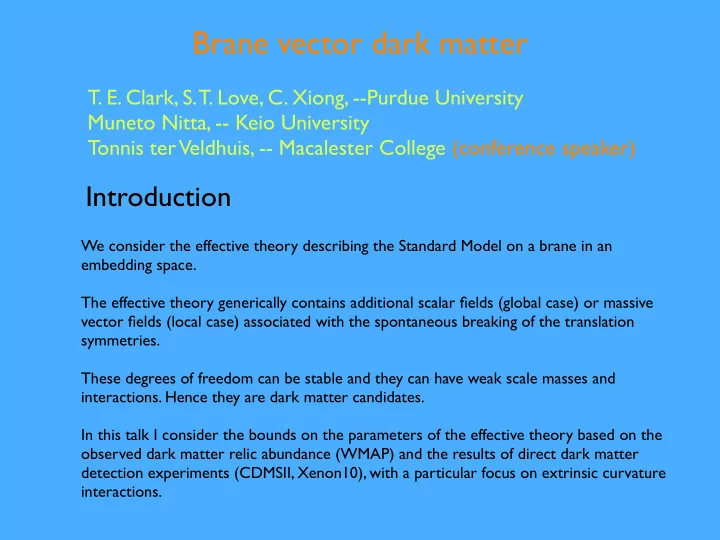
Brane vector dark matter T. E. Clark, S. T. Love, C. Xiong, --Purdue University Muneto Nitta, -- Keio University Tonnis ter Veldhuis, -- Macalester College (conference speaker) Introduction We consider the effective theory describing the


slide-1
SLIDE 1

Brane vector dark matter

  • T. E. Clark, S. T. Love, C. Xiong, --Purdue University

Muneto Nitta, -- Keio University Tonnis ter Veldhuis, -- Macalester College (conference speaker)

Introduction

We consider the effective theory describing the Standard Model on a brane in an embedding space. The effective theory generically contains additional scalar fields (global case) or massive vector fields (local case) associated with the spontaneous breaking of the translation symmetries. These degrees of freedom can be stable and they can have weak scale masses and

  • interactions. Hence they are dark matter candidates.

In this talk I consider the bounds on the parameters of the effective theory based on the

  • bserved dark matter relic abundance (WMAP) and the results of direct dark matter

detection experiments (CDMSII, Xenon10), with a particular focus on extrinsic curvature interactions.

slide-2
SLIDE 2

Other talks concerning the same model at this conference: “Higgs Decays and Brane Graviphotons,” Sherwin Love, 3.15 pm, this afternoon, Extra Dimensions session. “Brane Osciallation at the TeVatron and LHC,” Thomas Clark, 3.30 pm, this afternoon, Extra Dimensions session.

slide-3
SLIDE 3

The Model

LSMX LSM 1 4 FΜΝFΜΝ 1 2 MX

2 XΜXΝ 1

2 MX

2

FX

4 XΜTΜΝ SMXΝ

MX

2

FX

4 Κ1BΜΝ Κ2 B

  • ΜΝΜ XΡ Ρ XΝ

Parameters:

extrinsic curvature interaction

MX FX

4

Κ1, Κ2 brane tension brane vector mass dimensionless coupling constants Fields:

XΜ BΜΝ, B

  • ΜΝ

FΜΝ

brane vector field field strength for brane vector field field strength for hypercharge gauge field, and dual

slide-4
SLIDE 4

Additional comments

The displayed action is the leading part of an underlying action that is invariant under all Standard Model symmetries and the non-linearly realized symmetries corresponding to extra dimensions. That underlying invariant action was constructed using the coset method An additional coupling of the brane vector to the Higgs bilinear invariant can also be included in the action but will not be consider it here. A flavor index for the brane vector has been suppressed. There is one flavor of brane vectors for each additional dimension. In this talk I will focus on the case of a single

  • flavor. Generalization of the results is trivial.

The link with the globally invariant action can be made with the identification

MX

2

FX

4 XΜ

Μ

Note that the extrinsic curvature interaction terms identically vanish in the global case. Goldstone boson

  • J. A. R. Cembranos, A. Dobado, A. L. Maroto
  • P. Creminelli, A. Strumia
slide-5
SLIDE 5

Relic Density Calculation

Brane vector annihilation cross-sections: (non-relativistic limits shown)

f

  • f

X X X X X X X X

H H A A

Z Z

1 144Π MX2 FX

8

MX2 MH2 2MX4 MH4 s 4 MX2 1 18Π MX7 FX

8

1 s 4 MX2 1 72Π MX2 FX

8

MX2 mf2 MX4 mf4 s 4 MX2 1 144Π MX2 FX

8

MX2 MZ2 10MX4 8MX2MZ2 3MZ4 s 4 MX2

universal for all SM fermions

s 4 MX2 2 MX v

slide-6
SLIDE 6

50 100 150 200 250 100 200 300 400 500 600 700 MX GeV FX GeV

50 100 150 200 250 5 10 15 20 25 MX GeV xfMXTf

Freezeout temperature

50 100 150 200 250 0.0 0.2 0.4 0.6 0.8 1.0 MX GeV ch2

X Relic Abundance

Relation between parameters so that WMAP result for the relic dark matter density is reproduced. Energy momentum term only!

slide-7
SLIDE 7

Additional contributions to the annihilation cross-sections

X X X X X X

f

f

  • W

W

Z Z

H

Z Γ Z Γ

, ,

1 13 824Π 1 FX

8

A2 MX2 MZ2 s s 4 MX2 s MH MZ2 s MH MZ2 MH4 MZ4 26 MZ2 s s2 2 MH2 MZ2 s s Κ12 Κ22s 4 MX2 1 27 648 Π A2 MX2 s2 F8 MW4

  • s 4 MW2

s 4 MX2 9 s2 4 MW2 s 160 MW4 s Κ12 Κ22s 4 MX2 1 3456 Π MX2 s FX

8

s 4 mf2 s 4 MX2 A2 2 mf2 s B2 s 4 mf2 s Κ12 Κ22s 4 MX2

These contributions to the annihilation cross-sections are suppressed in the non-relativistic limit.

slide-8
SLIDE 8

50 100 150 200 250 0.0 0.2 0.4 0.6 0.8 1.0 MX GeV ch2

X Relic Abundance

50 100 150 200 250 5 10 15 20 25 MX GeV xfMXTf

Freezeout temperature

50 100 150 200 250 50 100 150 200 250 MX GeV FX GeV

Relation between parameters so that WMAP result for the relic dark matter density is reproduced. Extrinsic curvature terms only! Z-boson resonance

slide-9
SLIDE 9

X X

f f

Σel 7 36 Π Κ0

2 MX 4

FX

8 MX mf4

MX mf6 v0 c

  • 4

f f

X X

+

5 9 Κ1

2Α q2 Cos2ΘW MX 4

FX

8 MX mf4

MX mf6 v0 c

  • 4
  • Κ2

2Α q2 Cos2ΘW MX 4

FX

8 MX mf2

MX mf2 v0 c

  • 2

Elastic scattering cross-section

Non-relativistic limit,

Direct Detection

MX mf

Suppression factor:

v0 c 0.001

slide-10
SLIDE 10

WIMP Mass [GeV/c2] Cross-section [cm2] (normalised to nucleon)

080428214401

http://dmtools.brown.edu/ Gaitskell,Mandic,Filippini

10

1

10

2

10

3

10

  • 46

10

  • 45

10

  • 44

10

  • 43

10

  • 42

10

  • 41

080428214401

XENON10 2007 (Net 136 kg-d) CDMS: 2004+2005 (reanalysis) +2008 Ge CDMS 2008 Ge DATA listed top to bottom on plot

Estimate:

MX 100 GeV FX 250 GeV Κ2 1 Σel 1051 cm2 The parameter space of the model is not constrained by the direct detection data. Since the indirect detection signal from neutrinos due to annihilation of dark matter in the center of the Sun or the Earth is also determined by the same non-relativistic elastic scattering cross section, the neutrino data is not expected to constrain the model either.

slide-11
SLIDE 11

Conclusions

The brane vector model provides an effective description of some scenarios where our world is embedded in a higher dimensional space. The brane vector is a dark matter candidate as it can be stable. The WMAP observed relic dark matter can be correctly reproduced without straining the parameter space. The elastic scattering cross-section of the brane vector with fermions is suppressed in the non-relativistic limit. It seems therefore unlikely that the parameter space can be probed by using the data from the direct dark matter detection experiments. For the same reason it is expected that the indirect detection results which yield bounds on potential neutrinos produced in dark matter annihilations in the center of the Sun or the Earth do not put constraints on the parameter space. Additional constraints on the parameter space follow from collider experiments data See talk by Thomas Clark later this afternoon.