Brain Applying Autonomics to Create an Intelligent, Ubiquitous - - PDF document

brain
SMART_READER_LITE
LIVE PREVIEW

Brain Applying Autonomics to Create an Intelligent, Ubiquitous - - PDF document

8/5/2010 Multichannel Flexible and Biocompatible Microelectrode SangHoon Lee Department of Biomedical Engineering, Korea University, Seoul, 136-703, Korea Applying Autonomics to Create an Intelligent, Ubiquitous Environment Slide 1 Brain


slide-1
SLIDE 1

8/5/2010 1

Applying Autonomics to Create an Intelligent, Ubiquitous Environment Slide 1

Department of Biomedical Engineering, Korea University, Seoul, 136-703, Korea

Multichannel Flexible and Biocompatible Microelectrode

SangHoon Lee

Applying Autonomics to Create an Intelligent, Ubiquitous Environment Slide 2

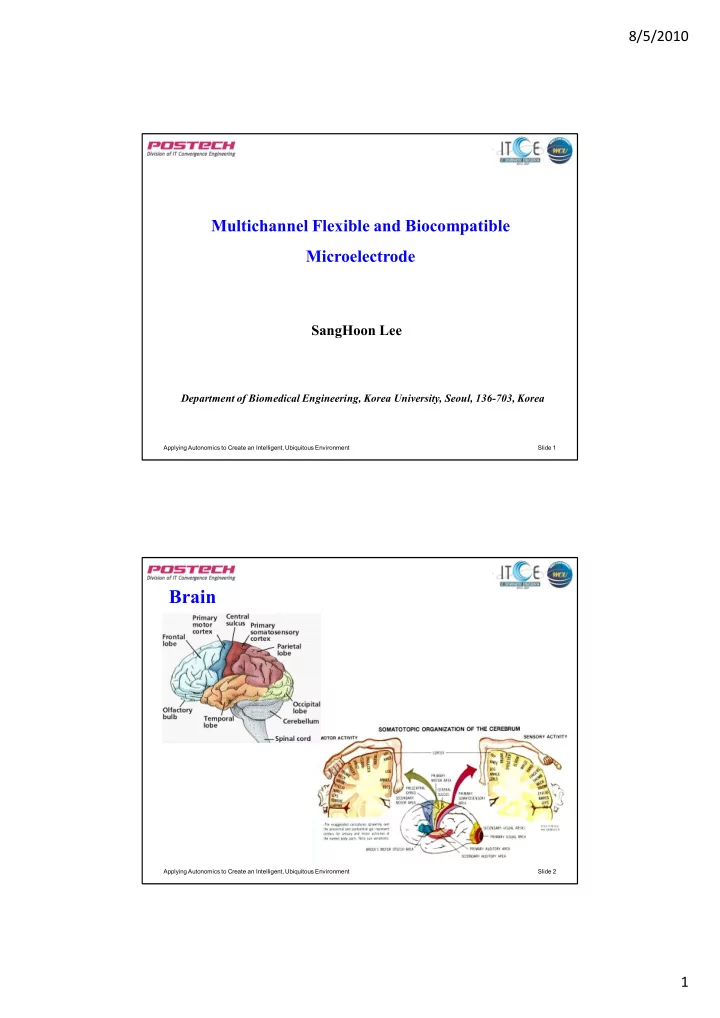
Brain

slide-2
SLIDE 2

8/5/2010 2

Applying Autonomics to Create an Intelligent, Ubiquitous Environment Slide 3

Recover the broken cord Possible?

Applying Autonomics to Create an Intelligent, Ubiquitous Environment Slide 4

Regeneration

Nerve Nerve Nerve Nerve Nerve Nerve

In reality

Nerve Nerve

POW 10 week/ with Dankook Univ.

Neuronal Circuit?

slide-3
SLIDE 3

8/5/2010 3

Applying Autonomics to Create an Intelligent, Ubiquitous Environment Slide 5

Prosthesis

Wiring

Possible?

Applying Autonomics to Create an Intelligent, Ubiquitous Environment Slide 6

NMI (Neuron to Machine Interface)

slide-4
SLIDE 4

8/5/2010 4

Applying Autonomics to Create an Intelligent, Ubiquitous Environment Slide 7 J.R. Wolpaw et al. 2002

BCI (BMI): bypasses the brain’s normal pathways of peripheral nerves and muscles

Concept of BMI

Applying Autonomics to Create an Intelligent, Ubiquitous Environment Slide 8

Duke University Center for Neuro-engineering

Neuronal activity is recorded in multiple brain areas and translated to commands to the actuator, via the control computer and multiple decoding algorithms (blue loop).

slide-5
SLIDE 5

8/5/2010 5

Applying Autonomics to Create an Intelligent, Ubiquitous Environment Slide 9

Nature, 442, 2006

Nagle: Quadriplegic patient and the first human volunteer John Donoghue (Brown University in Rhode Island)

Human trial

Applying Autonomics to Create an Intelligent, Ubiquitous Environment Slide 10

Major application of BMI

Sensory Recovery Motion Recovery

slide-6
SLIDE 6

8/5/2010 6

Applying Autonomics to Create an Intelligent, Ubiquitous Environment Slide 11

Core technologies for BMI

THE SIX MILLION DOLLAR MAN

Understanding of brain (neuron) Electrode for Interface Neuro-signal processing

Communication

Applying Autonomics to Create an Intelligent, Ubiquitous Environment Slide 12

Focusing on Electrode

slide-7
SLIDE 7

8/5/2010 7

Applying Autonomics to Create an Intelligent, Ubiquitous Environment Slide 13

State of the Art

u Neural Recording Electrode u Flexible Electrode u Micro Electrode for Visual Cortex u Neural Probe with Microfluidic Channel u 2-D & 3-D Neural Stimulation and Sensing

Applying Autonomics to Create an Intelligent, Ubiquitous Environment Slide 14

Classification of Neural Electrode

Shape Materials

Neural Electrode Depth Electrode Planar Electrode Sieve Electrode Cuff Electrode Hard Materials Soft Materials

UEA, Michigan Electrode MEA Regeneration type nerve electrode Silicone electrode Flexible electrode. Polyimide, PDMS, Parylene

slide-8
SLIDE 8

8/5/2010 8

Applying Autonomics to Create an Intelligent, Ubiquitous Environment Slide 15

Depth Type Electrode

Applying Autonomics to Create an Intelligent, Ubiquitous Environment Slide 16

Electrodes for the sub-retinal prosthesis

slide-9
SLIDE 9

8/5/2010 9

Applying Autonomics to Create an Intelligent, Ubiquitous Environment Slide 17

Operation of Electrodes for the Rabbit Retina

Applying Autonomics to Create an Intelligent, Ubiquitous Environment Slide 18

Thomas Schanze et. al, Experimental Eye Research(2005) Pig, subretinal New Zealand White Rabbit, subretinal VEP ; 200~225 ms EEP ; 75~100 ms

NIHON KOHDEN Neuropack Four mini MEB-5304K

VEP (Visual Evoked Potential) & EEP (Electrical Evoked Potential) Test

slide-10
SLIDE 10

8/5/2010 10

Applying Autonomics to Create an Intelligent, Ubiquitous Environment Slide 19

Fabrication Fabrication of PI

  • f PI-based electrode process

based electrode process

  • Fig. 1. A schematic overview of polyimide based electrode process. (a) Sacrificial layer (Al). (b) Polyimide for 1st layer

spin-coating and patterning. (c) Metallization (Ti/Au). (d) Polyimide for 2nd layer spin-coating and patterning. (e) peel-off the polyimide base electrode. (f) Connector connection. Sacrificial layer Al layer - 1000Å 1st polyimide layer 3000rpm - 30sec soft baking 95℃ - 3min UV exposure 150mJ/㎠ PEB 95℃ - 3min Develop & rinse Developer : 5min (soak) dry N2 blowing metal deposition Ti : 500Å, Au : 2500Å metal patterning 3500rpm - 30sec (AZ1512) soft baking 95℃ - 1 min UV exposure 150mJ/㎠ develop 1 min metal patterning Au etching - HCl: HNO3=3:1 Ti etching - H2O: HF: HNO3 = 50:1:1 Removal PR Acetone - 3min

Applying Autonomics to Create an Intelligent, Ubiquitous Environment Slide 20

Platinum Platinum (Pt) electro (Pt) electro-

  • plating method

plating method

Electroplating solution Electroplating solution * H * H2PtCl PtCl2 : 5g (Chloroplatinic acid, Sigma : 5g (Chloroplatinic acid, Sigma-Aldrich) Aldrich) * Pb (NO * Pb (NO3) : 2 71.4mg (lead acetate, Sigma ) : 2 71.4mg (lead acetate, Sigma-Aldrich) Aldrich) * DI * DI-water : 357mL water : 357mL Method #01 Method #02 Method #03 *Chemical- treatment Chemical- treatment *Ultra-sonic Ultra-sonic

*Chemical-treatment : H2SO4 solution dipping for 20sec *Ultra-sonic : ultra-sonic wave during electroplating process TABLE 1. electroplating conditions TABLE 1. electroplating conditions

PDMS Electroplating solution Ultra-sonic wave Applied current density Applied current density ① 0.4mA/cm 0.4mA/cm2 ② 2.0 2.0mA/cm mA/cm2 ③ 5.9 5.9m mA/cm A/cm2

2
slide-11
SLIDE 11

8/5/2010 11

Applying Autonomics to Create an Intelligent, Ubiquitous Environment Slide 21

Electrical Electrical & Mechanical characterization & Mechanical characterization

Counter electrode working electrode Reference electrode (+) (-) Potentiostat Electrical characterization Electrical characterization Mechanical characterization Mechanical characterization Glass (1cmx1cm) Ti/Au layer (500/2000Å) Polyimide layer Adhesive tape Applying Autonomics to Create an Intelligent, Ubiquitous Environment Slide 22

Electrical Electrical & Mechanical characterization & Mechanical characterization

  • Fig. 5. (a) measured the impedance of electrode electroplated with method #02.

(b) measured the impedance of bare gold, non-electroplated on seed layer. b a

slide-12
SLIDE 12

8/5/2010 12

Applying Autonomics to Create an Intelligent, Ubiquitous Environment Slide 23

Electrodes for Mouse EEG from Skull

PCB connector Recording site Male SMT

c) Load cell a) PCB connector holder b) Heater Lever e) Digital display d) Thermocouple

Applying Autonomics to Create an Intelligent, Ubiquitous Environment Slide 24 right left frontal caudal

d c

L1 L3 L4 L5 L7 L6 L2 L8 L10 L9 L11 L13 L12 L14 Ref. L15 L18 L17 L20 L19 R1 R4 R3 R6 R7 R5 R2 R9 L10 R8 R12 R13 R11 R15 GND R14 R17 R18 R19 R20

C R

In vivo Evaluation

slide-13
SLIDE 13

8/5/2010 13

Applying Autonomics to Create an Intelligent, Ubiquitous Environment Slide 25

Electrodes for IBAN

N E T W O R K

Cellular phone or PDA EEG Hearing aids ECG Blood pressure Glucose sensor Intra- Body Area Network Hospital Ambulance Police

Why IBAN?

Lower PI layer Top PDMS sheet Ti/Au pattern Upper PI layer Bottom PDMS sheet PDMS PI Au/Ti Lines Contacting Spot PDMS Connecting Part Wire

120µm

Applying Autonomics to Create an Intelligent, Ubiquitous Environment Slide 26

Potential Applications of IBAN

CH 1 CH 2

Time (ns)

slide-14
SLIDE 14

8/5/2010 14

Applying Autonomics to Create an Intelligent, Ubiquitous Environment Slide 27 PDMS Silver Ball Cu Wire #1 #2 #3 #4 #5 #7 #8 #9 #10

Electrode to Detect Neural Pathway

Single Electrode Abnormal MU Tendon Multichannel Electrode MU Abnormal MU Metal Mold Ball Cover Silver Ball Cu Wire

Applying Autonomics to Create an Intelligent, Ubiquitous Environment Slide 28

Deep Brain Stimulation (1)

Gateway of information

Dopaminergic pathways of the human brain in normal condition (left) and Parkinson's disease (right). Red Arrows indicate suppression of the target, blue arrows indicate stimulation of target structure.

http://www.youtube.com/watch?v=1yCgLythe00&feature=related

slide-15
SLIDE 15

8/5/2010 15

Applying Autonomics to Create an Intelligent, Ubiquitous Environment Slide 29

Deep Brain Stimulation (2)

http://www.youtube.com/watch?v=WYDoHmg9ECI&feature=related

Applying Autonomics to Create an Intelligent, Ubiquitous Environment Slide 30

3D & Hybrid Type Electrodes

3-D Electrode for DBS Hybrid Electrode (Electrode + Drug Delivery)

Future Work

slide-16
SLIDE 16

8/5/2010 16

Applying Autonomics to Create an Intelligent, Ubiquitous Environment Slide 31

Conclusion

  • High potential applications in medicine
  • Neural prosthesis
  • Wireless communication
  • U-Health
  • Customer electronic devices

Applying Autonomics to Create an Intelligent, Ubiquitous Environment Slide 32