Brachytherapy Dose Calculation Advancements Intro by Geoffrey S. - - PowerPoint PPT Presentation

brachytherapy dose
SMART_READER_LITE
LIVE PREVIEW

Brachytherapy Dose Calculation Advancements Intro by Geoffrey S. - - PowerPoint PPT Presentation

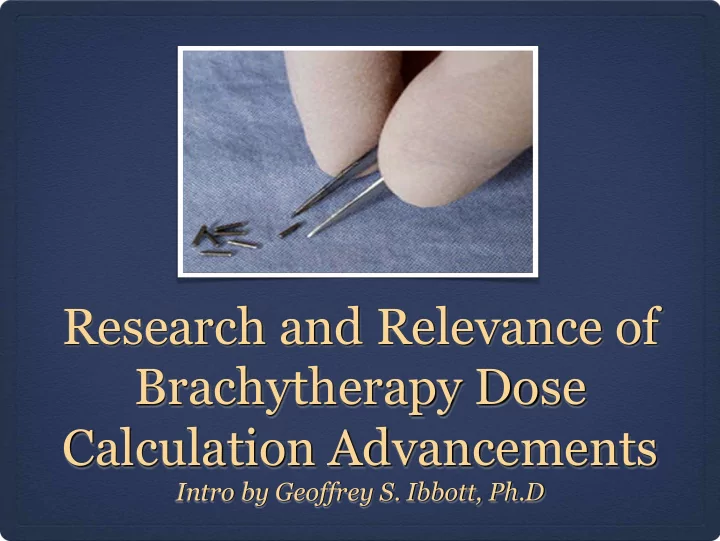
Research and Relevance of Brachytherapy Dose Calculation Advancements Intro by Geoffrey S. Ibbott, Ph.D Origins of Brachytherapy First medical experience with radium in 1901 and subsequent years, in Paris, London and New York Cancer

slide-1
SLIDE 1

Research and Relevance of Brachytherapy Dose Calculation Advancements

Intro by Geoffrey S. Ibbott, Ph.D

slide-2
SLIDE 2

Origins of Brachytherapy

  • First medical experience with radium in 1901 and

subsequent years, in Paris, London and New York

  • Cancer treatments started in 1909 in London
slide-3
SLIDE 3

Early Brachytherapy Dosimetry

  • Early techniques were based on rules
  • Stockholm system
  • Paris system
  • Quimby system
  • Manchester system (Patterson-Parker)
  • Rules generally described placement of sources to

achieve a uniform dose distribution

  • Dose rate was predicted at a reference point,

generally 0.5 cm from plane of sources

slide-4
SLIDE 4

Dose Calculations

  • Escargot Diagram

(Paris System)

slide-5
SLIDE 5

Along-and-Away Tables

slide-6
SLIDE 6

Simple Calculations

slide-7
SLIDE 7

Computerized Dose Calculations

  • Sievert Integral and

subsequent solutions

slide-8
SLIDE 8

The Shalek and Stovall Calculation Method

slide-9
SLIDE 9

The Shalek and Stovall Calculation Method

slide-10
SLIDE 10

TG43 (1995)

slide-11
SLIDE 11

Recent Advances

  • Monte Carlo
  • Grid-Based Boltzmann Solvers
  • Collapsed Cone Convolution
  • ...and other Model Based Dose Calculation

Algorithms (MBDCAs)

slide-12
SLIDE 12

MBDCAs

  • Accuracy and methods of use have not been

established

  • Consortium to establish clinical benchmark cases and

enable evaluation of MBDCAs

  • AAPM
  • ESTRO
  • Australasian Brachytherapy Group (ABG)
slide-13
SLIDE 13

Speakers

  • Current status of benchmark cases
  • Facundo Ballester, Ph.D.
  • Background and rationale for MBDCAs
  • Åsa Carlsson Tedgren, Ph.D.
  • Advances in brachytherapy dose calculation
  • Firas Mourtada, Ph.D.
  • Q&A