Bourne Shell Programming Topics Covered Shell variables Using - - PowerPoint PPT Presentation

bourne shell programming topics
SMART_READER_LITE
LIVE PREVIEW

Bourne Shell Programming Topics Covered Shell variables Using - - PowerPoint PPT Presentation

Bourne Shell Programming Topics Covered Shell variables Using options using getopts Using Quotes Reading Data Arithmetic On Shell Environment and subshells Passing Arguments Parameter substitution


slide-1
SLIDE 1

1

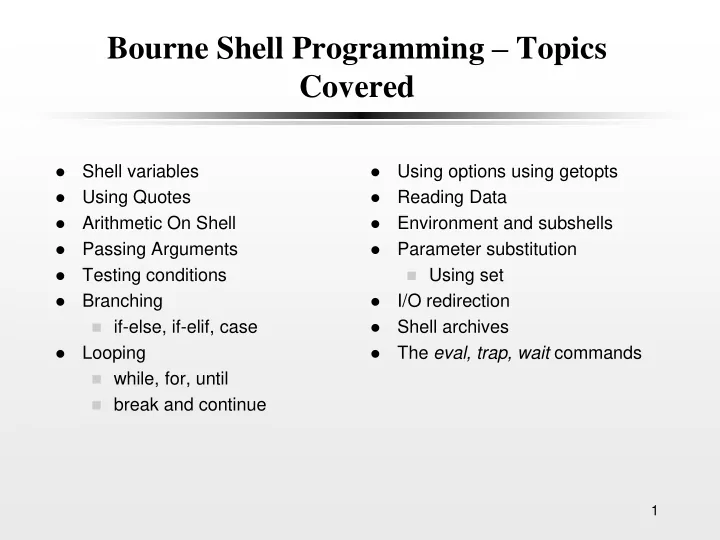
Bourne Shell Programming – Topics Covered

Shell variables

Using Quotes

Arithmetic On Shell

Passing Arguments

Testing conditions

Branching

 if-else, if-elif, case

Looping

 while, for, until  break and continue

Using options using getopts

Reading Data

Environment and subshells

Parameter substitution

 Using set

I/O redirection

Shell archives

The eval, trap, wait commands

slide-2
SLIDE 2

2

Part 1 Some Regular Expression Characters

. (dot) – any character

^ - beginning of line

$ - end of line

* - zero or more occurences of previous regular expression

[chars] – any character in the set of chars

[^chars] – any character not in chars.

\{min,max\} – at least min occurences and at most max occurences of the previous regular expression.

slide-3
SLIDE 3

3 2

Shell Scripts

Bourne Shell/Korn Shell

Invoking a shell script $shell_script_file or $sh -options shell_script_file

 the script file must have execute-permission. 

Shell Variables

 mydir=/usr/jsmith/bin  count=

#assign a null value to the variable

 echo $mydir

#display the contents of mvdir

 x=*  echo $x

#substitutes the names of the files in the directory #name of a command, options and arguments can be stored inside variables command=ls

  • ption=-l

filename=namesFile $command $option $filename #shell performs the variable substitution before it # executes the command.

slide-4
SLIDE 4

4

Quotes

The Single Quote

 The white-space characters

enclosed between the single quotes are preserved by the shell.

 The special characters are

ignored.

 Example:

filename=/usr/jsmith/bin/prog1 echo $filename echo ‘$filename’ echo ‘<> | ; () {} ` & “‘

The Double Quote

 The special characters, $, back

quotes (`) and back slashes (\) are not ignored.

 Example;  x=*  echo $x #filenames are substituted  echo ‘$x’ #$x is displayed  echo “$x” # * is displayed, variable substitution is done inside the double quotes, no file name substitution is done and * is passed to the shell.

slide-5
SLIDE 5

5

Quotes

The Back Quote

purpose is to tell the shell to execute the enclosed command and to insert the standard output from the command at that point

  • n the command line.

Example: echo The date and time is: `date` echo There are `who | wc -l` users logged on filelist=`ls` echo $filelist (#what is the output) mail `sort -u names` < memo #-u option removes the duplicate # entries from the file

The Back Slash

Is same as putting single quotes around a single character.

Quotes the single character that immediately follows it.

X=*

echo \$x # $x is displayed

Is interpreted inside the double quotes.

Use backslash inside the double quotes to remove the meaning of characters that otherwise would be interpreted.

Examples: echo “\$x” #$x is displayed echo “The value of x is \”$x\”” #The value of x is “5” is displayed
slide-6
SLIDE 6

6

Arithmetic On Shell

A variable is just considered a string of characters.

 Example:  x=1  x=$x+1  echo $x #will display 1+1  A unix program expr evaluates an expression given to it on the

command line.

 Each operator and operand given to expr must be a separate

  • argument. The operators, +, -, *, /, % are recognized.

 Example:

i=1 i=`expr $i + 1`

 Evaluates only integer arithmetic expressions.  awk may be used for floating point calculations.

expr 10 * 2 # what is the problem with this?

slide-7
SLIDE 7

7

Passing Arguments

$#: Number of arguments passed to the program from the command line.

$* : references all the arguments Example: %cat showArgs echo $# arguments passed. echo they are :$*: %showArgs a b c d 1 #output - %showArgs “a b c d 1” #output - % showArgs `cat names` #output - % showArgs x* #output - %cat lookup grep $1 phonebook lookup “Mary Jones” What is the result?

slide-8
SLIDE 8

8

Positional Parameters

Positional parameters

 set shell script arguments. e.g.

$my_script a b xy “1 2 3”

 positional parameters have the values

$0 -- my_script $1 -- a $2 -- b $3 -- xy $4 -- 1 2 3

 $* - references all the variables passed as arguments

slide-9
SLIDE 9

9

The shift command

shift

 left-shifts the positional

parameters.

 If more than 9 arguments

are supplied, arguments 10 and up cannot be referenced.

 use shift to access these

arguments.

 shift assigns value in $2 into

$1, $3 into $2 etc.

 The number of arguments

($#) gets decremented by

  • ne on each shift.

%cat testshift echo $# $* shift echo $# $* shift echo $# $* % cat testshift 1 2 3 4 5 6 7 8 9 10 What is the output?

slide-10
SLIDE 10

10

Testing Conditions

if statement: allows to test a condition and branch on the exit status of the condition tested.

An exit status of 0 indicates the program executed successfully.

An exit status of non-zero indicates a failure.

$?: contains the exit status of the last command executed.

Operators for integer comparisons

 eq (equal), -ge (greater than or equal), -gt (greater than), le (less than or

equal), -lt (less than) and –ne (not equal)

Operators for string comparisons

 = , !=, -n (string is not null) and –z (string is null)

File operators

 -d file file is a directory  -f file file is an ordinary file  -r file file is readable by the process  -s file is of non-zero length

slide-11
SLIDE 11

11

Testing Conditions

Examples user=$1 who | grep “^$user” > /dev/null

  • the exit status of the last command in the pipe line is returned.
slide-12
SLIDE 12

12

The test command

The test command is used to test one or more conditions in an if statement. y=ABC test "$y" = ABC echo $? # displays 0 x= test -n x #checks if x is not null echo $? #displays 1 test -z x #checks if string is null echo $? x=ABC [ "$x" = ABC ] #[] same as using test [ ! "$x" = ABC ] x=5 # -a for logical and -o for logical or [ "$x" -ge 0 -a "$x" -lt 10 ] [ -f “$file1” -a -r “$file1” ]

slide-13
SLIDE 13

13

Branching

%cat isUserOn #checks if a user is logged on User=$1 if who | grep “$user” #what is the problem with matching a username in the output of who? then echo “$user is logged on” fi ======================================== if [ “$#” -ne 1 ] #checking for the correct number of arguments then echo “Incorrect number of args” exit 1 #terminates the program with the exit status fi if [“$NAME” = “John Doe” -a “$BAL” -gt 5000] then echo “ok” else echo “not ok” fi

slide-14
SLIDE 14

14

Using case

case: allows a comparison of a single character against other values and execute a command if a match is found. %cat ctype x=A case "$x“ #The value in x is compared with each of the cases

#until a match is found. When a match is found, the #commands up to the double colons are executed.

in [0-9] ) echo digit;; [A-Z] ) echo uppercase;; [a-z ) echo lowercase;; * ) echo special character;; esac

Exercise: Can you rewrite the script passing the value to be tested as an argument?

slide-15
SLIDE 15

15

The && and || constructs

command1 && command2

 if the exit status of command 1 is 0 then command 2 is executed.  Example

EDITOR=[ -z "$EDITOR" ] && EDITOR=/bin/ed echo "$EDITOR"

command1 || command2

 If the exit status of command 1 is not zero, then command 2 is

executed.

 Example:

grep “$name” phonebook || echo “Couldn’t find name”

slide-16
SLIDE 16

Debugging with a -x option

Trace the execution of any program by typing in sh -x followed by the name of the program and its arguments.

Starts up a new shell to execute the program with the debug

  • ption.

Commands are printed at the terminal as they are executed preceded by a + sign. sh -x ctype A + [ 1 -eq 1 ] + x=A + + echo A + wc -c num=2 + [ 2 -ne 1 ] + echo Enter a single character Enter a single character + exit 1

slide-17
SLIDE 17

Looping

The for loop is executed for as many words as are included after in

for var in listofwords do commands done for i in 1 2 3 do echo $i done for file in * #substitutes all the files in the # directory do processCmd $file done

slide-18
SLIDE 18

18

The for loop

for var #uses all the arguments given to the program on the command line do command command done for file in $* # Replaces $1, $2 as $1, $2 etc do x=`wc -l $file` echo There are `echo $x |cut -f1 -d’ ‘` lines in $file done for file in “$@” #Replaces $1, $2 as “$1”, “$2” etc. Should be included in double quotes do echo $file done

slide-19
SLIDE 19

Looping

while command do command1 command2 done

command1 and 2 are executed until command returns a nonzero exit status # Print command line arguments while [ “$#” -ne 0 ] do echo “$1” shift done until command do command1 command2 done

command1 and command2 are executed as long as command returns a non-zero exit status. until who | grep “^$user “ do sleep 60 done

slide-20
SLIDE 20

Break and continue

break: to break out of a loop.

break n: to break out of n inner most loops for file do #variable error can be set to a value count=1 while [ “$count” -le 5 ] do #process file if [ -n “$error” ] #contains a value then break 2 fi count=`expr $count + 1` done done

continue: the remaining commands in the loop are skipped. for file do if [ ! -f “$file” ] then echo “$file not found” continue fi cat $file done

slide-21
SLIDE 21

11

The getopts command

The built-in command, getopts processes the command line arguments.

Format: getopts options variable

Used in designing programs which take options.

Example:

 isLoggedOn mary  isLoggedOn -m mary  isLoggedOn -m -t 120 mary  isLoggedOn -t 120 -m mary

The getopts command is designed to be executed inside a loop.

slide-22
SLIDE 22

An example using getopts

#wait until a specified user logs on -- version with

  • ptions

mailopt=FALSE interval=60 #process command options using getopts while getopts mt: option do case "$option" in m) mailopt=TRUE;; t) interval=$OPTARG;; \?) echo "Usage : mailTo [-m] [-t n] user" exit 1;; esac done

slide-23
SLIDE 23

An example using getopts (cont)

#Make sure a user name is specified if [ "$OPTIND" -gt "$#" ] then echo "Missing user name" exit 2 fi #get the user name into $1 shiftcount=`expr $OPTIND - 1` shift $shiftcount #Check for user logging on # If the user is logged on, send mail (a reminder) if the mail

  • ption

# is true. user=$1

slide-24
SLIDE 24

24

Reading Data

read variables – shell reads a line from stdin and assigns the first word to the first variable, second word to the second variable etc.If there are more words than variables, the excess words are assigned to the last variable.

Can redirect the input from a file. Examples: read x y #reads the input from the stdin read x y < names # reads the first line in names file and assigns the first word into x and the rest into y Example: while read val1 val2 do total=`expr $val1 + $val2` echo $total done

slide-25
SLIDE 25

25

Copying a file using mycopy #check if two arguments are supplied. if not exit with an error message and usage fromFile="$1" toFile="$2" #check if the destination is a directory if [ -d "$toFile" ] then #extract the file name from the source file name and #concatenate it to the destination directory toFile=$toFile/`basename $fromFile` fi #check if a file with the destination file name exists if [ -f "$toFile" ] then echo "The file $toFile already exists. Do you want to

  • verwrite it?"

read $answer if [ "$answer" != "yes" ] then exit 0 fi cp $fromFile $toFile fi

slide-26
SLIDE 26

26

SubShells

$cat shelltest x=200 echo $x $shelltest #output is 200. The program shelltest executed in a # subshell. x=100 echo $x #output is 100

A subshell runs in its own environment with its own local variables.

A subshell has no knowledge of the local variables in the parent shell, therefore cannot change the value of a variable in the parent shell.

The command export is used to make the variables in a shell known to all subshells executed from that point.

slide-27
SLIDE 27

27

$cat one echo “x = $x y = $y “ $ one #x = y = are displayed since x and y have null values $ x=100 $ y=200 $ export y $ one #y=200 is displayed

Once a variable is exported, it remains exported to all the subshells that are subsequently executed.

Exported variables and their values are copied into a subshell’s environment, where they may be accessed. Any changes made to them have no effect on the variables in the parent shell.

A variable can be exported before or after it is assigned a value.

slide-28
SLIDE 28

28

Subshells

$cat one echo "x = $x" echo "y = $y" $cat two x=1 y=2 z=3 export z three $cat three echo "x = $x" echo "y = $y" echo "z = $z" $one #What is the output $y=100 $export y $one #What is the output $two # output # x = # y = #what is the output? # z = 3 why? $three #output # x = # y = 100 # z = Why?

slide-29
SLIDE 29

29

Some Environment Variables

PS1- stores the command prompt

PS2 – stores the secondary command prompt

HOME – Stores the home directory

PATH – contains a list of directories which the shell searches whenever you type in the name of the program to be executed.

The PATH specifies the directories to be searched for programs to be executed and not for any other types of files. $ echo $PATH – displays output which may look like this /bin:/usr/bin::

CDPATH

slide-30
SLIDE 30

30

The set command

Is used to set various shell options.

Is used to reassign the positional parameters.

Set with no arguments will give a list of all the variables that exist in your environment.

HOME, PATH, SHELL are some of the variables that are displayed.

Set can be used to reassign the positional parameters – can be used to parse the data from a file or the terminal.

Example: $cat testSet set x y z echo $1: $2: $3 echo $# echo $* $testSet x: y: z 3 x y z

slide-31
SLIDE 31

31

Examples: $cat countWords read line #reads a line of input from the terminal set $line #each word in the input line is assigned # to a positional parameter echo $# #No. of words in the input line #A modified version of countWords read line #reads a line of input from the terminal set --$line #each word in the input line is assigned # to a positional parameter. With the – option, an input line like “-1 + 2 = “ will not cause problems. echo $#

slide-32
SLIDE 32

32

The eval command

eval command-line – shell scans the command line twice.

Examples: $pipe=‘|’ $ls $pipe wc –l #will generate the errors - | not found wc not found –l not found The reason: Pipes and IO redirection is done before variable substitution Fix: $eval ls $pipe wc –l #will work as expected #The first time, the shell scans the line and substitutes | as the value of the

  • pipe. Then the command line is rescanned at which point the pipe is

recognized. Exercise: How do you print the last argument given to a program?

slide-33
SLIDE 33

33

In-line Input Redirection

Command << endingword #The shell will use the lines from the stdin as the input to the command until a line with endingword Example: $ wc -l <<TheEnd > Hi > This is a test > TheEnd 2

slide-34
SLIDE 34

34

Shell Archives

 One or more related shell programs can be put into a single file

and shipped to a username with a mail command.

 The shipped file can be “unpacked” by running the shell on it.  Example:

 An archive file called shellProgs is created using the shell

script, shellArchive The file shellProgs contains two shell scripts – lookup and countWords.

 The file shellProgs is mailed to a username.  The user unpacks” the file shellProgs by running the shell on it

– resulting in the files, lookup and countWords

slide-35
SLIDE 35

35

$ cat shellProgs echo "Extracting script lookup" cat >lookup <<\END_OF_DATA name=$1 grep "$name" $PHONEBOOK if [ $? -ne 0 ] then echo "Name is not in the phone book" fi END_OF_DATA echo "Extracting script countWords" cat >countWords <<\END_OF_DATA read line set $line echo "NoOfWOrds = $#" END_OF_DATA

slide-36
SLIDE 36

36

$cat shellArchive # Creates a shell archive from a set of files. The filenames are given as # command line arguments For file do echo echo “echo extracting script $file” echo “cat >$file <<\END_OF_DATA cat $file echo “END_OF_DATA” done

slide-37
SLIDE 37

37

Grouping Commands

The semicolon allows users to string commands together on a single line as if one command was being issued. Each command within the semicolon separated list is executed by the shell in succession.

Examp mple le:

 $ cd /user/jsmith; make

The parentheses, when grouped around a command, cause the command to be executed in a sub-shell. hell.

Example:

$ cd ; ls #change to the home directory and list the contents

$ cprogs shellprogs # contents of the home directory

$ (cd cprogs ; ls ); ls

a.c b.c x.c #contents of cprogs

cprogs shellprogs #contents of home directory

slide-38
SLIDE 38

38

Grouping commands

Examples: $ line=hi $(line=bye) #execute it in a subshell $echo $line #hi $ { line=bye; } #execute it in the current shell $echo $line #bye

slide-39
SLIDE 39

39

Parameter Substitution

 Parameter substitution is a method of providing a

default value for a variable in the event that it is currently null.

 The construct uses a combination of braces delimiting

a variable and its default. The variable and default value are separated by a keyword.

 The keyword serves as a condition for when to assign

the value to the variable. Supposing a script tries to de-reference a null variable, a good programmer can avoid catastrophic errors by using parameter substitution:

slide-40
SLIDE 40

40

Examples: ${parameter} - Substitute the value of parameter.

 file=prog1  cp $file $filea # intention is to copy

prog1 into prog1a.# Will not work since filea will be treated as a variable

 cp $file ${file}a

slide-41
SLIDE 41

41

${parameter:-value} - Substitute the value of parameter if it is not null; otherwise, use value. $ result=1 $ echo "result is ${result:-2}" result is 1 $ result= $ echo "result is ${result:-2}“ #the value can be a backquoted command result is 2 $ echo "$result"

slide-42
SLIDE 42

42

${parameter:=value} Substitute the value of parameter if it is not null; otherwise, use value and also assign value to parameter. Example: $ result= $ echo "result is ${result:=2}" result is 2 $ echo "$result" 2

slide-43
SLIDE 43

43

${parameter:?value} Substitute the value of parameter if it is not null; otherwise, write value to standard error and exit. If value is omitted, then write "parameter: parameter null or not set" instead. Example: result= $ echo "result is ${result:?}" sh: result: Parameter null or not set. $ echo "result is ${result:? “result set now”}

slide-44
SLIDE 44

44

${parameter:+value} Substitute value if parameter is not null; otherwise, substitute nothing. Example: $ tracing=T $ echo "tracing is ${tracing:+on}" tracing is on

slide-45
SLIDE 45

45

exec

 The exec built-in command spawns its arguments into a new

process and runs it in place of the currently running process.

 Example

if [ "${MYSCRIPT}" = "" ] then exit else if [ -x ${MYSCRIPT} ] then echo "Executing ${MYSCRIPT}" exec ${MYSCRIPT} fi fi

slide-46
SLIDE 46

46

Synchronizing tasks

Since UNIX offers multitasking, commands can be sent to the background so that they are executed when the kernel finds time.

After a command is sent to the background, the shell frees itself to handle other commands.

To background a command, the user appends an ampersand, &, to it.

Example:

$ find / -name junkfile.tar –print 2>/dev/null & [1] 10876 #process id is printed by the shell $date #handle another command Wed Jun 21 08:46:58 PDT 2000

slide-47
SLIDE 47

47

wait

 Sometimes it may be necessary to synchronize a script with an

asynchronous process, ie. a backgrounded job.

 Wait is a built-in command for such synchronization.  Wait takes an optional process number as its argument and

pauses the shell's execution until the specified process had terminated.

 If only one process has been sent to the background, then wait

can be issued without an argument. It will automatically wait for the job to complete. If more than one job is running in the background

 Wait $! # waits for the last process that is sent to the

background

 process identifiers can be stored in variables and passed to

wait to specify the job to be waited for.

slide-48
SLIDE 48

48

wait

Examples:

$ find / -name junkfile.tar –print 2>/dev/null & [1] 10876 #process id is printed by the shell $ Wait 10876 $processCmd1 & $pid1=$! $processCmd2 & $pid2=$! … wait $pid1 wait $pid2

slide-49
SLIDE 49

49

trap

The pressing of DELETE key at the terminal, when a program is in execution, sends a signal to the executing program.

Using the trap command, the program can specify the action to be taken on receiving the signal.

Usage: trap commands signals, where commands are the actions to be taken on receiving the signals.

Some Commonly used signal numbers

Exit from Shell

1 Hangup

2 Interrupt (eg: Delete key)

15 Software termination (sent by kill, for example)

slide-50
SLIDE 50

50

Example

Example: #!/bin/sh i=1 JUNK=junkfile trap ‘rm $JUNK$$;exit’ 2 while [ $i -le 100 ] Do # remove the file when interrupt is received echo $i >> $JUNK$$ i=`expr $i + 1` done

slide-51
SLIDE 51

51

More On I/O

The shell permits the combination of the basic I/O constructs with a file descriptor.

A file descriptor (also known as a file handle) is a non-negative digit that points at a file.

The file descriptors for stdin, stdout, and stderr are 0, 1, and 2,

  • respectively. Any of these may be redirected to a file or to each other. In other

words, it is quite possible to send the output from stdin and stderr to the same

  • file. This is quite useful when a user would rather check a script's results after it

has completed processing. Examples command 2> file – redirects the standard error from any command cd JUNK 2>>out #the directory JUNK does not exist cat out sh: JUNK: not found.

$ cd JUNK >>out 2>&1 #Change directory to JUNK, redirect stdout to the file out, and then redirect stderr to the same file that stdout uses." $ cat out sh: JUNK: not found.

slide-52
SLIDE 52

52

Functions

 The Bourne shell allows the grouping of commands into

a reusable instruction set called a function.

 Functions have two parts: a label and a body. The label

names the function and is used to invoke the function.

 Some rules in declaring a function:

  • 1. The function label must be unique; it cannot be the

same as any other variable or other function.

  • 2. An empty set of parentheses must always follow the

function label. They instruct the shell that a function is being defined.

  • 3. Braces, {}, must be used to delimit the function's body.
  • 4. A function must be defined before it can be used in a

script.

slide-53
SLIDE 53

53

Functions

$cat fun_example1 #!/bin/sh

setEnvironment () { ROOT=${PWD} LIB=${ROOT}/proglib BIN=${ROOT}/bin } echo "Trying to print environment..." echo ${ROOT} ${LIB} ${BIN} #invoking the function setEnvironment echo "Trying to print environment again..." echo ${ROOT} ${LIB} ${BIN}

slide-54
SLIDE 54

54

$fun_example1

#output Trying to print environment... Trying to print environment again... /proglib /bin

slide-55
SLIDE 55

55

Functions with arguments

cat fun_example2

#!/bin/sh

setEnvironment () {

ROOT=${1} LIB=${ROOT}/proglib BIN=${ROOT}/bin } echo "Trying to print environment..." echo ${ROOT} ${LIB} ${BIN}

#invoking setEnvironment with an argument setEnvironment ./demos echo "Trying to print environment again..." echo ${ROOT} ${LIB} ${BIN}

slide-56
SLIDE 56

56

$fun_example2

#output Trying to print environment... Trying to print environment again... ./demos ./demos/proglib ./demos/bin

slide-57
SLIDE 57

57

Returning a value

 Functions return the exit status of the last command executed.  it uses the status of the last command issued.  A script controls its exit status by issuing an exit with a non-

negative value. On the other hand, functions do not use exit because it is designed to terminate the shell. Instead, functions use return.

 The return command stops execution of a function returning

program control to the point in the script where the function was

  • called. Script execution continues from where the function was
  • invoked. The format of return follows return n where n is any

non-negative integer. Providing a return value is optional just as providing a status code to exit is optional. If no code is given, return defaults to the value returned by the last command executed.

slide-58
SLIDE 58

58

Functions – returning a value

$cat fun_example3 #!/bin/sh isADir() { if [ ! -d ${1} ] then return 1 fi } isADir demos echo $? isADir fun2 echo $?

slide-59
SLIDE 59

59

Functions $cat fun_example4 #!/bin/sh isADir() { if [ ! -d ${1} ] then return 1 fi } #Functions can be embedded in a test if [ "isADir ${HOME}" ] then echo "Yes $HOME is a directory" fi

slide-60
SLIDE 60

60

Changes made in functions

Changes made to variables persist beyond execution

  • f the function.

Cat fun_example5 #!/bin/sh

change(){ ONE="Hi" TWO="NewVal"} ONE="Bye" echo "ONE = ${ONE}" echo "TWO = ${TWO}" change echo "ONE = ${ONE}" echo "TWO = ${TWO}"

slide-61
SLIDE 61

61

$fun_example5 #output changesInfun ONE = Bye TWO = ONE = Hi TWO = NewVal

slide-62
SLIDE 62

62

Including functions in multiple scripts

% cat printData #!/bin/sh printArg () { echo ${1} echo }

cat counterUser #!/bin/sh # execute the file printData in the # current shell. This will cause any functions # defined inside the file printData to be read in # and defined In the current shell. . printData x=0 while [ ${x} -le 10 ] do #calling function printData printArg $x x=`expr ${x} + 1` done echo "Done"

slide-63
SLIDE 63

63

Functions

 Functions are a very useful tool to allow scripters to organize

actions into logical blocks. It is easier to think of a program a series of steps to perform and then to expand those steps into functions that perform the necessary actions. This is much better than trying to list every single command in order.

 In addition, functions can improve a script's performance. Rather

than employ functions, you might consider grouping logical blocks into subscripts which the main script uses. This technique will work just fine, but the program's execution time will take a hit. When a script calls a subscript, the shell must find the subscript

  • n disk, open it, read it into memory, and then execute it. This

process happens every time a subscript is called even though the subscript may have been used previously.

 Functions are read once into memory as soon as they are

  • declared. They have the advantage of one time read for multiple

execution.

slide-64
SLIDE 64

64

Some Environment Variables

PS1- stores the command prompt

PS2 – stores the secondary command prompt

HOME – Stores the home directory

PATH – contains a list of directories which the shell searches whenever you type in the name of the program to be executed.

The PATH specifies the directories to be searched for programs to be executed and not for any other types of files. $ echo $PATH – displays output which may look like this /bin:/usr/bin::

CDPATH

slide-65
SLIDE 65

65

The .profile file

At the end of the login sequence, the login shell executes two special files -

/etc/profile and .profile in your home directory.

 /etc/profile – set up by the SysAdmin and does the tasks that the

administrator wants to execute when you log in (eg: checking if you have mail)

 .profile (you will get a default .profile when you get your account): gets

automatically gets executed when you log in. You can include any commands that you want executed whenever you login. Example: PATH=/bin:/usr/bin:/$HOME/bin:: CDPATH=:$HOME:$HOME/progs PS1=“=>” PS2=“=” export PATH CDPATH PS1 PS2