Bot 2.0: Botany through Web 2.0, the Memex, and Social Learning - - PowerPoint PPT Presentation

bot 2 0 botany through web 2 0 the memex and social
SMART_READER_LITE
LIVE PREVIEW

Bot 2.0: Botany through Web 2.0, the Memex, and Social Learning - - PowerPoint PPT Presentation

Bot 2.0: Botany through Web 2.0, the Memex, and Social Learning Jacob Kramer-Duffield, Ph.D. Student University of North Carolina - Chapel Hill School of Information and Library Science This work is licensed under the Creative Commons


slide-1
SLIDE 1

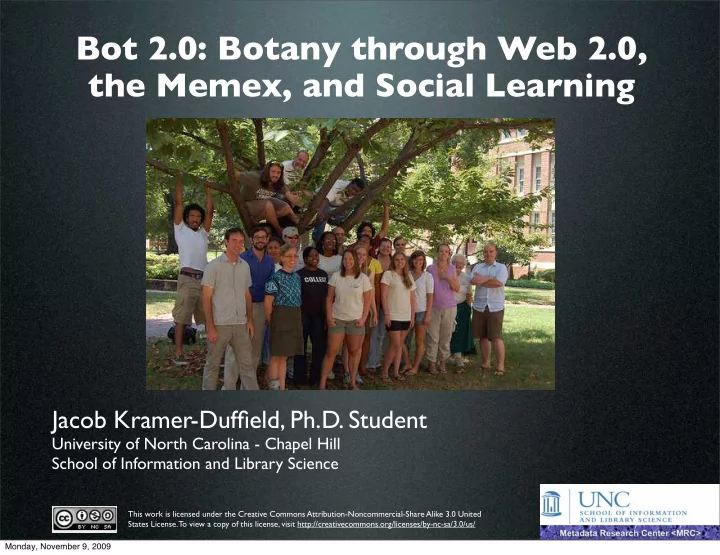
Bot 2.0: Botany through Web 2.0, the Memex, and Social Learning

Jacob Kramer-Duffield, Ph.D. Student

University of North Carolina - Chapel Hill School of Information and Library Science

This work is licensed under the Creative Commons Attribution-Noncommercial-Share Alike 3.0 United States License. To view a copy of this license, visit http://creativecommons.org/licenses/by-nc-sa/3.0/us/ Monday, November 9, 2009

slide-2
SLIDE 2

Bot 2.0: Botany through Web 2.0, the Memex, and Social Learning

  • This presentation will cover:
  • What Bot2.0 and BotCamp is
  • Picture of participants’ technology uses
  • Findings from both 2008 and 2009
  • Implications for Personal Digital Libraries
  • Individual Experiences
  • Next Steps/Implications for Future Research and Design

Monday, November 9, 2009

slide-3
SLIDE 3

Bot 2.0: Botany through Web 2.0, the Memex, and Social Learning

  • Bot 2.0 was an NSF-funded project using social software,

mobile technologies and experiential learning in assessing and developing student interest in and knowledge of botanical sciences.

  • The project addressed the lack of diversity - in race, gender,

social status and educational background - in the student population pursuing the botanical sciences

  • Findings support the promise of unstructured tagging

approaches and experiential learning in instruction of students in unfamiliar subject areas, and of the benefits of experiential learning for non-traditional students in botany

Monday, November 9, 2009

slide-4
SLIDE 4

Bot 2.0: Botany through Web 2.0, the Memex, and Social Learning

− Bot2.0: 2008 Findings − One channel of social media participation – free-text

tagging and use of folksonomies for plant identification – seems a promising ground for future investigation of one possible emergent new literacy, being formed “in the wild” and collaboratively.

Monday, November 9, 2009

slide-5
SLIDE 5

Bot 2.0: Botany through Web 2.0, the Memex, and Social Learning

 Modes of communication

and expression depend

  • n context and audience

1.3 2.5 3.8 5.0 E-mail Landline Phone Cell Phone Face to Face TXT IM SNS Message BotCamp 2009

Friends Family School Instructors

1.3 2.5 3.8 5.0 E-mail Landline Phone Cell Phone Face to Face TXT IM SNS Message BotCamp 2008

Monday, November 9, 2009

slide-6
SLIDE 6

Bot 2.0: Botany through Web 2.0, the Memex, and Social Learning

1.8 3.5 5.3 7.0 E-mail Landline Phone Cell Phone Face to Face TXT IM SNS Message BotCamp 2008

Best way to collaborate How do I collaborate

1.8 3.5 5.3 7.0 E-mail Landline PhoneCell Phone Face to Face TXT IM SNS Message BotCamp 2009

Monday, November 9, 2009

slide-7
SLIDE 7

Bot 2.0: Botany through Web 2.0, the Memex, and Social Learning

  • BotCamp 2009: In post-camp survey, all participants reported taking and

storing digital photos

  • Photos are clearly important and consideration is given to their

preservation 31% 69%

Use Camera Phone Own Cell But Not for Pictures

38% 31% 31%

One Storage Method Two Storage Methods Three or More Storage Methods

Monday, November 9, 2009

slide-8
SLIDE 8

Bot 2.0: Botany through Web 2.0, the Memex, and Social Learning

  • BotCamp 2009: Photo Description
  • Most were not very specific about the kind of information they added to

photos 25% 6% 13% 56%

Always Add Descriptions Sometimes Add Descriptions Never Add Descriptions Add Descriptions When Public

81% 19%

Have Not Tagged Others’ Photos Have Tagged Others’ Photos

Monday, November 9, 2009

slide-9
SLIDE 9

Bot 2.0: Botany through Web 2.0, the Memex, and Social Learning

  • Technology Accessibility: BotCamp 2008 vs. BotCamp 2009
  • These are small sample sizes but confirm other findings that

computer and web access – esp. among young people – is becoming more mobile and less tethered to the desktop

4 8 11 15 BotCamp 2008 BotCamp 2009

Own Desktop Own Laptop Phone Web Access No Phone Web Access

Monday, November 9, 2009

slide-10
SLIDE 10

Bot 2.0: Botany through Web 2.0, the Memex, and Social Learning

  • With students moving to a more mobile

information space, with different media for different functions, what are the implications for our ideas about personal digital libraries?

Monday, November 9, 2009

slide-11
SLIDE 11

Bot 2.0: Botany through Web 2.0, the Memex, and Social Learning

Student A, FG#1:

“It would have been easier if we could have put the pictures on the Facebook group and then commented through that… It seemed like we were going to ten different websites just for one program, whereas everything could have been all Facebook or something like that, [it] would have been a little bit easier.

Monday, November 9, 2009

slide-12
SLIDE 12

Bot 2.0: Botany through Web 2.0, the Memex, and Social Learning

Student F, FG#2:

“I thought the tags were useful when we were trying to identify

  • ur group’s[photos]. If they had

tagged ‘alternate’ or ‘opposite’, we’d be able to go through the dichotomous key and be able to identify [the tree] easier.

Student G, FG#2:

“And you can even try to create a dichotomous key with the tags, because if you click on ‘serrate’, then you just get all the... trees that were serrate, and then it can go further than that so you click on the tags of the serrate plants…

Monday, November 9, 2009

slide-13
SLIDE 13

Bot 2.0: Botany through Web 2.0, the Memex, and Social Learning

  • BotCamp 2009: Technology and Learning
  • In focus groups, respondents reported satisfaction with

specific features of Flickr but frustration with the fragmented experience

  • Opinions were mixed on course management software –

many expressed frustration but also great satisfaction with those professors who could use the interface well

  • Nearly all expressed a desire for a streamlined, all-in-
  • ne, Memex-type system for both BotCamp and their

courses

Monday, November 9, 2009

slide-14
SLIDE 14

Bot 2.0: Botany through Web 2.0, the Memex, and Social Learning

  • Initial Conclusions and Next Steps
  • Students are moving their lives to mobile devices and the

cloud, and they want us to do the same as educators – but better

  • More work to be done in vocabulary continuum, from

unstructured to structured – this project underlined the exciting potentials for both novices and experts in this area

  • My future work will establish baselines of actual

undergraduate uses of and beliefs regarding tagging

Monday, November 9, 2009

slide-15
SLIDE 15

Acknowledgements

  • Many thanks to the Bot2.0 Project team: Alan Weakley, Evelyn

Daniel, Michael Shoffner, Stephen Seiberling Phil Edwards, Claudia Gollop, Hill Taylor, and David Woodbury

  • Bot2.0 was funded under award #0737466 from the National

Science Foundation; Course, Curriculum, and Laboratory Improvement (CCLI)-Phase 1 (Exploratory), Scholarships in Science, Technology, Engineering, and Mathematics (S-STEM).

Monday, November 9, 2009