BORIT ASBESTOS PROPOSED PLAN MICHAEL LYTHCOTT TERRIE BOGUSKI SKEO - - PowerPoint PPT Presentation

borit asbestos
SMART_READER_LITE
LIVE PREVIEW

BORIT ASBESTOS PROPOSED PLAN MICHAEL LYTHCOTT TERRIE BOGUSKI SKEO - - PowerPoint PPT Presentation

TASC REVIEW OF BORIT ASBESTOS PROPOSED PLAN MICHAEL LYTHCOTT TERRIE BOGUSKI SKEO Photo from EPAs Removal Action Slideshow (03/04/2009) PRESENTATION OUTLINE TASC Program Overview Proposed Remedial Action Plan Removal action


slide-1
SLIDE 1

TASC REVIEW OF BORIT ASBESTOS PROPOSED PLAN

MICHAEL LYTHCOTT TERRIE BOGUSKI SKEO

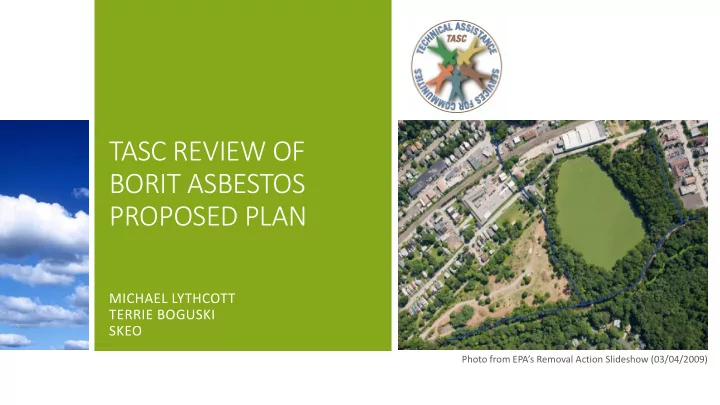
Photo from EPA’s Removal Action Slideshow (03/04/2009)
slide-2
SLIDE 2

PRESENTATION OUTLINE

▪ TASC Program Overview ▪ Proposed Remedial Action Plan

▪ Removal action ▪ Operation and maintenance (O&M) and institutional controls (ICs)

▪ TASC Comments ▪ Making Effective Comments

2

slide-3
SLIDE 3

TASC PROGRAM OVERVIEW

slide-4
SLIDE 4

WHAT IS TASC?

▪ Technical Assistance Services for Communities ▪ One of several -sponsored technical assistance programs ▪ Program goal: help people understand complex environmental issues to ensure meaningful community involvement in environmental decision-making ▪ Independent services provided under contract with

▪ Information and opinions of TASC do not necessarily reflect EPA opinions, actions or policies

4

slide-5
SLIDE 5

TASC SERVICES

  • 1. Reviewing and explaining technical information
  • 2. Developing informational materials such as fact sheets and brochures
  • 3. Developing and giving educational presentations
  • 4. Conducting technical assistance needs assessments

5

slide-6
SLIDE 6

COMMUNITIES SERVED

6

slide-7
SLIDE 7

BORIT ASBESTOS SUPERFUND SITE PROPOSED REMEDIAL ACTION PLAN

slide-8
SLIDE 8

WHERE DOES PROPOSED PLAN FIT INTO SUPERFUND PROCESS?

▪ After feasibility study (FS) and before Record of Decision (ROD) ▪ FS

▪ Remedial alternatives are identified; pros and cons are explored ▪ Conducted at same time as remedial investigation (RI)

▪ Proposed Plan

▪ Explains EPA’s preferred alternative from among remedial alternatives discussed in FS

▪ ROD

▪ Legally binding document ▪ Describes how site will be remediated

8

Proposed Plan

slide-9
SLIDE 9

AREAS ADDRESSED IN PROPOSED PLAN

▪ Park Parcel ▪ Reservoir Parcel ▪ Asbestos Pile Parcel ▪ Stream Banks

9

Source: Figure 6 of Proposed Plan

slide-10
SLIDE 10

REMEDIAL ALTERNATIVES CONSIDERED IN FEASIBILITY STUDY

▪ Waste, soil and reservoir sediment 1 (WSS1) – No Action ▪ WSS2 – Capping ▪ WSS3 – Excavation and Off-site Disposal ▪ WSS4 – In Situ (in place) Joule Heating (heating with electrodes) ▪ WSS5 – Excavation, On-site Ex Situ (removed or not in place) Plasma Arc Furnace and On-site Disposal (not retained) ▪ WSS6 – Excavation, On-site Ex Situ Thermochemical Conversion Technology (TCCT) and On-site Disposal * ▪ WSS7 – Excavation, Off-site Ex Situ TCCT, and Off-site Disposal (not retained)

10

*WSS6 was renamed WSS5 after WSS5 in FS was not retained

slide-11
SLIDE 11

ANALYSIS OF RETAINED REMEDIAL ALTERNATIVES

Criteria WSS1 WSS2 WSS3 WSS4 WSS5 No Action Capping Excavation and Off-site Disposal In Situ Joule Heating Excavation, On-site Ex Situ TCCT, and On-site Disposal Overall Protection of Human Health and the Environment No Yes Yes Yes Yes Compliance with ARARs No Yes Yes Yes Yes Long-Term Effectiveness 4 5 4 5 Reduction of Toxicity, Mobility, or Volume through Treatment 4 5 Short-Term Effectiveness 4 2 3 2 Implementability 5 4 2 1 1 Cost (million $) 0.165 27.1 269 257 267

11

slide-12
SLIDE 12

ANALYSIS OF RETAINED REMEDIAL ALTERNATIVES

▪ Modifying criteria

▪ State (support agency) acceptance

▪ Pennsylvania Department of Environmental Protection (PADEP)

▪ Community acceptance

▪ Proposed Plan will be released for public comment

12

slide-13
SLIDE 13

HOW TO COMMENT

  • 1. Attend EPA’s public meeting

▪ January 10, 2017, at 6:00 p.m. at Ambler Borough Hall

  • 2. By mail to:

▪ U.S. EPA Region III 1650 Arch Street (Mailcode 3HS21) Philadelphia, PA 19103 Attn: Jill Lowe, RPM (postmarked by February 1, 2017)

  • 3. By email to:

▪ R3_Boritcomments@epa.gov

13

Comments Due February 1, 2017

slide-14
SLIDE 14

REMOVAL ACTION

slide-15
SLIDE 15

REMOVAL ACTIONS THAT ARE PART OF PROPOSED PLAN

▪ Armoring all stream banks that border ACM waste disposal areas ▪ Routing portion of Tannery Run through a pipe to prevent further erosion from the creek flow ▪ Cutting back slopes on the Asbestos Pile to a stable 3 horizontal : 1 vertical gradient ▪ Covering Asbestos Pile and Reservoir berm with geotextile (type of plastic fabric), minimum of 2 feet of clean material and 6 inches of topsoil to support vegetative cover ▪ Consolidating some waste on Park parcel into two waste cells at south end of Park parcel and covering it with geotextile, minimum 2 feet of clean material and 6 inches of topsoil to support vegetative cover ▪ Other areas of Park parcel to be covered with geotextile, 2 feet of clean material and about 6 inches of topsoil, then hydroseeded

15

slide-16
SLIDE 16

Contractor adding about 2 feet of riprap rock to outside of riprap area per Design Engineer's recommendations (April 2009)

16

Source: EPA

slide-17
SLIDE 17

Contractors placing geotextile fabric on part of Park parcel before covering with clean fill (July 2016)

17

Source: EPA

slide-18
SLIDE 18

Contractors spreading clean fill to build cap

  • ver contaminated

area (August 2016)

18

Source: EPA

slide-19
SLIDE 19

Contractors hydroseeding topsoil in north half of Park parcel (August 2016)

19

Source: EPA

slide-20
SLIDE 20

OPERATION AND MAINTENANCE (O&M) and INSTITUTIONAL CONTROLS (ICs)

slide-21
SLIDE 21

OPERATION AND MAINTENANCE (O&M)

Yearly ▪ Inspections for 30 years* ▪ Cap maintenance (mowing, repairs, reseeding) for 30 years ▪ Sampling for the first four years after cap completion Periodically ▪ Sampling in years 10, 15, 20, 25 and 30 after cap’s completion ▪ Five-Year Reviews for 30 years*

21

* EPA uses 30 years for comparing costs of remedial alternatives. This does not mean that maintenance stops after 30 years.

slide-22
SLIDE 22

INSTITUTIONAL CONTROLS (ICs)

Site-wide ▪ No activities or modifications that could disturb soil cover on capped areas ▪ No construction without EPA approval ▪ No modification to drainage patterns without EPA and PADEP concurrence ▪ Restricted public access after major storm events ▪ No uses of parcels except by maintenance workers, recreational visitors and commercial workers (i.e. no residential use)

22

slide-23
SLIDE 23

INSTITUTIONAL CONTROLS (ICs)

Parcel-specific ▪ No construction of structures or habitat enhancements that could undermine slope stability of Asbestos Pile parcel ▪ No trees on Asbestos Pile and Reservoir parcels or on steep creek slopes ▪ Maintenance of vegetation on Reservoir parcel and stream banks

23

slide-24
SLIDE 24

TASC COMMENTS

slide-25
SLIDE 25

WHAT HAPPENS AFTER 30 YEARS?

▪ 30 years of O&M activities are planned

▪ You may want to ask EPA for more information about what will happen after 30 years

▪ EPA uses 30 years for comparing costs of remedial alternatives ▪ This does not mean that maintenance stops after 30 years ▪ Do you want more information about how maintenance will be paid for in the short- and long-term?

25

slide-26
SLIDE 26

STREAM BANK CAPPING

▪ Some stream bank areas are covered with only 10 to 15 inches of clean fill, whereas 2 feet of clean fill is required for other areas and some areas have been armored to prevent flood damage.

▪ You may want to ask EPA to explain why 10 to 15 inches

  • f clean fill and topsoil is acceptable in these locations

▪ You may want to ask EPA to explain why these stream bank areas do not require erosion control measures

26

slide-27
SLIDE 27

GROUNDWATER PROTECTION

▪ Metals exceeding soil screening levels at the Park parcel include aluminum, arsenic, cobalt, iron, lead, manganese, mercury, nickel and vanadium. It is unclear if any metals were detected at significant enough concentrations to potentially impact groundwater

▪ You may want to ask EPA to clarify in the Proposed Plan the potential for metals to leach into groundwater

27

slide-28
SLIDE 28

CONFIRMATION SAMPLING

▪ The Proposed Plan notes that confirmation sampling may include activity-based sampling (ABS), surface soil sampling, ambient air monitoring, sediment sampling and surface water sampling, when applicable

▪ You may want to ask EPA to also consider confirmation sampling for groundwater

28

slide-29
SLIDE 29

HOW WILL SURFACE RUNOFF BE MANAGED?

▪ Surface runoff can cause erosion

▪ You may want to ask EPA to clarify how surface runoff will be managed

29

slide-30
SLIDE 30

HOW WILL ACCESS BE RESTRICTED AFTER STORMS?

▪ A planned IC will restrict public access after major storm events until the site has been inspected for signs of damage or erosion

▪ You may want to ask EPA how this IC will be managed and enforced

30

slide-31
SLIDE 31

MAKING EFFECTIVE COMMENTS

This is what I think about the Proposed Plan

slide-32
SLIDE 32

MAKING EFFECTIVE COMMENTS

▪ Building good relationships and communicating effectively with regulators ▪ Separating fact from exaggeration ▪ Using passion to underscore and not obscure your message ▪ Saying what you need to say in five minutes

32

slide-33
SLIDE 33

BUILDING GOOD RELATIONSHIPS AND COMMUNICATING EFFECTIVELY WITH REGULATORS

▪ Regulators are not the enemy ▪ You can create conditions for mutual respect by treating regulators with respect ▪ You can build relationships with regulators to establish a strong foundation for productive dialogue and conversation

33

slide-34
SLIDE 34

SEPARATING FACT FROM EXAGGERATION

▪ State facts clearly and plainly ▪ Gather data from established sources ▪ Make statements based on facts that describe what you or others in the community have seen and experienced firsthand. ▪ Learn about the regulating agency’s powers and authority and recommend specific actions you would like them to take to assist your community

34

slide-35
SLIDE 35

USING PASSION TO UNDERSCORE AND NOT OBSCURE YOUR MESSAGE

▪ It is ok to be angry – try to channel your anger constructively when dealing with regulators ▪ If people are being shouted out, cursed at or otherwise disrespected, most of them shut down ▪ Being passionate does not mean being disrespectful to others

35

slide-36
SLIDE 36

SAYING WHAT YOU NEED TO SAY IN FIVE MINUTES

▪ Most official hearings allow no more than 3 to 5 minutes per person for public comment ▪ Spend time preparing your public comments by organizing your statement, including your main points related to the focus of the hearing ▪ Give a brief statement about what you want the regulating agency to do ▪ Whenever possible, provide written comments that elaborate on your verbal statement ▪ Written comments can be of any length

36

slide-37
SLIDE 37

SUMMARY – GIVING EFFECTIVE PUBLIC COMMENTS

▪ Respect time limits given for individual public comments ▪ Balance statements with fact, passion and recommendations for action ▪ Organize as many people from your community as possible to participate in public comment sessions and public hearings

37

slide-38
SLIDE 38

SUMMARY – EFFECTIVE WRITTEN COMMENTS

▪ Write about the specific issues being considered ▪ Work with others to produce your written comments and/or have someone else read your written comments before you submit them ▪ Consider proceeding with written comments in one of two ways:

▪ Have one set of comments that are signed on to by many people and

  • rganizations (this can be very persuasive!)

▪ Organize efforts in your community and help people submit many individual comments

▪ Be sure to include specific recommendations for how you think the regulating agency should address the issues

38

slide-39
SLIDE 39

Michael Lythcott Terrie Boguski (732) 394-6638 913-780-3328 mlythcott@skeo.com tboguski@skeo.com

CONTACT INFORMATION

Note: This presentation contains Adobe Stock images that may not be used elsewhere without permission from Adobe Stock. Readers may not access or download Adobe Stock images from this document for any purpose and must comply with Adobe Stock’s Terms of Use, which require users to obtain a license to the work.