Bond Issuance Programme Listed in Luxembourg and authorised by the - - PowerPoint PPT Presentation
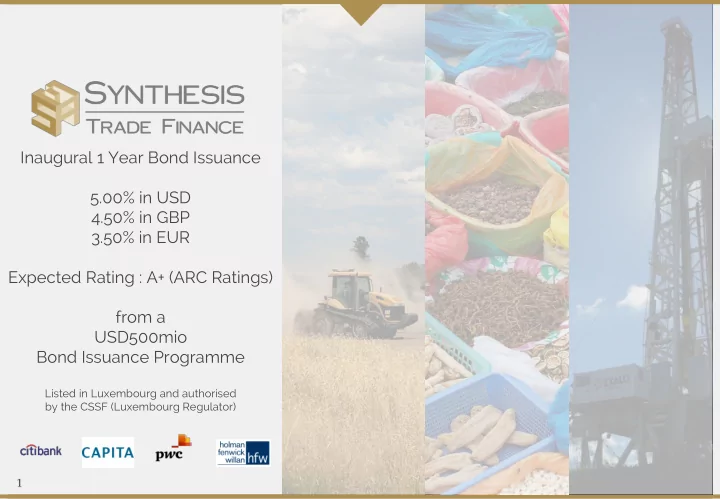
Inaugural 1 Year Bond Issuance 5.00% in USD 4.50% in GBP 3.50% in EUR Expected Rating : A+ (ARC Ratings) from a USD500mio Bond Issuance Programme Listed in Luxembourg and authorised by the CSSF (Luxembourg Regulator) 1 Transaction
2
Transaction Highlights
- Unique opportunity for investors to receive an above-market return from trade finance
- Investment grade bond structure that is independently assessed by ARC Ratings as being higher grade
than many well known corporate bonds
- Experienced management team
- Fixed, semi-annual returns from a bond that is listed and issued from a program authorised by the
Luxembourg Regulator (CSSF)
Termsheet and Timeline
Page 4
3
What is Structured Trade Finance?
Page 8
Our Strategy
Page 14
Transaction Structure
Page 19
Our People
Page 23
Termsheet and Timeline
4
Indicative Termsheet
Issuer : Synthesis Trade Finance I SA Status of the Notes : Senior Secured Notes issued from the Synthesis Trade Finance USD500,000,000 MTN Programme Purpose of the Note Issue : The Borrower will purchase a diversified portfolio of trade finance loans that will each be backed by collateral, letters of credit or credit insurance, as detailed in the Programme Credit Rating : ARC Ratings : A+ (indicative) Issue Size : USD [50-75] mio across any or all of USD, EUR and GBP Marketing Period : [9th] November 2016—[28]th November 2016 Issue Date : [5]th December 2016 Maturity Date : [5]th December 2017 Issue Price : 100.000% Denominations : USD2,000 / EUR2,000 / GBP2,000 Interest Rate : USD : 5.00% ; EUR 3.50% ; GBP : 4.50% Listing and Admission to Trading : Application will be made by the Issuer for the Notes to be admitted to trading on the Euro MTF Market of the Luxembourg Stock Exchange Minimum Subscription : USD2,000 / EUR1,000 / GBP2,000 ISIN : See separate termsheets Issuing and Paying Agent : Citibank N.A., London Branch Auditor : PricewaterhouseCoopers Societe Cooperative Security and Note Trustee : Capita Trust Company Ltd Legal Counsel for the Borrower : Holman Fenwick Willan Settlement Agent : Citibank N.A., London Branch Settlement : Euroclear/Clearstream Governing Law : English Business Days : [London, New York, Target]
5
3rd October
Synthesis Management Limited receives MIFID Licence from the UK‘s FCA
27th October
Synthesis Trade Finance S.A. Bond Issuance Program receives formal approval from Luxembourg‘s CSSF
9th November – 28th November
Synthesis Trade Finance bonds are marketed
24th November – 27th November
Expected size of the issuance will be announced and investors will be asked to place firm orders for the bonds
28th November
Final size of the bond issue is determined and published and investors will receive their allocations from their authorised distributor
9th November
Final Timeline for Bond Issuance by Synthesis Trade Finance I SA is agreed
28th November
Investors provide full settlement instructions to the Authorised Distributor
5th December SETTLEMENT DATE
Investor Timeline Borrower Timeline
6
Synthesis Trade Finance SA Bond Issuance
Synthesis Trade Finance SA intend to issue the first in a series of bonds during November 2016 following the approval of our bond programme by the Luxembourg financial regulator, the CSSF. The notes will be :
- Listed on the Luxembourg Stock Exchange
- With a minimum denomination of USD2,000 or equivalent
- Available for trading on the Euro-MTF market
- Assigned a credit rating that is expected to be A+
- Allocated an ISIN code and deliverable in Euroclear, Clearstream and
CREST The proceeds of the notes will be used to finance short-dated, secured, trade finance loans to a diverse pool of borrowers. Every loan will have either a Letter of Credit or Credit Insurance backing it, as well as appropriate legal charges over the financed goods. The underlying loans will have no market risk because we are simply financing existing back-to- back contracts. The goods themselves will primarily be commodities. The loans will be originated by Synthesis Structured Commodity Trade Finance Limited and purchased by Synthesis Trade Finance I SA. This document gives an overview of our planned issuance programme.
Stock Exchange listed Investment Grade Retail-denominated Secured 7
What is Structured Trade Finance?
8
Structured Trade Finance keeps the global economy running. It touches all of us each day.
Traditionally it has been a business controlled by banks, but in recent years more and more
- pportunities have arisen for non-bank participants to lend in the sector. By focussing on the
transactions with the strongest security, it has become possible to create strong returns with minimal risk.
9
Structured trade finance is where a loan is made to a company and that loan is secured on the trade assets of the borrower.
Those assets could be goods in transit, receivables, inventory
- r any combination or variation of these. The advantage for
borrowers is that the lender is looking beyond the balance sheet of the company at specific assets. The advantages for investors are that trade finance portfolios : Strong Returns Enhanced Security Self-Liquidating Low Default Rates
The lender generally has a charge
- ver the assets being financed as
well as access to a Letter of Credit or Credit Insurance
Have strong security
Trade finance loans are typically 30- 60 days so there is a clear exit path for the lender. It also allows lenders to quickly reduce exposure to borrowers, sectors and geographies
Are self-liquidating
Historically, structured trade finance loans have very low default rates and very strong recovery rates, thanks to the strong asset security
Have low default rates
Typically trade finance loans have very strong returns due to the short
- tenor. By efficiently keeping money
deployed, this can be converted to strong annualised returns
Have strong returns
10
$6 trillion
Despite global economic uncertainty, international trade continues to grow SMEs continue to globalise, moving their goods in greater size, across greater distances However, as deliveries take longer, SMEs turn to trade finance to bridge the cashflow gap between production and payment According to the International Chamber of Commerce Report in 2011, default rates in trade finance stood at around 0.02%, better than investment grade bonds* WTO Member Exports per year
>50%
SME share of that trade
80%
Of the SME share requires trade finance
0.02%
Is the historical default rate
Structured Trade Finance in numbers
11
* http://iccreport2015
Product Total Exposure ($mio) Total Defaulted Exposure ($mio) Exposure-weighted Default Rate Transaction Default Rate Export L/C 988,434 235 0.02% 0.01% Import L/C 1,656,528 1,210 0.07% 0.08% Performance Guarantees 1,023,561 1,154 0.11% 0.17% Loans for Import/Export 3,154,407 5,323 0.17% 0.22%
Why is there an opportunity for investors in Structured Trade Finance?
Banks are less likely to provide trade finance credit lines now than in the past. There are several reasons for this. First, the operational costs
- f financing small transactions can be quite high as it can require large
teams of people for a very small margin per transaction. Secondly, many transactions are cross-border and where a bank does not
- perate in both jurisdictions they may decline to take on such business.
Finally, many trade finance transactions are for large amounts compared with the equity value of the company. With banks less willing to lend to SMEs, despite the strong asset qualities in trade finance, an opportunity has been created for smaller, more nimble financial organisations to enter the market. With the right experience and understanding of global trade flows, a new breed of trade finance houses is emerging who can lend based upon assets, increasing security whilst maintaining strong returns.
The Global Financial Crisis created a gap
With the phased implementation of Basel III and tighter lending criteria from banks, many SMEs have lost access to the funding that they previously had.
12
13
Anatomy of a trade
Pre-production Finance Inland Inventory Finance Export port Inventory Finance Marine Transport Finance Processing Finance Receivable Discounting Transit Finance Transit Finance Transit Finance Transit Finance Import port Inventory Finance Cash in Advance Letter of Credit Cash against Document Open Account Open Account Cash against Document Letter of Credit Cash in Advance
Supplier Buyer
Most Secure Least Secure
Our Strategy
14
Strong client base B. Strong business model Strong management A. C.
Synthesis chooses who to lend to based on these criteria
MARKET KNOWLEDGE
How do we choose our clients?
Here at Synthesis, a large part of our success within the group comes from working exclusively with borrowers who have a strong track record in their industry. We look for a minimum of three years of successful trading by the management team and a strong business model with good margins across their product range.
15
What goods do we finance?
Oil and Energy Products
Eg petrol, aviation fuel
With buoyant consumption of oil products around the world and long delivery times, there is continual demand for funding
Soft commodities
Eg grains and beans
Soft commodities are often seasonal which makes it harder for small companies to raise finance. Using our strong market knowledge we can seek out mutualy beneficial relationships
Hard commodities
Eg polymers, metals
Metals and polymers are businesses that
- ften have regular contracts that allow us
to remain well invested by continually moving money from one contract to the next
Semi-finished or finished goods
Eg generic pharmaceuticals
A proportion of our portfolio may be used to finance non- commodities as long as the margins are strong and the products are generic and liquid
16
Underlying asset
The underlying asset must be something that we can take control of, check the quality of and re-sell if necessary. It is always non-perishable
Credit Enhancement
The transactions that we finance are always backed by a Letter of Credit or Credit insurance from an investment grade counterparty
Loan-to-value
Typically we look at a “real” valuation of the asset in terms of what price it can be sold at in a variety of jurisdictions
Monitoring
Are we able to identify, monitor and exercise control over the asset at any point during the transaction?
Deal selection
In Structured Trade Finance the key to a successful portfolio is not just to choose the right counterparties, but also to select the deals with the right characteristics. Each commodity has its
- wn idiosyncrasies, but in all transactions we seek verification of the value of the goods and will,
where possible, take a charge over the goods. In the event of non-payment, we would liquidate the assets, hence our preference for non- perishable, generic commodities. 17
Inventory Finance Transit Finance
Where goods need to move from one point to another, whether by ship, plane, road or rail, we help to provide finance for that movement.
Pre-Export Finance
Pre-export financing solutions allow buyers and
- ff-takers to place orders
and enter into contracts at advantageous rates.
Receivables Finance
Receivables financing differs from inventory financing in that the goods have already been sold but payment has not been made. In this case, the security for the lender is based upon the value of the unmade payments. Receivables financing is
- ften done by “factoring”, where the lender
purchases the invoices and becomes the legal
- wner of the debt, or “invoice discounting” where
the lender becomes the borrower AND remains responsible for collection and enforcement of the debt. Inventory finance is primarily for sold goods. It frees up valuable cashflow for smaller commodity sellers, allowing them to re- finance stock. Goods are evidenced by warehouse warrants/warehouse receipts
I
Transaction Types
18
Transaction Structure
19
Bankruptcy remote
The SPV structure means that each issuer is independent of the others and dependent only upon its underlying investments
Excess spread
Each Issuer retains its excess spread (the difference between where it borrows and where it invests), less management costs, to provide a buffer for investors
Luxembourg regulated
All bonds are authorised by the CSSF and application will be made for them to be traded
- n the Euro-MTF market
Pari passu
All bonds issued with the same maturity date are pari passu and senior secured
Synthesis Trade Finance I SA
Bond Structure
20
Loan documensts confirmed by SSCTF STF I SA purchases loan and underlying security from SSCTF STF I SA secures repayment and re- invests the proceeds Loan
- riginated
by SSCTF Loan
- ffered to
STF I SA SSCTF monitors loan performance for its duration
Securitisation Structure
As a securitisation vehicle, Synthesis Trade Finance I SA (STF I SA) has no ability to make loans directly. This provides additional protection to investors because loans are originated by a separate company with a separate decision making process (Synthesis Structured Commodity Trade Finance Ltd) and only purchased with the approval of the separate board of Synthesis Trade Finance SA.
21
Risk Mitigation
Key Risk Factors
Risk of non-payment
- Synthesis only lends to companies or management teams with a
significant track record in the relevant commodity
- Both the arranger of the deal and the debtor are required to pass
- ur KYC process
- Each transaction will have in place a Letter of Credit or Credit
Insurance to act as a safeguard Risk of rejection of goods
- Goods are checked for quality where necessary and certified by an
independent inspector before the loan is extended Country Risk
- In conjunction with leading trade finance law firm Holman Fenwick
Willan, Synthesis Trade Finance SA continually monitors any potential risks, in particular those relating to currency restrictions, sanctions or embargoes Commodity Price Risk
- Synthesis Trade Finance SA does not engage in transactions where
the return is in any way linked to the price of the underlying goods. Each transaction will have a sales contract at a pre-agreed price so that the return is fixed
- In the event of non-payment by a borrower, Synthesis Trade
Finance SA would first look to enforce the terms of the contract. It would then seek to sell the commodity to another buyer. It is only after that that they would seek recovery through the Letter of Credit or Credit Insurance. By concentrating on fungible, hard commodities, the risk of depreciation of the asset is minimised Risk of Documentary Failure
- Facility Documentation is arranged by Holman Fenwick Willan and
all transactions are documented by experienced professionals
All foreign exchange risk will be hedged on a transactional or full portfolio basis The bond will hold a well diversified pool of loans (minimum 15 different borrowers) to protect investors The bond will be diversified across asset classes in order to minimise risks of over- exposure 22
Our People
23
Synthesis Structured Commodity Trade Finance Ltd Management
David Phipps
Having worked in the financial industry for almost 30 years, David has built up significant and broad experience in Commodity Risk Management, Commodity Trading and Financing of
- Commodities. David has held senior
positions at investment banks, including Head of Commodities at ABN AMRO Bank NV, Co-Global Head
- f Commodities at ETD UBS AG, and
CEO of a London Stock Exchange listed trading company. David has extensive knowledge of market and credit risk management including risk mitigation products in physical, on exchange and OTC products.
Frances Walsh
Frances is a highly experienced structured trade financier with comprehensive knowledge of and extensive practical experience in providing finance within the international trade sector. Frances’ expertise encompasses traditional trade finance, factoring and forfaiting in the export markets. This experience is complemented by a strong legal background and 25 years’ exposure to the international banking and finance markets, having held senior positions with UK-based firms London Forfeiting Company, BCI Soditic Trade Finance Company, Fairfax Gerrard and Trade Finance Partners Limited, latterly as Structured Finance Director.
Andy Sweeney
Andy has over 16 years of experience in debt capital markets, all gained working in major global investment
- banks. He began his career at
Citigroup with a focus on raising short term finance for companies via the commercial paper market. Subsequently he worked in the note syndication teams at RBC Capital Markets and Mizuho International, advising banks, governments and corporates on issuing notes across a range of currencies for periods of anything from one year to fifty years, and in sizes ranging into the billions of pounds sterling. Andy graduated from Cambridge University with an MA (Hons) in Law
24
Synthesis Trade Finance SA Management
Spyros Papadopoulos
Spyros has over 17 years of experience in alternative investments. He began his career in Private Banking, first with Citigroup in London and Geneva, where he was the key contributor to the development of both the Spanish and Greek Wealth Management Desks, and then with Société Générale in Athens, where he was instrumental to the expansion of the Greek Private Banking division. Spyros resigned from Private Banking in 2006 to set up an asset management company for Deloitte, before returning to London as Director
- f the hedge fund Absolute Return
- Partners. He left to found Synthesis in
June 2009. His clients came through unscathed, and indeed profited, from the crises of 2000-02 and 2007-
- present. Spyros holds the Investment
Management Certificate of the CFASociety of the UK.
Marc Lefebvre
Marc started his career as an auditor
- f investment funds at
- PricewaterhouseCoopers. He then
moved on to Nordea Bank to assist with Compliance, Anti-Money Laundering and Legislation issues and set up controls and processes to ensure efficient monitoring. Later, as Board Member and Conducting Officer with Glitnir Bank, he was instrumental in setting up the investment fund arm of the bank. Marc subsequently set up his own advisory firm, LEVeL Advisory, providing services to the asset management and banking sector. Marc holds a Masters Degree in Finance and a Masters Degree in Control from HEC. He is a Certified Director of the Luxembourg Institute of Administrators (ILA), and a certified “Senior Fund Specialist” and “Compliance Officer” of the Institut de Formation Bancaire in Luxembourg.
Manuel Bertrand
Manuel is a CSSF Authorized Director in the investment fund sector, acting as executive or non-executive
- Director. Manuel previously headed
the Finance & Administration Management activities of several industrial companies, both at subsidiary and mother company level, where his primary focus was to ensure the existence and the communication
- f accurate and reliable financial data.
Manuel gained his first experience at PricewaterhouseCoopers, Liege, where he was in charge of the audit of a number of major industrial
- companies. Manuel holds a Degree in
Commercial Engineering from HEC in Belgium.
25
Disclaimer
This communication is being furnished solely on a confidential basis to the recipient. This communication is directed at persons having professional experience in matters related to investments and any investment or investment activity to which this communication relates is available only to such persons or will be engaged in only with such persons (or other persons to whom such investment can lawfully be made available or with whom such investment activity can lawfully be engaged). If you do not have professional experience in matters relating to investments you should not rely on this communication. Neither this Communication nor any of the associated documents may be reproduced, re-transmitted or further distributed to any other person or published, in whole or in part, for any other purpose than that stated above. The information in this document, which is in draft form and incomplete, is subject to updating, completion, revision, further verification and/or amendment. In particular, the documents refer to certain events having occurred which have not yet occurred at the date these documents are made available, but which are expected to occur prior to the publication of an approved prospectus in final form. Recipients of this Communication (or any of the associated documents) who are considering purchasing or subscribing for Notes in any of the issuers are reminded that any such purchase or subscription must be made only on the basis of information contained in the approved prospectus its final form, which may be different from the information contained in this document. Notes may not at this time be offered by any of the issuers directly to the public. Neither this Communication nor any of the attached documents constitutes an offer of Notes. By accepting delivery of this Communication, you agree to keep it and its content (including the attached documents) confidential, and not copy, publish, distribute, pass on or disclose any of it except with the prior written consent of Synthesis. To the extent permitted by applicable law and regulation, Synthesis Trade Finance S.A. and its affiliated companies expressly disclaims and excludes any and all liability that may be based on this communication and the attached documents, any errors in it/them or omissions from it/them.