Board of Trustees Budget Workshop June 24, 2008 UConn among the - - PDF document

board of trustees
SMART_READER_LITE
LIVE PREVIEW

Board of Trustees Budget Workshop June 24, 2008 UConn among the - - PDF document

Board of Trustees Budget Workshop June 24, 2008 UConn among the top 24 in the nation and rated the top public university in New England for the past 9 years ( U.S. News & World Report ) UConn ranked in the top 30 best value public


slide-1
SLIDE 1

1

Board of Trustees

Budget Workshop

June 24, 2008

UConn among the top 24 in the nation and

rated the top public university in New England for the past 9 years (U.S. News & World Report)

UConn ranked in the top 30 best value public

colleges for in-state costs (Kiplinger's Personal Finance)

94% of recent graduates are either employed or

are in graduate/professional schools

68% of those working full-time are doing so in CT

slide-2
SLIDE 2

2

UCONN 2000 program

has completed more than 9.5 million square feet of new & renovated space

Athletic teams have won 8

NCAA Division I national championships, 38 Big East tournaments & 44 Big East regular season titles since 1995

UConn Health Center’s

John Dempsey Hospital honored with a Premier| CareScience Select Practice National Quality Award in 2007

UConn Health

Center’s School of Dental Medicine is consistently #1 or #2 in the country by the National Dental Board

Faculty Research, Training & Service:

  • Contributes to Connecticut’s economic growth
  • Enhances health, technological advancement & quality of life

across the state, the nation & beyond

  • External funding increased 99.5% from FY96 to FY08

Fuel Cells:

  • CT Global Fuel Cell Center-supported by federal

government & major state and other firms

  • Involves 40 faculty in vital cutting-edge research

Innovative Technologies:

  • Faculty awarded more than 184 patents in the past ten years &
  • ver 18 companies have been created from faculty inventions

in this time period

UConn adds $3.1 billion annually to Connecticut’s gross state product

slide-3
SLIDE 3

3

Over the last 6 years (fall 2002-2007):

  • School of Medicine applications have

increased by 68% (1,776 to 2,976)

  • School of Dental Medicine applications have

increased by 79% (870 to 1,557)

  • School of Medicine passing rates on National Exams

have averaged 98% or above

  • School of Dental Medicine passing rates on National

Exams have been at 100%

Approximately 35% of School of Medicine graduates

practice in the state while 46% of School of Dental Medicine graduates practice in the state

Health Center

Fall 2008 estimates compared to fall 1995 at Storrs:

  • Applications will increase 113% (9,874 to 21,004)
  • Freshman enrollment will increase 73% (2,021 to 3,500)
  • Freshman minority enrollment will increase 134%

(308 to 720)

  • SAT scores will increase 87 points from fall ’96 (1113

to 1200)

Valedictorians and

salutatorians will increase to 146, bringing the total since 1995 to 1,074 at all campuses

Storrs & Regional Campuses

slide-4
SLIDE 4

4

14,667 14,382 15,741 17,630 19,287 20,525 20,846 21,185 7,804 6,867 6,500 5,950 6,869 7,073 7,344 7,344 502 504 495 471 473 485 487 487

8,000 11,000 14,000 17,000 20,000 23,000 26,000 29,000 1995 (22,973) 1997 (21,753) 1999 (22,736) 2001 (24,051) 2003 (26,629) 2005 (28,083) 2007 (28,677) 2008 est (29,016) Fall (Total) Medicine & Dental Medicine Graduate/Professional Undergraduate

Undergraduate enrollment is projected to increase 44% from 1995 to 2008

Fall 2005 freshman retention rate is substantially higher

than the 80% average for 438 colleges & universities in the national Consortium for Student Retention Data Exchange (CSRDE)

86% 88% 89% 88% 88% 90% 92% 93% 93% 70% 75% 80% 85% 90% 95% 100% 1998 1999 2000 2001 2002 2003 2004 2005 2006 Year (Fall) of Entry

Storrs Campus

slide-5
SLIDE 5

5

Fall 2005 minority freshman retention rate is also

substantially higher than the national 79% average (CSRDE)

88% 87% 89% 87% 88% 89% 93% 91% 91% 70% 75% 80% 85% 90% 95% 100% 1998 1999 2000 2001 2002 2003 2004 2005 2006 Year (Fall) of Entry

Storrs Campus

UConn’s ranking among the 58 Public Research

Peer Universities:

  • Fall 2000 4-year graduation rate of 53% ranks 10th
  • Fall 2000 average time to graduate of 4.3 years ranks 5th

Only University of Virginia-Main Campus, University of North Carolina at Chapel Hill, University of Michigan-Ann Arbor & University of Illinois at Urbana-Champaign rank higher

43% 43% 46% 45% 50% 53% 54% 56% 61% 40% 45% 50% 55% 60% 65% 1995 1996 1997 1998 1999 2000 2001 2002 2003 Year (Fall) of Entry

Storrs Campus

slide-6
SLIDE 6

6

UConn’s ranking among the 58 Public Research

Peer Universities:

  • Fall 2000 6-year graduation rate of 74% ranks 21st
  • Fall 2000 6-year minority graduation rate of 69% ranks

20th

70% 69% 70% 71% 72% 74% 75% 60% 65% 70% 75% 1995 1996 1997 1998 1999 2000 2001 Year (Fall) of Entry

Storrs Campus

2,951 2,778 2,866 2,854 3,499 3,684 3,845 4,255 4,376 1,757 1,845 1,595 1,718 1,805 1,702 2,121 2,148 2,166 114 127 120 114 113 103 109 121 112

1,000 2,000 3,000 4,000 5,000 6,000 7,000 1995 (4,822) 1997 (4,750) 1999 (4,581) 2001 (4,686) 2003 (5,417) 2004 (5,489) 2005 (6,075) 2006 (6,524) 2007 (6,654) FY (Total)

Medicine & Dental Medicine Graduate/Professional Undergraduate

Approximately 103,800 alumni live in Connecticut Undergraduate degrees have increased 53% since 2001

slide-7
SLIDE 7

7

Revenues Budget Forecast Variance State Support (w/deficiency appropriation) $130.1 $154.3 $24.2 Gifts, Grants & Contracts 93.7 85.9 (7.8) Correctional Managed Health Care 99.4 100.2 0.8 Net Patient Care 307.0 300.3 (6.7) All Other Revenues 76.6 73.7 (2.9) Expenses Personal Services (including Fringe) $447.5 $452.0 $4.5 Drugs/Medical Supplies 72.6 75.6 3.0 Outside & Other Purchases 51.9 53.6 1.7 Medical Contractual Support 14.8 15.5 0.7 Medical/Dental House Staff 34.9 34.7 (0.2) Utilities 18.9 16.5 (2.4) Insurance 5.0 5.7 0.7 All Other Expenses 61.2 60.8 (0.4)

Revenues: $714.4M & Expenses: $714.4M

Health Center

Revenues Budget Forecast Variance State Support $325.3 $325.3 $0.0 Tuition & Fees 266.3 268.8 2.5 Gifts, Grants & Contracts 134.5 143.4 8.9 Investment Income 11.1 10.1 (1.0) Auxiliary Enterprise Revenue 139.1 134.0 (5.1) All Other Revenue 24.7 26.0 1.3 Expenses Personal Services (including Fringe) $513.0 $514.5 $1.5 Other Expenses 160.4 154.7 (5.7) Energy 31.6 29.0 (2.6) Financial Aid 81.0 81.0 0.0 Transfers 37.5 37.5 0.0 All Other Expenses 79.8 84.4 4.6 Revenues: $907.6M & Expenses: $901.1M = Net Gain: $6.5M

Storrs & Regional Campuses

slide-8
SLIDE 8

8

19.5% 5.6% 43.7% 13.9% 11.9% 5.4%

Revenues

State Support: 19.5% Interns & Residents: 5.6% Patient Care: 43.7% CMHC: 13.9% Gifts, Grants & Contracts: 11.9% All Other: 5.4% 63.1% 10.5% 7.6% 2.0% 4.9% 11.9%

Expenses

Personal Services (w/FB): 63.1% Drugs/Medical Supplies: 10.5% Outside & Other Purchases: 7.6% Medical Contractual Support: 2.0% Medical/Dental House Staff: 4.9% All Other: 11.9%

Health Center

Revenues: $747.5M & Expenses: $759.0M = Net Loss: ($11.5)M

36.0% 30.0% 14.7% 15.6% 3.7%

Revenues

State Support: 36.0% Tuition & Fees: 30.0% Auxiliaries: 14.7% Gifts, Grants & Contracts: 15.6% All Other: 3.7% 57.5% 21.5% 9.5% 3.8% 7.7%

Expenses

Personal Services (w/FB): 57.5% Equipment & Other: 21.5% Financial Aid: 9.5% Transfers: 3.8% Research Fund: 7.7%

Storrs & Regionals

Revenues: $953.3M & Expenses: $954.2M = Net Loss: ($0.9)M

slide-9
SLIDE 9

9

Storrs & Regionals $229.4M

Includes $2M for the Eminent Faculty program Excludes the state’s share of collective bargaining increases

Health Center $102.0M

Includes $6.5M for the Academic Gap Does not reflect $3.6M for JDH fringe benefit costs, included

in the appropriation for the State Comptroller’s Office

Excludes the state’s share of collective bargaining increases

Research funding Private support Clinical revenue @

Health Center

Tuition/fees/room/board @ Storrs &

Regionals

slide-10
SLIDE 10

10

$59.6 $61.2 $78.9 $92.1 $91.5 $93.1 $100.3 $101.8 $44.8 $49.7 $69.1 $96.2 $92.5 $92.5 $96.0 $92.0 $0 $50 $100 $150 $200 FY97 ($104.4) FY99 ($110.9) FY01 ($148.0) FY03 ($188.3) FY05 ($184.0) FY07 ($185.6) FY08 ($196.3) est FY09 ($193.8) est Health Center Storrs & Regionals $49.5 $175.7 $209.2 $272.0 $298.9 $336.0 $315.0 $0 $50 $100 $150 $200 $250 $300 95 99 03 05 06 075/31/08 Fiscal Year

Endowment Assets

$5.1 $12.7 $25.6 $27.9 $33.7 $33.3 $20.8 $0 $5 $10 $15 $20 $25 $30 $35 95 99 03 05 06 07 5/31/08 Fiscal Year

Support of Students & Programs

slide-11
SLIDE 11

11

Program Summary:

  • 1996 – 1:1 state to private match
  • 1998 – 1:2 state to private match
  • 2005 – 1:4 state to private match, no state funds released until Rainy

Day Fund is 10% of General Fund

$64M received from state through Program from 1996 to 2007 $11.4M due to University for 2005-2007

$9.1 $6.8 $15.0 $10.0 $15.0 $14.0 $13.2 $9.2 $13.4 $16.4 $10.5 $8.2 $2.9 $9.1 $6.8 $7.5 $5.0 $7.5 $7.0 $6.6 $4.6 $6.7 $7.4 $4.1 $2.5 $0.9

$0 $5 $10 $15 $20 CY96 CY97 CY98 CY99 CY00 CY01 CY02 CY03 CY04 CY05 CY06 CY07 CY08 Eligible Gifts State Match

Private Schools In & Out

  • f State

Public Schools In State Out of State Boston College $36,079 Penn State $12,851 $24,021 Boston Univ $35,418 Univ Vermont $12,044 $27,928 Fairfield $33,905 Univ New Hampshire $11,070 $24,030 Northeastern $32,149 Rutgers $10,706 $19,874 Syracuse $31,686 Univ Massachusetts $9,921 $20,499 Providence $29,405 Univ Connecticut $8,852 $22,796 Quinnipiac $28,720 Univ Maine $8,330 $20,540 Univ Hartford $26,996 Univ Delaware $8,305 $19,555 Univ Rhode Island $8,184 $23,038 Univ Maryland $7,969 $22,208

slide-12
SLIDE 12

12

Private Schools In & Out

  • f State

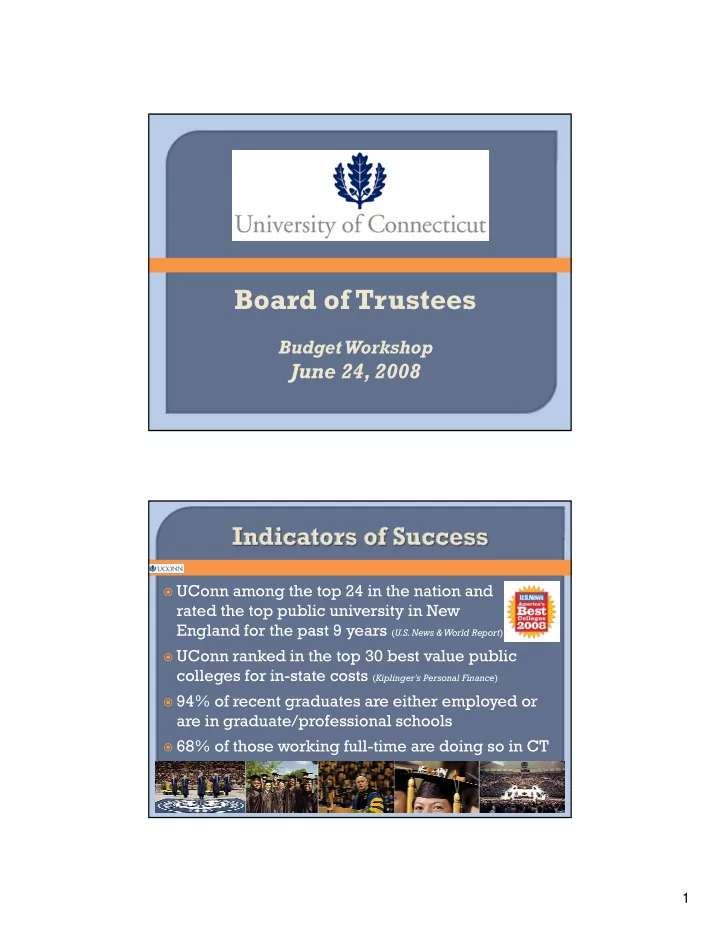
Public Schools In State Out of State Boston College $47,139 Penn State $20,584 $31,452 Boston Univ $46,598 Rutgers $20,468 $29,636 Fairfield $44,735 Univ Vermont $20,376 $36,260 Northeastern $43,569 Univ New Hampshire $20,038 $32,998 Syracuse $43,276 Univ Massachusetts $17,768 $28,346 Quinnipiac $39,920 Univ Rhode Island $17,762 $32,616 Providence $39,740 Univ Connecticut** $17,702 $31,646 Univ Hartford $38,454 Univ Maryland $17,023 $31,262 Univ Delaware $16,253 $27,503 Univ Maine $15,814 $28,024

* Board rates reflect the most expensive meal plan available. ** 34% of degree-seeking undergrads do not pay room & 42% do not pay board

$17,702 $27,503 $28,024 $28,346 $29,636 $31,262 $31,452 $32,616 $32,998 $36,260 $38,454 $39,740 $39,920 $43,276 $43,569 $44,735 $46,598 $47,139

$0 $5,000 $10,000 $15,000 $20,000 $25,000 $30,000 $35,000 $40,000 $45,000 $50,000 UConn UDel UMaine UMass Rutgers Maryland Penn State URI UNH UVM UHartford Providence Quinnipiac Syracuse Northeastern Fairfield BU BC

Chart reflects the costs for a Connecticut student *Board rates reflect the most expensive meal plan available.
slide-13
SLIDE 13

13

Tuition & Fees:

  • National rates 6.6% higher in FY 2008 than FY 2007

(UConn 5.86%)

  • National increase of 51% from FY 2003 - FY 2008

(UConn 44%)

  • National increase of 99% from FY 1998 - FY 2008

(UConn 69%) Tuition, Fees, Room & Board:

  • National increase of 40% from FY 2003 - FY 2008

(UConn 39%)

  • National increase of 82% from FY 1998 - FY 2008

(UConn 65%)

Source: 2007 Trends in College Pricing, College Board

I n-State

FY08 Amount FY09 Amount

Increase Over FY08

Undergraduate Tuition $6,816 $7,200

5.63% $384

Room $4,698 $5,090

8.34% $392

Board (Value Meal Plan) $3,960 $4,210

6.31% $250

Undergraduate Total $17,510 $18,638

6.44% $1,128

Graduate Total $19,356 $20,592

6.39% $1,236

Out-of-State

Undergraduate Total $31,454 $33,350

6.03% $1,896

Graduate Total $32,838 $34,812

6.01% $1,974 * Board rates reflect the Value meal plan which is the most popular plan available.

Storrs & Regional Campuses

slide-14
SLIDE 14

14

FY07 FY08

Forecast

FY09

Budget

% Change

(FY07-FY09)

Need-Based Grants $50.7 $54.0 $59.9

18.1%

University Scholarships 24.9 25.4 28.9

16.1%

Non-University Scholarships 5.1 5.2 5.5

7.8%

Loans (federal & private) 118.2 127.1 132.7

12.3%

Tuition Waivers 37.8 39.9 43.9

16.1%

Subtotal $236.7 $251.6 $270.9

14.4%

Work Study/Student Labor 13.9 15.9 16.3

17.3%

Total Financial Aid $250.6 $267.5 $287.2

14.6%

Storrs & Regional Campuses FY07 FY08

Forecast

FY09

Budget

Total Tuition Funded Financial Aid $85.8 $85.5 $96.0 Total Tuition Funded as a % of Gross Tuition Revenue 39.5% 37.4% 38.9% Tuition Funded Need-Based as a % of Net Tuition Revenue 19.1% 16.6% 17.5% DHE Need-Based Set Aside Policy 15.0% 15.0% 15.0% Storrs & Regional Campuses

slide-15
SLIDE 15

15

All tuition, fees, room & board increases have been

accompanied by an off-setting increase in financial aid to ensure that any qualified student can attend the University regardless of financial means

For FY09, total aid is projected to

increase 7.4% and need-based grants are projected to increase 10.9%

Meet direct educational expenses for

the neediest in-state students

77% of students (undergraduate and

graduate) received aid in FY08

Storrs & Regional Campuses

Storrs & Regionals

  • Faculty hires
  • Undergraduate enrichment
  • Course coverage

Health Center

  • Financial stability
slide-16
SLIDE 16

16

Academic Leadership Undergraduate Enrichment & Diversity Increased Collaborations Research: Blueprint for the Future Faculty Hiring: Continuing Momentum Implementation of New Initiatives Re-Phasing of UCONN 2000

Storrs & Regional Campuses

Senior academic leadership

provided by 13 Deans

  • 4 Deans hired in FY 2008:

Law, Business, Nursing & Engineering

  • 4 new Deans recruited to start in FY

2009: Medicine, CLAS, Social Work & CANR

  • Successful completion of these

searches has been the highest priority in Academic Affairs

slide-17
SLIDE 17

17

Honors program expansion – additional 70 students

expected in fall 2008 compared to fall 2007 ($255k)

Living & Learning Communities –

Honors & Global Houses ($100k)

Study Abroad Goals

  • Increase percentage of students who benefit from an

international experience from 18% to 30%

  • Forge substantial partnerships with

a limited number of prestigious international universities Storrs & Regional Campuses

Increase the international dimension of

teaching & research programs and enhance the range of diversity programming

Increase recruitment efforts for undergraduate international students Achieve diversity goals spelled out in various college plans for faculty & students Increased diversity in graduate programs Focused effort to recruit diverse faculty

Storrs & Regional Campuses

slide-18
SLIDE 18

18

CICATS (CTSA)-Connecticut Institute for Clinical

and Translational Science

Nanotechnology Stem Cell Research: $16.1M v

supports 23 researchers

School of Medicine: post doctoral training for

Nursing faculty

Honors Program: students working in Neonatal

Intensive Care Unit

Pappanikou Center for Excellence in

Developmental Disabilities: joint hires

Inter-Departmental and Inter-Campus

Increase emphasis on focused research areas

  • Eminent Faculty program: Alternative Energy & Fuel Cells

$2M state funding -Eminent faculty hire anticipated (fall 2009)

  • Center for Entrepreneurship program: Business & Law

6 faculty hired (FY08)

  • Nanotechnology: partnering with state agencies
  • Collaboration with foreign institutions
  • Pursuing workforce development for the state
  • Strategic investment in cultural & artistic programming

Storrs & Regional Campuses

slide-19
SLIDE 19

19

Net new faculty

  • 51 in FY06
  • 13 in FY07

Faculty Hiring Plan: 175 net new by FY12

  • 30 in FY08
  • Approximately 30 in FY09 (fall 2008)

Workforce Development Undergraduate Instructional Needs Research Direction in Academic Plans

  • Funding from reallocations

Storrs & Regional Campuses

1,148 1,106 1,040 1,096 1,122 1,121 1,130 1,165 1,107 1,200 1,251 1,264 1,294 1,324 500 700 900 1,100 1,300 '95 '96 '97 '98 '99 '00 '01 '02 '03 '04 '05 '06 '07 08 est Fall

Storrs & Regional Campuses

slide-20
SLIDE 20

20

14.21 14.17 14.86 14.88 15.19 15.83 16.56 17.10 18.16 17.47 17.21 17.26 17.00 16.85 4 8 12 16 20 '95 '96 '97 '98 '99 '00 '01 '02 '03 '04 '05 '06 '07 08 est Fall

Storrs & Regional Campuses

To be in alignment with Academic Plan

priorities:

  • Enhancement of undergraduate teaching and learning -

Arjona and Monteith schematic design in progress

  • Building upon research & creative activities –

Psychology, Fine Arts and Gentry renovations

  • Improvement of technology support – Gant

(IMS, Mathematics, Physics, UITS) planning underway

  • Increase capacity for modern life science research –

determination to replace or renovate Torrey in process

  • Achieve AAALAC standards and accreditation

Storrs & Regional Campuses

slide-21
SLIDE 21

21

Allows the university to:

  • Focus on academic priorities
  • Continue emphasis on deferred maintenance

projects

  • Preserve older beautiful buildings
  • Achieve efficiencies by completing code

corrections and renovations together

  • Fund smaller projects while planning for larger

projects

Storrs & Regional Campuses

Board of Trustees

Budget Workshop

June 24, 2008

slide-22
SLIDE 22

22

We welcome new leadership We are exploring regional partnership in keeping with the

CASE recommendations and subsequent legislation

We are pursuing cost reduction and revenue enhancement

  • After $78M in cost reduction and revenue enhancement

since 2000, low-hanging fruit is gone

  • PwC recommendations fuel new efforts

Near-term revenue cycle activity is underway and reflected in FY09 budget Productivity enhancement and performance improvement is longer-term Revenue enhancement and cost savings initiatives in the FY09 budget total $9.5M

Structural problems persist

  • JDH is undersized and outdated
  • 116 of 224 beds are low-reimbursement specialty

(NICU, newborn, high-risk maternity, psychiatry, Correction) unavailable for med/surg activity

For FY08, NICU average loss per case is estimated at $33,700

  • JDH carries a unique hospital fringe benefit obligation:

estimated fringe benefit differential for FY08 is $12.5M

UMG must rebalance the physician clinical

service mix to enhance revenue while still meeting the needs of a comprehensive medical education program

slide-23
SLIDE 23

23

The academic/research enterprise faces

challenges

  • A tight federal fiscal environment threatens medical

education and intensifies competition for the research dollar

  • Changing federal direction in research requires

restructuring and investment (CTSA)

  • Current regional arrangement prevents full cost

recovery for the UCHC intern/residency program

  • Current SOM and SODM class size may not produce

the number of doctors and dentists the region will need

The proposed budget is $759M, which supports

“current services” increases and limited new activity:

  • essential clinical investment to stimulate growth in patient

volume

  • strategic positioning in research
  • cost efficiencies in management and operations (PwC, IT)

require upfront financial support ($586,000)

The proposed $759M budget shows a deficit of $11.5M

  • It reflects an increase in expenses of $44.7M
  • Revenues are increasing over FY08 by $41.6M

Every effort will be made to reduce the projected FY09

deficit through faculty productivity, other performance improvements, and cost reductions

slide-24
SLIDE 24

24

Approximately 75% of the $44.7M increase in

expenses is for current services:

  • $16.9M is associated with existing employees

(contractual & fringe benefit increases)

  • $2.2M is for medical house staff increases
  • $2.3M is associated with utilities, repairs and

maintenance

  • $4.2M is for drugs and medical supplies
  • Approximately $9.0M is for purchased services,

depreciation and other expenses

$10.1M is associated with new positions and related fringe SOM-New Positions (7.6 new faculty, including 5.5 of Dean/VP & research team) $2,077,000 SOM-New Positions (CICATS) 161,000 SODM-New Positions (Oral Surgeon & U24 researcher) 239,000 Dental Implant Center-New Positions 693,000 JDH-New Staffing Impact (Cardiology Space Expansion) 401,000 UMG-New Faculty & support staff 2,440,000 CMHC-Offset by Revenue 754,000 Institutional Support-PwC Recommendations (Decision Support, Project Mgr, Director of Contracts, Cap Purchasing Specialist) 388,000 Institutional Support-New Positions (.5 Dean, Construction Proj Mgr, AVP for IT Res, IT Tech Analyst, Application Developers, HR Director) 790,000 Fringe Benefit Increase-New Positions 2,202,000

slide-25
SLIDE 25

25

Musculoskeletal Institute

  • Dental Implant Center to start June 2008
  • Three clinical faculty (1 Joint, 2 Sports Medicine)
  • Four basic scientists (tissue engineering)

Cancer

  • Tomotherapy Center enhancement (high dose density)

Cardiology

  • Electrophysiology Lab Operations
  • 5 clinical faculty (3 Cardiologists and 2 EPs)
  • Cardiology space expansion

Center for Public Health at current services level

Signature Programs

Connecticut Institute for Clinical and

Translational Science (CICATS)

Transition funding for General Clinical

Research Center (GCRC)

Stem Cell Core (signal pathways for

embryonic stem cells)

Musculoskeletal (new research team) Immunology

Research Strategic Investments

slide-26
SLIDE 26

26

UMG

  • Faculty recruitment & hiring plan – rebalancing the clinical

mix to grow revenue

GI, Cardiology, Orthopedics, Dermatology

John Dempsey Hospital

  • Revenue cycle improvement (PwC)
  • Performance improvement (PwC)

Supply chain Labor expense management through training, consolidation & reorganization

  • This budget reflects conservative volume estimates,

including a decrease in patient visits for existing physicians and a decrease in patient visits due to loss of physician time (turnover, medical and family leave)

Clinical Stabilization

State Support for the “Academic Gap”, Current Services,

partial JDH Fringe Benefits, and Correctional Managed Health Care

  • The FY09 budget includes the increases above the FY08 amounts as

enacted in the second year of the state’s FY08 - FY09 biennial budget

Academic Gap $6,500,000 JDH Fringe Benefits $3,600,000 Current Services $1,093,000 Correctional Managed Health Care $4,693,000 Full cost recovery in the intern/residency program

  • Full accounting of direct costs
  • 15% indirect cost charge

Full transition of student health insurance to University-

wide program

Financial aid increases to reflect tuition increase

slide-27
SLIDE 27

27

Research

  • The overall research budget deficit is estimated at $9M

as compared to the FY08 projected loss of $8M

The FY09 budget assumes a flat revenue projection for spending, which reflects retention of most existing grants, but a lower level of new grants

The non-federal revenue is expected to increase due to the additional awards for the Stem Cell program

The F&A recovery is budgeted to increase due to the 25% F&A recovery on the Stem Cell grants

Federal grants are expected to receive the current F&A rate However, total federal dollars will decrease with the NMR purchase, as there is no F&A recovery on capital expenditures.

The net loss grows due to salary and fringe benefit increases, which are higher than the total F&A recovery Salary Support on Grants

  • The FY09 budget assumes that the loss of grant funding

will make it necessary to move $1.1M of salary expense from grant dollars to the General Fund

CICATS

  • The creation of this research support infrastructure is

undertaken jointly with the Storrs research program

  • 4th quarter GCRC activity moves from grant funds to

general fund ($569,000)

  • $222,000 in new and $345,000 in reallocated dollars for

salary/fringe costs will support pursuit of the CTSA

slide-28
SLIDE 28

28

Endowment / Foundation Income

  • This revenue is anticipated to decrease by

$158,000

The Dental Implant Center budget includes the expenditure of $450,000 in donations The drawdown of restricted and unrestricted funds for FY09 will decrease by $608,000 from FY08, as FY08 included a one-time gift for operating costs

Utilities

  • Based on current consumption, costs, and rate structures, we are

estimating an increase of 4.5% over the FY08 utility budget

Gas, fuel oil and water costs are projected to increase significantly Electric expenses will decrease as the result of the state-negotiated purchase agreement Repairs and Maintenance

  • JDH costs will increase due to new service agreements on

equipment coming off warranty

  • Based on FY08 experience, we are estimating an increase of 14.2%

for FY09

Depreciation

  • The FY09 budget is based on up-to-date data and also takes into

consideration the anticipated capital expenditures and assets that will be fully depreciated by FY09

slide-29
SLIDE 29

29

Information Technology

  • Increased staffing supports clinical systems as well as

the central infrastructure and academic/research IT investments of UCONN 2000

  • FY09 increase is $2.5M which includes:

Enhanced security and data storage hardware and software Support for audit compliance, server support and student administration system upgrade Investment Income

  • The overall investment revenue is anticipated to

decrease by $954,000 based on current interest rates

Salary and Fringe Benefit Costs: annualization, collective

bargaining increases, managerial and faculty pools, fringe rate changes, and new hires, total $27.1M

  • Annualization and compensated balance increase

$3.3M

  • Collective Bargaining salary increases

$9.9M

  • Managerial and faculty salary pools

$1.9M

  • New hires salary

$7.9M

  • Fringe benefit increases on salary

$4.1M

  • Total salary costs:

FY08 $ 352,109,000 FY09 $ 374,966,000

  • Total fringe benefit costs:

FY08 $ 99,987,000 FY09 $ 104,062,000

slide-30
SLIDE 30

30

John Dempsey Hospital has a loss of $15.5M in this budget,

  • f which $3.6M is offset by the new fringe benefit support

from the State, leaving a budgeted $11.9M shortfall

  • This compares to a FY08 projected loss of $20.0M (As in FY08,

much of the loss is associated with the NICU, Psychiatry and high risk maternity OB/GYN programs)

  • Total net patient revenue is anticipated to increase by $15.7M:

The FY09 budget includes an increase in net revenue of $8M from the results of the PwC revenue cycle engagement Net Revenue per Adjusted Discharge is increasing by 3.4% or $418 per discharge, of which $397 is due to the PwC Revenue Cycle initiatives (Net Expense per Adjusted Discharge is up only 1.1% over FY08) Budgeted increases for inpatient admissions and outpatient visits increase budgeted net revenue by $6.7M UConn Medical Group has a loss of $3.5M in this

budget

  • This compares to a FY08 projected loss of $6.9M
  • Total net patient revenue is anticipated to increase by

$7.6M: The FY09 budget includes the annualized impact ($500,000) of the increase in Medicaid rates implemented in January 2008 The FY09 budget includes the annualized impact of the renegotiated managed care contracts, an increase of $1.8M Estimates of ambulatory visits increase the budgeted net revenue by $5.7M

slide-31
SLIDE 31

31

34.07% 38.72% 37.11% 40.08% 27.17% 27.39% 28.93% 27.72% 15% 25% 35% 45% FY04 FY05 FY06 FY07 John Dempsey Hospital Connecticut Hospital Association

The impact in FY05 of this fringe benefit differential is an additional expense of $8.1M; $6.3M in FY06; $10.7M in FY07 and is estimated to be $12.5M in FY08 The fringe benefit rate is budgeted at 40.34% in FY09