Bj ork Chapter (3rd edition) 23 : Short rate models; generalities. - - PowerPoint PPT Presentation

bj ork chapter 3rd edition 23 short rate models
SMART_READER_LITE
LIVE PREVIEW

Bj ork Chapter (3rd edition) 23 : Short rate models; generalities. - - PowerPoint PPT Presentation

Bj ork Chapter (3rd edition) 23 : Short rate models; generalities. Empirically: Variations in the short rate explains a large percentage of the variation of the whole term structure. (The tail wagging the dog) An


slide-1
SLIDE 1

Bj¨

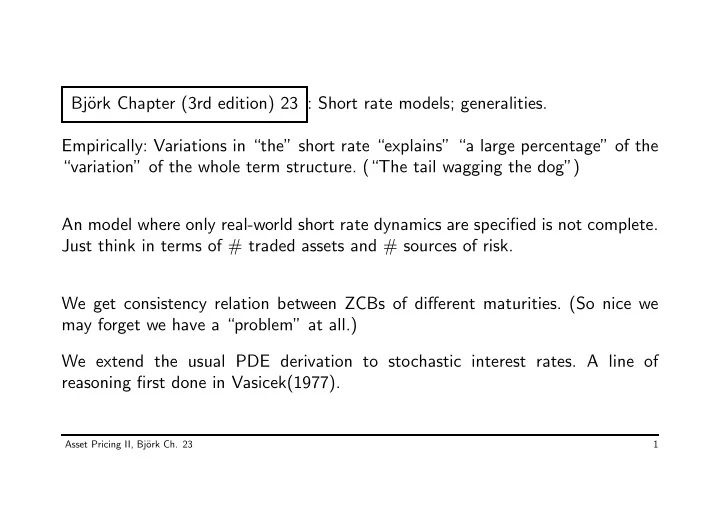
  • rk Chapter (3rd edition) 23 : Short rate models; generalities.

Empirically: Variations in “the” short rate “explains” “a large percentage” of the “variation” of the whole term structure. (“The tail wagging the dog”) An model where only real-world short rate dynamics are specified is not complete. Just think in terms of # traded assets and # sources of risk. We get consistency relation between ZCBs of different maturities. (So nice we may forget we have a “problem” at all.) We extend the usual PDE derivation to stochastic interest rates. A line of reasoning first done in Vasicek(1977).

Asset Pricing II, Bj¨

  • rk Ch. 23

1

slide-2
SLIDE 2

Look (first) at the case where dr(t) = µ(t, r(t))dt + σ(t, r(t))dW P(t) where µ and σ are functions and W P is a 1-dimensional Brownian motion under the real-world probability measure P. So r is Markov wrt. its own filtration. Suppose all kinds of ZCB exist. The “formal” equation P(t; T) = EQ

t

  • exp

T

t

r(u)du

  • makes us conjecture that

P(t; T) = F(t, r(t); T)

Asset Pricing II, Bj¨

  • rk Ch. 23

2

slide-3
SLIDE 3

for some smooth function F (of 3 variables.) Hide T-dependence in a superscript and use Ito to get dF T F T = F T

t + µF T r + 1 2σ2F T rr

F T

  • :=αT

dt + σF T

r

F T

:=σT

dW P(t) Now make a self-financing portfolio with a T-ZCB and an S-ZCB. V is the value process and (uT, uS) relative portfolio weights. From Chapter 6 we have dV V = uT dF T F T + uS dF S F S = (uTαT + uSαS)dt + (uTσT + uSσS)dW P(t)

Asset Pricing II, Bj¨

  • rk Ch. 23

3

slide-4
SLIDE 4

By construction we must have uT + uS = 1, but still 1 degree of freedom. A clever choice is uTσT + uSσS = 0. The dW P-term vanishes, we get uT = −σS σT − σS (symmetric in S), and dV V = αSσT − αTσS σT − σS

  • must = r(t) otherwise arbitrage

dt.

Asset Pricing II, Bj¨

  • rk Ch. 23

4

slide-5
SLIDE 5

Rewriting αS − r(t) σS = αT − r(t) σT LHS doesn’t depend on T, RHS doesn’t depend on S ⇒ the ratio is independent

  • f maturity:

αS − r(t) σS := λ(r(t); t). λ: “market price of risk”; interpretation as excess expected return relative to

  • volatility. Has to be exogenously specified.

Usually: Postulate form that gives same structure under P and Q — a subtlety that people may be obtuse about.

Asset Pricing II, Bj¨

  • rk Ch. 23

5

slide-6
SLIDE 6

Substitute back and get the term structure PDE: F T

t + (µ − λσ)F T r + 1

2σ2F T

rr = rF T

and F T(T; r) = 1 This may be Feynman-Kac represented and we may change measure: F(t, r(t); T) = EQ

  • exp

T

t

r(s)ds

  • where

dr(s) = (µ − λσ)ds + σdW Q(s) Note: Clearly P(t; T)/β(t) is a Q-martingale.

Asset Pricing II, Bj¨

  • rk Ch. 23

6

slide-7
SLIDE 7

Writing dP(t; T) P(t; T) = αT(t; T)dt+σT(t, T)dW P = r(t)dt+σT(t, T)

  • dW P + αT − r(t)

σT dt

  • =dW Q, by Girsanov

shows that pieces fit. We’re still not very concrete.

Asset Pricing II, Bj¨

  • rk Ch. 23

7