BIOSECURITY IN THE TOP OF THE SOUTH REGION Oliver Floerl (Cawthron - - PowerPoint PPT Presentation

biosecurity in the top of the south region
SMART_READER_LITE
LIVE PREVIEW

BIOSECURITY IN THE TOP OF THE SOUTH REGION Oliver Floerl (Cawthron - - PowerPoint PPT Presentation

SCIENCE UPDATE RESEARCH RELEVANT TO BIOSECURITY IN THE TOP OF THE SOUTH REGION Oliver Floerl (Cawthron Institute), TOSMBP Management Committee SABELLA SPALLANZANII IMPACTS, BIOLOGY AND NOVEL DETECTION TOOLS 1. Experiments to determine


slide-1
SLIDE 1

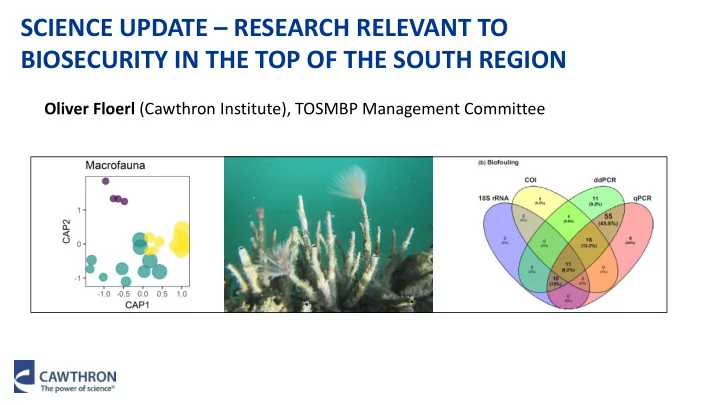
SCIENCE UPDATE – RESEARCH RELEVANT TO BIOSECURITY IN THE TOP OF THE SOUTH REGION

Oliver Floerl (Cawthron Institute), TOSMBP Management Committee

slide-2
SLIDE 2

SABELLA SPALLANZANII IMPACTS, BIOLOGY AND NOVEL DETECTION TOOLS

  • 1. Experiments to determine ecological

impact of fanworms in soft sediments

  • 2. Reproductive biology of Sabella
  • 3. Optimisation of eDNA based

surveillance tools

Image: J. Atalah

slide-3
SLIDE 3
  • 1. How does Sabella spallanzanii modify the functioning of

soft sediment communities?

  • 2016 – 18, Rangitoto Channel
  • Transplants – worms and mimics
  • Density gradients (0-50 per m2)
  • 6 months

Examined impacts on:

  • Soft-sediment fauna (macro/micro)
  • Community respiration
  • Denitrification
  • Primary productivity
slide-4
SLIDE 4
  • No impacts on sediment

biodiversity

  • But shifts in the composition of

sediment communities

  • Increased community metabolism

and reduced denitrification

  • Worms change structure of above-

sediment physical habitat

Worm density

  • 1. How does Sabella spallanzanii modify the functioning of

soft sediment communities?

slide-5
SLIDE 5

Quantified impacts on ecosystem services Spatial spread models Economic valuation of ecosystem services Decision-making for investment in eradication / management Javier.Atalah@cawthron.org.nz Leigh.Tait@niwa.co.nz

  • 1. How does Sabella spallanzanii modify the functioning of

soft sediment communities?

Impact research leads

slide-6
SLIDE 6
  • 2. PhD project: Sabella spallanzanii in the context of mussel

farms in the Coromandel

Project aims

  • Reproductive cycle and output
  • Seasonal presence of larvae around

mussel farms

  • Larval development and settlement

preferences

  • Potential for regeneration after

fragmentation Sarah Brand Institute of Marine Science sbra338@aucklanduni.ac.nz

Image: Kathy Walls

slide-7
SLIDE 7

Reproductive cycle and output

  • 1,200 worms sampled over 1y
  • Worms <5cm (<10cm tube length)

generally not reproductively mature

  • Sex ratio of 1:1 not confirmed
  • Wide range of egg sizes produced each

month

  • Continuous egg production and

gametogenesis, potentially enabling spawning events year-round

  • Evidence for a spawning event in Aug/Sept
slide-8
SLIDE 8
  • 3. Environmental DNA approaches to finding Sabella (and others)

eDNA sample

Anastasija.Zaiko@cawthron.org.nz

slide-9
SLIDE 9

Marine biosecurity applications Biodiversity screening

Community-wide inventories HTS metabarcoding Multiple taxa, incidental detections Validation of positive detections is recommended

Target species detection

Species-specific assays qPCR, ddPCR One-to-few known target taxa High specificity

RNA (Ribonucleic acid) DNA (Deoxyribonucleic acid)

slide-10
SLIDE 10

Targeted detection surveys to:

Verify the results of traditional surveillance over various spatial scales Assess large-scale pest occupancy (distribution) Optimise surveillance designs and management programmes Verify eradication success over a constrained area (in prog.)

Image: J. Atalah Image: J. Atalah

slide-11
SLIDE 11

Method development/optimisation

Sampling methods/matrices: filtered water samples vs settlement plates vs sediment Analytical platforms: qPCR vs ddPCR vs metabarcoding eDNA and eRNA fate in water: Experimental study of shedding and decay rates International validation and standardization

  • f pipelines
slide-12
SLIDE 12

Estimate occupancy of the species (accounting for potentially imperfect detection) Estimate probability of detection for particular method/ sampling approach Design fit-for-purpose surveys - optimised detection probabilities for a given sampling effort Informed interpretation of non-detections In development: coupling eDNA with hydrodynamic models and novel sampling methods

Coupling eDNA signals with probabilistic models to:

slide-13
SLIDE 13

FOR MORE INFORMATION….

Ecological impacts Reproduction & biology Molecular search tools Other

  • J. Atalah (Cawthron)

Javier.Atalah@cawthron.org.nz

  • L. Tait (NIWA)

Leigh.Tait@niwa.co.nz

  • S. Brand (Univ. of Auckland) sbra338@aucklanduni.ac.nz

Zaiko (Cawthron) Anastasija.Zaiko@cawthron.org.nz

  • O. Floerl (Cawthron)

Oliver.Floerl@cawthron.org.nz