Biometric Authentication Revisited: Understanding the Impact of - - PowerPoint PPT Presentation

biometric authentication revisited understanding the
SMART_READER_LITE
LIVE PREVIEW

Biometric Authentication Revisited: Understanding the Impact of - - PowerPoint PPT Presentation

Biometric Authentication Revisited: Understanding the Impact of Wolves in Sheeps clothing in Sheeps clothing Lucas Ballard, Fabian Monrose, Daniel Lopresti Presented by : Anuj Sawani 1 Biometrics What is it? identifying, or


slide-1
SLIDE 1

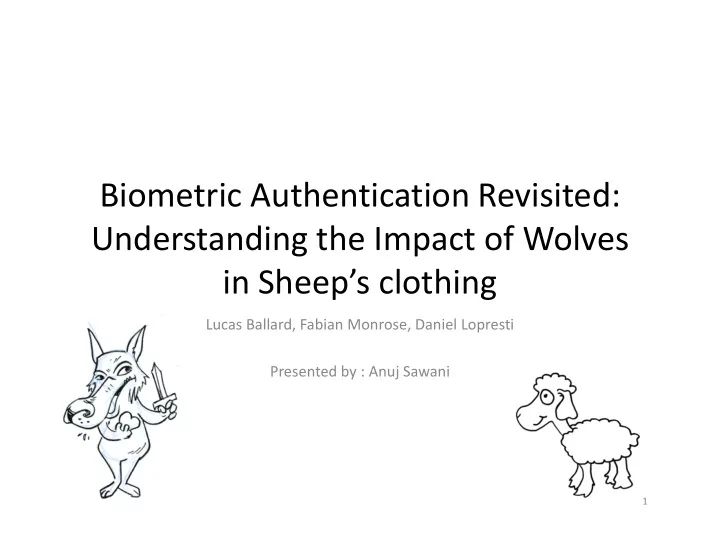
Biometric Authentication Revisited: Understanding the Impact of Wolves in Sheep’s clothing in Sheep’s clothing

Lucas Ballard, Fabian Monrose, Daniel Lopresti Presented by : Anuj Sawani

1
slide-2
SLIDE 2

Biometrics

  • What is it?

– identifying, or verifying a person based on

  • Physiological characteristics
  • Behavioral characteristics

Examples? – Examples?

  • Biometric Authentication vs Identification

– “Am I who I claim to be?” – “Who am I?”

  • Better than passwords?

2

slide-3
SLIDE 3

Handwriting as a biometric

  • Offline

– 2-D bitmap

  • Online

Real-time data – Real-time data

  • Signatures as a biometric?

Feature extraction Hash/Key

3

slide-4
SLIDE 4

So, what’s with the menagerie?

  • Sheep

– Easily accepted by the system

  • Goats

Exceptionally unsuccessful at being accepted – Exceptionally unsuccessful at being accepted

  • Lambs

– Exceptionally vulnerable to imitations

  • Wolves

– Exceptionally successful at imitations

4

slide-5
SLIDE 5

The Threat Model

  • Exploiting poorly protected template

databases Eavesdropping communication between

  • Eavesdropping communication between

sensor and the system

  • Presenting artificially created samples to the

sensor

5

slide-6
SLIDE 6

A neat idea – Concatenation attack

  • Samples of user’s handwriting from other

contexts

  • General samples of the style of writing

Feature analysis …

  • Feature analysis …
  • Generate the user’s handwriting synthetically!

6

slide-7
SLIDE 7

Performance Statistics

False Accept Rate (FAR) False Reject Rate (FRR) Equal Error Rate (ERR)

7

slide-8
SLIDE 8

Forgery styles

  • Naïve

– Use other users’ writing as it was naturally rendered to forge the passphrase

  • Naïve*

Naïve*

– Similar to Naïve, but uses similar writing styles

  • Static

– Forgery using an image of the passphrase

  • Dynamic

– Real-time rendering of the passphrase

8

slide-9
SLIDE 9

Grooming the sheep into wolves

  • 11,038 handwriting samples
  • Incentives awarded to consistent writers,

“dedicated forgers” Three Rounds

  • Three Rounds
  • 1. Collect the samples
  • 2. Static and Dynamic forging
  • 3. Selected “trained” forgers

9

slide-10
SLIDE 10

Handwriting features

  • How difficult is the feature to forge?
  • Signals – t, x(t), y(t), p(t)
  • For every feature f

– rf missed by legitimate users – rf missed by legitimate users – af missed by forgers

  • Quality metric

– Q = (af - rf + 1)/2

  • Q = 0 – never reliably reproduced by users
  • Q = 1 – never reproduced by forgers

10

slide-11
SLIDE 11

The winning features

  • The probability that the ith stroke of c1

connects c2

  • Median gap between the adjacent characters

Median time between end of c and beginning

  • Median time between end of c1 and beginning
  • f c2
  • Pen-up velocity
  • A total of 36 good features out of 144

11

slide-12
SLIDE 12

Algorithm to generate a known passphrase

  • Select n-grams from different context such that

– g1 || g2 || … ||gk = passphrase

  • Normalize t, x(t) and y(t) – match baselines
  • Spatial adjustment of x(t)

– Use median gap feature

Fabricate p(t)

  • Fabricate p(t)

– Use probability of connection feature – Delayed strokes pushed into stack

  • Executed after each pen-up
  • Add time delays

– Use median time feature – Use pen-up velocity and distance between strokes

12

slide-13
SLIDE 13

The system at work…

  • Used small sample set of 15 samples of user’s

writing

– Each character from passphrase exists in set – Does not include passphrase Does not include passphrase

  • Also, used 15 samples of similar writing style
  • The algorithm caused an EER of 27.4%

– Forgers caused an EER of 20.6%

  • n-gram length < 2
  • Used 6.67 of the samples on average

13

slide-14
SLIDE 14

Conclusion

  • Handwriting as a reliable biometric?

– Refutable

  • Adversary has been under-estimated till now

Generative approach produces better

  • Generative approach produces better

forgeries than trained humans

14

slide-15
SLIDE 15

Take away Watch out for the next generation

  • f wolves!

15