
Bioidentical Hormones: What Are the Issues? NAMS Annual Meeting NAMS Annual Meeting October 12, 2013
Bioidentical Hormone Therapy: What? Why? How?
Jan L. Shifren, M. D.
Associate Professor of Obstetrics, Gynecology and Reproductive Biology Harvard Medical School Director, Menopause Program, Vincent Ob/Gyn Service Division of Reproductive Endocrinology and Infertility Massachusetts General Hospital
What IS “Bioidentical” (or “Human identical”) Hormone Therapy? Why is Bioidentical Hormone Therapy
QUESTIONS
Controversial? Why Consider BioHT vs. “Traditional” HT? How May BioHT Be Prescribed consistent with high standard of evidence-based care?
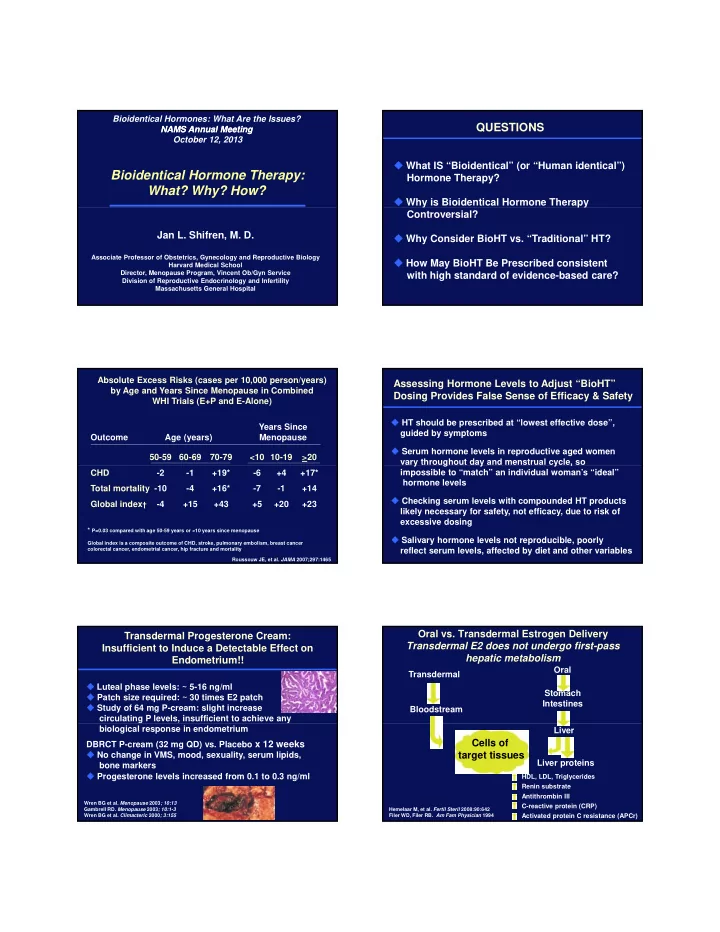
50-59 60-69 70-79 <10 10-19 >20 Years Since Outcome Age (years) Menopause Absolute Excess Risks (cases per 10,000 person/years) by Age and Years Since Menopause in Combined WHI Trials (E+P and E-Alone) CHD
- 2
- 1
+19*
- 6
+4 +17* Total mortality -10
- 4
+16*
- 7
- 1
+14 Global index†
- 4
+15 +43 +5 +20 +23
* P=0.03 compared with age 50-59 years or <10 years since menopause
Global index is a composite outcome of CHD, stroke, pulmonary embolism, breast cancer colorectal cancer, endometrial cancer, hip fracture and mortality Roussouw JE, et al. JAMA 2007;297:1465
HT should be prescribed at “lowest effective dose”, guided by symptoms Serum hormone levels in reproductive aged women vary throughout day and menstrual cycle, so
Assessing Hormone Levels to Adjust “BioHT” Dosing Provides False Sense of Efficacy & Safety
y g y y , impossible to “match” an individual woman’s “ideal” hormone levels Checking serum levels with compounded HT products likely necessary for safety, not efficacy, due to risk of excessive dosing Salivary hormone levels not reproducible, poorly reflect serum levels, affected by diet and other variables Luteal phase levels: ~ 5-16 ng/ml Patch size required: ~ 30 times E2 patch Study of 64 mg P-cream: slight increase circulating P levels, insufficient to achieve any
Transdermal Progesterone Cream: Insufficient to Induce a Detectable Effect on Endometrium!!
biological response in endometrium DBRCT P-cream (32 mg QD) vs. Placebo x 12 weeks No change in VMS, mood, sexuality, serum lipids, bone markers Progesterone levels increased from 0.1 to 0.3 ng/ml
Wren BG et al. Menopause 2003; 10:13 Gambrell RD. Menopause 2003; 10:1-3 Wren BG et al. Climacteric 2000; 3:155
Oral vs. Transdermal Estrogen Delivery Transdermal E2 does not undergo first-pass hepatic metabolism
Transdermal Bloodstream Oral Stomach Intestines Liver Liver proteins
Cells of target tissues
Hemelaar M, et al. Fertil Steril 2008:90:642 Filer WD, Filer RB. Am Fam Physician 1994
HDL, LDL, Triglycerides Renin substrate Antithrombin III C-reactive protein (CRP) Activated protein C resistance (APCr)