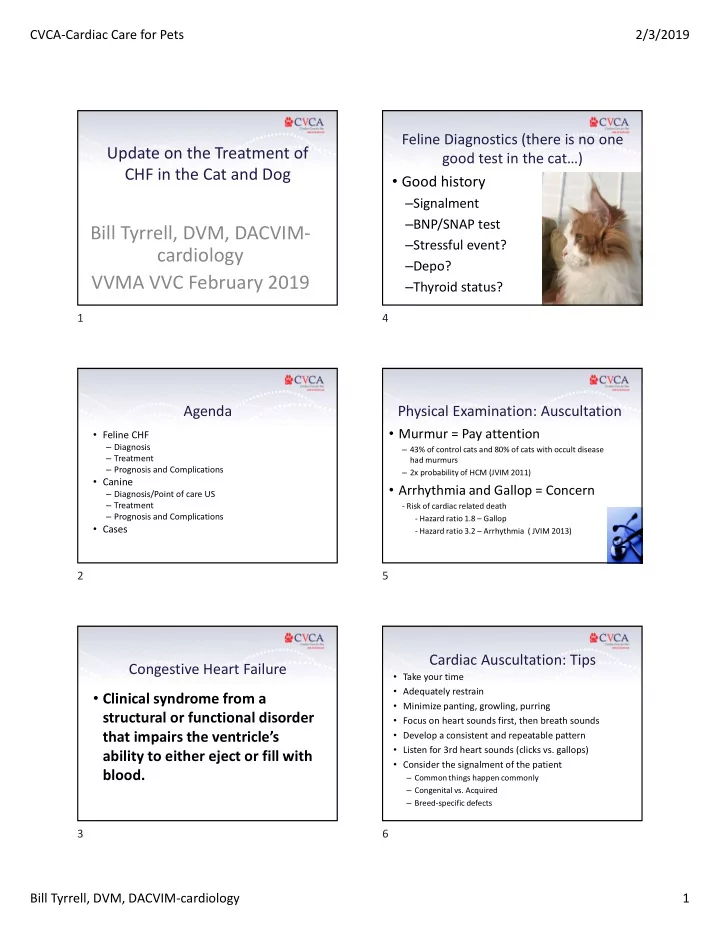
Bill Tyrrell, DVM, DACVIM- Stressful event? cardiology Depo? VVMA - - PDF document

bill tyrrell dvm dacvim
SMART_READER_LITE
LIVE PREVIEW

Bill Tyrrell, DVM, DACVIM- Stressful event? cardiology Depo? VVMA - - PDF document

CVCA-Cardiac Care for Pets 2/3/2019 Feline Diagnostics (there is no one Update on the Treatment of good test in the cat) CHF in the Cat and Dog Good history Signalment BNP/SNAP test Bill Tyrrell, DVM, DACVIM- Stressful


slide-1
SLIDE 1

CVCA-Cardiac Care for Pets 2/3/2019 Bill Tyrrell, DVM, DACVIM-cardiology 1

Update on the Treatment of CHF in the Cat and Dog

Bill Tyrrell, DVM, DACVIM- cardiology VVMA VVC February 2019

Agenda

  • Feline CHF

– Diagnosis – Treatment – Prognosis and Complications

  • Canine

– Diagnosis/Point of care US – Treatment – Prognosis and Complications

  • Cases

Congestive Heart Failure

  • Clinical syndrome from a

structural or functional disorder that impairs the ventricle’s ability to either eject or fill with blood. Feline Diagnostics (there is no one good test in the cat…)

  • Good history

–Signalment –BNP/SNAP test –Stressful event? –Depo? –Thyroid status?

Physical Examination: Auscultation

  • Murmur = Pay attention

– 43% of control cats and 80% of cats with occult disease had murmurs – 2x probability of HCM (JVIM 2011)

  • Arrhythmia and Gallop = Concern
  • Risk of cardiac related death
  • Hazard ratio 1.8 – Gallop
  • Hazard ratio 3.2 – Arrhythmia ( JVIM 2013)

Cardiac Auscultation: Tips

  • Take your time
  • Adequately restrain
  • Minimize panting, growling, purring
  • Focus on heart sounds first, then breath sounds
  • Develop a consistent and repeatable pattern
  • Listen for 3rd heart sounds (clicks vs. gallops)
  • Consider the signalment of the patient

– Common things happen commonly – Congenital vs. Acquired – Breed-specific defects

1 2 3 4 5 6

slide-2
SLIDE 2

CVCA-Cardiac Care for Pets 2/3/2019 Bill Tyrrell, DVM, DACVIM-cardiology 2 Feline Chest Radiographs: Quick Review

  • VHS

6.7-8.1 (mean 7.5)

  • JAVMA 2013:

VHS > 9.3 is likely cardiac cause for dyspnea ( N= 7.5)

4 5 10 9 8 7 6

Cat in a Box Radiograph Trick

DIAGNOSTICS

  • PE
  • Rads
  • +/- ECG
  • Labwork incl. T4
  • NT-ProBNP

L

Seemed fine yesterday… Rule Outs: Feline

  • Causes of Dyspnea (Big 3)

– CHF – Asthma / Inflammatory bronchial disease – Pneumonia/infectious

  • Pleural effusion

– R or L sided (parietal vs. visceral) – R/O Neoplastic

  • CHF Pulmonary Infiltrates

– Cardiomegaly – Diffuse and variable

We have diagnosed heart disease…now what?...therapy in feline acute CHF

  • Treat pulmonary edema and/or pleural effusion

– O2 support (cage vs. nasal canula) – Furosemide (2-4 mg/kg) IM vs. IV – Thoracocentesis

  • Maintain BP/CO

– Pimobendan 0.25-.03 mg/kg PO BID – Dobutamine CRI 1-5 mcg/kg/min

  • Unlikely as needed adjunctive Meds:

– Sedation – Butorphanol 0.2 mg/kg – Nitroprusside CRI 0.5 – 2 mcg/kg/min

7 8 9 10 11 12

slide-3
SLIDE 3

CVCA-Cardiac Care for Pets 2/3/2019 Bill Tyrrell, DVM, DACVIM-cardiology 3 Supportive Care is Crucial to Survival

  • Heat
  • NE tube
  • Anti-thrombotics

–Heparin vs. Clopidogrel

  • Basic monitoring
  • Mirtazapine/Cerenia, etc.
  • No IV fluids

In Hospital Monitoring

  • BP – q 6 hours, q 1hr if hypotensive
  • Renal panel with lytes q 24 hours
  • Rads q 24-48 hours.
  • Individualize
  • Body temperature

Prognosis of CHF and Cats

  • Hypotensive + Hypothermic + Dehydrated =

Poor Prognosis

– Need NE tube for caloric and rehydration needs

  • Cats that do not respond to standard therapy =

Poor Prognosis

– Cats are more sensitive to CRI – Nitroprusside can be very useful (if BP is normal)

Worst case scenario?

  • Silent/occult

cardiomyopathies

  • 250 FATE cases

– Only 11% had previous diagnosis of heart disease

  • JVIM 2013

FATCAT study– Plavix/Clopidogrel vs. ASA

  • Prospective, 72 cats – 50% ASA/50% Plavix
  • Looked at cats that had survived FATE
  • On Plavix, MST 443 days
  • On ASA, MST 192 days

100 200 300 400 500 MST

MST progression

New Generation Anti Xa Drugs

  • Xarelto (rivaroxaban) 2.5 mg SID PO per cat
  • Eliquis (apixaban) (BID dosing)

– VERY EXPENSIVE MEDS!

13 14 15 16 17 18

slide-4
SLIDE 4

CVCA-Cardiac Care for Pets 2/3/2019 Bill Tyrrell, DVM, DACVIM-cardiology 4

Other Meds While in Hospital?

  • ACE inhibitor?
  • Spironolactone?

Chronic monitoring

  • Blood pressure, chem +/- T4 and +/- rads in 2

weeks and then every 4-6 months

  • Appetite, vomiting, maintain body weight
  • PE – New arrhythmia/gallop/loss of murmur
  • At home RR monitoring

Take Home Feline Pearls

  • Thoracocentesis
  • Judicious Lasix (Start at 2 mg/kg parenteral)
  • NE tube
  • Pimobendan
  • Clopidogrel
  • ACE inhibitors are not intended for acute tx

Questions ? Case: Tut

  • 12 year old MC DSH
  • 11 lbs.
  • Off for the past 2-3 weeks with slight decreased

appetite

  • Presented to neighboring ER with dyspnea
  • Transferred to our ER for further therapy and

diagnostics

  • Normal renal values from ER

Physical Examination

  • Heart/breath sounds muffled bilaterally
  • Increased WOB
  • HR 220 with extrasystolic beats
  • Gallop
  • No murmur
  • T nodule

19 20 21 22 23 24

slide-5
SLIDE 5

CVCA-Cardiac Care for Pets 2/3/2019 Bill Tyrrell, DVM, DACVIM-cardiology 5

Radiographs EKG Echo Echo Echo

25 26 27 28 29 30

slide-6
SLIDE 6

CVCA-Cardiac Care for Pets 2/3/2019 Bill Tyrrell, DVM, DACVIM-cardiology 6

Echo Treatment—In Hospital

  • Thoracocentesis
  • Lasix 2 mg/kg IV TID
  • Pimobendan 0.25-0.3 mg/kg PO BID

– Often use TinyTabs/Compressed Tabs for cats

  • Clopidogrel 18.75 mg total PO

Other Diagnostics

  • T4=6.0
  • Repeat renal/lytes—all WNL
  • Began to eat post thoracocentesis so no need

for NE tube

Discharge/At Home Therapy

  • Pimobendan 1.25 mg PO BID(0.25-0.3 mg/kg bid)
  • Methimazole 2.5 mg PO BID
  • Furosemide 10 mg PO TID for 3 days, then

decrease to BID provided doing well

  • Clopidogrel 18.75 mg PO (Total dosage)
  • In 4-5 days, titrate Benazepril up to 2.5 mg PO SID

(0.5 mg/kg SID)

Further Recommendations

  • Owner to monitor resting RR/RE at home
  • Recheck CBC/Chem/T4 in 2-3 weeks
  • Recheck echocardiogram in 4-6 months
  • Prognosis?

Canine CHF

31 32 33 34 35 36

slide-7
SLIDE 7

CVCA-Cardiac Care for Pets 2/3/2019 Bill Tyrrell, DVM, DACVIM-cardiology 7

Diagnosis

  • History

– Presence of a murmur – Duration of symptoms

  • PE

– Heart rate – BCS

  • NT-proBNP?
  • Rads/Echo
  • Furosemide trial

Crackles Do Not Always Indicate CHF

Cardiac Respiratory Activity  +/- Exercise intolerance Normal Weight/BCS +/- Weight loss +/- Obese Lungs Sounds Normal to  BV sounds +/- Soft crackles Normal to  BV sounds +/- Loud crackles +/- Wheezes RR/RE/Pattern Usually short, rapid,+/- abdominal effort Exaggerated expiration +/- exp abdominal push HR/Rhythm Normal to Tachycardia Normal +/- RSA CXR VHS High Bronchial, Broncho-interstitial pattern, Peri-bronchial enhancement

Signalment

  • History
  • Older, small breeds
  • Chronic, loud murmur
  • Recent signs

Rads

  • Normal dogs:

8.5-10.7 (9.7 +/- 0.5)

  • Boxers:

10.3-12.6

  • Labrador

Retrievers: 9.7- 11.7

  • CKCS:

9.9-11.7

Lung ultrasound

Positioning: sternal or standing Transducer sites: Vet BLUE protocol

8 transducer positions

  • Right and left caudal

lung lobe

  • Right and left perihilar

lung lobe

  • Right and left middle

lung lobe

  • Right and left cranial

lung lobe

Ward et al. JAVMA 2017

37 38 39 40 41 42

slide-8
SLIDE 8

CVCA-Cardiac Care for Pets 2/3/2019 Bill Tyrrell, DVM, DACVIM-cardiology 8

Lung ultrasound

Air attenuates ultrasound waves

High acoustic impedance = difficult to image lungs

Lung US looks at ARTIFACTS, not lung itself

Normal: see reverberation artifacts under lung surface Disease: reflect pathology that extends to lung surface

Normal Lung Ultrasound

A-lines

  • Horizontal lines represent reflection of interlobular septae

Slide credit to Jessica Ward, DVM, DACVIM- cardiology Iowa State University

Lisciandro 2014

Normal Lung Ultrasound

A-lines and Glide sign

Lisciandro 2014

Slide credit to Jessica Ward, DVM, DACVIM-cardiology Iowa State University

Lung ultrasound

B-lines (lung rockets, comet tails)

  • Small fluid-filled alveoli below resolution threshold of US
  • Surrounded by air = high impedance gradient
  • Discrete, narrow, hyperechoic, vertical, “laser-like”
  • Extend from pulmonary to pleural interface to far

edge of screen w/o fading

  • Move synchronously with respiration

Slide credit to Jessica Ward, DVM, DACVIM-cardiology Iowa State University

Abnormal Lung Ultrasound

Lisciandro 2014

B-lines (lung rockets)

Slide credit to Jessica Ward, DVM, DACVIM-Cardiology; Iowa State University

B-lines (lung rockets)

QUANTIFY B-LINES: 0, 1, 2, 3, >3, INFINITY

Ward et al. JAVMA 2017

Slide credit to Jessica Ward, DVM, DACVIM-cardiology Iowa State University

Normal LUS vs. B-lines

Slide credit to Jessica Ward, DVM, DACVIM-cardiology Iowa State University

43 44 45 46 47 48

slide-9
SLIDE 9

CVCA-Cardiac Care for Pets 2/3/2019 Bill Tyrrell, DVM, DACVIM-cardiology 9 Resolution of B-lines during CHF treatment

Presentation (respiratory distress) Hospital discharge (20 hours later)

Slide credit to Jessica Ward, DVM, DACVIM-cardiology Iowa State University

Summary: What can POC-TUS do for you?

  • TFAST
  • Focused echo
  • LUS (Vet BLUE)

Ward 2017 Lisciandro 2014 Lisciandro 2011

Pleural effusion Pericardial effusion Pneumothorax Chest wall disease Guide centesis Severe LV enlargement or systolic dysfunction Severe LA enlargement B-lines: alveolar/interstitial fluid Other abnormalities: Shred, Tissue, Nodule

Slide credit to Jessica Ward, DVM, DACVIM-cardiology Iowa State University

Summary: what CAN’T POC-TUS do for you?

  • Definitively diagnose airway disease or mild/focal interstitial

disease

  • Diagnose preclinical (asymptomatic) or congenital heart disease
  • Replace a thorough history and PE
  • Replace TXR
  • Replace cardiologist’s echocardiogram or other advanced imaging

Slide credit to Jessica Ward, DVM, DACVIM-cardiology Iowa State University

POC-TUS: a tool in your triage toolbox

  • Extension of physical exam
  • Rapid, noninvasive, low stress
  • Can postpone initial TXR in unstable patients
  • Increases confidence in CHF diagnosis (or ruling out CHF)
  • Small portable machine; minimal training required

Slide credit to Jessica Ward, DVM, DACVIM-cardiology Iowa State University

CASE STUDY

Comments / Questions

Contact Information:

bill.tyrrell@cvcavets.com cvcaleesburg@cvcavets.com 703.669.9311 www.cvcavets.com

49 50 51 52 53 54