SLIDE 1
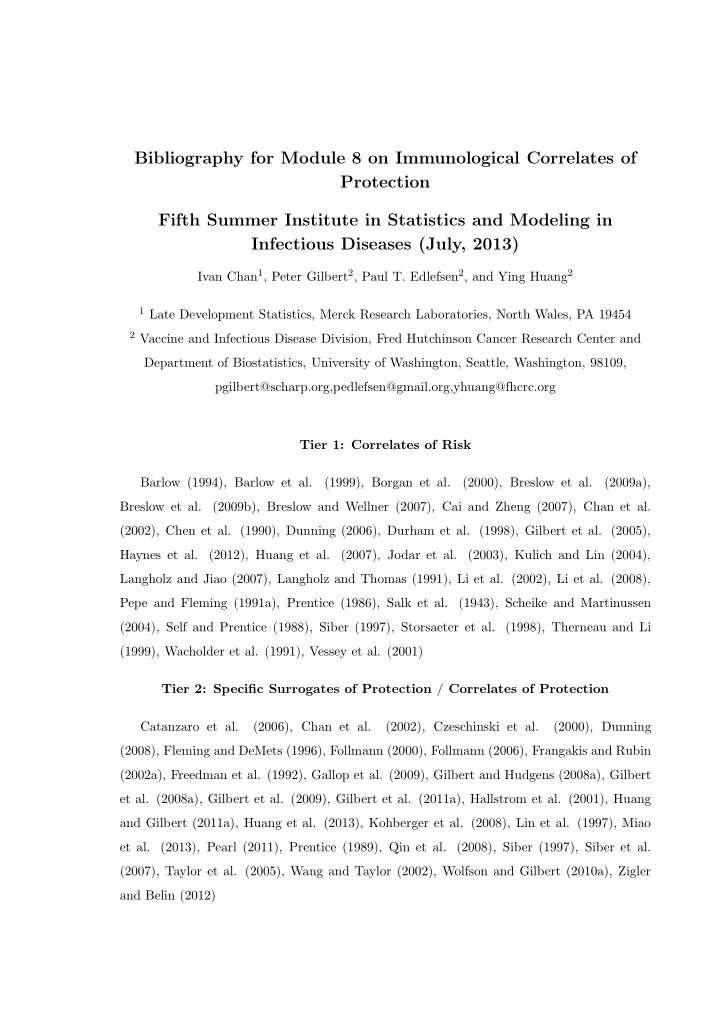
Bibliography for Module 8 on Immunological Correlates of Protection Fifth Summer Institute in Statistics and Modeling in Infectious Diseases (July, 2013)
Ivan Chan1, Peter Gilbert2, Paul T. Edlefsen2, and Ying Huang2
1 Late Development Statistics, Merck Research Laboratories, North Wales, PA 19454 2 Vaccine and Infectious Disease Division, Fred Hutchinson Cancer Research Center and
Department of Biostatistics, University of Washington, Seattle, Washington, 98109, pgilbert@scharp.org,pedlefsen@gmail.org,yhuang@fhcrc.org Tier 1: Correlates of Risk Barlow (1994), Barlow et al. (1999), Borgan et al. (2000), Breslow et al. (2009a), Breslow et al. (2009b), Breslow and Wellner (2007), Cai and Zheng (2007), Chan et al. (2002), Chen et al. (1990), Dunning (2006), Durham et al. (1998), Gilbert et al. (2005), Haynes et al. (2012), Huang et al. (2007), Jodar et al. (2003), Kulich and Lin (2004), Langholz and Jiao (2007), Langholz and Thomas (1991), Li et al. (2002), Li et al. (2008), Pepe and Fleming (1991a), Prentice (1986), Salk et al. (1943), Scheike and Martinussen (2004), Self and Prentice (1988), Siber (1997), Storsaeter et al. (1998), Therneau and Li (1999), Wacholder et al. (1991), Vessey et al. (2001) Tier 2: Specific Surrogates of Protection / Correlates of Protection Catanzaro et al. (2006), Chan et al. (2002), Czeschinski et al. (2000), Dunning (2008), Fleming and DeMets (1996), Follmann (2000), Follmann (2006), Frangakis and Rubin (2002a), Freedman et al. (1992), Gallop et al. (2009), Gilbert and Hudgens (2008a), Gilbert et al. (2008a), Gilbert et al. (2009), Gilbert et al. (2011a), Hallstrom et al. (2001), Huang and Gilbert (2011a), Huang et al. (2013), Kohberger et al. (2008), Lin et al. (1997), Miao et al. (2013), Pearl (2011), Prentice (1989), Qin et al. (2008), Siber (1997), Siber et al. (2007), Taylor et al. (2005), Wang and Taylor (2002), Wolfson and Gilbert (2010a), Zigler and Belin (2012)
SLIDE 2
Tier 3: General Surrogates of Protection Alonso et al. (2004), Buyse et al. (2000), Daniels and Hughes (1997a), Gail et al. (2000), Pearl and Bareinboim (2011), Sadoff and Wittes (2007) Multiple Tiers Alonso et al. (2006), Burzykowski et al. (2005), Buyse and Molenberghs (1998), Hughes (2002), Joffe and Greene (2009), Pearl (2000), Plotkin and Gilbert (2012), Qin et al. (2007a), Robins and Greenland (1992), Rosenbaum (1984), Weir and Walley (2006) General Buchbinder et al. (2008), Chan and Bohidar (1998), Chan et al. (2004), Flynn et al. (2005), Halloran and Struchiner (1995), Hsieh and Lavori (1998), Lachin and Foulkes (1986), Lakatos (1988), Oxman et al. (2005), Plotkin (2008), Plotkin (2010), Robins (1995), Rubin (1986), Rerks-Ngarm et al. (2009), Schoenfeld (1981), Schoenfeld (1982), Smith et al. (1984), Organization (1993), Zhao et al. (2008), Li et al. (2013) Session 10: Elaborations of Statistical Methods for Assessing Specific Surrogates of Protection Bura and Gastwirth (2001), Chatterjee et al. (2003), Chatterjee and Chen (2007), Daniels and Hughes (1997b), Follmann (2006), Frangakis and Rubin (2002b), Gilbert and Hudgens (2008b), Gilbert et al. (2008b), Gilbert et al. (2011b), Heagerty and Pepe (1999), Huang et al. (2007), Huang and Gilbert (2011b), Huang and Pepe (2009), Molenberghs et al. (2008), Pepe and Fleming (1991b), Prentice (1989), Qin et al. (2007b), Schmader et al. (2012), Wolfson and Gilbert (2010b) Main Sieve Analysis Articles Binary endpoint sieve, “sieve conditions” for prospective interpretation based on retro- spective analysis Gilbert et al. (1998) Comparison of methods, refinement of “sieve conditions” Gilbert (2000) Sieve analysis overview, examples, discussion of “sieve conditions” Gilbert et al. (2001) 2
SLIDE 3
Genome scanning methods Gilbert et al. (2008) RV144 V2 sieve analysis results Rolland, Edlefsen et al. (2012) Liao et al. (2013) Categorical Models and Inference Methods Multinomial logistic regression (MLR) Gilbert et al. (1998), Cox (1970), Anderson (1972) Exact inference for MLR Hirji (1992) Ordered stereotype model Anderson (1984) Cumulative logit model McCullagh (1980) Likelihood ratio chi-squared test Armitage (1971) Test for trend in odds ratios Breslow et al. (1980) Linear-by-linear association test Agresti (1990) (pg. 284) MLR asymptotic chi-squared test Zelen (1991) Generalized logistic regression (GLR) Gilbert et al. (1999), Gilbert et al. (2000) Discrete Competing Risks Cause-specific hazards Prentice et al. (1978), Gray (1988), Aly et al. (1994) Trick for assessing differential vaccine efficacy Lunn and McNeil (1995) Linear rank tests Hu and Tsai (1999), Luo and Turnbull (1999), Sun (2001), McKeague et al. (2001) Leaky vaccine Halloran et al. (1992) Unbiased beta-hats for RCTs with low infection rates Rhodes et al. (1996) Continuous Distance/Mark Models and Inference Methods Nonparametric and semiparametric estimation and testing of mark-specific vaccine effi- cacy Gilbert et al. (2008), Sun et al. (2009) Nonparametric and semiparametric estimation and testing of mark-specific vaccine effi- cacy accounting for missing marks/genetic distances Sun and Gilbert (2012) Extensions to handle multiple genetic distances Sun et al. (2013), Juraska and Gilbert (2013) 3
SLIDE 4 Genome Scanning Hamming weights; VESPA software KORBER and MYERS (1992) HIV-specific substitution matrices Nickle et al. (2007) Amino acid physicochemical properties and antibody binding Hopp and Woods (1981) Protein conformation and antigen accessibility Hopp (1984) Using known antibody epitopes to predict antigenicity Welling et al. (1985) Previous approaches to AA divergence metrics: standardized Euclidean and Kullback- Leibler Wu et al. (2001) Previous approaches to AA divergence metrics: Mahalanobis Kowalski et al. (2002) Adding small positive constants to two-sample statistics in microarray analysis Efron et al. (2001), Tusher et al. (2001), Guo et al. (2003), L¨
Mahalanobis asymptotics Johnson and Wichern (2002) pg. 285 Pan’s method for p-value pooling Pan (2003) Reasons to upweight positions in HIV Wyatt et al. (1998), Wei et al. (2003) Multiplicity adjustment Tarone (1990), Benjamini and Hochberg (1995), Gilbert (2005) Data Examples Hepatitis B example Szmuness et al. (1981) HIV-1 Ordinal V3 tip sequence example Gilbert et al. (1998), Berman et al. (1997) STEP trial Buchbinder et al. (2008)
References
Agresti, A. (1990). Analysis of categorical data. Alonso, A., Molenberghs, G., Burzykowski, T. and et al. (2004). Prentice’s approach and the meta-analytic paradigm: a reflection on the role of statistics in the evaluation of surrogate
- endpoints. Biometrics 60, 724–728.
Alonso, A., Molenberghs, G., Geys, H., Buyse, M. and Vangeneugden, T. (2006). A unify- ing approach for surrogate marker validation based on Prentice’s criteria. Statistics in Medicine 25, 205–221. 4
SLIDE 5 Aly, E., Kochar, S. and McKeague, I. (1994). Some tests for comparing cumulative incidence functions and cause-specific hazard rates. Journal of the American Statistical Association pages 994–999. Anderson, J. (1972). Separate sample logistic discrimination. Biometrika 59, 19–35. Anderson, J. (1984). Regression and ordered categorical variables. Journal of the Royal Statistical Society. Series B (Methodological) pages 1–30. Armitage, S. (1971). Methods in medical research. Barlow, W. (1994). Robust variance estimation for the case-cohort design. Biometrics 50, 1064–1072. Barlow, W., Ichikawa, L., Rosber, D. and Izumi, S. (1999). Analysis of case-cohort designs. Journal of Clinical Epidemiology 52, 1165–1172. Benjamini, Y. and Hochberg, Y. (1995). Controlling the false discovery rate: a practical and powerful approach to multiple testing. Journal of the Royal Statistical Society. Series B (Methodological) pages 289–300. Berman, P., Gray, A., Wrin, T., Vennari, J., Eastman, D., Nakamura, G., Francis, D., Gorse,
- G. and Schwartz, D. (1997). Genetic and immunologic characterization of viruses infecting
mn-rgp120-vaccinated volunteers. Journal of Infectious Diseases 176, 384. Borgan, L., Langholz, B., Samuelson, S. and Pogoda, J. (2000). Exposure stratified case- cohort designs. Lifetime Data Analysis 6, 39–58. Breslow, N., Day, N. et al. (1980). Statistical methods in cancer research. Vol. 1. The analysis
- f case-control studies., volume 1. Distributed for IARC by WHO, Geneva, Switzerland.
Breslow, N., Lumley, T., Ballantyne, C., Chambless, L. and Kulich, M. (2009a). Improved horvitz-thompson estimation of model parameters from two-phase stratified samples: Ap- plications in epidemiology. Statistical Biosciences 1, 32–49. Breslow, N., Lumley, T., Ballantyne, C., Chambless, L. and Kulich, M. (2009b). Using the whole cohort in the analysis of case-cohort dat. American Journal of Epidemiology 169, 1398–1405. Breslow, N. and Wellner, J. (2007). Weighted likelihood for semiparametric models and two-phase stratified samples, with application to Cox regression. Scandinavian Journal of Statistics 34, 86–102. Buchbinder, S., Mehrotra, D., Duerr, A., Fitzgerald, D., Mogg, R., Li, D., Gilbert, P., Lama, 5
SLIDE 6 J., Marmor, M., del Rio, C., McElrath, M., Casimiro, D., Gottesdiener, K., Chodakewitz, J., Corey, L. and Robertson, M. (2008). Efficacy assessment of a cell-mediated immunity HIV-1 vaccine (the Step Study): A double-blind, randomised, placebo-controlled, test-of- concept trial. Lancet 372, 1881–1893. Buchbinder, S. P., Mehrotra, D. V., Duerr, A., Fitzgerald, D. W., Mogg, R., Li, D. et al. (2008). Efficacy assessment of a cell-mediated immunity HIV-1 vaccine (the Step Study): a double-blind, randomised, placebo-controlled, test-of-concept trial. LANCET 372, 1881– 1893. Bura, R. and Gastwirth, J. (2001). The binary regression quantile plot: Assessing the im- portance of predictors in binary regression visually. Biometrical Journal 43, 5–21. Burzykowski, T., Molenberghs, G. and Buyse, M. (2005). The Evaluation of Surrogate End-
Buyse, M. and Molenberghs, G. (1998). Criteria for the validation of surrogate endpoints in randomized experiments. Biometrics 54, 1014–1029. Buyse, M., Molenberghs, G., Burzykowski, T., Renard, D. and Geys, H. (2000). The valida- tion on surrogate endpoints in meta-analyses of randomized experiments. Biostatistics 1, 49–67. Cai, J. and Zheng, D. (2007). Power calculation for case-cohort studies with nonrare events. Biometrics 63, 1288–1295. Catanzaro, A., Koup, R., Roederer, M. and et al. (2006). Safety and immunogenicity evalu- ation of a multiclade HIV-1 candidate vaccine delivered by a replication-defective recom- binant adenovirus vector. Journal of Infectious Diseases 194, 1638–1649. Chan, I. and Bohidar, N. (1998). Exact power and sample size for vaccine efficacy studies. Communications in Statistics, Theory and Methods 27, 1305–1322. Chan, I., Shu, L., Matthews, H., Chan, C., Vessey, R., Sadoff, J. and Heyse, J. (2002). Use
- f statistical models for evaluating antibody response as a correlate of protection against
- varicella. Statistics in Medicine 21, 3411–3430.
Chan, I., Wang, W. and Heyse, J. (2004). Exact power and sample size for vaccine efficacy
- studies. Informa Healthcare.
Chatterjee, N. and Chen, Y. (2007). A semiparametric pseudo-score method for analysis of two-phase studies with continuous phase-i covariates. Lifetime Data Analysis 13, 607–622. 6
SLIDE 7 Chatterjee, N., Chen, Y. and Breslow, N. (2003). A pseudoscore estimator for regression problems with two-phase sampling. Journal of the American Statistical Association 98, 158–168. Chen, R., Markowitz, L., Albrecht, P., Stewart, J., Mofenson, L., Preblud, S. and Orenstein,
- W. (1990). Measles antibody: reevaluation of protective titers. The Journal of Infectious
Diseases 162, 1036–1042. Cox, D. (1970). Analysis of binary data. Methuen. Czeschinski, P., Binding, N. and Witting, U. (2000). Hepatitis A and hepatitis B vaccinations: immunogenicity of combined vaccine and of simultaneously or separately applied single
- vaccines. Vaccine 18, 1074–1080.
Daniels, M. and Hughes, M. (1997a). Meta-analysis for the evaluation of potential surrogate
- markers. Statistics in Medicine 16, 1965–1982.
Daniels, M. and Hughes, M. (1997b). Meta-analysis for the evaluation of potential surrogate
- markers. Statistics in Medicine 16, 1965–1982.
Dunning, A. (2006). A model for immunological correlates of protection. Statistics in Medicine 25, 1485–1497. Dunning, A. (2008). Comment on “Evaluating a surrogate endpoint at three levels, with application to vaccine development.”. Statistics in Medicine 27, 6268–6270. Durham, L., Longini, I., Halloran, M., Clemens, J., Nizam, A. and Rao, M. (1998). Estimation
- f vaccine efficacy in the presence of waning: application to cholera vaccines. American
Journal of Epidemiology 147, 948–959. Efron, B., Tibshirani, R., Storey, J. and Tusher, V. (2001). Empirical bayes analysis of a microarray experiment. Journal of the American Statistical Association 96, 1151–1160. Fleming, T. and DeMets, D. (1996). Surrogate endpoints in clinical trials: Are we being misled? Annals of Internal Medicine 125, 605–613. Flynn, N., Forthal, D., Harro, C., Judson, F., Mayer, K., Para, M., Gilbert, P. and rgp120 HIV Vaccine Study Group, T. (2005). Placebo-controlled phase 3 trial of re- combinant glycoprotein 120 vaccine to prevent HIV-1 infection. Journal of Infectious Diseases 191, 654–65. Follmann, D. (2000). On the effect of treatment among treatment compliers: An analysis of the multiple risk factor intervention trial. Journal of the American Statistical Association 7
SLIDE 8
95, 1101–1109. Follmann, D. (2006). Augmented designs to assess immune response in vaccine trials. Bio- metrics 62, 1161–1169. Frangakis, C. and Rubin, D. (2002a). Principal stratification in causal inference. Biometrics 58, 21–29. Frangakis, C. and Rubin, D. (2002b). Principal stratification in causal inference. Biometrics 58, 21–29. Freedman, L., Graubard, B. and Schatzkin, A. (1992). Statistical validation of intermediate endpoints for chronic diseases. Statistics in Medicine 11, 167–178. Gail, M., Pfeiffer, R., Van Houwelingen, H. and Carroll, R. (2000). On meta-analytic assess- ment of surrogate outcomes. Biostatistics 1, 231–246. Gallop, R., Small, D., Lin, J., Elliott, M., Joffe, M. and Ten Have, T. (2009). Mediation analysis with principal stratification. Statistics in Medicine 28, 1108–1130. Gilbert, P. (2000). Comparison of competing risks failure time methods and time-independent methods for assessing strain variations in vaccine protection. Statistics in medicine 19, 3065–3086. Gilbert, P. (2005). A modified false discovery rate multiple-comparisons procedure for discrete data, applied to human immunodeficiency virus genetics. Journal of the Royal Statistical Society: Series C (Applied Statistics) 54, 143–158. Gilbert, P., Hanna, G., DeGruttola, V., Martinez-Picado, J., Kuritzkes, D., Johnson, V., Richman, D. and D’Aquila, R. (2000). Comparative analysis of HIV type 1 genotypic resistance across antiretroviral trial treatment regimens. AIDS Research and Human Retroviruses 16, 1325–1336. Gilbert, P. and Hudgens, M. (2008a). Evaluating candidate principal surrogate endpoints. Biometrics 64, 1146–1154. Gilbert, P. and Hudgens, M. (2008b). Evaluating candidate principal surrogate endpoints. Biometrics 64, 1146–1154. Gilbert, P., Hudgens, M. and Wolfson, J. (2011a). Commentary on “Principal stratification– a goal or a tool?”. The International Journal of Biostatistics . Gilbert, P., Hudgens, M. and Wolfson, J. (2011b). Commentary on” principal stratificationa goal or a tool?” by judea pearl. The International Journal of Biostatistics 7, 36. 8
SLIDE 9
Gilbert, P., Lele, S. and Vardi, Y. (1999). Maximum likelihood estimation in semiparametric selection bias models with application to AIDS vaccine trials. Biometrika 86, 27–43. Gilbert, P., McKeague, I. and Sun, Y. (2008). The two-sample problem for failure rates depending on a continuous mark: an application to vaccine efficacy. Biostatistics 9, 263– 276. Gilbert, P., Peterson, M., Follmann, D. and et al. (2005). Correlation between immunologic responses to a recombinant glycoprotein 120 vaccine and incidence of HIV-1 infection in a Phase 3 HIV-1 preventive vaccine trial. Journal of Infectious Diseases 191, 666–677. Gilbert, P., Qin, L. and Self, S. (2008a). Evaluating a surrogate endpoint at three levels, with application to vaccine development. Statistics in Medicine 27, 4758–4778. Gilbert, P., Qin, L. and Self, S. (2008b). Evaluating a surrogate endpoint at three levels, with application to vaccine development. Statistics in medicine 27, 4758–4778. PM- CID:PMC2646675. Gilbert, P., Qin, L. and Self, S. (2009). Response to Andrew Dunning’s comment on “Evaluating a surrogate endpoint at three levels, with application to vaccine develop- ment”. Statistics in Medicine 28, 716–719. Gilbert, P., Self, S. and Ashby, M. (1998). Statistical methods for assessing differential vaccine protection against human immunodeficiency virus types. Biometrics 54, 799–814. Gilbert, P., Self, S., Rao, M., Naficy, A. and Clemens, J. (2001). Sieve analysis: methods for assessing from vaccine trial data how vaccine efficacy varies with genotypic and phenotypic pathogen variation. Journal of clinical epidemiology 54, 68–85. Gilbert, P., Wu, C. and Jobes, D. (2008). Genome scanning tests for comparing amino acid sequences between groups. Biometrics 64, 198–207. Gray, R. (1988). A class of k-sample tests for comparing the cumulative incidence of a competing risk. The annals of statistics pages 1141–1154. Guo, X., Qi, H., Verfaillie, C. and Pan, W. (2003). Statistical significance analysis of longi- tudinal gene expression data. Bioinformatics 19, 1628–1635. Halloran, M., Haber, M. and Longini, I. (1992). Interpretation and estimation of vaccine efficacy under heterogeneity. American Journal of Epidemiology 136, 328–343. Halloran, M. and Struchiner, C. (1995). Causal inferences in infectious diseases. Epidemiology 6, 142–151. 9
SLIDE 10 Hallstrom, A., McAnulty, J., Wilkoff, B., Follmann, D., Raitt, M., Carlson, M., Gillis, A., Shih, H., Powell, J., Duff, H. and Halperin, B. (2001). Patients at lower risk of arrhythmia
- ccurrence: A subgroup in whom implantable defibrillators may not offer benefit. Journal
- f the American College of Cardiology 37, 1093–1099.
Haynes, B., Gilbert, P., McElrath, M. and et al. (2012). Immune correlates analysis of the ALVAC-AIDSVAX HIV-1 vaccine efficacy trial. New England Journal of Medicine 366, 1275–1286. Heagerty, P. J. and Pepe, M. S. (1999). Semiparametric estimation of regression quantiles with application to standardizing weight for height and age in u.s. children. Applied Statistics 48, 533–551. Hirji, K. (1992). Computing exact distributions for polytomous response data. Journal of the American Statistical Association pages 487–492. Hopp, T. (1984). Protein antigen conformation: folding patterns and predictive algorithms; selection of antigenic and immunogenic peptides. Annali Sclavo. Collana monografica 1, 47. Hopp, T. and Woods, K. (1981). Prediction of protein antigenic determinants from amino acid sequences. Proceedings of the National Academy of Sciences 78, 3824. Hsieh, F. and Lavori, P. (1998). Sample size calculations for the Cox proportional hazards regression model with nonbinary covariates. Controlled Clinical Trials 21, 552–560. Hu, X. and Tsai, W. (1999). Linear rank tests for competing risks model. Statistica Sinica 9, 971–984. Huang, Y. and Gilbert, P. (2011a). Comparing biomarkers as principal surrogate endpoints. Biometrics 67, 1442–1451. Huang, Y., Gilbert, P. and Wolfson, J. (2013). Design and estimation for evaluating principal surrogate markers in vaccine trials. Biometrics . Huang, Y. and Gilbert, P. B. (2011b). Comparing biomarkers as principal surrogate end-
- points. Biometrics 67, 1442–1451. PMCID:PMC3163011.
Huang, Y. and Pepe, M. (2009). A parametric roc model-based approach for evaluating the predictiveness of continuous markers in case–control studies. Biometrics 65, 1133–1144. PMCID:PMC2794984. Huang, Y., Pepe, M. and Feng, Z. (2007). Evaluating the predictiveness of a continuous 10
SLIDE 11
- marker. Biometrics 63, 1181–1188.
Huang, Y., Sullivan Pepe, M. and Feng, Z. (2007). Evaluating the predictiveness of a contin- uous marker. Biometrics 63, 1181–1188. Hughes, M. (2002). Evaluating surrogate endpoints. Controlled Clinical Trials 23, 703–707. Jodar, L., Butler, J., Carlone, G., Dagan, R., Goldblatt, D., Kyhty, H., Klugman, K., Plikaytis, B., Siber, G., Kohberger, R., Chang, I. and Cherian, T. (2003). Serological criteria for evaluation and licensure of new pneumococcal conjugate vaccine formulations for use in infants. Vaccine 21, 3265–3272. Joffe, M. and Greene, T. (2009). Related causal frameworks for surrogate outcomes. Bio- metrics 65, 530–538. Johnson, R. and Wichern, D. (2002). Applied multivariate statistical analysis, volume 4. Prentice hall Upper Saddle River, NJ. Juraska, M. and Gilbert, P. (2013). Mark-specific hazard ratio model with multivariate continuous marks: An application to vaccine efficacy. Biometrics . Kohberger, R., Jemiolo, D. and Noriega, F. (2008). Prediction of pertussis vaccine efficacy using a correlates of protection model. Vaccine 26, 3518–3521. KORBER, B. and MYERS, G. (1992). Signature pattern analysis: a method for assessing viral sequence relatedness. AIDS research and human retroviruses 8, 1549–1560. Kowalski, J., Pagano, M. and DeGruttola, V. (2002). A nonparametric test of gene region heterogeneity associated with phenotype. Journal of the American Statistical Association 97, 398–408. Kulich, M. and Lin, D. (2004). Improving efficiency of relative-risk estimation in case-cohort
- studies. Journal of the American Statistical Association 99, 832–844.
Lachin, J. and Foulkes, M. (1986). Evaluation of sample size and power for analyses of survival with allowance for nonuniform patient entry, losses to follow-up, non-compliance, and stratification. Biometrics 42, 507–519. Lakatos, E. (1988). Sample size based on the log-rank statistic in complex clinical trials. Biometrics 44, 229–241. Langholz, B. and Jiao, J. (2007). Computational methods for case-cohort studies. Computa- tional Statistics and Data Analysis 51, 3737–3748. Langholz, B. and Thomas, D. (1991). Efficiency of cohort sampling designs: Some surprising 11
SLIDE 12
- results. Biometrics 47, 1563–1571.
Li, S., Chan, I., Matthews, H., Heyse, J., Chan, C., Kutler, B., Kaplan, K., Vessey, S. and Sadoff, J. (2002). Childhood vaccination against varicella: inverse relationship between 6- week postvaccination varicella antibody response and likelihood of long-term breakthrough
- infection. Pediatric Infectious Disease Journal 21, 337–342.
Li, S., Parnes, M. and Chan, I. (2013). Determining the cutoff based on a continuous variable to define two populations with application to vaccines. Journal of Biopharmaceutical Statistics 23, 662–680. Li, Z., Gilbert, P. and Nan, B. (2008). Weighted likelihood method for grouped survival data in case-cohort studies with application to HIV vaccine trials. Biometrics 64, 1247–1255. Liao, H.-X., Bonsignori, M., Alam, S., McLellan, J., Tomaras, G. and et al. (2013). Vaccine induction of antibodies against a structurally heterogeneous site of immune pressure within HIV-1 envelope protein variable regions 1 and 2. Immunity 38, 176–186. Lin, D., Fleming, T. and De Gruttola, V. (1997). Estimating the proportion of treatment effect explained by a surrogate marker. Statistics in Medicine 16, 1515–1527. L¨
- nnstedt, I. and Speed, T. (2002). Replicated microarray data. Statistica sinica 12, 31–46.
Lunn, M. and McNeil, D. (1995). Applying cox regression to competing risks. Biometrics pages 524–532. Luo, X. and Turnbull, B. (1999). Comparing two treatments with multiple competing risks
- endpoints. Statistica Sinica 9, 985–998.
McCullagh, P. (1980). Regression models for ordinal data. Journal of the royal statistical
- society. Series B (Methodological) pages 109–142.
McKeague, I., Gilbert, P. and Kanki, P. (2001). Omnibus tests for comparison of competing risks with adjustment for covariate effects. Biometrics 57, 818–828. Miao, C., Li, X., Gilbert, P. and Chan, I. (2013). A multiple imputation approach for surro- gate marker evaluation in the principal stratification causal inference framework. In: Risk Assessment and Evaluation of Predictions. Molenberghs, G., Burzykowski, T., Alonso, A., Assam, P., Tilahun, A. and Buyse, M. (2008). The meta-analytic framework for the evaluation of surrogate endpoints in clinical trials. Journal of statistical planning and inference 138, 432–449. Nickle, D., Heath, L., Jensen, M., Gilbert, P., Mullins, J. and Pond, S. (2007). Hiv-specific 12
SLIDE 13 probabilistic models of protein evolution. PLoS One 2, e503. Organization, W. H. (1993). The immunological basis for immunization series, module 1. General Immunology . Oxman, M., Levin, M. and Johnson, G. e. a. (2005). A vaccine to prevent herpes zoster and postherpetic neuralgia in older adults. New England Journal of Medicine 352, 2271–2284. Pan, W. (2003). On the use of permutation in and the performance of a class of nonparametric methods to detect differential gene expression. Bioinformatics 19, 1333–1340. Pearl, J. (2000). Causality: models, reasoning, and inference. Cambridge University Press, London. Pearl, J. (2011). Principal stratification– a goal or a tool? The International Journal of Biostatistics 7, Article 20. Pearl, J. and Bareinboim, E. (2011). Transportability across studies: A formal approach. Technical Report pages 1–33. Pepe, M. and Fleming, T. (1991a). A non-parametric method for dealing with mismeasured covariate data. Journal of the American Statistical Association 86, 108–113. Pepe, M. and Fleming, T. (1991b). A nonparametric method for dealing with mismeasured covariate data. Journal of the American Statistical Association pages 108–113. Plotkin, S. and Gilbert, P. (2012). Nomenclature for immune correlates of protection after
- vaccination. Clinical Infectious Diseases .
Plotkin, S. A. (2008). Vaccines: Correlates of vaccine-induced immunity. Clinical Infectious Diseases 47, 401–409. Plotkin, S. A. (2010). Correlates of protection induced by vaccination. Clinical Vaccine Immunology 17, 1055–1065. Prentice, R. (1986). A case-cohort design for epidemiologic cohort studies and disease pre- vention trials. Biometrika 73, 1–11. Prentice, R. (1989). Surrogate endpoints in clinical trials: definition and operational criteria. Statistics in Medicine 8, 431–440. Prentice, R. L., Kalbfleisch, J. D., Peterson, A. V., J., Flournoy, N., Farewell, V. T. and Breslow, N. E. (1978). The analysis of failure times in the presence of competing risks. Biometrics 34, pp. 541–554. Qin, L., Gilbert, P., Corey, L., McElrath, J. and Self, S. (2007a). A framework for assessing an 13
SLIDE 14 immunological correlate of protection in vaccine trials. The Journal of Infectious Diseases 196, 1304–1312. Qin, L., Gilbert, P., Corey, L., McElrath, M. and Self, S. (2007b). A framework for assessing immunological correlates of protection in vaccine trials. Journal of Infectious Diseases 196, 1304. Qin, L., Gilbert, P., Follmann, D. and Li, D. (2008). Assessing surrogate endpoints in vaccine trials with case-cohort sampling and the Cox model. Annals of Applied Statistics 2, 386– 407. Rerks-Ngarm, S., Pitisuttithum, P., Nitayaphan, S. and et al. (2009). Vaccination with ALVAC and AIDSVAX to prevent HIV-1 infection in thailand. New England Journal of Medicine 361, 2209–2220. Rhodes, P., Halloran, M. and Longini, I. (1996). Counting process models for infectious disease data: distinguishing exposure to infection from susceptibility. Journal of the Royal Statistical Society, Series B 58, 751–762. Robins, J. (1995). An analytic method for randomized trials with informative censoring: Part
- I. Lifetime Data Analysis 1, 241–254.
Robins, J. and Greenland, S. (1992). Identifiability and exchangeability of direct and indirect
- effects. Epidemiology 3, 143–155.
Rolland, M., Edlefsen, P., Larsen, B., Tovanabutra, S., Sanders-Buell, E. and et al. (2012). Increased HIV-1 vaccine efficacy against viruses with genetic signatures in Env V2. Nature 490, 417–420. Rosenbaum, P. (1984). The consequence of adjustment for a concomitant variable that has been affected by the treatment. Journal of the Royal Statistical Society, Series A 147, 656–666. Rubin, D. (1986). Statistics and causal inference: which ifs have causal answers. Journal of the American Statistical Association 81, 961–962. Sadoff, J. and Wittes, J. (2007). Correlates, surrogates, and vaccines. The Journal of Infec- tious Diseases 196, 1279–1281. Salk, J., Menke, W. J. and Francis, T. J. (1943). A clinical, epidemiological and immunological evaluation of vaccination against epidemic influenza. American Journal of Hygiene 42, 57–93. 14
SLIDE 15 Scheike, T. and Martinussen, T. (2004). Maximum likelihood estimation for Cox’s regression model under case-cohort sampling. Scandinavian Journal of Statistics 31, 283–293. Schmader, K. E., Levin, M. J., Gnann, J. W., McNeil, S. A., Vesikari, T., Betts, R. F., Keay, S., Stek, J. E., Bundick, N. D., Su, S.-C. et al. (2012). Efficacy, safety, and tolerability of herpes zoster vaccine in persons aged 50–59 years. Clinical infectious diseases 54, 922–928. Schoenfeld, D. (1981). The asymptotic properties of nonparametric tests for comparing survival distributions. Biometrika 68, 316–331. Schoenfeld, D. (1982). Partial residuals for the proportional hazards regression model. Biometrika 69, 239–241. Self, S. and Prentice, R. (1988). Asymptotic distribution theory and efficiency results for case-cohort studies. Annals of Statistics 16, 64–81. Siber, G. (1997). Methods for estimating serological correlates of protection. Developments in Biological Standardization 89, 283–296. Siber, G., Chang, I., Baker, S., Fernsten, P., O’Brien, K., Santosham, M., Klugman, K., Madhi, S., Paradiso, P. and Kohberger, R. (2007). Estimating the protective concentration
- f anti-pneumococcal capsular polysaccharide antibodies. Vaccine 25, 3816–3826.
Smith, P., Rodrigues, L. and Fine, P. (1984). Assessment of the protective efficacy of vaccines against common diseases using case-control and cohort studies. International Journal of Epidemiology 13, 87–93. Storsaeter, J., Hallander, H., Gustafsson, L. and Olin, P. (1998). Levels of anti-pertussis antibodies related to protection after household exposure to bordetella pertussis. Vaccine 16, 1907–1916. Sun, Y. (2001). Generalized nonparametric test procedures for comparing multiple cause- specific hazard rates. Journal of Nonparametric Statistics 13, 171–207. Sun, Y. and Gilbert, P. (2012). Estimation of stratified mark-specific proportional hazards models with missing marks. Scandinavian Journal of Statistics 39, 34–52. Sun, Y., Gilbert, P. and McKeague, I. (2009). Proportional hazards models with continuous
- marks. Annals of Statistics 37, 394–426.
Sun, Y., Li, M. and Gilbert, P. (2013). Mark-specific proportional hazards model with mul- tivariate continuous marks and its application to HIV vaccine efficacy trials. Biostatistics 14, 60–74. 15
SLIDE 16 Szmuness, W., Stevens, C., Zang, E., Harley, E. and Kellner, A. (1981). A controlled clinical trial of the efficacy of the hepatitis b vaccine (heptavax b): a final report. Hepatology 1, 377–385. Tarone, R. (1990). A modified bonferroni method for discrete data. Biometrics pages 515–522. Taylor, J., Wang, Y. and Thibaut, R. (2005). Counterfactual links to the proportion of treatment effect explained by a surrogate marker. Biometrics 61, 1102–1111. Therneau, T. and Li, H. (1999). Computing the Cox model for case-cohort designs. Lifetime Data Analysis 5, 99–112. Tusher, V., Tibshirani, R. and Chu, G. (2001). Significance analysis of microarrays applied to the ionizing radiation response. Proceedings of the National Academy of Sciences 98, 5116. Vessey, S., Chan, C., Kuter, B., Kaplan, K., Waters, M., Kutzler, D., Carfagno, P., Sadoff, J., Heyse, J., Matthews, H., Li, S. and Chan, I. (2001). Childhood vaccination against varicella: persistence of antibody, duration of protection, and vaccine efficacy. The Journal
- f Pediatrics 139, 297–304.
Wacholder, S., Gail, M. and Pee, D. (1991). Selecting an efficient design for assessing exposure-disease relationships in an assembled cohort. Biometrics 47, 63–76. Wang, Y. and Taylor, J. (2002). A measure of the proportion of treatment effect explained by a surrogate marker. Biometrics 58, 803–812. Wei, X., Decker, J., Wang, S., Hui, H., Kappes, J., Wu, X., Salazar-Gonzalez, J., Salazar, M., Kilby, J., Saag, M. et al. (2003). Antibody neutralization and escape by hiv-1. Nature 422, 307–312. Weir, C. and Walley, R. (2006). Statistical evaluation of biomarkers as surrogate endpoints: a literature review. Statistics in Medicine 25, 183–203. Welling, G., Weijer, W., van der Zee, R. and Welling-Wester, S. (1985). Prediction of se- quential antigenic regions in proteins. FEBS letters 188, 215–218. Wolfson, J. and Gilbert, P. (2010a). Statistical identifiability and the surrogate endpoint problem, with application to vaccine trials. Biometrics 66, 1153–1161. Wolfson, J. and Gilbert, P. (2010b). Statistical identifiability and the surrogate endpoint problem, with application to vaccine trials. Biometrics . Wu, T.-J., Hsieh, Y.-C. and Li, L.-A. (2001). Statistical measures of dna sequence dissimi- 16
SLIDE 17 larity under markov chain models of base composition. Biometrics 57, pp. 441–448. Wyatt, R., Kwong, P., Desjardins, E., Sweet, R., Robinson, J., Hendrickson, W., Sodroski, J. et al. (1998). The antigenic structure of the hivgp120 envelope glycoprotein. NATURE- LONDON- pages 705–710. Zelen, M. (1991). Multinomial response models. Computational statistics & data analysis 12, 249–254. Zhao, Y., Wang, W. and Chan, I. (2008). Application of survival methodologies in vaccine
- trials. FDA/Industry Workshop on Applied Statistics .
Zigler, C. and Belin, T. (2012). A bayesian approach to improved estimation of causal effect predictiveness for a principal surrogate endpoint. Biometrics 68, 922–932. 17