Bi-abduction and Abstraction In the last lecture, we saw how frame - - PDF document

bi abduction and abstraction
SMART_READER_LITE
LIVE PREVIEW

Bi-abduction and Abstraction In the last lecture, we saw how frame - - PDF document

8 Bi-Abduction Bi-Abduction Bi-abduction and Abstraction In the last lecture, we saw how frame inference lets us verify that the pre- and post-conditions and loop invariants of a given program are correct. Abstraction lets us infer loop


slide-1
SLIDE 1

8 Bi-Abduction

Bi-Abduction

Bi-abduction and Abstraction

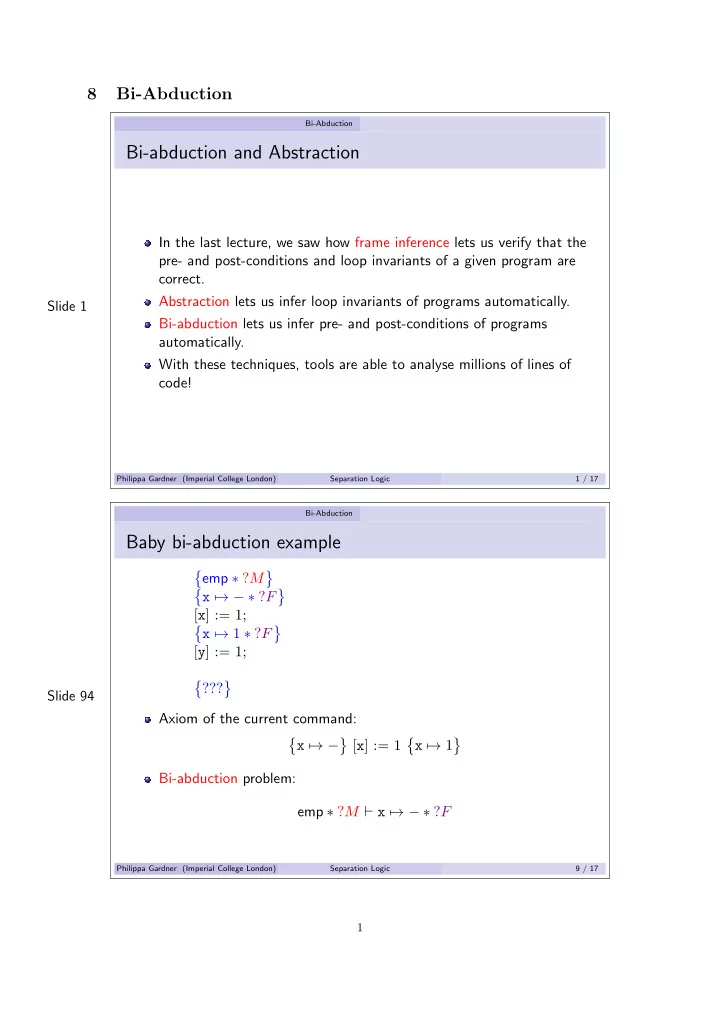
In the last lecture, we saw how frame inference lets us verify that the pre- and post-conditions and loop invariants of a given program are correct. Abstraction lets us infer loop invariants of programs automatically. Bi-abduction lets us infer pre- and post-conditions of programs automatically. With these techniques, tools are able to analyse millions of lines of code!

Philippa Gardner (Imperial College London) Separation Logic 1 / 17

Slide 1

Bi-Abduction

Baby bi-abduction example

  • emp ∗ ?M
  • x → − ∗ ?F
  • [x] := 1;
  • x → 1 ∗ ?F
  • [y] := 1;
  • ???
  • Axiom of the current command:
  • x → −
  • [x] := 1
  • x → 1
  • Bi-abduction problem:

emp ∗ ?M ⊢ x → − ∗ ?F

Philippa Gardner (Imperial College London) Separation Logic 9 / 17

Slide 94

1

slide-2
SLIDE 2

Bi-Abduction

Abductive Inference

From philosophy: “Abduction is the process of forming an explanatory hypothesis. It is the only logical operation which introduces any new idea.” Charles Peirce, writing about the scientific process.

Philippa Gardner (Imperial College London) Separation Logic 3 / 17

Slide 3

Bi-Abduction

The Abduction problem

Given formulas P and Q, the abduction problem between P and Q consists in finding ?M such that P ∗ ?M ⊢ Q M = False and M = Q are always solutions In general, we look for solutions that are minimal with respect to an

  • rdering .

Philippa Gardner (Imperial College London) Separation Logic 4 / 17

Slide 4

2

slide-3
SLIDE 3

Bi-Abduction

On the Quality of Abduction Solutions

Consider the abduction problem emp ∗ ?M ⊢ x → − The ordering takes into account spatial minimality: x → − x → − ∗ y → − and logical minimality: x → − False x → − x → 10 ∧ x = 12 The -minimal solution to this abduction problem is M = x → −.

Philippa Gardner (Imperial College London) Separation Logic 5 / 17

Slide 5

Bi-Abduction

Abduction Examples

x → 1 ∗ ?M ⊢ y → − ∗ True x → a, null ∗ ?M ⊢ list(x) ∗ list(y)

Philippa Gardner (Imperial College London) Separation Logic 6 / 17

Slide 6

3

slide-4
SLIDE 4

Bi-Abduction

The Bi-Abduction problem

Given formulas P and Q, the bi-abduction problem between P and Q consists in finding ?M and ?F such that P ∗ ?M ⊢ Q ∗ ?F M = False or (M = Q and F = P) are always solutions Again, we look for solutions that are minimal with respect to an

  • rdering .

One way to solve bi-abduction problems (used by tools):

1

Find M such that P ∗ ?M ⊢ Q ∗ True

2

Find F such that P ∗ M ⊢ Q ∗ ?F

Philippa Gardner (Imperial College London) Separation Logic 7 / 17

Slide 7

Bi-Abduction

Bi-Abduction Examples

emp ∗ ?M ⊢ x → − ∗ ?F x → 1 ∗ ?M ⊢ y → − ∗ ?F

Philippa Gardner (Imperial College London) Separation Logic 8 / 17

Slide 8

4

slide-5
SLIDE 5

Bi-Abduction

Baby bi-abduction example

  • emp ∗ ?M
  • x → − ∗ ?F
  • [x] := 1;
  • x → 1 ∗ ?F
  • [y] := 1;
  • ???
  • Axiom of the current command:
  • x → −
  • [x] := 1
  • x → 1
  • Bi-abduction problem:

emp ∗ ?M ⊢ x → − ∗ ?F

Philippa Gardner (Imperial College London) Separation Logic 9 / 17

Slide 101

Bi-Abduction

Bi-Abduction along a Path

In the previous example, we did not need to restart from the top every time new pieces were added to the pre-condition. This is thanks to the following rule, derived from sequence, frame, and consequence, when C1 does not modify variables in M:

  • P
  • C1
  • Q
  • Q ∗ M ⊢ Q′
  • Q′

C2

  • R
  • P ∗ M
  • C1; C2
  • R
  • Abducing pre-conditions on a path is sound for that path.

What about non straigtht-line code, i.e., conditionals and loops?

Philippa Gardner (Imperial College London) Separation Logic 10 / 17

Slide 10

5

slide-6
SLIDE 6

Bi-Abduction

Abducing Unsound Pre-Conditions

z := random(); if (z = 0) { [y] := 0; dispose(x); } else { dispose(x); dispose(y); }

Philippa Gardner (Imperial College London) Separation Logic 11 / 17

Slide 11

Bi-Abduction

Re-Execution

Abducing pre-conditions inside a path is unsound for other paths in general. Bi-abduction yields only candidate pre-conditions. A re-execution phase (` a la Smallfoot) prunes incorrect specifications.

Philippa Gardner (Imperial College London) Separation Logic 12 / 17

Slide 12

6

slide-7
SLIDE 7

Bi-Abduction

Bi-Abduction and Abstraction: High-Level Overview

Inferred pre-condition:

  • while(x = null){

t := x; x := [x + 1]; dispose(t); dispose(t + 1); }

Philippa Gardner (Imperial College London) Separation Logic 13 / 17

Slide 13

Bi-Abduction

Abstraction in Pre-Conditions and Re-Execution

Abstraction replaces a candidate pre-condition A with A′ such that A A′. As a tentative rule: A A′

  • A
  • C
  • B
  • A′

C

  • B
  • Unsound!

Abstracted pre-conditions also need to be re-executed.

Philippa Gardner (Imperial College London) Separation Logic 14 / 17

Slide 14

7

slide-8
SLIDE 8

Bi-Abduction

Summary

Recipe for bi-abductive program analysis: Do symbolic execution Abduce missing resources Abstract to discover loop invariants Repeat until the post-condition is reached Check the candidate specifications by re-execution if needed

Philippa Gardner (Imperial College London) Separation Logic 15 / 17

Slide 15

Bi-Abduction

Bi-Abduction

  • x .

= x0

  • y := null;

while(x = null) { z := [x + 1]; [x + 1] := y; y := x; x := z; } return y; Philippa Gardner (Imperial College London) Separation Logic 16 / 17

Slide 16

8

slide-9
SLIDE 9

Bi-Abduction

Attacking Large Programs

We can show memory safety for large programs: the program does not dereference null or dangling pointers, and does not leak memory. for large programs. This reasoning is possible, due to the compositional reasoning given by bi-abduction. Examples OS device drivers (< 15K lines), Apache (1.7M), the Linux kernel (16M), recently 15 bugs found in OpenSSL (450K lines). Still, we need to scale to industrial tools . . .

Philippa Gardner (Imperial College London) Separation Logic 17 / 17

Slide 17

9