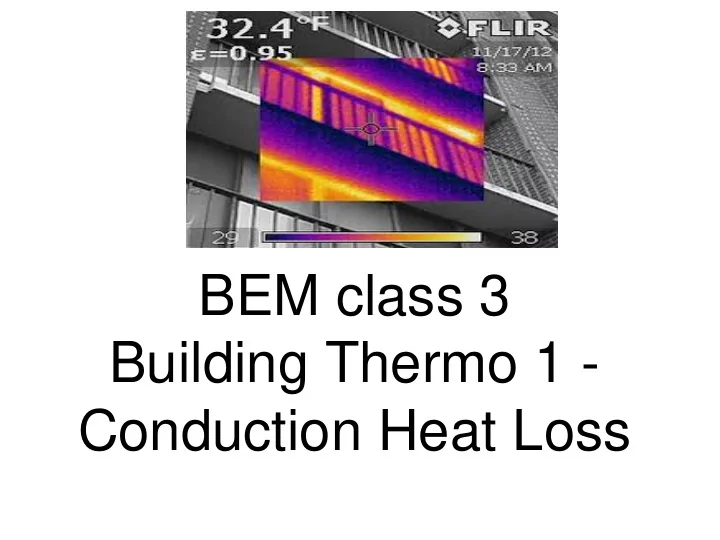
BEM class 3 Building Thermo 1 - Conduction Heat Loss Building - - PowerPoint PPT Presentation

bem class 3 building thermo 1 conduction heat loss
SMART_READER_LITE
LIVE PREVIEW

BEM class 3 Building Thermo 1 - Conduction Heat Loss Building - - PowerPoint PPT Presentation

BEM class 3 Building Thermo 1 - Conduction Heat Loss Building Thermodynamics How buildings lose/gain heat - 3 fundamental mechanisms of heat transfer Conduction Convection Radiation How Loads are Calculated Heating Load, Q =


slide-1
SLIDE 1

BEM class 3 Building Thermo 1 - Conduction Heat Loss

slide-2
SLIDE 2

Building Thermodynamics

How buildings lose/gain heat - 3 fundamental mechanisms of heat transfer

  • Conduction
  • Convection
  • Radiation
slide-3
SLIDE 3

How Loads are Calculated

Heating Load, Q = conduction + infil/ventil [– SG – IG] Cooling Load, Q = conduction + infil/ventil + SG + IG

SG = solar gain IG = internal gains For cooling load, infil/ventil includes Latent Heat

slide-4
SLIDE 4

Conductive Heat Loss

  • Heat flows along thermal gradient
  • Flow proportional to gradient - delta T
  • Rate of flow characteristic for any

material is its "k" or "U" value

  • BTU / SF / degree dT
  • QC = U A dT

Remember that this is just for conduction. Heat transfers from air flow and from radiation are equally important in overall heat load calcs.

slide-5
SLIDE 5

U-values and R-values

  • U = 1 / R
  • Per thickness of

material

  • Look-up tables for

tested values.

  • Field testing with

infrared to measure heat flux.

  • R-values are additive;

U-values are NOT.

slide-6
SLIDE 6

Conduction in composite constructions

Construction elements are not necessarily uniform. fenestration

  • Varied features
  • frame characteristics

frame walls

  • compute R at each distinct kind of

construction.

  • Convert to U-values, pro-rating

contribution to overall U based on percentage of area (see procedure in table

  • n next slide)

Interesting application problem - compute the dew point temperature within a wall construction

slide-7
SLIDE 7

Conduction in composite constructions

  • Brick is uniform -

add R-values of layers

  • Frame wall has

different condition at stud - add up the R- values for each construction

  • Calculate each U

and pro-rate (multiply) by percentage of surface area. Add these all up to get an

  • verall U-value for

the construction.

slide-8
SLIDE 8

Conduction Heat Loss Calculation

  • Collect, compute, compile R and U values and

areas for various constructions (walls, roof, windows). Apply UAdT to each. Sum. (Hmmm, where does that dT come from??)

  • Can also develop overall envelope U by adding

“UA”s -- this weights the U-values proportional to building surface areas. This is the basis of envelope trade-off procedures in Code.

  • What about foundation and/or slab heat losses?
slide-9
SLIDE 9

Code

  • ASHRAE 90.1 and ICC
  • State Energy Codes

– http://www.dos.ny.gov/dcea/energycode_code.html – http://publicecodes.cyberregs.com/st/ny/st/index.htm

  • NYC Energy Code

– http://www.nyc.gov/html/dob/html/codes_and_reference_materials/nycecc_mai n.shtml

– Training Modules

http://www.nyc.gov/html/dob/html/codes_and_reference_materials/nycecc_trai ning_modules.shtml

  • Sallan Foundation "Decoding the Code"
slide-10
SLIDE 10

Code cont'd

  • Focus on envelope insulation values
  • Compliance pathways
  • Prescriptive A - meet U values by component
  • Prescriptive B- meet overall U
  • "appendix G" modeling against baseline
  • RESCHECK, COMCHECK - free tools,

download, widely used.

slide-11
SLIDE 11

"Effective R-value”

What you calculate isn’t necessarily what you get

  • Product and construction

flaws

  • gas-filled windows
  • insulated walls and insulation

by-passes

slide-12
SLIDE 12

"Effective R-value”

What you calculate isn’t necessarily what you get

  • Thermal Bridges
  • “thermal break” construction
slide-13
SLIDE 13

Thermal Lags

  • Building dynamics, non-steady-state
  • Effect of “thermal mass”
  • Most important as weather conditions swing

daily

slide-14
SLIDE 14

Weather data

  • Not to be confused with

CLIMATE data

  • Climate zones. Design-for-

climate.

  • Design Conditions - dT
  • Annual Usage - Degree-days.
  • Bins. Hourly.
slide-15
SLIDE 15

Weather data cont'd

  • Sources
  • "weather tapes"
  • TMY